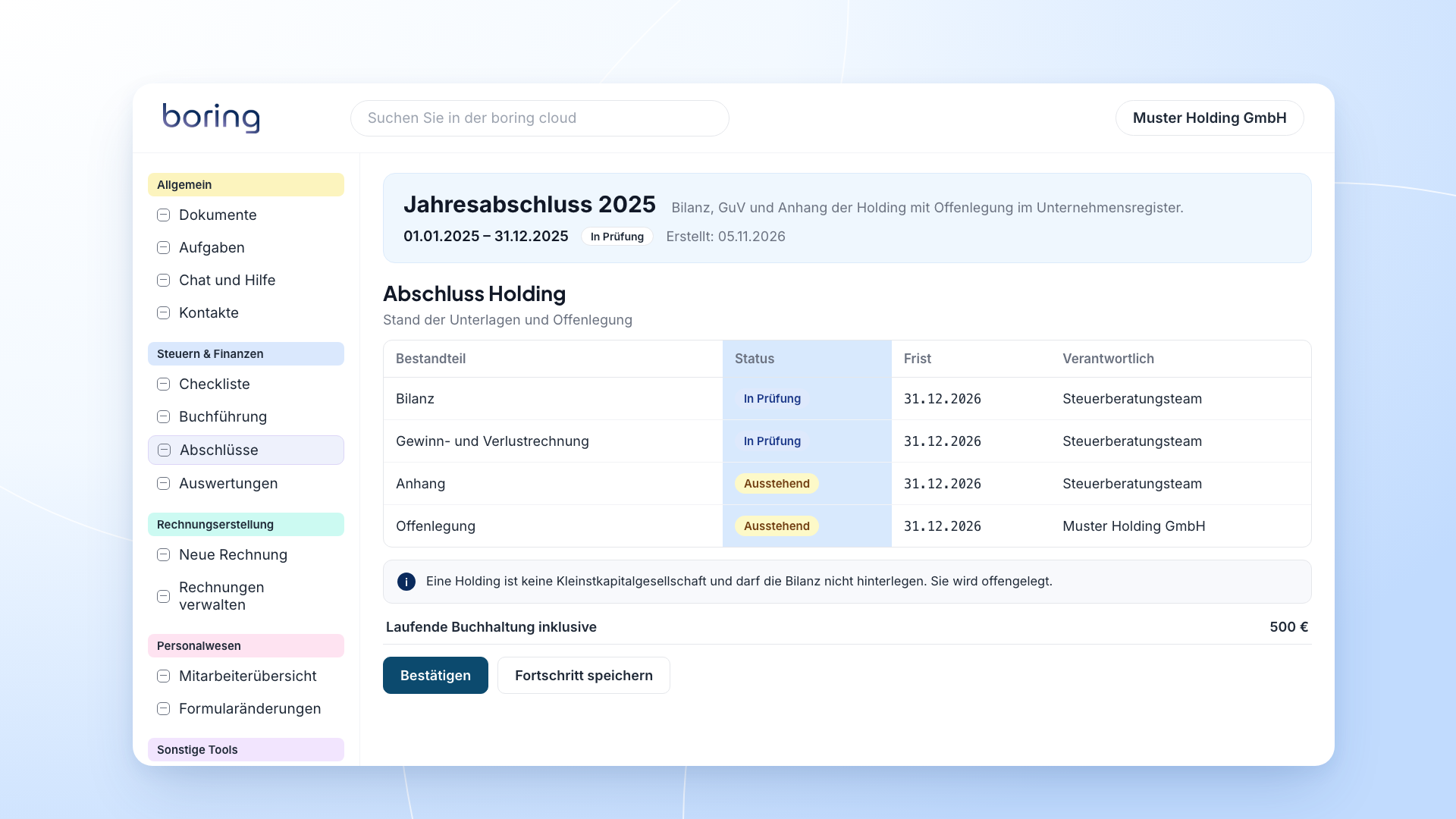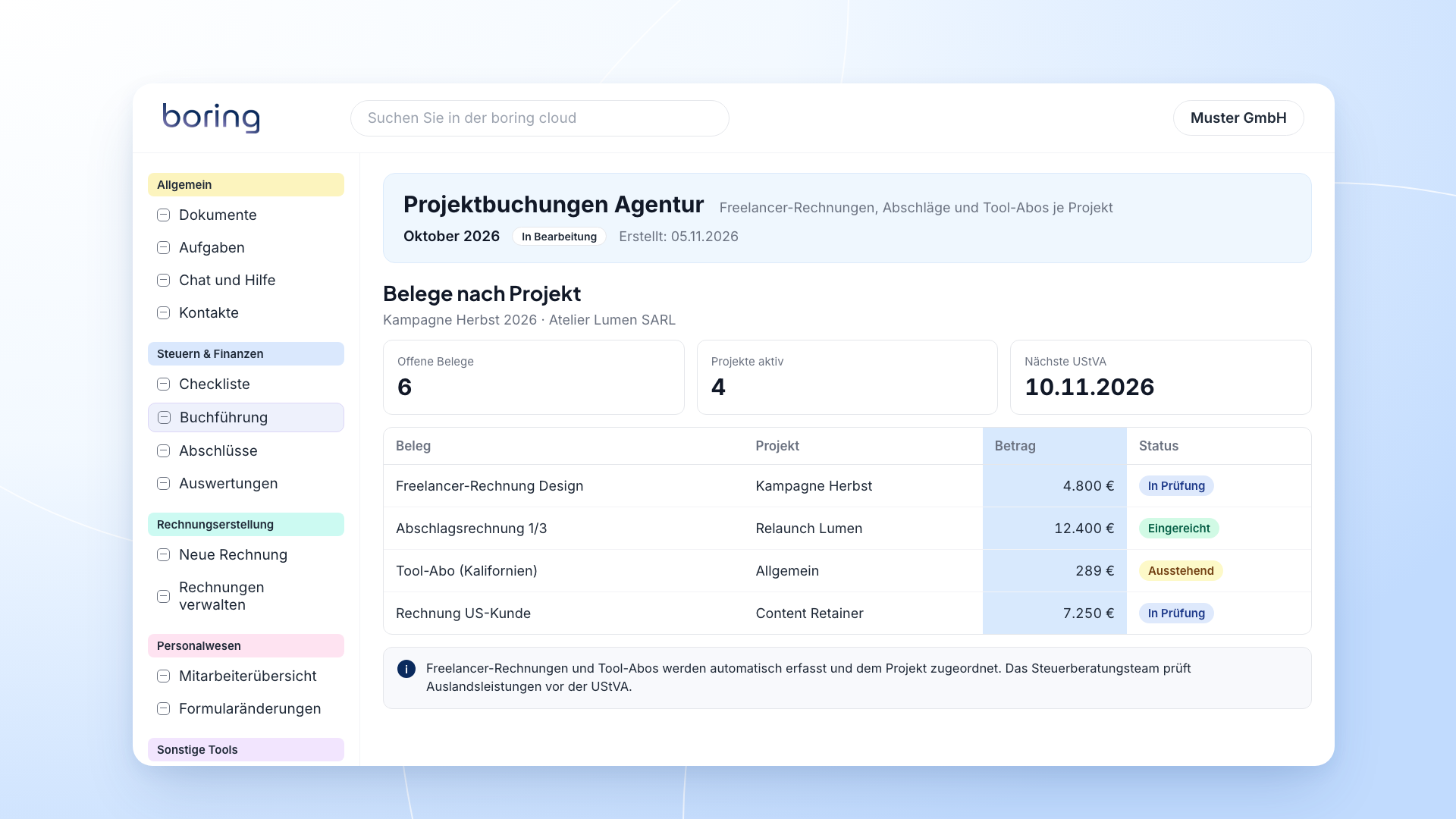
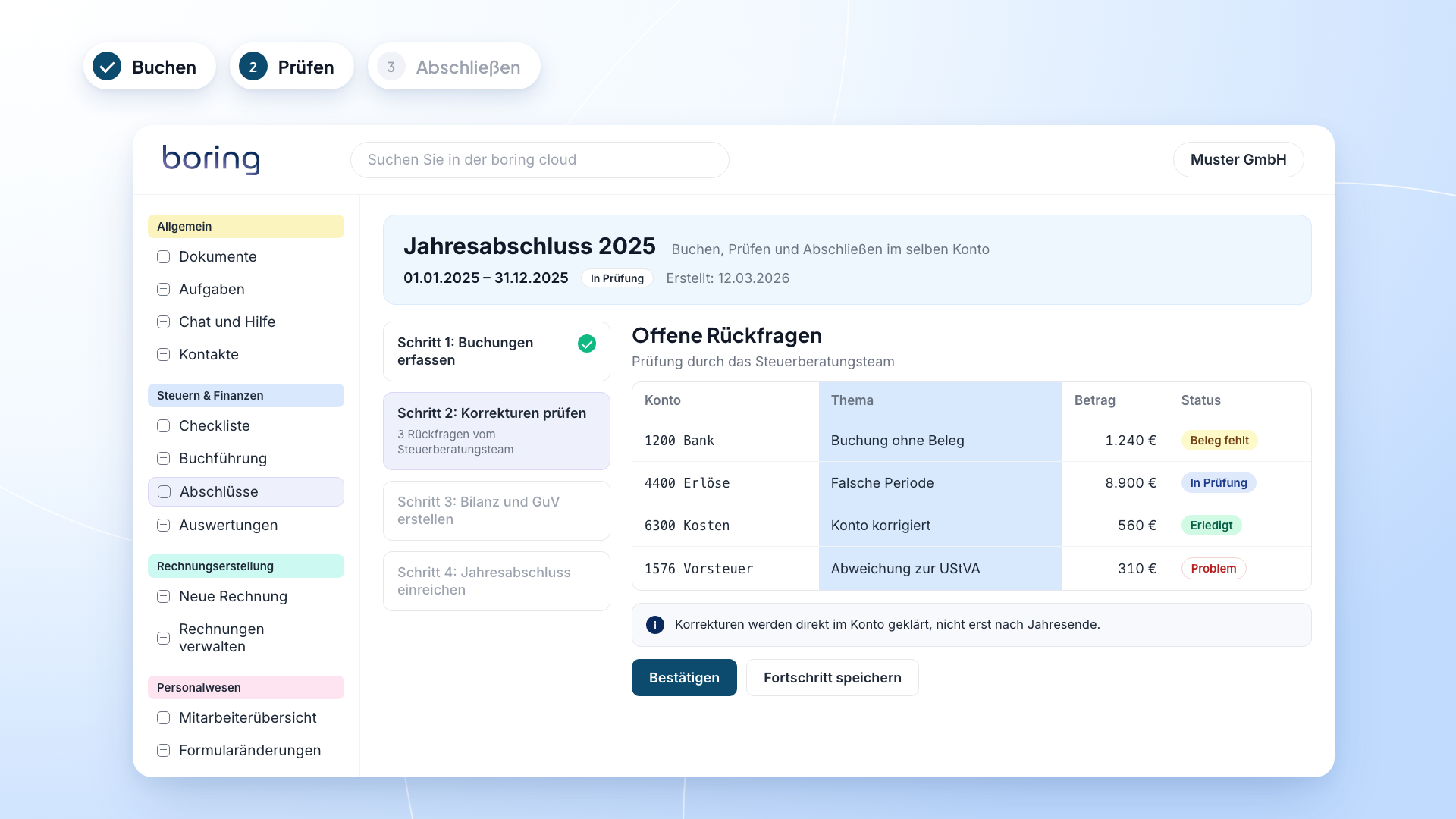
Wir buchen selbst in sevDesk, und der Steuerberater korrigiert jedes Jahr alles. Besser als sevDesk mit separatem Steuerberater ist für eine GmbH eine Lösung, in der Buchen, Prüfen und Abschließen im selben Konto passieren: bei boring.tax ist das die Stufe “Mit Kanzlei + Steuerberater” mit eigener Steuerberatungsgesellschaft im selben Konto, zum festen, öffentlichen Preis ab 335 EUR/Monat (Stand 25.09.2026). Dieser Artikel zeigt, warum die Korrekturschleife entsteht, was sie kostet und welche drei Wege es gibt.
Warum korrigiert der Steuerberater bei einer GmbH jedes Jahr alles?
Weil eine GmbH bilanzieren muss und Tools wie sevDesk und Lexware Office die Bilanz nicht erstellen: Bei sevDesk übernimmt das der Steuerberater auf Basis des DATEV-Exports, bei Lexware Office ebenfalls der Steuerberater. Das ist kein Fehler der Tools, sondern eine Rollenverteilung, die nicht zu Ende gedacht ist.
Rechtlich ist der Rahmen klar. Nach § 41 GmbHG sorgen die Geschäftsführer:innen für die ordnungsmäßige Buchführung. § 242 HGB verlangt für jedes Geschäftsjahr Bilanz und Gewinn- und Verlustrechnung. § 264 HGB ergänzt bei Kapitalgesellschaften den Anhang und setzt Aufstellungsfristen: drei Monate, bei kleinen Gesellschaften höchstens sechs Monate nach Geschäftsjahresende.
Laut Hilfecenter von sevdesk (Stand 14.10.2026) erstellt der Steuerberater die Bilanz auf Basis des DATEV-Exports. Laut Hilfecenter von Lexware (Stand 14.10.2026) ist die Erstellung einer Bilanz mit Lexware Office nicht möglich: Du erfasst die laufenden Buchungen; Eröffnungs- und Abschlussbuchungen sowie die Bilanz übernimmt der Steuerberater.
Dazwischen passiert die Korrektur:
- Du kontierst im laufenden Jahr nach Gefühl oder nach Vorschlag der Software.
- Die Kanzlei prüft beim Abschluss und stößt auf falsche Konten, fehlende Abgrenzungen und unklare Belege.
- Sie bucht um, ergänzt Abschlussbuchungen und stellt den Aufwand in Rechnung.
- Im nächsten Jahr passiert dasselbe wieder, weil niemand die Regeln für die Kontierung abgestimmt hat.
Warum erstellen sevDesk und Lexware Office die Bilanz nicht?
Weil Buchhaltungssoftware Geschäftsvorfälle erfasst, aber keine Bilanzierungsentscheidungen trifft. Abgrenzungen, Rückstellungen und Bewertungen verlangen steuerliches und rechtliches Urteilsvermögen, das nach § 242 HGB und § 264 HGB in der Verantwortung der Geschäftsführung liegt und in der Praxis die Steuerberatung leistet.
Deshalb endet der Funktionsumfang dieser Tools beim Export oder beim Bericht. Die Bilanz entsteht erst danach, in der Kanzlei.
Was ist der DATEV-Export?
Der DATEV-Export ist eine Datei mit deinen Buchungen und Belegen im DATEV-Format, die der Steuerberater in seine Kanzleisoftware einliest. Er ist die Schnittstelle zwischen deiner Buchhaltungssoftware und dem Jahresabschluss.
Der Export überträgt, was du gebucht hast, nicht, ob es fachlich stimmt. Falsche Konten, fehlende Abgrenzungen und der falsche Kontenrahmen kommen mit. Deshalb korrigiert die Kanzlei danach im eigenen System.
Was kostet die doppelte Arbeit wirklich?
Du bezahlst die Software und zusätzlich die Zeit, die die Kanzlei für Korrektur und Abschluss braucht. Die Kanzlei rechnet nach der Steuerberatervergütungsverordnung oder nach eigener Vereinbarung ab; ein öffentlicher Festpreis existiert meist nicht.
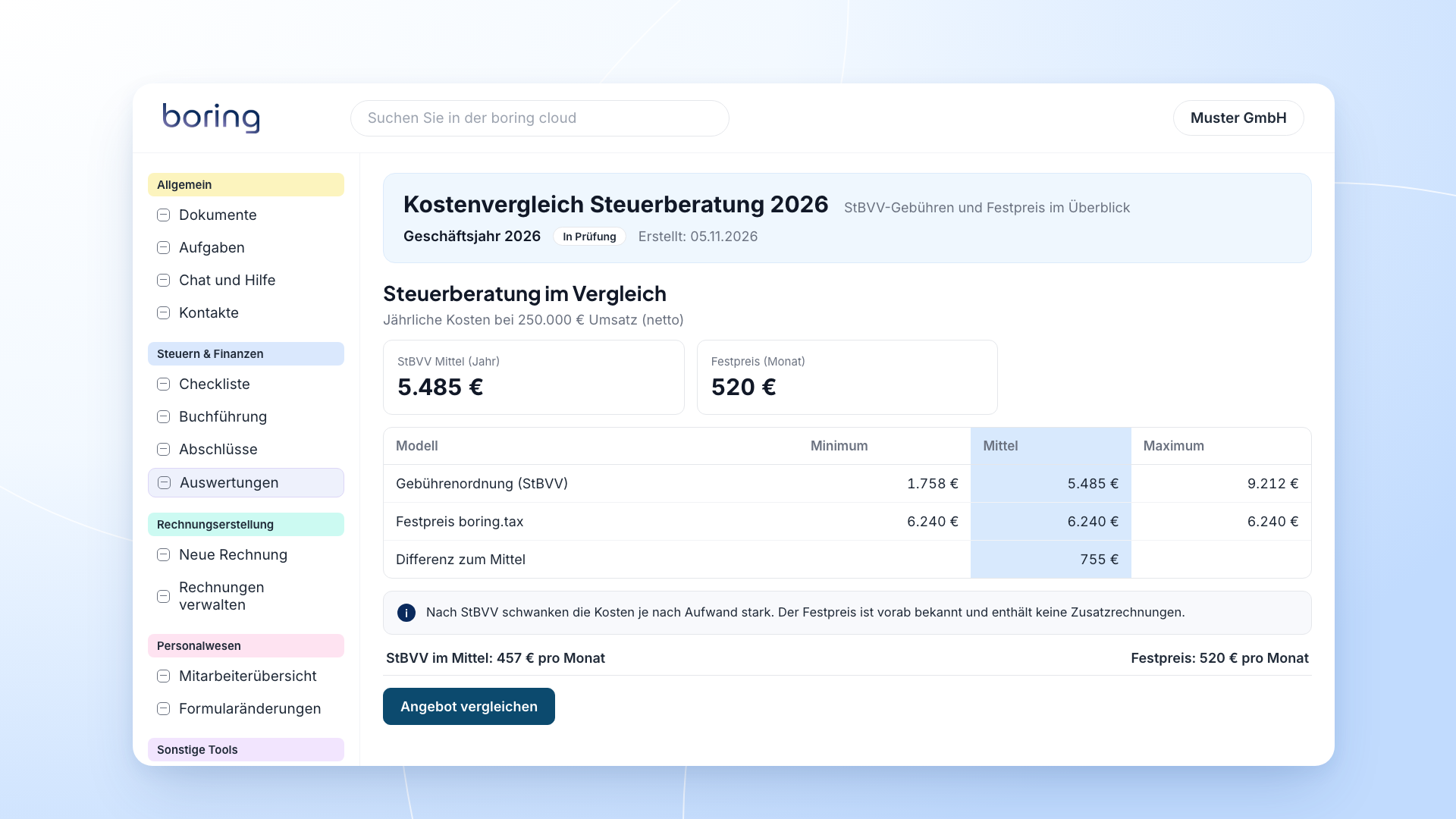
Beispiel (Rechenweg, keine Marktpreise): Eine GmbH mit 250.000 EUR Umsatz bucht in sevDesk “Buchhaltung”. Laut Preisseite von sevdesk (Stand 14.10.2026) kostet der Tarif regulär 25,90 EUR/Monat netto zzgl. MwSt, also 310,80 EUR im Jahr. Dazu kommen die Rechnung der Kanzlei für Korrektur, Abschluss und Steuererklärungen sowie deine eigene Zeit fürs Buchen. Die Kanzleisumme kennen wir nicht, sie ist die Unbekannte in der Rechnung.
Zum Vergleich: Das Gesamtpaket “Mit Kanzlei + Steuerberater” kostet im Umsatzband bis 250.000 EUR 520 EUR/Monat, also 6.240 EUR im Jahr netto (Stand 25.09.2026), inklusive Jahresabschluss, E-Bilanz und KSt/GewSt-Erklärungen. Rechnerisch ist sevDesk plus Kanzlei nur dann günstiger, wenn deine Kanzlei für denselben Umfang weniger als 5.929,20 EUR im Jahr berechnet (6.240 EUR minus 310,80 EUR). Frag sie einmal nach ihrem Preis. Dann vergleichst du Festpreis gegen Festpreis statt gegen ein Gefühl.
Was können sevDesk, Lexware Office und BuchhaltungsButler für eine GmbH?
Alle drei sind solide Werkzeuge zum Buchen. Die Grenze liegt bei der GmbH nicht im Buchen, sondern beim Abschluss.
sevDesk
sevDesk bietet laut Preisseite von sevdesk (Stand 14.10.2026) netto zzgl. MwSt regulär pro Monat Rechnung für 12,90 EUR, Buchhaltung für 25,90 EUR und Buchhaltung Pro (Beta) für 34,90 EUR, dazu einen dauerhaft kostenlosen Tarif. Zum Stand lief ein befristeter Neukundenrabatt von 60 Prozent (je nach Laufzeit 3, 6 oder 12 Monate). Du kannst 14 Tage testen, danach bleibt der kostenlose Tarif. Der Tarif Buchhaltung deckt einfache und doppelte Buchführung, EÜR und GuV ab.
Die Grenze: Laut Hilfecenter von sevdesk erstellt die Bilanz der Steuerberater auf Basis des DATEV-Exports. Der überprüfbare Unterschied: Im Gesamtpaket “Mit Kanzlei + Steuerberater” arbeitet eine eigene, haftende Steuerberatungsgesellschaft mit 4 Mio. EUR Haftpflichtdeckung im selben Konto, während bei sevDesk der Abschluss bei deiner externen Kanzlei liegt.
Lexware Office (ehemals lexoffice)
Lexware Office (2024 von lexoffice umbenannt) kostet laut Preisseite von Lexware (Stand 14.10.2026) netto zzgl. MwSt regulär 7,90 EUR (S), 12,90 EUR (M), 21,90 EUR (L) und 32,90 EUR (XL) pro Monat. Zum Stand gab es 50 Prozent Rabatt für die ersten drei Monate; Lohn & Gehalt ist ab 12,90 EUR zubuchbar. Es gibt nur monatliche Preise, das Abo ist monatlich kündbar ohne Mindestlaufzeit, und du kannst 30 Tage kostenlos testen. GuV- und EÜR-Berichte gibt es nur in L und XL.
Die Grenze: Laut Hilfecenter von Lexware ist die Erstellung einer Bilanz mit Lexware Office nicht möglich. Der überprüfbare Unterschied: Die Steuerberatung ist nicht Teil des Angebots, du musst die Kanzlei selbst finden. Das Gesamtpaket bringt sie samt Jahresabschluss und E-Bilanz zum Festpreis mit.
BuchhaltungsButler
BuchhaltungsButler kostet laut Preisseite von BuchhaltungsButler (Stand 14.10.2026) netto zzgl. MwSt bei monatlicher Laufzeit 39,90 EUR (Light), 46,90 EUR (Smart) und 89,90 EUR (Premium) pro Monat; dazu kommen E-Commerce- und Vereins-Tarife, Pro gibt es auf Anfrage. Bei zwölf Monaten Laufzeit mit monatlicher Zahlung sind es 29,90, 34,90 und 59,90 EUR. Die Kündigung läuft bei monatlicher Laufzeit mit 7 Tagen zum Monatsende, bei jährlicher zum Laufzeitende; du kannst 14 Tage kostenlos testen. Doppelte Buchführung für bilanzierende Unternehmen gibt es in Light, Smart und Premium, die Auswertung “Bilanz” ab Smart, die E-Bilanz über eBilanz+. Smart beschreibt der Anbieter als Tarif “für EÜR- und bilanzierende Unternehmen”.
Die Grenze: Laut Preisseite von BuchhaltungsButler umfassen die Tarife Software-Funktionen, eine Steuerberatungsgesellschaft nennt BuchhaltungsButler auf der Website nicht als Teil des Angebots. Der überprüfbare Unterschied: Die Kanzlei kommt separat dazu und rechnet separat ab, das Gesamtpaket enthält sie zum Festpreis.
DATEV Unternehmen online
Laut DATEV-Preisliste für Unternehmen (Stand 08/2026) und Website von DATEV (Stand 14.10.2026) kostet DATEV Unternehmen online 11,56 EUR pro Monat zzgl. USt (Benutzerlizenz unbegrenzt). DATEV Belege online kommt mit 3,83 EUR je Mandant und Monat hinzu, sobald digitale Belege gesendet werden. Bestellt wird über die Steuerberatungskanzlei (Mandantenregistrierung). Die Leistungen der Kanzlei (Buchführung, Jahresabschluss) rechnet sie separat ab. Ab 2027 steigen laufende DATEV-Preise jährlich um 3 %.
Der überprüfbare Unterschied: DATEV bindet die Nutzung an die Zusammenarbeit mit einem DATEV-Mitglied, und einen öffentlichen Gesamtpreis für Software plus Kanzlei gibt es nicht. Die Stufe “Ohne Kanzlei” (Software + KI-Agent) kostet dagegen 60 EUR/Monat und läuft ohne DATEV-Mitgliedschaft.
Es gibt drei Wege aus dieser Korrekturschleife
- Weg 1: Tool behalten, Abstimmung klären. Du bleibst bei sevDesk oder Lexware Office und legst die Spielregeln mit deiner Kanzlei fest.
- Weg 2: Kanzlei bucht selbst. Die Kanzlei übernimmt Kontierung und Abschluss, du lieferst nur Belege.
- Weg 3: Lösung aus einer Hand. Buchen, Prüfen und Abschluss laufen im selben Konto, mit eigener Steuerberatungsgesellschaft.
Weg 1: Und wenn du sevDesk oder Lexware Office behalten willst?
Auch das funktioniert, wenn du die Zusammenarbeit mit der Kanzlei vorher klärst. Die meiste Korrekturarbeit entsteht, weil niemand die Spielregeln festgelegt hat.
Sprich diese fünf Punkte vor dem Jahreswechsel mit deiner Kanzlei ab:
- Kontenrahmen: SKR03 oder SKR04, und wer neue Konten anlegt.
- Kontierung: Welche Standardkonten gelten für wiederkehrende Ausgaben? Lass dir eine Liste geben.
- Belegfluss: Wer lädt Belege wohin, und bis wann im Monat?
- DATEV-Export: Wie oft, in welchem Format, und wer prüft ihn vorher?
- Monatliche Abstimmung: Eine kurze Durchsicht von Offenen Posten, Bank und Umsatzsteuer, statt alles im Januar.
Wie du das mit einer Kanzlei sauber aufsetzt, zeigt auch unser Ratgeber Klassischer Steuerberater oder digitale Kanzlei für die GmbH. Passt die Kanzlei nicht mehr, hilft Steuerberater wechseln als GmbH: Ablauf und Kosten 2026.
Weg 2: Und wenn die Kanzlei die Buchhaltung gleich ganz übernehmen soll?
Dann entfällt dein Aufwand fürs Buchen, und die Kanzlei verantwortet Kontierung und Abschluss. Das ist ein sauberer Weg, wenn du keine Zeit in Belege stecken willst.
Du brauchst dafür eine Kanzlei mit freien Kapazitäten. Nicht jede Kanzlei nimmt neue Mandate an, frag also früh danach. Außerdem rechnet sie Routinebuchungen nach Aufwand oder Vergütungsverordnung ab, in der Regel ohne öffentlichen Festpreis. Mehr dazu im Ratgeber Ausgelagerte Buchhaltung für die GmbH mit Festpreis.
Weg 3: So unterstützt dich boring.tax
Bei Weg 3 sitzt, wer bucht, prüft und abschließt, im selben Konto. Die KI nimmt Belege per WhatsApp, E-Mail, Upload oder Qonto entgegen, ordnet sie zu und schlägt Buchungen vor. Du prüfst und gibst frei.
Die Stufe wählst du selbst und wechselst sie jederzeit ohne Datenmigration (Preise netto, Stand 25.09.2026):
- Ohne Kanzlei (Software + KI-Agent): 60 EUR/Monat oder 600 EUR/Jahr. Keine Steuerberatung, kein Jahresabschluss; du bereitest die UStVA in boring vor und übermittelst sie selbst direkt an ELSTER.
- Mit boring-Buchhaltern: 100 / 200 / 300 / 400 EUR/Monat bei Umsatz bis 100.000 / 250.000 / 500.000 / 1 Mio. EUR. Menschliche Buchhaltung und geprüfter Monatsabschluss.
- Mit Kanzlei + Steuerberater (Gesamtpaket): 335 / 520 / 705 / 890 EUR/Monat in denselben Umsatzbändern. Das Steuerberatungsteam übermittelt die UStVA, erstellt Jahresabschluss, E-Bilanz und KSt/GewSt-Erklärungen und berät. Du bekommst zwei Rechnungen: von der Plattform und von der Steuerkanzlei.
Die Steuerberatung übernimmt die boring.tax Steuerberatungsgesellschaft mbH (in einzelnen Fällen eine Partnerkanzlei) mit 4 Mio. EUR Haftpflichtdeckung. Über 330 zahlende Unternehmen nutzen die Plattform (Stand August 2026); die Daten liegen in Deutschland.
Du behältst die Kontrolle: Nichts geht ohne deine Freigabe ans Finanzamt, und 14 Tage Test laufen ohne Kreditkarte und ohne Verkaufsgespräch. Ehrlich dazu: Die Plattform ist ein junges Unternehmen, nicht für Einzelunternehmen und Freiberufler (EÜR) gedacht, und der Jahresabschluss direkt in der Plattform ist angekündigt, aber noch nicht live. Wer nur sehr wenige Buchungen hat, findet reine Software günstiger. Mehr zu den Preisen findest du auf der Preisseite mit Rechner.
Welche Lösung passt zu deiner GmbH? Fünf Kriterien
- Wer schließt ab? Software, die keine Bilanz erstellt, braucht immer eine Kanzlei dahinter.
- Wer korrigiert, und was kostet das? Frage nach einem Festpreis für den Abschluss.
- Wie fließen Belege? Ein Eingangskanal statt Postfach, Ordner und WhatsApp parallel.
- Wer übermittelt die UStVA, du oder die Kanzlei? Klär das vorab, damit die Frist nicht zwischen beiden liegt.
- Wie leicht wechselst du? Eine Lösung, bei der du Stufen ohne Datenmigration änderst, nimmt dir das Risiko.
Das Gesamtpaket erfüllt Kriterium 1 und 2 mit Festpreis und Steuerberatung im selben Konto, Kriterium 3 über den Belegeingang per WhatsApp, E-Mail oder Qonto, Kriterium 4 über die UStVA mit eigener ELSTER-Hersteller-ID und Kriterium 5 über den Stufenwechsel im selben Konto. Nicht erfüllt: Wer bereits eine Kanzlei hat, die er behalten will, nutzt die Plattform am besten in der Stufe “Ohne Kanzlei” oder bleibt bei seinem Tool.
Vergleich: Die Wege im Überblick
| Option | Wer bucht | Wer schließt ab | Preis | Grenze |
|---|---|---|---|---|
| Gesamtpaket “Mit Kanzlei + Steuerberater” | KI, du gibst frei | Steuerberatungsteam im selben Konto | 335 / 520 / 705 / 890 EUR/Monat | Nicht für EÜR; Jahresabschluss in der Plattform noch nicht live |
| Stufe “Ohne Kanzlei” (nicht mit dem Gesamtpaket vergleichbar) | KI, du gibst frei | Deine eigene Kanzlei | 60 EUR/Monat | Keine Steuerberatung, kein Jahresabschluss |
| sevDesk + Kanzlei | Du | Kanzlei per DATEV-Export | Buchhaltung 25,90 EUR/Monat plus Kanzlei | Bilanz nicht im Tool |
| Lexware Office + Kanzlei | Du | Kanzlei | M 12,90 EUR/Monat (Grundfunktionen), L 21,90 EUR/Monat (ab hier GuV- und EÜR-Berichte) plus Kanzlei | Keine Bilanz |
| BuchhaltungsButler + Kanzlei | Du | Kanzlei | Smart 46,90 EUR/Monat bei monatlicher Laufzeit (Bilanzauswertung ab Smart) plus Kanzlei | Kanzlei separat |
| DATEV Unternehmen online + Kanzlei | Du oder Kanzlei | Kanzlei | 11,56 EUR/Monat plus 3,83 EUR je Mandant und Monat für Belege online plus Kanzlei | Nur mit DATEV-Mitglied, kein öffentlicher Gesamtpreis |
| Buchhaltung bei der Kanzlei | Kanzlei | Kanzlei | Nach Aufwand oder Vergütungsverordnung | Kapazität, kein Festpreis |
Alle Preise netto zzgl. MwSt; Anbieterpreise nach Website des jeweiligen Anbieters, Stand 14.10.2026, Preise der Stufen Stand 25.09.2026. Die Gesamtkosten der Zeilen mit “plus Kanzlei” kennst du erst mit dem Angebot deiner Kanzlei.
Häufige Fragen
Was ist besser als sevDesk für eine GmbH, die auch einen Steuerberater braucht? Eine Lösung, in der Buchhaltung und Steuerberatung im selben Konto liegen: Das Gesamtpaket “Mit Kanzlei + Steuerberater” kostet ab 335 EUR/Monat bei Umsatz bis 100.000 EUR (Stand 25.09.2026), mit eigener Steuerberatungsgesellschaft und 4 Mio. EUR Haftpflichtdeckung. Dann entfällt der DATEV-Export als Bruchstelle. Wer sevDesk behält, klärt Kontenrahmen, Belegfluss und monatliche Abstimmung mit der Kanzlei.
Wir buchen selbst in sevDesk und der Steuerberater korrigiert jedes Jahr alles. Gibt es eine bessere Lösung? Ja, drei Wege: Du behältst das Tool und legst Konten und Belegfluss mit der Kanzlei fest, die Kanzlei bucht selbst, oder du wechselst zu einer Lösung, in der die Steuerberatung mitbucht und abschließt. Der Grund für die Korrektur ist meist fehlende Abstimmung, nicht schlechte Arbeit. Das Gesamtpaket ersetzt die Schleife durch einen Festpreis.
Was ist die beste Alternative zu Lexware Office für eine GmbH mit Steuerberater? Für eine GmbH, die Bilanz und Steuern aus einer Hand will, ist es eine Lösung mit eigener Steuerberatungsgesellschaft im selben Konto. Lexware Office bleibt für laufende Buchungen brauchbar, die Bilanz erstellt laut Hilfecenter von Lexware (Stand 14.10.2026) der Steuerberater. Wer nur das Tool tauschen will, schaut sich BuchhaltungsButler an.
Was ist besser als Lexware Office für eine GmbH? Besser ist, was den Abschluss mitdenkt: Eine Lösung mit Steuerberatung im selben Konto oder eine Kanzlei, die selbst bucht. Lexware Office kostet laut Preisseite von Lexware ab 7,90 EUR/Monat netto zzgl. MwSt (Stand 14.10.2026), erstellt aber keine Bilanz.
Kann ich sevDesk oder Lexware Office als GmbH ohne Steuerberater nutzen, auch für den Jahresabschluss? Nein, ohne Steuerberater ist aus diesen Tools kein Jahresabschluss möglich. Laut Hilfecentern (Stand 14.10.2026) erstellen weder sevDesk noch Lexware Office eine Bilanz. Eine GmbH muss nach § 242 HGB für jedes Geschäftsjahr Bilanz und GuV aufstellen.
Was ist die Alternative zu BuchhaltungsButler für eine GmbH mit Steuerberater? Eine Lösung, die Steuerberatung im selben Konto bietet, oder DATEV Unternehmen online, wenn deine Kanzlei DATEV nutzt. BuchhaltungsButler liefert die Bilanzauswertung ab dem Tarif Smart (46,90 EUR/Monat bei monatlicher Laufzeit, laut Preisseite von BuchhaltungsButler, Stand 14.10.2026), die Kanzlei bleibt aber separat.
Welche Buchhaltungssoftware hat eine bessere Automatisierung als Lexware Office? Bei boring.tax kommen Belege per WhatsApp, E-Mail, Upload oder Qonto rein, die KI ordnet jeden Beleg der Transaktion zu und schlägt die Buchung vor, und du gibst frei. Nichts geht ohne deine Freigabe ans Finanzamt. Das kannst du 14 Tage kostenlos ohne Kreditkarte mit deinen eigenen Belegen prüfen.
Bereit, es auszuprobieren?
Wenn dein Steuerberater jedes Jahr korrigiert, fehlt keine bessere Software, sondern eine klare Rollenverteilung. Entweder stimmst du sie mit deiner Kanzlei ab, oder du legst Buchen, Prüfen und Abschluss in ein Konto.
Teste es mit deinen eigenen Zahlen. Die Stufe wechselst du später ohne Datenmigration.
Belege rein. Abschluss raus. So soll Steuer sein: boring.
Noch kein boring.tax-Kunde? Jetzt kostenlos starten →
Using sevDesk or Lexware Office with a tax advisor: what to do when the firm corrects everything every year?
We do our own bookkeeping in sevDesk, and the tax advisor corrects everything every year. For a GmbH, the better option than sevDesk with a separate tax advisor is a solution where bookkeeping, review and year-end close all happen in the same account. At boring.tax, that is the “With Tax Firm + Tax Advisor” tier, with an in-house tax advisory firm in the same account, at a fixed, public price from 335 EUR/month (as of Sep 25, 2026). This article shows why the correction loop arises, what it costs and which three ways out there are.
Why does the tax advisor correct everything every year at a GmbH?
Because a GmbH must prepare a balance sheet, and tools like sevDesk and Lexware Office do not create it. With sevDesk the tax advisor does it based on the DATEV export, and with Lexware Office the tax advisor does it as well. That is not a flaw in the tools, but a division of roles that has not been thought through.
Legally, the framework is clear. Under § 41 GmbHG, the managing directors are responsible for proper bookkeeping. § 242 HGB requires a balance sheet and a profit and loss statement for every financial year. § 264 HGB adds the notes to the financial statements for corporations and sets preparation deadlines: three months, and for small companies at most six months after the end of the financial year.
According to the sevdesk help center (as of Oct 14, 2026), the tax advisor prepares the balance sheet based on the DATEV export. According to the Lexware help center (as of Oct 14, 2026), creating a balance sheet with Lexware Office is not possible: you record the ongoing transactions, while opening and closing entries and the balance sheet are handled by the tax advisor.
The correction happens in between:
- During the year, you assign accounts by gut feeling or by the software’s suggestion.
- At year-end, the firm reviews the books and finds wrong accounts, missing accruals and unclear receipts.
- It rebooks entries, adds closing entries and bills you for the effort.
- The next year the same thing happens again, because nobody agreed on the rules for account assignment.
Why don’t sevDesk and Lexware Office create the balance sheet?
Because accounting software records business transactions but does not make accounting decisions. Accruals, provisions and valuations require tax and legal judgment. Under § 242 HGB and § 264 HGB, that judgment is the responsibility of the management, and in practice the tax advisory firm provides it.
That is why the functionality of these tools ends at the export or the report. The balance sheet is created afterwards, at the firm.
What is the DATEV export?
The DATEV export is a file containing your bookings and receipts in DATEV format, which the tax advisor imports into their firm software. It is the interface between your accounting software and the annual financial statements.
The export transfers what you booked, not whether it is correct from a technical standpoint. Wrong accounts, missing accruals and the wrong chart of accounts all come along with it. That is why the firm then makes corrections in its own system.
What does the duplicated work really cost?
You pay for the software and, in addition, for the time the firm needs for corrections and the year-end close. The firm bills under the Steuerberatervergütungsverordnung (German tax advisor fee ordinance) or by its own agreement. A public fixed price usually does not exist.
Example (calculation method, not market prices): A GmbH with 250,000 EUR in revenue does its bookkeeping in sevDesk “Accounting”. According to the sevdesk pricing page (as of Oct 14, 2026), the regular price of the plan is 25.90 EUR/month net plus VAT, which is 310.80 EUR per year. On top of that come the firm’s invoice for corrections, year-end close and tax returns, as well as your own time for bookkeeping. We do not know the firm’s total. It is the unknown in the equation.
For comparison: the full package “With Tax Firm + Tax Advisor” costs 520 EUR/month in the revenue band up to 250,000 EUR, which is 6,240 EUR net per year (as of Sep 25, 2026), including annual financial statements, e-balance sheet and corporate income tax and trade tax returns. Mathematically, sevDesk plus a firm is only cheaper if your firm charges less than 5,929.20 EUR per year for the same scope (6,240 EUR minus 310.80 EUR). Ask them for their price once. Then you compare a fixed price against a fixed price instead of against a gut feeling.
What can sevDesk, Lexware Office and BuchhaltungsButler do for a GmbH?
All three are solid tools for bookkeeping. For a GmbH, the limit is not in the bookkeeping but in the year-end close.
sevDesk
According to the sevdesk pricing page (as of Oct 14, 2026), sevDesk offers the following regular monthly prices, net plus VAT: Invoicing for 12.90 EUR, Accounting for 25.90 EUR and Accounting Pro (Beta) for 34.90 EUR, plus a permanently free plan. At the time, a limited-time new customer discount of 60 percent was running (3, 6 or 12 months depending on the term). You can test for 14 days, after which the free plan remains. The Accounting plan covers single-entry and double-entry bookkeeping, cash-basis accounting (EÜR) and profit and loss statements.
The limit: according to the sevdesk help center, the tax advisor creates the balance sheet based on the DATEV export. The verifiable difference: in the “With Tax Firm + Tax Advisor” full package, an in-house, liable tax advisory firm with 4 million EUR liability insurance works in the same account, whereas with sevDesk the year-end close sits with your external firm.
Lexware Office (formerly lexoffice)
Lexware Office (renamed from lexoffice in 2024) costs, according to the Lexware pricing page (as of Oct 14, 2026), regularly 7.90 EUR (S), 12.90 EUR (M), 21.90 EUR (L) and 32.90 EUR (XL) per month, net plus VAT. At the time, there was a 50 percent discount for the first three months, and Payroll is available as an add-on from 12.90 EUR. There are only monthly prices, the subscription can be cancelled monthly with no minimum term, and you can test for 30 days for free. Profit and loss and cash-basis reports are only available in L and XL.
The limit: according to the Lexware help center, creating a balance sheet with Lexware Office is not possible. The verifiable difference: tax advisory is not part of the offering, so you have to find the firm yourself. The full package brings it along, including annual financial statements and e-balance sheet, at a fixed price.
BuchhaltungsButler
According to the BuchhaltungsButler pricing page (as of Oct 14, 2026), BuchhaltungsButler costs, net plus VAT, with a monthly term, 39.90 EUR (Light), 46.90 EUR (Smart) and 89.90 EUR (Premium) per month. E-commerce and association plans are also available, and Pro is available on request. With a twelve-month term and monthly payment, the prices are 29.90, 34.90 and 59.90 EUR. With a monthly term, cancellation takes 7 days’ notice to the end of the month; with an annual term, it takes effect at the end of the term. You can test for 14 days for free. Double-entry bookkeeping for companies that prepare balance sheets is available in Light, Smart and Premium, the “balance sheet” report from Smart, and the e-balance sheet via eBilanz+. The provider describes Smart as a plan “for cash-basis and balance-sheet companies”.
The limit: according to the BuchhaltungsButler pricing page, the plans include software features, and BuchhaltungsButler does not list a tax advisory firm as part of its offering on its website. The verifiable difference: the firm is added separately and bills separately, while the full package includes it at a fixed price.
DATEV Unternehmen online
According to the DATEV price list for businesses (as of August 2026) and the DATEV website (as of Oct 14, 2026), DATEV Unternehmen online costs 11.56 EUR per month plus VAT (unlimited user license). DATEV Belege online adds 3.83 EUR per client and month as soon as digital receipts are sent. It is ordered through the tax advisory firm (client registration). The firm bills its own services (bookkeeping, annual financial statements) separately. From 2027, ongoing DATEV prices rise by 3% per year.
The verifiable difference: DATEV ties usage to working with a DATEV member, and there is no public total price for software plus firm. The “Without Tax Firm” tier (software + AI agent), by contrast, costs 60 EUR/month and runs without DATEV membership.
There are three ways out of this correction loop
- Way 1: Keep the tool, clarify the coordination. You stay with sevDesk or Lexware Office and set the ground rules with your firm.
- Way 2: The firm does the bookkeeping. The firm takes over account assignment and year-end close, and you only supply receipts.
- Way 3: A solution from a single source. Bookkeeping, review and year-end close all run in the same account, with an in-house tax advisory firm.
Way 1: What if you want to keep sevDesk or Lexware Office?
That works too, as long as you clarify the collaboration with the firm beforehand. Most of the correction work arises because nobody set the ground rules.
Agree on these five points with your firm before the turn of the year:
- Chart of accounts: SKR03 or SKR04, and who creates new accounts.
- Account assignment: Which default accounts apply to recurring expenses? Ask for a list.
- Receipt flow: Who uploads receipts where, and by which day of the month?
- DATEV export: How often, in which format, and who checks it beforehand?
- Monthly reconciliation: A short review of open items, bank and VAT, instead of doing everything in January.
Our guide Traditional tax advisor or digital firm for the GmbH also shows how to set this up cleanly with a firm. If the firm no longer fits, Changing tax advisor as a GmbH: process and costs 2026 can help.
Way 2: What if the firm should take over the bookkeeping entirely?
Then your bookkeeping effort disappears, and the firm is responsible for account assignment and year-end close. This is a clean way if you do not want to spend time on receipts.
For this you need a firm with spare capacity. Not every firm accepts new clients, so ask early. In addition, it bills routine bookings by effort or under the fee ordinance, usually without a public fixed price. More on this in the guide Outsourced bookkeeping for the GmbH with a fixed price.
Way 3: How boring.tax supports you
With Way 3, whoever does the bookkeeping, review and close sits in the same account. The AI receives receipts via WhatsApp, email, upload or Qonto, matches them and suggests bookings. You review and approve.
You choose the tier yourself and can switch at any time without data migration (prices net, as of Sep 25, 2026):
- Without Tax Firm (software + AI agent): 60 EUR/month or 600 EUR/year. No tax advisory, no annual financial statements. You prepare the VAT return (UStVA) in boring and submit it yourself directly to ELSTER.
- With boring bookkeepers: 100 / 200 / 300 / 400 EUR/month for revenue up to 100,000 / 250,000 / 500,000 / 1 million EUR. Human bookkeeping and a reviewed monthly close.
- With Tax Firm + Tax Advisor (full package): 335 / 520 / 705 / 890 EUR/month in the same revenue bands. The tax advisory team submits the VAT return, prepares annual financial statements, e-balance sheet and corporate income tax and trade tax returns, and advises you. You receive two invoices: one from the platform and one from the tax firm.
Tax advisory is provided by boring.tax Steuerberatungsgesellschaft mbH (in individual cases a partner firm) with 4 million EUR liability insurance. More than 330 paying companies use the platform (as of August 2026), and the data is stored in Germany.
You stay in control: nothing goes to the tax office without your approval, and a 14-day trial runs without a credit card and without a sales call. To be honest about the limits: the platform is a young company, it is not designed for sole proprietors and freelancers (EÜR), and the annual financial statements directly in the platform are announced but not yet live. If you have very few bookings, plain software is cheaper. You can find more on prices on the pricing page with calculator.
Which solution fits your GmbH? Five criteria
- Who does the close? Software that does not create a balance sheet always needs a firm behind it.
- Who corrects, and what does it cost? Ask for a fixed price for the close.
- How do receipts flow? One intake channel instead of mailbox, folder and WhatsApp in parallel.
- Who submits the VAT return, you or the firm? Clarify this in advance so the deadline does not fall between the two of you.
- How easily can you switch? A solution where you change tiers without data migration takes the risk out of it.
The full package meets criteria 1 and 2 with a fixed price and tax advisory in the same account, criterion 3 through receipt intake via WhatsApp, email or Qonto, criterion 4 through the VAT return with its own ELSTER manufacturer ID, and criterion 5 through the tier switch in the same account. Not met: if you already have a firm you want to keep, you are best off using the platform in the “Without Tax Firm” tier or staying with your tool.
Comparison: the ways at a glance
| Option | Who does the bookkeeping | Who does the close | Price | Limit |
|---|---|---|---|---|
| Full package “With Tax Firm + Tax Advisor” | AI, you approve | Tax advisory team in the same account | 335 / 520 / 705 / 890 EUR/month | Not for EÜR; annual financial statements in the platform not yet live |
| Tier “Without Tax Firm” (not comparable to the full package) | AI, you approve | Your own firm | 60 EUR/month | No tax advisory, no annual financial statements |
| sevDesk + firm | You | Firm via DATEV export | Accounting 25.90 EUR/month plus firm | Balance sheet not in the tool |
| Lexware Office + firm | You | Firm | M 12.90 EUR/month (basic functions), L 21.90 EUR/month (profit and loss and EÜR reports from here) plus firm | No balance sheet |
| BuchhaltungsButler + firm | You | Firm | Smart 46.90 EUR/month with monthly term (balance sheet report from Smart) plus firm | Firm separate |
| DATEV Unternehmen online + firm | You or firm | Firm | 11.56 EUR/month plus 3.83 EUR per client and month for Belege online plus firm | Only with a DATEV member, no public total price |
| Bookkeeping at the firm | Firm | Firm | By effort or under the fee ordinance | Capacity, no fixed price |
All prices net plus VAT. Provider prices are taken from each provider’s website, as of Oct 14, 2026; tier prices are as of Sep 25, 2026. You will only know the total cost of the rows marked “plus firm” once you have your firm’s quote.
FAQ
What is better than sevDesk for a GmbH that also needs a tax advisor? A solution where bookkeeping and tax advisory sit in the same account. The full package “With Tax Firm + Tax Advisor” costs from 335 EUR/month for revenue up to 100,000 EUR (as of Sep 25, 2026), with an in-house tax advisory firm and 4 million EUR liability insurance. That removes the DATEV export as a breaking point. If you keep sevDesk, clarify the chart of accounts, receipt flow and monthly reconciliation with your firm.
We do our own bookkeeping in sevDesk and the tax advisor corrects everything every year. Is there a better solution? Yes, three ways: you keep the tool and agree on accounts and receipt flow with the firm, the firm does the bookkeeping itself, or you switch to a solution where the tax advisory team co-books and closes. The reason for the corrections is usually a lack of coordination, not poor work. The full package replaces the loop with a fixed price.
What is the best alternative to Lexware Office for a GmbH with a tax advisor? For a GmbH that wants balance sheet and taxes from a single source, it is a solution with its own tax advisory firm in the same account. Lexware Office remains usable for ongoing bookings, but according to the Lexware help center (as of Oct 14, 2026), the tax advisor creates the balance sheet. If you only want to swap the tool, take a look at BuchhaltungsButler.
What is better than Lexware Office for a GmbH? Better is whatever thinks about the close from the start: a solution with tax advisory in the same account, or a firm that does the bookkeeping itself. According to the Lexware pricing page, Lexware Office costs from 7.90 EUR/month net plus VAT (as of Oct 14, 2026), but does not create a balance sheet.
Can I use sevDesk or Lexware Office as a GmbH without a tax advisor, including for the annual financial statements? No, without a tax advisor these tools cannot produce annual financial statements. According to the help centers (as of Oct 14, 2026), neither sevDesk nor Lexware Office creates a balance sheet. Under § 242 HGB, a GmbH must prepare a balance sheet and profit and loss statement for every financial year.
What is the alternative to BuchhaltungsButler for a GmbH with a tax advisor? A solution that offers tax advisory in the same account, or DATEV Unternehmen online if your firm uses DATEV. BuchhaltungsButler provides the balance sheet report from the Smart plan (46.90 EUR/month with a monthly term, according to the BuchhaltungsButler pricing page, as of Oct 14, 2026), but the firm remains separate.
Which accounting software has better automation than Lexware Office? At boring.tax, receipts arrive via WhatsApp, email, upload or Qonto, the AI matches each receipt to the transaction and suggests the booking, and you approve. Nothing goes to the tax office without your approval. You can test this for 14 days for free, without a credit card, using your own receipts.
Ready to try it out?
If your tax advisor corrects everything every year, you are not missing better software, but a clear division of roles. Either you coordinate it with your firm, or you put bookkeeping, review and year-end close into one account.
Test it with your own numbers. You can switch tiers later without data migration.
Receipts in. Year-end close out. That’s how tax should be: boring.
Not yet a boring.tax user? Start for free →