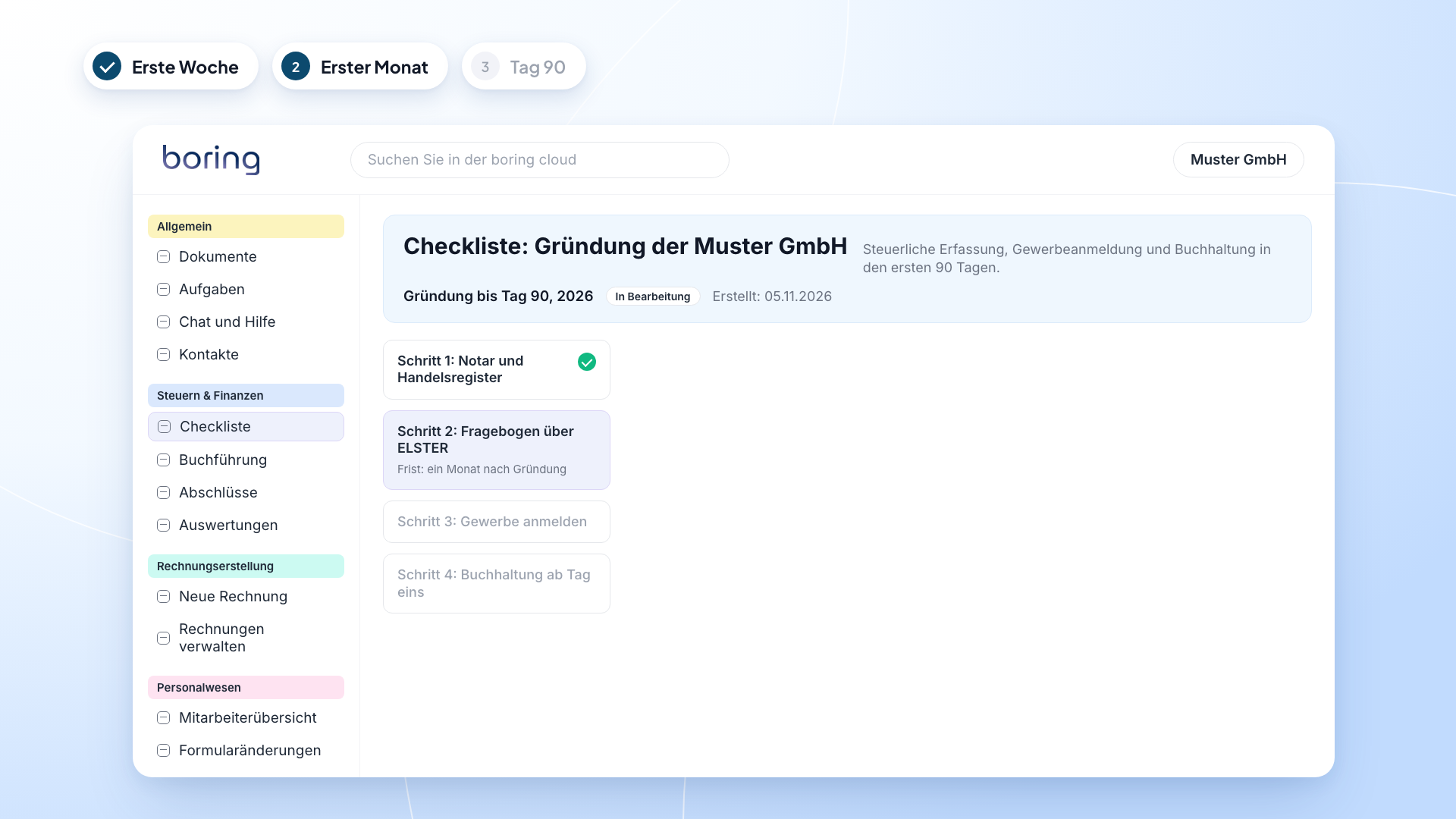
Der Jahresabschluss ist überfällig. Deine Mails bleiben wochenlang unbeantwortet, und dann kommt eine Rechnung, mit der du nicht gerechnet hast. Zeit für eine neue Steuerberatung.
Als GmbH kannst du deinen Steuerberater jederzeit wechseln. Für den Wechsel selbst zahlst du keine Gebühr. Kosten entstehen nur durch offene Rechnungen der alten Kanzlei und durch die Einarbeitung bei der neuen. Am meisten sparst du, wenn du zum Jahreswechsel wechselst und vorher klärst, wer den letzten Jahresabschluss erstellt.
Hinter einem Wechsel stecken fast immer dieselben Probleme: Der Kanzlei fehlt die Kapazität, die Preise sind nicht planbar, und du hast keine Kontrolle über deine eigenen Daten. boring.tax setzt mit klar getrennten Stufen genau dort an. Die Software-Stufe ohne Kanzlei bucht deine Belege laufend mit KI, ab 29,99 EUR im Monat. Steuerberatung ist in dieser Stufe nicht enthalten, den Jahresabschluss machst du nur in Eigenregie (bei jährlicher Zahlung eine Einreichung pro Jahr inklusive, sonst 99 EUR je Einreichung). Im Gesamtpaket ab 335 EUR im Monat erstellt das Steuerberatungsteam Abschluss, E-Bilanz und Steuererklärungen, und die eigene boring.tax Steuerberatungsgesellschaft mbH (in einzelnen Fällen eine Partnerkanzlei) übernimmt die Vollmachten und haftet für alles, was ans Finanzamt geht. Das HR- und Lohn-Portal verwaltet Mitarbeitende, Lohndaten und Onboarding für 20 EUR pro Mitarbeitendem und Monat.
Dieser Ratgeber zeigt dir Ablauf, Fristen, Kosten und die typischen Stolperfallen. Bei jedem Schritt siehst du, welche Stufe dir dabei die Arbeit abnimmt.
Was ist ein Steuerberaterwechsel?
Beim Steuerberaterwechsel kündigt deine GmbH das Mandat bei der bisherigen Kanzlei. Eine neue Steuerberatung übernimmt dann Buchhaltung, Jahresabschluss, Steuererklärungen und Lohn. Dazu gehören drei Dinge: die Kündigung, die Übergabe der Unterlagen und Daten und neue Vollmachten beim Finanzamt.
Rechtlich ist das unkompliziert. Ein Steuerberatungsvertrag gilt in der Regel als Dienstvertrag über “Dienste höherer Art”. Nach § 627 BGB kannst du so einen Vertrag grundsätzlich jederzeit kündigen, auch ohne Begründung. Eine Ausnahme gilt, wenn ein dauerhaftes Dienstverhältnis mit festen Bezügen vereinbart wurde. Lies deinen Vertrag vor der Kündigung deshalb trotzdem.
Organisatorisch macht ein Wechsel mehr Arbeit. Deine GmbH hat laufende Pflichten wie Umsatzsteuervoranmeldung, Lohn und Jahresabschluss. Keine davon darf während der Übergabe liegen bleiben. Bei boring.tax ist jede dieser Pflichten einer eigenen Stufe oder Leistung zugeordnet. Sie hängen also nicht mehr an einzelnen Personen.
Warum wechseln so viele GmbHs gerade jetzt den Steuerberater?
Meist fehlt der Kanzlei die Kapazität, nicht die Qualität. Laut der Berufsstatistik der Bundessteuerberaterkammer gab es zum 1.1.2025 in Deutschland 88.995 Steuerberater:innen. Die Zahl der Berufsträger:innen insgesamt war gegenüber dem Vorjahr um 1,6 % gesunken. Gleichzeitig wächst die Arbeit: E-Rechnung, E-Bilanz und neue Meldepflichten kommen dazu.
Als Gründer:in einer GmbH merkst du das an diesen Punkten:
- Belege werden erst Monate später gebucht, und die BWA kommt zu spät, um damit zu steuern.
- Der Jahresabschluss rückt bedenklich nah an die Frist.
- Kanzleien nehmen keine neuen Mandate an oder kündigen kleinere.
- Rückfragen dauern, weil deine Akte bei wechselnden Sachbearbeiter:innen landet.
Auch die Kosten steigen. Seit der Änderung der Steuerberatervergütungsverordnung (StBVV) am 1.7.2025 liegt die Zeitgebühr nach § 13 StBVV bei 16,50 bis 41 EUR je angefangener Viertelstunde, also 66 bis 164 EUR pro Stunde. Abgerechnet wird jetzt im Viertelstundentakt statt pro halbe Stunde. Auch die Gebührentabellen wurden angepasst; die genauen Werte findest du in der Übersicht der Steuerberaterkammer Köln zur Änderung. Kanzleien, die nach Gebührenordnung abrechnen, geben die höheren Sätze in der Regel an ihre Mandant:innen weiter.
boring.tax löst beide Probleme an der Wurzel. Die Software-Stufe ohne Kanzlei übernimmt das Buchen, also genau die Arbeit, für die klassischen Kanzleien die Leute fehlen. Und statt Zeitgebühr zahlst du für jede Stufe einen festen Monatspreis, den du vorher auf der Preisseite siehst.
Wie geht ein Steuerberaterwechsel als GmbH? In 7 Schritten
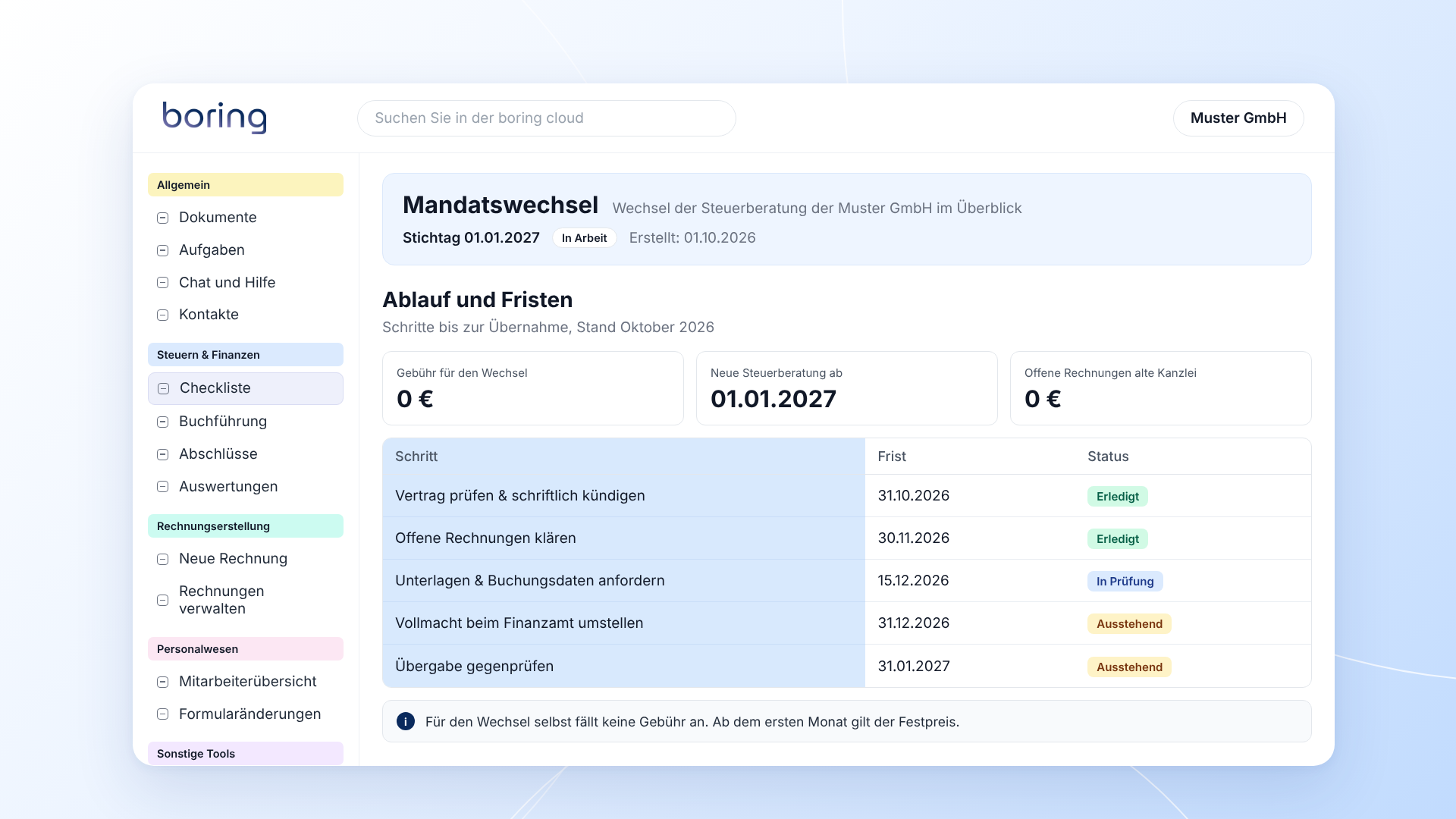
Arbeite diese sieben Schritte der Reihe nach ab. Wichtig: Erledige Schritt 2 (neue Kanzlei finden) vor Schritt 3 (Kündigung). So bleibt kein Monat ohne Betreuung.
- Vertrag prüfen. Lies Laufzeit, Kündigungsfrist, Form der Kündigung und mögliche Pauschalvereinbarungen. Prüf auch, ob Leistungen für das laufende Jahr schon abgerechnet oder vorausbezahlt sind.
- Neue Steuerberatung auswählen und zusagen lassen. Hol dir vor der Kündigung eine schriftliche Zusage mit Startdatum und klarem Leistungsumfang. Bei boring.tax brauchst du dafür kein Verkaufsgespräch. Du legst ein Konto an, testest die Software-Stufe ohne Kanzlei 14 Tage auf deinen eigenen Zahlen und stellst dir im Preisrechner die Leistungen zusammen, die du brauchst.
- Schriftlich kündigen. Nenn das Datum, ab dem die alte Kanzlei nichts mehr für dich übernimmt. Leg genau fest, welche Arbeiten sie noch abschließt, zum Beispiel “UStVA bis einschließlich Dezember 2026” oder “Jahresabschluss 2025”.
- Offene Rechnungen klären. Solange Gebühren offen sind, darf die alte Kanzlei Unterlagen zurückhalten (dazu unten mehr). Bezahl unstrittige Rechnungen deshalb zügig.
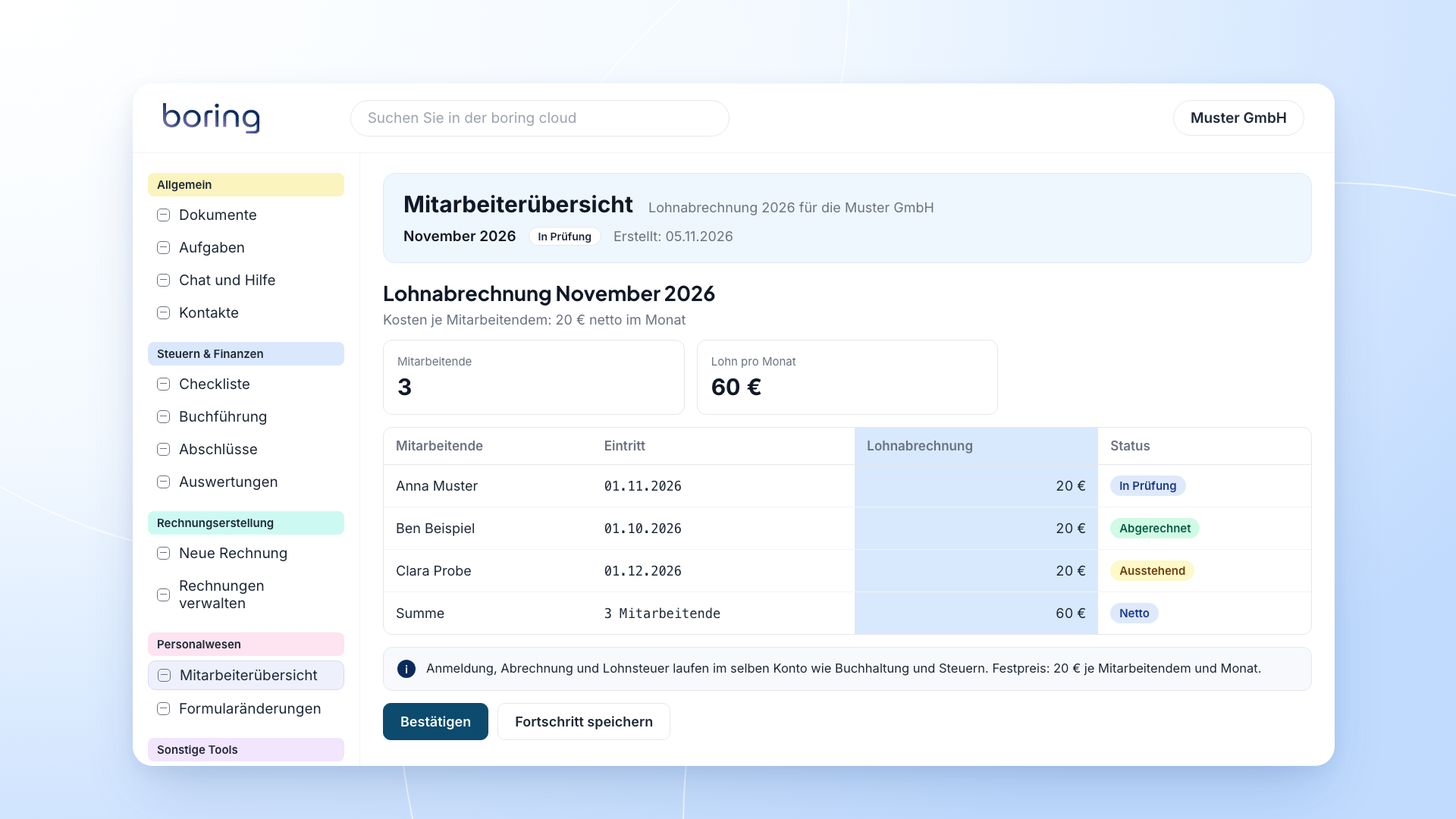
- Unterlagen und Daten anfordern. Fordere eine vollständige Übergabe an: Buchungsdaten, Stammdaten, Saldenvorträge, Anlagenverzeichnis, Lohnkonten, Vorjahresabschlüsse, E-Bilanzen und Steuerbescheide. Verlang die digitalen Daten in einem Format, das die neue Steuerberatung oder die neue Software einlesen kann. Mitarbeitende und Lohndaten legst du im HR- und Lohn-Portal von boring.tax an.
- Vollmachten umstellen. Die alte Vollmacht beim Finanzamt erlischt nicht automatisch. Widerruf sie und lass die neue Kanzlei ihre Vollmacht eintragen, in der Regel über die Vollmachtsdatenbank der Steuerberaterkammern. Im Gesamtpaket erteilst du die Vollmacht der boring.tax Steuerberatungsgesellschaft mbH (in einzelnen Fällen eine Partnerkanzlei), die für alles haftet, was ans Finanzamt geht. Denk zusätzlich an Lohnportale, Krankenkassen und die Berufsgenossenschaft.
- Übergabe gegenprüfen. Stimmen die Eröffnungssalden mit dem letzten Abschluss überein? Sind alle offenen Posten übernommen? Erst wenn das passt, ist der Wechsel wirklich fertig.
Was gehört zur Datenübergabe?
Prüf die Übergabe anhand dieser Liste:
- Buchungsdaten der letzten Jahre inklusive Kontenrahmen (meist SKR03 oder SKR04)
- Saldenlisten (SuSa) und Eröffnungsbilanzwerte
- Offene-Posten-Listen für Debitoren und Kreditoren
- Anlagenverzeichnis mit Abschreibungen
- Jahresabschlüsse, E-Bilanzen, Steuererklärungen und Bescheide
- Lohnkonten, Lohnjournale und Meldungen zur Sozialversicherung
- Korrespondenz mit dem Finanzamt, insbesondere offene Einsprüche und Betriebsprüfungen
Achte darauf, dass du die Unterlagen vollständig zurückbekommst. Denn für die Aufbewahrung ist am Ende deine GmbH verantwortlich, nicht die Kanzlei. Was das konkret heißt, liest du im nächsten Abschnitt.
Was darf die alte Kanzlei zurückhalten?
Die alte Kanzlei muss dir deine Unterlagen herausgeben. Solange Gebühren für genau diese Angelegenheit offen sind, darf sie sie aber zurückhalten. Grundlage ist § 66 StBerG. Die Vorschrift regelt zwei Dinge: wie lange die Kanzlei ihre Handakte aufbewahrt und wann sie sie an dich herausgeben muss.
Was regelt § 66 StBerG genau?
Aufbewahrung durch die Kanzlei. Steuerberater:innen müssen ihre Handakte 10 Jahre nach Ende des Mandats aufbewahren. Diese Pflicht endet früher, wenn die Kanzlei dich zur Abholung auffordert und du die Unterlagen nicht innerhalb von sechs Monaten abholst. Verlass dich also nicht darauf, dass deine Akte bei der alten Kanzlei sicher liegt.
Herausgabe an dich. Nach Mandatsende muss die Kanzlei die Handakte herausgeben. Das gilt nach Auffassung der Bundessteuerberaterkammer auch für elektronische Datenbestände, etwa Buchungsdaten im Kanzleisystem. Ausgenommen ist der Briefwechsel zwischen dir und der Kanzlei sowie Schriftstücke, die du schon im Original oder als Kopie hast.
Zurückbehaltungsrecht. Solange Gebühren und Auslagen offen sind, darf die Kanzlei die Herausgabe verweigern. Das gilt aber nur, wenn das Zurückhalten nicht unangemessen ist. Unangemessen ist es zum Beispiel, wenn nur ein kleiner Betrag offen ist oder dir wegen des Zurückhaltens eine Frist beim Finanzamt verloren geht.
Was darf zurückgehalten werden und was nicht?
| Unterlage | Muss die Kanzlei sie herausgeben? | Darf sie sie zurückhalten? |
|---|---|---|
| Deine Originalbelege (Rechnungen, Kontoauszüge, Verträge) | ja, sie gehören dir | nur bei offenen Gebühren für dieselbe Angelegenheit und nur, wenn das nicht unangemessen ist |
| Bescheide und Schreiben des Finanzamts | ja, als Teil der Handakte | wie oben, nicht bei drohender Einspruchsfrist |
| Elektronische Buchungsdaten und Stammdaten | ja, nach Auffassung der BStBK | wie oben |
| Arbeitsergebnisse (fertige Buchhaltung, Abschluss, Erklärungen) | ja, wenn du sie bezahlt hast | ja, solange die Leistung nicht bezahlt ist |
| Briefwechsel zwischen dir und der Kanzlei | nein | entfällt |
| Interne Arbeitspapiere der Kanzlei | nein | entfällt |
Unterscheide also immer zwischen deinen eigenen Belegen und den Arbeitsergebnissen der Kanzlei. Für Arbeitsergebnisse kann die Kanzlei Bezahlung verlangen. Deine Belege darf sie nur als Sicherheit für offene Gebühren derselben Angelegenheit festhalten.
Hältst du eine Rechnung für zu hoch, musst du nicht erst den Streit klären. Du kannst das Zurückbehaltungsrecht abwenden, indem du für den strittigen Betrag Sicherheit leistest, zum Beispiel durch Hinterlegung (§ 273 Abs. 3 BGB). Die Kanzlei muss dann herausgeben. In der Praxis bringt dich ein sachlicher Ton fast immer weiter als juristische Schärfe. Die meisten Kanzleien wollen ein Mandat sauber abschließen.
Die 10-Jahres-Pflicht trägt deine GmbH
Unabhängig davon, was die Kanzlei aufbewahrt: Die gesetzliche Aufbewahrungspflicht nach § 257 HGB und § 147 AO liegt bei deiner GmbH. Bücher, Jahresabschlüsse, Inventare und Eröffnungsbilanzen bewahrst du 10 Jahre auf. Für Buchungsbelege gilt seit dem Bürokratieentlastungsgesetz IV eine Frist von 8 statt 10 Jahren. Empfangene und versandte Handelsbriefe hebst du 6 Jahre auf. Die Frist beginnt jeweils mit dem Ende des Kalenderjahres, in dem die Unterlage entstanden ist.
Das wird beim Wechsel schnell zum Problem. Fragt der Betriebsprüfer in drei Jahren nach Belegen aus 2020 und liegen die nur im System der alten Kanzlei, musst du sie dort anfordern. Im schlimmsten Fall ist die Kanzlei aufgelöst oder ihre eigene Pflicht ist abgelaufen. Fehlende Unterlagen können zu Schätzungen durch das Finanzamt führen. Bei digitalen Daten verlangt das Finanzamt außerdem, dass sie maschinell auswertbar sind, ein PDF-Ausdruck reicht dann nicht.
Lass dir deshalb bei der Übergabe alle Unterlagen der noch laufenden Aufbewahrungsfristen geben, auch ältere Jahre. Und bewahr sie dort auf, wo du selbst jederzeit Zugriff hast.
So vermeidest du das Problem beim nächsten Wechsel
Bei boring.tax gibt es keine Handakte, die du anfordern musst. Belege, Buchungen, Lohndaten und Abschlüsse aller Stufen liegen in deinem eigenen Konto, auf deinen Namen und mit Datenstandort Deutschland. Die Steuerberatung arbeitet in diesem Konto mit dir, nicht in einem eigenen System.
Das hat zwei Folgen. Du kannst bei einer Betriebsprüfung selbst auf alle Jahre zugreifen, ohne jemanden zu fragen. Und falls du irgendwann wieder wechseln willst, gibt es nichts, was zurückgehalten werden könnte, weil deine Daten nie bei einer Kanzlei gelegen haben.
Was kostet es, den Steuerberater zu wechseln?
Für den Wechsel selbst zahlst du keine Gebühr. Es fallen aber vier Kostenarten an, die du vorher kennen solltest:
| Kostenart | Wer stellt sie in Rechnung? | Wie du sie klein hältst | Was bei boring.tax hilft |
|---|---|---|---|
| Offene und noch ausstehende Leistungen | alte Kanzlei | Leistungsende in der Kündigung genau festlegen | Eigene Steuerberatungsgesellschaft (Gesamtpaket): Startdatum steht vorher fest, ab dem ersten Monat gilt der Festpreis |
| Datenexport, Kopien, Herausgabe | alte Kanzlei (Auslagen) | digitale Übergabe statt Papier anfordern | Software-Stufe ohne Kanzlei: Belege und Bankdaten liegen digital in deinem Konto, kein Papierweg |
| Einarbeitung, Übernahme der Bestände | neue Kanzlei | vollständige Daten liefern, Festpreis vereinbaren | Jahresabschluss im Gesamtpaket: keine Einarbeitung nach Zeitgebühr, der Monatspreis deckt den definierten Umfang |
| Nacharbeiten bei Rückständen | neue Kanzlei | Rückstände vor dem Wechsel sichtbar machen | Software-Stufe ohne Kanzlei: KI ordnet Banktransaktionen und Belege zu, statt jede Viertelstunde abzurechnen |
Am teuersten wird es, wenn sich zwei Kanzleien die Zuständigkeit teilen und niemand den Überblick hat. Ein typisches Beispiel: Die alte Kanzlei hat den Jahresabschluss 2025 noch nicht begonnen. Die neue soll ihn erstellen, bekommt aber unvollständige Buchungsdaten. Dann zahlst du die Nacharbeiten doppelt: einmal für die Buchhaltung und einmal für die Abstimmung zwischen beiden Kanzleien.
Du vermeidest das, indem du in der Kündigung festlegst, wer welches Geschäftsjahr abschließt. Lass dir außerdem vor dem Wechsel zeigen, wie weit die Buchhaltung tatsächlich ist. Mit der Software-Stufe ohne Kanzlei siehst du das schon in der Testphase. Du verbindest dein Geschäftskonto, die KI ordnet die Transaktionen zu, und fehlende Belege werden sofort sichtbar.
Was kostet die laufende Betreuung danach?
Mit dem Wechsel entscheidest du auch über das Preismodell. Klassische Kanzleien rechnen meist nach StBVV ab, also nach Gegenstandswert (Umsatz, Bilanzsumme) oder nach Zeit. Das ist rechtlich sauber, für dich aber schwer vorherzusagen. Rückfragen, Korrekturen und Sonderthemen kommen extra.
Alternativ vereinbarst du einen Festpreis für einen klar definierten Umfang. Frag dabei immer, was genau enthalten ist: Monatliche Buchhaltung? UStVA-Übermittlung? Jahresabschluss, Körperschaft- und Gewerbesteuer, E-Bilanz, Offenlegung im Bundesanzeiger? Lohn pro Mitarbeitendem? Ein Festpreis bringt dir nur etwas, wenn der Umfang schriftlich steht.
Bei boring.tax ist der Umfang über die Stufen festgelegt. Die Software-Stufe ohne Kanzlei kostet ab 29,99 EUR im Monat, enthält aber keine Steuerberatung; den Jahresabschluss erstellst du nur in Eigenregie (bei jährlicher Zahlung eine Einreichung pro Jahr inklusive, sonst 99 EUR je Einreichung). Das HR- und Lohn-Portal kostet 20 EUR pro Mitarbeitendem und Monat. Jahresabschluss und die eigene Steuerberatungsgesellschaft sind im Gesamtpaket ab 335 EUR im Monat enthalten, zum Beispiel für 520 EUR im Monat bei bis zu 250.000 EUR Umsatz. Eine Rückfrage zum Jahresabschluss löst also keine Zusatzrechnung im Viertelstundentakt aus.
Wann ist der beste Zeitpunkt für den Wechsel?
Am einfachsten wechselst du zum 1. Januar, wenn die alte Kanzlei den Jahresabschluss des Vorjahres noch fertigstellt. Die neue Kanzlei übernimmt dann ein abgeschlossenes Jahr mit festen Eröffnungssalden. Für kein Geschäftsjahr ist die Verantwortung geteilt.
Ein Wechsel im laufenden Jahr ist auch möglich, etwa wenn die Kanzlei nicht mehr reagiert oder Fristen in Gefahr sind. Dann musst du sauber trennen: Bis zu welchem Monat bucht die alte Kanzlei, ab wann die neue? Wer meldet die letzte UStVA? Mit boring.tax kannst du auch mitten im Jahr starten. Ab welchem Meldezeitraum die Steuerberatungsgesellschaft übernimmt, vereinbarst du vorab schriftlich mit ihr. Der Jahresabschluss im Gesamtpaket umfasst am Ende das ganze Jahr.
Behalte dabei die wichtigsten Fristen im Blick:
- UStVA: monatlich oder quartalsweise bis zum 10. des Folgemonats, mit Dauerfristverlängerung einen Monat später. Mehr dazu im Ratgeber zur Umsatzsteuervoranmeldung für KMU.
- Steuererklärungen 2025: Mit Steuerberatung endet die Frist nach § 149 Abs. 3 AO am letzten Tag des Februars 2027. Das ist der 28.2.2027, ein Sonntag. Deshalb gilt nach § 108 Abs. 3 AO der Montag, 1.3.2027.
- Offenlegung im Bundesanzeiger: spätestens 12 Monate nach Ende des Geschäftsjahres (§ 325 HGB).
Eine Übersicht aller Termine findest du im Beitrag Fristen für Kapitalgesellschaften.
Welche Stolperfallen gibt es beim Wechsel?
Die meisten Probleme entstehen in der Lücke zwischen alter und neuer Kanzlei. Diese fünf kommen am häufigsten vor. Daneben steht jeweils, was sie bei boring.tax abfängt:
Doppelte oder fehlende UStVA. Wenn beide Kanzleien denken, die andere sei zuständig, fehlt eine Meldung. Das Finanzamt setzt dann einen Verspätungszuschlag fest. Leg den letzten Meldezeitraum der alten Kanzlei schriftlich fest. In der Software von boring.tax siehst du jeden Meldezeitraum mit Status, und eine fehlende UStVA fällt sofort auf.
Alte Vollmacht bleibt aktiv. Bescheide gehen weiter an die alte Kanzlei, und Einspruchsfristen laufen ab. Widerruf die Vollmacht aktiv. Im Gesamtpaket erteilst du die neue Vollmacht der boring.tax Steuerberatungsgesellschaft mbH (in einzelnen Fällen eine Partnerkanzlei) direkt zum vereinbarten Startdatum.
Unvollständige Saldenvorträge. Ohne abgestimmte Eröffnungsbilanz baut die neue Kanzlei auf falschen Zahlen auf. Lass dir die Schlussbilanz und die SuSa zum Stichtag geben und gleich sie mit dem letzten Abschluss ab, bevor die laufende Buchhaltung startet. Im Gesamtpaket erstellt das Steuerberatungsteam danach den Jahresabschluss aus einer Hand.
Lohn vergessen. Lohn läuft oft in einem eigenen System. Wechselst du mitten im Jahr, musst du Lohnkonten übertragen, Meldungen an die Sozialversicherung fortführen und Jahresmeldungen klären. Bei boring.tax pflegst du Mitarbeitende, Lohndaten und Onboarding im HR- und Lohn-Portal, für 20 EUR pro Mitarbeitendem und Monat.
Belege nur bei der Kanzlei. Liegen deine Originalbelege nur im Kanzleisystem, hängst du von der Herausgabe ab, und deine Aufbewahrungspflicht (8 bis 10 Jahre) wird zum Risiko. Bewahr Belege in einem System auf, auf das du selbst zugreifen kannst. In der Software von boring.tax ist das Standard: Belege landen per Mail, Upload oder Bankanbindung in deinem Konto, nicht in einer fremden Akte.
Woran erkennst du die richtige neue Steuerberatung?
Die richtige neue Steuerberatung hat Kapazität für dein Mandat, nennt dir vorher einen verbindlichen Preis und lässt dich jederzeit selbst auf deine Zahlen zugreifen. Diese sieben Kriterien helfen dir beim Vergleich:
- Fester Preis mit klarem Umfang. Du willst vorher wissen, was das Jahr kostet, inklusive Jahresabschluss und Steuererklärungen.
- Kapazität und Reaktionszeit. Frag direkt, wie schnell Belege gebucht werden und wann der Monatsabschluss fertig ist.
- Echte, haftende Steuerberatung. Prüf, wer Jahresabschluss und Erklärungen verantwortet und wie hoch die Berufshaftpflicht ist. Reine Softwareanbieter sind keine Steuerberater.
- Digitaler Belegfluss. Belege per Mail, Upload oder Bankanbindung, ohne Pendelordner.
- Erfahrung mit GmbH und Holding. Gewinnausschüttungen, Geschäftsführergehalt, verdeckte Gewinnausschüttung und Beteiligungen sind typische Kapitalgesellschaftsthemen.
- Freigabe durch dich. Nichts sollte ohne deine Bestätigung ans Finanzamt gehen.
- Testbar ohne Risiko. Wenn du das System auf deinen eigenen Zahlen ausprobieren kannst, merkst du schneller als in jedem Verkaufsgespräch, ob es passt.
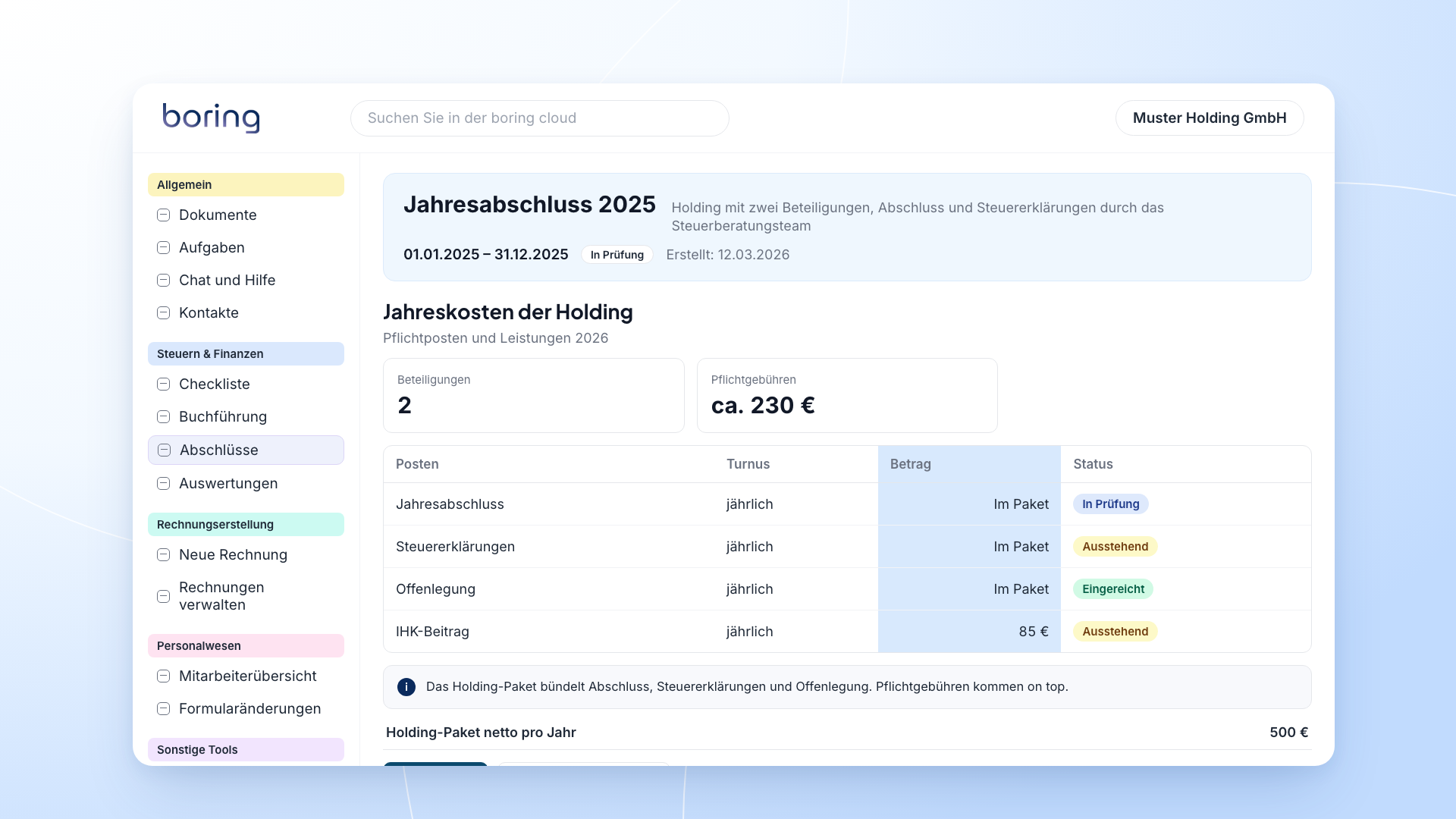
boring.tax deckt jeden Punkt über Stufen und Leistungen ab, mit zwei ehrlichen Einschränkungen. Bei Kriterium 2 sagt boring.tax dir keine feste Reaktionszeit und keine garantierte Dauer bis zum Monatsabschluss zu. Belegt ist nur, dass du das Tempo in den 14 Tagen Test auf deinen eigenen Zahlen selbst prüfen kannst. Bei Kriterium 5 gibt es für Holdings ein eigenes Jahresabschluss-Paket ab 500 EUR pro Jahr. Belegt zugesagt ist dieser Paketumfang, nicht eine bestimmte Zahl betreuter Holdings. Die übrigen Kriterien erfüllt boring.tax so: Die Software-Stufe ohne Kanzlei steht für öffentliche Festpreise und KI-Buchung. Die Steuerberatung leistet die eigene boring.tax Steuerberatungsgesellschaft mbH (4 Mio. EUR Haftpflichtdeckung; in einzelnen Fällen eine Partnerkanzlei), allerdings erst im Gesamtpaket ab 335 EUR im Monat. Dazu kommen die Freigabe durch dich und 14 Tage Test ohne Kreditkarte. Mehr zum Holding-Paket findest du auf der eigenen Seite.
Wie sich die Anbieter bei Haftung und Preis unterscheiden, siehst du in dieser Übersicht:
Anbieter im Überblick (Stand Oktober 2026)
| Anbieter | Modell | Wer macht die Steuerberatung und haftet? | Öffentlicher Preis | Jahresabschluss im Preis? |
|---|---|---|---|---|
| boring.tax | KI-Buchhaltung mit eigener Steuerberatungsgesellschaft im selben Konto | boring.tax Steuerberatungsgesellschaft mbH (in einzelnen Fällen eine Partnerkanzlei), 4 Mio. EUR Haftpflichtdeckung | ohne Kanzlei 29,99 EUR/Monat; Gesamtpaket mit Steuerberatung 335 bis 890 EUR/Monat je nach Umsatz (bis 1 Mio. EUR) | Ja, im Gesamtpaket (Holding: 500 EUR/Jahr) |
| Integral | Plattform der Wirtschaftsprüfungsgesellschaft Integral Tax GmbH (Berlin), steht nur deren Mandanten zur Verfügung; Zielgruppe: digitale Unternehmen, Startups, GmbH, UG, Holding | Integral Tax GmbH, selbst Wirtschaftsprüfungsgesellschaft | keine öffentlichen Preise; feste Monatsgebühr als individuelles Angebot nach kostenlosem Erstgespräch, abhängig von Belegen, Mitarbeitenden und Leistungen | Ja, Jahresabschluss mit KSt und GewSt gehört laut Website zu den Leistungen, ebenso laufende Buchhaltung mit BWA, UStVA und ZM, Lohnbuchhaltung und die Übernahme des Steuerberaterwechsels |
| Skalar | ”AI-first Steuer- und Buchhaltungskanzlei” der Skalar GmbH Wirtschaftsprüfungsgesellschaft (München) mit eigener Plattform; Zielgruppe: digitale Unternehmen mit 0,5 bis 20 Mio. EUR Umsatz, ideal ab 1 Mio. EUR | Skalar GmbH selbst, keine Partnerkanzlei; nach eigener Angabe keine Steuerberatungsgesellschaft, aber über ihre Steuerberater und Wirtschaftsprüfer zur Hilfeleistung in Steuersachen befugt (§ 3 StBerG, § 2 Abs. 2 WPO) | nennt Preise auf der Website nicht; Festpreis als monatliche Pauschale nach kostenlosem 30-Minuten-Erstgespräch, berechnet aus Jahresumsatz, Bilanzsumme und Belegvolumen; keine Testphase, nur Demo; Mindestlaufzeit nennt Skalar auf der Website nicht | Ja, aber nur, wenn auch die Finanzbuchhaltung bei Skalar liegt; Betriebsprüfungen, Steuergestaltung (z. B. Aufbau einer Holding-Struktur), Rechtsbehelfe und größere Beratungsprojekte stehen nicht im Festpreis |
| bsteuern | digitale Steuerberatung (bsteuern GmbH, Berlin) | bsteuern GmbH als Berufsausübungsgesellschaft | Festpreis netto zzgl. USt ab 299 EUR (Selbststarter), 359 EUR (Vorsorge), 449 EUR (Rundumservice) pro Monat, der Preis steigt mit Transaktionen und Jahresumsatz; Holding Paket 65 EUR für nicht operative Holdings; einmalig 399 EUR Onboarding; 12 Monate Mindestlaufzeit | Ja, immer inklusive KSt-, GewSt- und USt-Erklärung, E-Bilanz und Offenlegung; Belege bucht die Kanzlei nur im Rundumservice; Lohn und Geschäftsführergehalt sind nicht im Festpreis |
| Norman | KI-Buchhaltungs-App, Steuerberatung separat | Software: Kunde bleibt laut AGB für die Richtigkeit seiner Angaben verantwortlich; bei der separaten Steuerberatung zeichnet ein unabhängiger, nach § 3 StBerG zugelassener Steuerberater jede Einreichung, Norman selbst erbringt keine steuerberatenden Leistungen | Software für Kapitalgesellschaften zzgl. USt: Kostenlos 0 EUR, Pro 9 EUR, Max 39 EUR pro Monat (bei jährlicher Zahlung); Steuerberatung zzgl. USt: nicht operative Holding 39 EUR, UG/GmbH Start 99 EUR, Pro 199 EUR, Max 299 EUR pro Monat (bei monatlicher Zahlung; für Kapitalgesellschaften nur für die erste Einreichung, Neugründungen) | Jahresabschluss mit E-Bilanz im Software-Tarif Max; die Software erstellt Bilanz und GuV, du prüfst und lädst das von Norman erstellte PDF zur Offenlegung selbst hoch |
Quellen in Worten: Die Angaben zu Integral und Skalar stammen laut Website des jeweiligen Anbieters, Stand 14.10.2026. Die Angaben zu bsteuern (laut Preisseite und Impressum) und zu Norman (laut Website, Preisseite und AGB) stammen mit Stand 26.10.2026. Die boring.tax-Preise (netto, Stand 09.11.2026) stehen auf der Preisseite.
Der Unterschied zu boring.tax in Kürze: Integral und Skalar nennen auf ihrer Website keine Preise, bsteuern startet für GmbHs bei 299 EUR im Monat zzgl. 399 EUR Onboarding und 12 Monaten Mindestlaufzeit. Norman trennt Software und Steuerberatung in zwei Produkte. Bei boring.tax siehst du dagegen alle Stufen öffentlich, und die Steuerberatung der eigenen Steuerberatungsgesellschaft läuft im selben Konto wie die Software.
Wie sich klassische und digitale Kanzleien bei diesen Punkten unterscheiden, zeigt Klassischer Steuerberater oder digitale Kanzlei für die GmbH? Anbieter mit öffentlichem Festpreis vergleicht der Guide Online-Steuerberater für GmbH mit Festpreis.
Wie verändert KI den Wechsel und die Betreuung danach?
KI übernimmt die Routinearbeit, die bei klassischen Kanzleien die meisten Stunden frisst: Belege erkennen, Konten vorschlagen, Banktransaktionen zuordnen. Für deinen Wechsel hat das zwei Folgen.
Erstens hängst du weniger an einer einzelnen Person. Liegen Belege, Buchungen und Auswertungen in einem System, auf das du selbst zugreifst, wird der nächste Wechsel keine Datenrettung mehr. Zweitens kann die Steuerberatung ihre Zeit dort einsetzen, wo sie Mehrwert bringt: Jahresabschluss, Gestaltung, Fragen zu Ausschüttung und Gehalt.
Wichtig ist die Grenze. KI-Software ersetzt keine Steuerberatung. Für die Übermittlung einer UStVA bist du selbst oder deine Steuerberatung verantwortlich. Sinnvoll ist also ein Modell, in dem KI die Routine vorbereitet und Menschen dort prüfen, wo es um Haftung und Beratung geht. Bei boring.tax ist das auf die Stufen verteilt: Die Software bucht, Buchhalter:innen prüfen, und die eigene Steuerberatungsgesellschaft verantwortet, was ans Finanzamt geht.
Beispiel: Agentur-GmbH wechselt zum Jahreswechsel
Beispielszenario, keine Kundengeschichte.
Eine Agentur-GmbH mit rund 220.000 EUR Umsatz und vier Mitarbeitenden ist seit drei Jahren bei einer klassischen Kanzlei. Belege gehen als PDF-Stapel per Mail raus, und die BWA kommt mit zwei Monaten Verzug. Für Rückfragen zum Jahresabschluss kam zuletzt eine Zusatzrechnung nach Zeitgebühr.
Vorher: keine verlässliche Monatszahl, unklare Jahreskosten, Unsicherheit, ob der Jahresabschluss 2025 rechtzeitig fertig wird.
Der Wechsel: Im Oktober 2026 testet die Geschäftsführerin die Software-Stufe ohne Kanzlei mit ihrem Geschäftskonto. Im Preisrechner stellt sie ihr Paket zusammen: das Gesamtpaket mit Buchhaltung, Jahresabschluss und eigener Steuerberatungsgesellschaft für 520 EUR im Monat. Dazu kommt das HR- und Lohn-Portal für vier Mitarbeitende, also 80 EUR. Zusammen sind das 600 EUR im Monat bzw. 7.200 EUR im Jahr netto (Beispielrechnung, Stand 25.09.2026). Danach kündigt sie zum 31.12.2026. In der Kündigung steht, dass die alte Kanzlei die UStVA bis Dezember 2026 und den Jahresabschluss 2025 übernimmt. Die boring.tax Steuerberatungsgesellschaft mbH (in einzelnen Fällen eine Partnerkanzlei) erhält ihre Vollmacht zum Startdatum, und die alte Kanzlei übergibt Saldenvorträge, Anlagenverzeichnis, Lohnkonten und die Buchungsdaten der noch aufbewahrungspflichtigen Jahre digital.
Nachher: Belege fließen laufend in die Software, die KI bucht sie zeitnah, und die Monatszahlen sind da, wenn sie gebraucht werden. Mitarbeitende und Lohndaten liegen im HR- und Lohn-Portal im selben Konto. Der Jahrespreis steht vorher fest, Zusatzrechnungen für Rückfragen gibt es nicht. Der Jahresabschluss im Gesamtpaket wird 2026 aus einer Hand erstellt.
So unterstützt dich boring.tax
boring.tax ist für genau den Moment gebaut, in dem du als GmbH oder UG deinen Steuerberater wechselst. Du wählst nur die Stufen und Leistungen, die du brauchst. Alle laufen in einem Konto, auf das du jederzeit selbst zugreifst.
Die wichtigsten Fakten auf einen Blick:
- Die eigene boring.tax Steuerberatungsgesellschaft mbH (in einzelnen Fällen eine Partnerkanzlei) haftet für alles, was ans Finanzamt geht, mit 4 Mio. EUR Haftpflichtdeckung.
- Preise je Stufe: 29,99 EUR ohne Kanzlei, 100 bis 400 EUR mit boring-Buchhaltern, 335 bis 890 EUR im Gesamtpaket, Holding 500 EUR pro Jahr, HR- und Lohn-Portal 20 EUR je Mitarbeitendem und Monat.
- 14 Tage Test ohne Kreditkarte und ohne Verkaufsgespräch.
- Über 330 zahlende Unternehmen (Stand August 2026).
| Stufe oder Leistung | Was sie macht | Was sie dir beim Wechsel bringt |
|---|---|---|
| Software-Stufe ohne Kanzlei (ab 29,99 EUR/Monat) | KI bucht Belege und Banktransaktionen, bereitet die UStVA vor; keine Steuerberatung, Jahresabschluss nur in Eigenregie (bei jährlicher Zahlung eine Einreichung pro Jahr inklusive, sonst 99 EUR je Einreichung) | zeigt fehlende Belege und Meldezeiträume |
| Jahresabschluss im Gesamtpaket (ab 335 EUR/Monat) | Das Steuerberatungsteam erstellt Jahresabschluss, E-Bilanz, KSt- und GewSt-Erklärungen | ein Abschluss aus einer Hand, kein geteiltes Geschäftsjahr |
| Lohn (HR- und Lohn-Portal, 20 EUR pro Mitarbeitendem/Monat) | verwaltet Mitarbeitende, Lohndaten und Onboarding | Mitarbeitende und Lohndaten liegen im selben Konto |
| Eigene Steuerberatungsgesellschaft (im Gesamtpaket ab 335 EUR/Monat) | boring.tax Steuerberatungsgesellschaft mbH (4 Mio. EUR Haftpflichtdeckung; in einzelnen Fällen eine Partnerkanzlei) | übermittelt UStVA und Erklärungen, haftet und berät dich |
Diese Punkte kannst du vor dem Wechsel konkret prüfen:
| Was du prüfen willst | Wie es bei boring.tax ist |
|---|---|
| Preistransparenz | alle Preise öffentlich, eigener Preisrechner |
| Datenstandort | Daten liegen in Deutschland |
| Datenzugriff | Belege, Buchungen und Abschlüsse liegen in deinem Konto, keine Handakte bei einer Kanzlei |
| Kontrolle | nichts geht ohne deine Freigabe oder die deines Steuerberatungsteams ans Finanzamt |
| Testphase | 14 Tage kostenlos, ohne Kreditkarte, ohne Verkaufsgespräch |
| Verbreitung | mehr als 330 zahlende Unternehmen (Stand August 2026) |
Du wählst, wie viel menschliche Hilfe du brauchst. Die Stufe kannst du später im selben Konto wechseln, ohne Datenmigration:
- Ohne Kanzlei (29,99 EUR/Monat): Die KI bucht, du prüfst und gibst frei. Die UStVA bereitest du in boring vor und übermittelst sie selbst an ELSTER. Steuerberatung ist hier nicht enthalten, den Jahresabschluss machst du nur in Eigenregie (bei jährlicher Zahlung eine Einreichung pro Jahr inklusive, sonst 99 EUR je Einreichung).
- Mit boring-Buchhaltern (ab 100 EUR/Monat bei bis zu 100.000 EUR Umsatz): Menschen prüfen die Buchhaltung und schließen den Monat ab. Die UStVA übermittelst du.
- Gesamtpaket mit Jahresabschluss und eigener Steuerberatungsgesellschaft (ab 335 EUR/Monat, z. B. 520 EUR/Monat bei bis zu 250.000 EUR Umsatz): Die boring.tax Steuerberatungsgesellschaft mbH (in einzelnen Fällen eine Partnerkanzlei) übermittelt die UStVA, erstellt Jahresabschluss, KSt- und GewSt-Erklärungen und E-Bilanz und berät dich.
Für Holdings gibt es ein eigenes Jahresabschluss-Paket ab 500 EUR pro Jahr, inklusive Offenlegung im Bundesanzeiger. Das HR- und Lohn-Portal buchst du zu jeder Stufe dazu. Den Preis für deine GmbH berechnest du vorab auf der Preisseite mit Preisrechner. So weißt du vor der Kündigung, was dein Jahr bei der neuen Steuerberatung kostet.
Häufige Fragen
Kann eine GmbH ihren Steuerberater jederzeit kündigen? Ja, einen Steuerberatungsvertrag kannst du in der Regel jederzeit kündigen. Rechtliche Grundlage ist § 627 BGB für Dienste höherer Art. Vertraglich vereinbarte Laufzeiten oder Pauschalen können im Einzelfall dagegen sprechen, deshalb prüfst du deinen Vertrag vorher.
Kostet der Steuerberaterwechsel extra? Nein, für den Wechsel selbst zahlst du keine Gebühr. Du zahlst die Leistungen, die die alte Kanzlei noch erbringt, eventuelle Auslagen für die Datenübergabe und die Einarbeitung bei der neuen Steuerberatung. Bei boring.tax fällt keine Einarbeitung nach Zeitgebühr an, du zahlst ab Start den festen Monatspreis deiner Stufe.
Muss der alte Steuerberater meine Daten herausgeben? Ja, nach § 66 StBerG muss er die Handakte nach Mandatsende herausgeben, auch elektronische Daten. Solange Gebühren für die betreffende Angelegenheit offen sind, darf er die Herausgabe verweigern, außer das wäre unangemessen. Bei strittigen Beträgen kannst du Sicherheit leisten und so die Herausgabe erreichen.
Wie lange muss meine GmbH die Unterlagen aufbewahren? Bücher, Jahresabschlüsse und Inventare bewahrst du 10 Jahre auf, Buchungsbelege seit dem Bürokratieentlastungsgesetz IV 8 Jahre. Die Pflicht liegt bei deiner GmbH, nicht bei der Kanzlei. Lass dir beim Wechsel deshalb alle Unterlagen der noch laufenden Fristen übergeben.
Wer erstellt den Jahresabschluss im Wechseljahr? Das legst du in der Kündigung fest. Am saubersten ist es, wenn die alte Kanzlei den Abschluss des Vorjahres fertig macht und die neue ab dem 1. Januar übernimmt. Wechselst du im laufenden Jahr, erstellt die neue Steuerberatung den Abschluss für das ganze Jahr, bei boring.tax im Gesamtpaket ab 335 EUR im Monat, und braucht dafür alle Buchungen von der alten.
Muss ich das Finanzamt über den Wechsel informieren? Ja, indirekt über die Vollmachten. Widerruf die Vollmacht der alten Kanzlei und lass die neue ihre Vollmacht eintragen, meist über die Vollmachtsdatenbank der Steuerberaterkammern. Im Gesamtpaket erteilst du die Vollmacht der boring.tax Steuerberatungsgesellschaft mbH (in einzelnen Fällen eine Partnerkanzlei).
Wie lange dauert ein Steuerberaterwechsel? Plan zwei bis vier Wochen für Auswahl, Kündigung und Datenübergabe ein. Bei Rückständen oder offenen Rechnungen dauert es länger. Willst du zum Jahreswechsel wechseln, fängst du am besten im Oktober oder November an.
Kann ich mit boring.tax starten und meine bisherige Kanzlei behalten? Ja, das geht. Du beginnst mit der Software-Stufe ohne Kanzlei für 29,99 EUR im Monat, bereitest die Buchhaltung in boring vor und gibst die Ergebnisse an deine bisherige Kanzlei weiter. Steuerberatung ist in dieser Stufe nicht enthalten, den Jahresabschluss erstellst du dort nur in Eigenregie. Willst du später wechseln, buchst du im selben Konto das Gesamtpaket mit eigener Steuerberatungsgesellschaft ab 335 EUR im Monat dazu.
Bereit für den Wechsel?
Fast jeder Steuerberaterwechsel hat dieselben Ursachen: Die Kanzlei hat keine Kapazität, die Rechnungen sind nicht vorhersehbar, und deine Daten liegen woanders. boring.tax löst alle drei mit klaren Stufen. Die Software-Stufe ohne Kanzlei bucht laufend, damit nichts liegen bleibt. Im Gesamtpaket erstellt das Steuerberatungsteam den Jahresabschluss, und das HR- und Lohn-Portal liegt im selben Konto. Die eigene Steuerberatungsgesellschaft haftet für alles, was ans Finanzamt geht. Und weil deine Unterlagen in deinem eigenen Konto liegen, muss nie wieder jemand eine Handakte herausgeben.
Wenn du zum 1.1.2027 wechseln willst, ist jetzt der richtige Zeitpunkt. Teste die Software 14 Tage auf deinen eigenen Zahlen, ohne Kreditkarte und ohne Verkaufsgespräch. Deine Daten bleiben in Deutschland, und ohne deine Freigabe geht nichts ans Finanzamt.
Kanzlei gewechselt. Festpreis drin. So soll Steuer sein: boring.
Noch kein boring.tax-Kunde? Jetzt kostenlos starten →
Switching Tax Advisors as a GmbH: Process and Costs in 2026
Your annual financial statements are overdue. Your emails go unanswered for weeks, and then an invoice arrives that you did not expect. Time for a new tax advisor.
As a GmbH, you can switch tax advisors at any time. The switch itself costs nothing. Costs only arise from open invoices at the old firm and from the onboarding at the new one. You save the most if you switch at the turn of the year and settle beforehand who prepares the last annual financial statements.
Behind a switch there are almost always the same problems: the firm lacks capacity, prices are not predictable, and you have no control over your own data. boring.tax addresses exactly these with clearly separated tiers. The software tier without a tax firm books your receipts continuously with AI, from 29.99 EUR per month. Tax advice is not included in this tier, and you prepare the annual financial statements only on your own (one submission a year included with yearly billing, otherwise 99 EUR each). In the full package from 335 EUR per month, the tax advisory team prepares the financial statements, e-balance sheet and tax returns, and the boring.tax Steuerberatungsgesellschaft mbH (in individual cases a partner firm) takes over the powers of attorney and is liable for everything that goes to the tax office. The HR and payroll portal manages employees, payroll data and onboarding for 20 EUR per employee per month.
This guide shows you the process, deadlines, costs and the typical pitfalls. At each step you can see which tier takes the work off your hands.
What is a tax advisor switch?
In a tax advisor switch, your GmbH terminates the engagement with its current firm. A new tax advisor then takes over bookkeeping, annual financial statements, tax returns and payroll. Three things are involved: the termination, the handover of documents and data, and new powers of attorney at the tax office.
Legally, this is straightforward. A tax advisory contract is generally treated as a service contract for “services of a higher kind”. Under § 627 BGB, you can in principle terminate such a contract at any time, even without giving a reason. An exception applies if a permanent service relationship with fixed remuneration was agreed. So read your contract before you terminate anyway.
Organizationally, a switch is more work. Your GmbH has ongoing obligations such as VAT returns (UStVA), payroll and annual financial statements. None of them may be left hanging during the handover. At boring.tax, each of these obligations is assigned to its own tier or service. They no longer depend on individual people.
Why are so many GmbHs switching tax advisors right now?
Usually the firm lacks capacity, not quality. According to the professional statistics of the Federal Chamber of Tax Advisors, Germany had 88,995 tax advisors as of January 1, 2025. The total number of professionals had fallen by 1.6% compared with the previous year. At the same time, the workload is growing: e-invoicing, e-balance sheets and new reporting obligations are being added.
As a GmbH founder, you notice this in the following ways:
- Receipts are only booked months later, and the BWA (management accounts) arrives too late to steer by.
- The annual financial statements creep dangerously close to the deadline.
- Firms turn down new clients or terminate smaller ones.
- Queries take a long time because your file lands with changing case handlers.
Costs are rising too. Since the amendment of the fee regulation for tax advisors (StBVV) on July 1, 2025, the time-based fee under § 13 StBVV is 16.50 to 41 EUR per started quarter hour, that is 66 to 164 EUR per hour. Billing is now in quarter-hour increments instead of half hours. The fee tables were also adjusted; you can find the exact values in the overview of the Cologne Chamber of Tax Advisors on the amendment. Firms that bill under the fee regulation generally pass the higher rates on to their clients.
boring.tax solves both problems at the root. The software tier without a tax firm takes over the booking, which is exactly the work classic firms lack people for. And instead of time-based fees, you pay a fixed monthly price for each tier, which you can see in advance on the pricing page.
How does a GmbH switch tax advisors? In 7 steps
Work through these seven steps in order. Important: complete step 2 (finding a new firm) before step 3 (termination). That way no month is left without coverage.
- Review the contract. Read the term, notice period, form of termination and any flat-fee arrangements. Also check whether services for the current year have already been billed or prepaid.
- Choose a new tax advisor and get a commitment. Before terminating, get a written commitment with a start date and a clear scope of services. With boring.tax you do not need a sales call for this. You create an account, test the software tier without a tax firm for 14 days on your own numbers, and put together the services you need in the price calculator.
- Terminate in writing. State the date from which the old firm no longer handles anything for you. Specify exactly which work it still completes, for example “UStVA through December 2026 inclusive” or “annual financial statements 2025”.
- Settle open invoices. As long as fees are outstanding, the old firm may withhold documents (more on this below). So pay undisputed invoices promptly.
- Request documents and data. Request a complete handover: booking data, master data, balance carryforwards, fixed asset register, payroll accounts, prior-year financial statements, e-balance sheets and tax assessments. Ask for the digital data in a format that the new tax advisor or the new software can import. You set up employees and payroll data in the boring.tax HR and payroll portal.
- Switch the powers of attorney. The old power of attorney at the tax office does not expire automatically. Revoke it and have the new firm register its power of attorney, usually via the power of attorney database of the chambers of tax advisors. In the full package, you grant the power of attorney to boring.tax Steuerberatungsgesellschaft mbH (in individual cases a partner firm), which is liable for everything that goes to the tax office. Also remember payroll portals, health insurers and the employers’ liability insurance association.
- Cross-check the handover. Do the opening balances match the last financial statements? Have all open items been carried over? Only when that checks out is the switch truly complete.
What belongs in the data handover?
Check the handover against this list:
- Booking data of recent years including the chart of accounts (usually SKR03 or SKR04)
- Trial balances (SuSa) and opening balance sheet values
- Open item lists for debtors and creditors
- Fixed asset register with depreciation
- Annual financial statements, e-balance sheets, tax returns and assessments
- Payroll accounts, payroll journals and social security notifications
- Correspondence with the tax office, especially open objections and tax audits
Make sure you get the documents back in full. In the end, your GmbH is responsible for retention, not the firm. What that means in practice is covered in the next section.
What may the old firm withhold?
The old firm must hand over your documents. As long as fees for exactly that matter are outstanding, however, it may withhold them. The basis is § 66 StBerG. The provision covers two things: how long the firm retains its working file (Handakte) and when it must hand it over to you.
What exactly does § 66 StBerG regulate?
Retention by the firm. Tax advisors must retain their working file for 10 years after the engagement ends. This obligation ends earlier if the firm asks you to collect the documents and you do not collect them within six months. So do not rely on your file being safe at the old firm.
Handover to you. After the engagement ends, the firm must hand over the working file. According to the Federal Chamber of Tax Advisors, this also applies to electronic data, such as booking data in the firm’s system. Excluded are the correspondence between you and the firm and documents you already have in the original or as a copy.
Right of retention. As long as fees and expenses are outstanding, the firm may refuse to hand over the file. This only applies, however, if withholding is not inappropriate. It is inappropriate, for example, if only a small amount is outstanding or if you would miss a tax office deadline because of the withholding.
What may be withheld and what may not?
| Document | Must the firm hand it over? | May it withhold it? |
|---|---|---|
| Your original receipts (invoices, bank statements, contracts) | yes, they belong to you | only if fees for the same matter are outstanding and only if this is not inappropriate |
| Tax office assessments and letters | yes, as part of the working file | as above, not if an objection deadline is looming |
| Electronic booking data and master data | yes, in the view of the BStBK | as above |
| Work results (finished bookkeeping, financial statements, returns) | yes, if you have paid for them | yes, as long as the service has not been paid for |
| Correspondence between you and the firm | no | not applicable |
| The firm’s internal working papers | no | not applicable |
So always distinguish between your own receipts and the firm’s work results. For work results, the firm can demand payment. It may only hold your receipts as security for outstanding fees of the same matter.
If you think an invoice is too high, you do not have to settle the dispute first. You can avert the right of retention by providing security for the disputed amount, for example by depositing it (§ 273 Abs. 3 BGB). The firm must then hand over the file. In practice, a matter-of-fact tone almost always gets you further than legal sharpness. Most firms want to close an engagement cleanly.
Your GmbH bears the 10-year obligation
Regardless of what the firm retains: the statutory retention obligation under § 257 HGB and § 147 AO lies with your GmbH. You retain books, annual financial statements, inventories and opening balance sheets for 10 years. Since the Fourth Bureaucracy Relief Act (BEG IV), a period of 8 instead of 10 years applies to accounting vouchers. Received and sent commercial letters are kept for 6 years. The period starts at the end of the calendar year in which the document was created.
This quickly becomes a problem during a switch. If a tax auditor asks in three years for receipts from 2020 and they exist only in the old firm’s system, you have to request them there. In the worst case, the firm has been dissolved or its own obligation has expired. Missing documents can lead to estimates by the tax office. For digital data, the tax office also requires that they be machine-readable; a PDF printout is then not enough.
So at the handover, have all documents covered by retention periods that are still running handed over to you, including older years. And keep them somewhere you can access at any time yourself.
How to avoid the problem at your next switch
At boring.tax there is no working file you have to request. Receipts, bookings, payroll data and financial statements of all tiers are in your own account, in your name and with data location in Germany. The tax advisory team works with you in this account, not in a separate system.
This has two consequences. In a tax audit, you can access all years yourself without asking anyone. And if you ever want to switch again, there is nothing that could be withheld, because your data never sat with a firm.
What does it cost to switch tax advisors?
The switch itself costs nothing. But four types of cost arise that you should know in advance:
| Cost type | Who invoices it? | How to keep it low | What helps at boring.tax |
|---|---|---|---|
| Open and still outstanding services | old firm | specify the end of services precisely in the termination | Own tax advisory firm (full package): the start date is fixed in advance, the fixed price applies from the first month |
| Data export, copies, handover | old firm (expenses) | request a digital handover instead of paper | Software tier without a tax firm: receipts and bank data are digital in your account, no paper trail |
| Onboarding, taking over existing records | new firm | supply complete data, agree a fixed price | Annual financial statements in the full package: no time-based onboarding, the monthly price covers the defined scope |
| Rework on backlogs | new firm | make backlogs visible before the switch | Software tier without a tax firm: AI matches bank transactions and receipts instead of billing every quarter hour |
It gets most expensive when two firms share responsibility and nobody has an overview. A typical example: the old firm has not yet started the 2025 annual financial statements. The new one is supposed to prepare them but receives incomplete booking data. Then you pay for the rework twice: once for the bookkeeping and once for the coordination between the two firms.
You avoid this by specifying in the termination who closes which financial year. Also have the firm show you how far the bookkeeping actually is before the switch. With the software tier without a tax firm, you see this already during the trial. You connect your business account, the AI matches the transactions, and missing receipts become visible immediately.
What does ongoing support cost afterward?
With the switch, you also decide on the pricing model. Classic firms mostly bill under the StBVV, that is by value of the matter (revenue, balance sheet total) or by time. That is legally sound but hard for you to predict. Queries, corrections and special topics come extra.
Alternatively, you agree a fixed price for a clearly defined scope. Always ask what exactly is included: monthly bookkeeping? UStVA filing? Annual financial statements, corporate income tax and trade tax, e-balance sheet, publication in the Federal Gazette? Payroll per employee? A fixed price only helps you if the scope is in writing.
At boring.tax, the scope is defined by the tiers. The software tier without a tax firm costs from 29.99 EUR per month but includes no tax advice; you prepare the annual financial statements only on your own (one submission a year included with yearly billing, otherwise 99 EUR each). The HR and payroll portal costs 20 EUR per employee per month. Annual financial statements and the own tax advisory firm are included in the full package from 335 EUR per month, for example 520 EUR per month for revenue up to 250,000 EUR. So a question about the annual financial statements does not trigger an extra invoice by the quarter hour.
When is the best time to switch?
The easiest time to switch is January 1, when the old firm is still finishing the prior year’s annual financial statements. The new firm then takes over a closed year with fixed opening balances. For no financial year is responsibility split.
A switch during the year is also possible, for example if the firm no longer responds or deadlines are at risk. Then you have to separate cleanly: up to which month does the old firm book, from when the new one? Who files the last UStVA? With boring.tax you can also start in the middle of the year. From which reporting period the tax advisory firm takes over, you agree with it in writing in advance. The annual financial statements in the full package then cover the whole year.
Keep the key deadlines in view:
- UStVA: monthly or quarterly by the 10th of the following month, one month later with a permanent extension. More in the guide to the VAT return for SMEs.
- Tax returns 2025: with a tax advisor, the deadline under § 149 Abs. 3 AO ends on the last day of February 2027. That is February 28, 2027, a Sunday. Therefore, under § 108 Abs. 3 AO, Monday, March 1, 2027 applies.
- Publication in the Federal Gazette: at the latest 12 months after the end of the financial year (§ 325 HGB).
An overview of all deadlines can be found in the article Deadlines for corporations.
What pitfalls are there when switching?
Most problems arise in the gap between the old and the new firm. These five occur most often. Next to each is what boring.tax catches:
Duplicate or missing UStVA. If both firms think the other is responsible, a filing is missing. The tax office then imposes a late-filing penalty. Put the last reporting period of the old firm in writing. In the boring.tax software, you see every reporting period with its status, and a missing UStVA stands out immediately.
Old power of attorney stays active. Assessments keep going to the old firm, and objection deadlines expire. Actively revoke the power of attorney. In the full package, you grant the new power of attorney to boring.tax Steuerberatungsgesellschaft mbH (in individual cases a partner firm) directly as of the agreed start date.
Incomplete balance carryforwards. Without a reconciled opening balance sheet, the new firm builds on wrong numbers. Have the closing balance sheet and the trial balance (SuSa) as of the cutoff date handed over to you and reconcile them with the last financial statements before ongoing bookkeeping starts. In the full package, the tax advisory team then prepares the annual financial statements from a single source.
Forgetting payroll. Payroll often runs in a separate system. If you switch mid-year, you have to transfer payroll accounts, continue social security notifications and clarify annual notifications. At boring.tax, you maintain employees, payroll data and onboarding in the HR and payroll portal, for 20 EUR per employee per month.
Receipts only at the firm. If your original receipts exist only in the firm’s system, you depend on their handover, and your retention obligation (8 to 10 years) becomes a risk. Keep receipts in a system you can access yourself. In the boring.tax software, that is the default: receipts arrive in your account by email, upload or bank connection, not in someone else’s file.
How do you recognize the right new tax advisor?
The right new tax advisor has capacity for your engagement, gives you a binding price in advance and lets you access your numbers yourself at any time. These seven criteria help you compare:
- Fixed price with a clear scope. You want to know in advance what the year costs, including annual financial statements and tax returns.
- Capacity and response time. Ask directly how quickly receipts are booked and when the monthly close is done.
- Real, liable tax advice. Check who is responsible for the annual financial statements and returns and how high the professional liability insurance is. Pure software providers are not tax advisors.
- Digital receipt flow. Receipts by email, upload or bank connection, without shuttle folders.
- Experience with GmbHs and holdings. Profit distributions, managing director salary, hidden profit distributions and shareholdings are typical corporation topics.
- Approval by you. Nothing should go to the tax office without your confirmation.
- Testable without risk. If you can try the system on your own numbers, you will notice faster than in any sales call whether it fits.
boring.tax covers every point through tiers and services, with two honest limitations. On criterion 2, boring.tax does not promise you a fixed response time or a guaranteed time to monthly close. All that is documented is that you can check the pace yourself during the 14-day trial on your own numbers. On criterion 5, there is a dedicated annual financial statements package for holdings from 500 EUR per year. What is documented as promised is this package scope, not a particular number of holdings served. boring.tax meets the remaining criteria as follows: the software tier without a tax firm stands for public fixed prices and AI booking. Tax advice is provided by the boring.tax Steuerberatungsgesellschaft mbH (4 million EUR liability coverage; in individual cases a partner firm), but only in the full package from 335 EUR per month. In addition come approval by you and a 14-day trial without a credit card. You can find more about the holding package on its own page.
How providers differ in liability and price is shown in this overview:
Providers at a glance (as of October 2026)
| Provider | Model | Who provides the tax advice and is liable? | Public price | Annual financial statements included in the price? |
|---|---|---|---|---|
| boring.tax | AI bookkeeping with its own tax advisory firm in the same account | boring.tax Steuerberatungsgesellschaft mbH (in individual cases a partner firm), 4 million EUR liability coverage | without a tax firm 29.99 EUR/month; full package with tax advice 335 to 890 EUR/month depending on revenue (up to 1 million EUR) | Yes, in the full package (holding: 500 EUR/year) |
| Integral | Platform of the audit firm Integral Tax GmbH (Berlin), available only to its clients; target group: digital companies, startups, GmbH, UG, holding | Integral Tax GmbH, itself an audit firm | no public prices; fixed monthly fee as an individual offer after a free initial call, depending on receipts, employees and services | Yes, according to the website, annual financial statements with corporate income tax and trade tax are part of the services, as are ongoing bookkeeping with BWA, UStVA and ZM (EC sales list), payroll accounting and handling the tax advisor switch |
| Skalar | ”AI-first tax and accounting firm” of Skalar GmbH Wirtschaftsprüfungsgesellschaft (Munich) with its own platform; target group: digital companies with 0.5 to 20 million EUR revenue, ideally from 1 million EUR | Skalar GmbH itself, no partner firm; by its own statement not a tax advisory firm, but authorized to provide assistance in tax matters through its tax advisors and auditors (§ 3 StBerG, § 2 Abs. 2 WPO) | does not state prices on the website; fixed price as a monthly flat fee after a free 30-minute initial call, calculated from annual revenue, balance sheet total and receipt volume; no trial phase, only a demo; Skalar does not state a minimum term on its website | Yes, but only if the financial accounting is also with Skalar; tax audits, tax planning (e.g. setting up a holding structure), legal remedies and larger advisory projects are not in the fixed price |
| bsteuern | digital tax advice (bsteuern GmbH, Berlin) | bsteuern GmbH as a professional practice company | Fixed price net plus VAT from 299 EUR (Selbststarter), 359 EUR (Vorsorge), 449 EUR (Rundumservice) per month, the price rises with transactions and annual revenue; Holding package 65 EUR for non-operating holdings; one-time 399 EUR onboarding; 12-month minimum term | Yes, always including corporate income tax, trade tax and VAT return, e-balance sheet and publication; the firm books receipts only in the Rundumservice; payroll and managing director salary are not in the fixed price |
| Norman | AI bookkeeping app, tax advice separate | Software: according to the terms, the customer remains responsible for the accuracy of their information; for the separate tax advice, an independent tax advisor licensed under § 3 StBerG signs off every filing, Norman itself does not provide tax advisory services | Software for corporations plus VAT: Free 0 EUR, Pro 9 EUR, Max 39 EUR per month (with annual payment); tax advice plus VAT: non-operating holding 39 EUR, UG/GmbH Start 99 EUR, Pro 199 EUR, Max 299 EUR per month (with monthly payment; for corporations only for the first filing, new formations) | Annual financial statements with e-balance sheet in the Max software plan; the software prepares the balance sheet and income statement, and you review and upload the PDF created by Norman for publication yourself |
Sources in words: The information on Integral and Skalar comes from each provider’s website, as of October 14, 2026. The information on bsteuern (according to the pricing page and legal notice) and on Norman (according to the website, pricing page and terms) comes from October 26, 2026. The boring.tax prices (net, as of November 9, 2026) are on the pricing page.
The difference from boring.tax in brief: Integral and Skalar state no prices on their websites, and bsteuern starts for GmbHs at 299 EUR per month plus 399 EUR onboarding and a 12-month minimum term. Norman separates software and tax advice into two products. At boring.tax, by contrast, you see all tiers publicly, and the tax advice from the own tax advisory firm runs in the same account as the software.
How classic and digital firms differ on these points is shown in Classic tax advisor or digital firm for the GmbH? Providers with a public fixed price are compared in the guide Online tax advisor for GmbH with fixed price.
How does AI change the switch and the support afterward?
AI takes over the routine work that eats up most of the hours at classic firms: recognizing receipts, suggesting accounts, matching bank transactions. For your switch, this has two consequences.
First, you depend less on a single person. If receipts, bookings and reports are in a system you access yourself, the next switch is no longer a data rescue. Second, the tax advisory team can use its time where it adds value: annual financial statements, structuring, questions about distributions and salary.
The limit matters. AI software does not replace tax advice. For filing a UStVA, you yourself or your tax advisor are responsible. So a model makes sense in which AI prepares the routine and humans review where liability and advice are involved. At boring.tax, this is distributed across the tiers: the software books, accountants review, and the own tax advisory firm is responsible for what goes to the tax office.
Example: Agency GmbH switches at the turn of the year
Example scenario, not a customer story.
An agency GmbH with around 220,000 EUR revenue and four employees has been with a classic firm for three years. Receipts go out as a stack of PDFs by email, and the BWA arrives two months late. For questions about the annual financial statements, an additional invoice by time-based fee recently arrived.
Before: no reliable monthly figure, unclear annual costs, uncertainty whether the 2025 annual financial statements will be ready on time.
The switch: In October 2026, the managing director tests the software tier without a tax firm with her business account. In the price calculator she puts together her package: the full package with bookkeeping, annual financial statements and own tax advisory firm for 520 EUR per month. In addition comes the HR and payroll portal for four employees, which is 80 EUR. Together that is 600 EUR per month or 7,200 EUR per year net (sample calculation, as of September 25, 2026). She then terminates as of December 31, 2026. The termination states that the old firm will handle the UStVA through December 2026 and the 2025 annual financial statements. The boring.tax Steuerberatungsgesellschaft mbH (in individual cases a partner firm) receives its power of attorney as of the start date, and the old firm hands over balance carryforwards, fixed asset register, payroll accounts and the booking data of the years still subject to retention digitally.
After: Receipts flow continuously into the software, the AI books them promptly, and the monthly figures are there when they are needed. Employees and payroll data are in the HR and payroll portal in the same account. The annual price is fixed in advance, and there are no additional invoices for questions. The annual financial statements in the full package will be prepared from a single source in 2026.
How boring.tax supports you
boring.tax is built for exactly the moment when you switch tax advisors as a GmbH or UG. You choose only the tiers and services you need. All of them run in one account that you can access yourself at any time.
The key facts at a glance:
- The own boring.tax Steuerberatungsgesellschaft mbH (in individual cases a partner firm) is liable for everything that goes to the tax office, with 4 million EUR liability coverage.
- Prices per tier: 29.99 EUR without a tax firm, 100 to 400 EUR with boring accountants, 335 to 890 EUR in the full package, holding 500 EUR per year, HR and payroll portal 20 EUR per employee per month.
- 14-day trial without a credit card and without a sales call.
- Over 330 paying companies (as of August 2026).
| Tier or service | What it does | What it brings you during the switch |
|---|---|---|
| Software tier without a tax firm (from 29.99 EUR/month) | AI books receipts and bank transactions, prepares the UStVA; no tax advice, annual financial statements only on your own (one submission a year included with yearly billing, otherwise 99 EUR each) | shows missing receipts and reporting periods |
| Annual financial statements in the full package (from 335 EUR/month) | The tax advisory team prepares annual financial statements, e-balance sheet, corporate income tax and trade tax returns | one set of financial statements from a single source, no split financial year |
| Payroll (HR and payroll portal, 20 EUR per employee/month) | manages employees, payroll data and onboarding | employees and payroll data are in the same account |
| Own tax advisory firm (in the full package from 335 EUR/month) | boring.tax Steuerberatungsgesellschaft mbH (4 million EUR liability coverage; in individual cases a partner firm) | files the UStVA and returns, is liable and advises you |
You can check these points concretely before the switch:
| What you want to check | How it is at boring.tax |
|---|---|
| Price transparency | all prices public, own price calculator |
| Data location | data is stored in Germany |
| Data access | receipts, bookings and financial statements are in your account, no working file at a firm |
| Control | nothing goes to the tax office without your approval or that of your tax advisory team |
| Trial | 14 days free, no credit card, no sales call |
| Adoption | more than 330 paying companies (as of August 2026) |
You choose how much human help you need. You can change the tier later in the same account, without data migration:
- Without a tax firm (29.99 EUR/month): The AI books, you review and approve. You prepare the UStVA in boring and file it yourself with ELSTER. Tax advice is not included here, and you prepare the annual financial statements only on your own (one submission a year included with yearly billing, otherwise 99 EUR each).
- With boring accountants (from 100 EUR/month for revenue up to 100,000 EUR): People review the bookkeeping and close the month. You file the UStVA.
- Full package with annual financial statements and own tax advisory firm (from 335 EUR/month, e.g. 520 EUR/month for revenue up to 250,000 EUR): The boring.tax Steuerberatungsgesellschaft mbH (in individual cases a partner firm) files the UStVA, prepares annual financial statements, corporate income tax and trade tax returns and the e-balance sheet, and advises you.
For holdings, there is a dedicated annual financial statements package from 500 EUR per year, including publication in the Federal Gazette. You add the HR and payroll portal to any tier. You can calculate the price for your GmbH in advance on the pricing page with price calculator. That way you know before terminating what your year with the new tax advisor will cost.
FAQ
Can a GmbH terminate its tax advisor at any time? Yes, you can generally terminate a tax advisory contract at any time. The legal basis is § 627 BGB for services of a higher kind. Contractually agreed terms or flat fees may in individual cases speak against it, so you review your contract beforehand.
Does switching tax advisors cost extra? No, the switch itself costs nothing. You pay for the services the old firm still provides, any expenses for the data handover, and the onboarding at the new tax advisor. At boring.tax there is no time-based onboarding; from the start you pay the fixed monthly price of your tier.
Does the old tax advisor have to hand over my data? Yes, under § 66 StBerG it must hand over the working file after the engagement ends, including electronic data. As long as fees for the matter concerned are outstanding, it may refuse the handover unless that would be inappropriate. For disputed amounts, you can provide security and thereby obtain the handover.
How long must my GmbH retain documents? You retain books, annual financial statements and inventories for 10 years, and since the Fourth Bureaucracy Relief Act (BEG IV), accounting vouchers for 8 years. The obligation lies with your GmbH, not with the firm. So at the switch, have all documents with retention periods still running handed over to you.
Who prepares the annual financial statements in the year of the switch? You decide that in the termination. The cleanest way is for the old firm to finish the prior year’s financial statements and the new one to take over from January 1. If you switch during the year, the new tax advisor prepares the financial statements for the whole year, at boring.tax in the full package from 335 EUR per month, and needs all bookings from the old one for that.
Do I have to inform the tax office about the switch? Yes, indirectly via the powers of attorney. Revoke the old firm’s power of attorney and have the new one register its power of attorney, usually via the power of attorney database of the chambers of tax advisors. In the full package, you grant the power of attorney to boring.tax Steuerberatungsgesellschaft mbH (in individual cases a partner firm).
How long does a tax advisor switch take? Plan two to four weeks for selection, termination and data handover. With backlogs or open invoices, it takes longer. If you want to switch at the turn of the year, it is best to start in October or November.
Can I start with boring.tax and keep my current firm? Yes, that works. You start with the software tier without a tax firm for 29.99 EUR per month, prepare the bookkeeping in boring and pass the results on to your current firm. Tax advice is not included in this tier, and annual financial statements there are only on your own. If you want to switch later, you add the full package with own tax advisory firm from 335 EUR per month in the same account.
Ready to switch?
Almost every tax advisor switch has the same causes: the firm has no capacity, invoices are not predictable, and your data is somewhere else. boring.tax solves all three with clear tiers. The software tier without a tax firm books continuously so that nothing is left hanging. In the full package, the tax advisory team prepares the annual financial statements, and the HR and payroll portal is in the same account. The own tax advisory firm is liable for everything that goes to the tax office. And because your documents are in your own account, nobody ever has to hand over a working file again.
If you want to switch as of January 1, 2027, now is the right time. Test the software for 14 days on your own numbers, without a credit card and without a sales call. Your data stays in Germany, and nothing goes to the tax office without your approval.
Switched firms. Fixed price included. That’s how tax should be: boring.
Not yet a boring.tax user? Start for free →