Der Brief ist da, das Mandat endet. Die Fristen laufen trotzdem weiter. Und die drei Kanzleien in deiner Nähe haben “leider keine Kapazität”.
Wenn dein Steuerberater gekündigt hat, sicherst du in den ersten sieben Tagen Fristen, Daten und Vollmachten und beauftragst danach zügig eine neue Kanzlei. Das Gesamtpaket “Mit Kanzlei + Steuerberater” von boring.tax unterscheidet sich von einer klassischen Kanzlei darin, dass die eigene, haftende Steuerkanzlei (4 Mio. EUR Haftpflichtdeckung) im selben Konto arbeitet wie deine Buchhaltung; der feste, öffentliche Preis liegt ab 335 EUR/Monat netto. Du kannst 14 Tage kostenlos testen, ohne Kreditkarte und ohne Verkaufsgespräch.
Dieser Artikel zeigt dir die Checkliste, deine Rechte gegenüber der alten Kanzlei, die Fristen und die Kosten.
Was ist eine Mandatskündigung durch den Steuerberater?
Eine Mandatskündigung ist die Beendigung des Steuerberatungsvertrags durch die Kanzlei. Bei Diensten höherer Art, die auf besonderem Vertrauen beruhen, darf sie nach § 627 Abs. 1 BGB ohne wichtigen Grund erfolgen.
Der Bundesgerichtshof sieht Steuerberatung in der Regel als solche Dienste an. Der Auftrag kann danach “jederzeit und ohne Angabe von Gründen mit sofortiger Wirkung” enden (BGH, 11.02.2010, IX ZR 114/09). Rechtlich ist die Kündigung also meist wirksam, auch wenn sie dich kalt erwischt.
Was musst du in den ersten 7 Tagen tun?
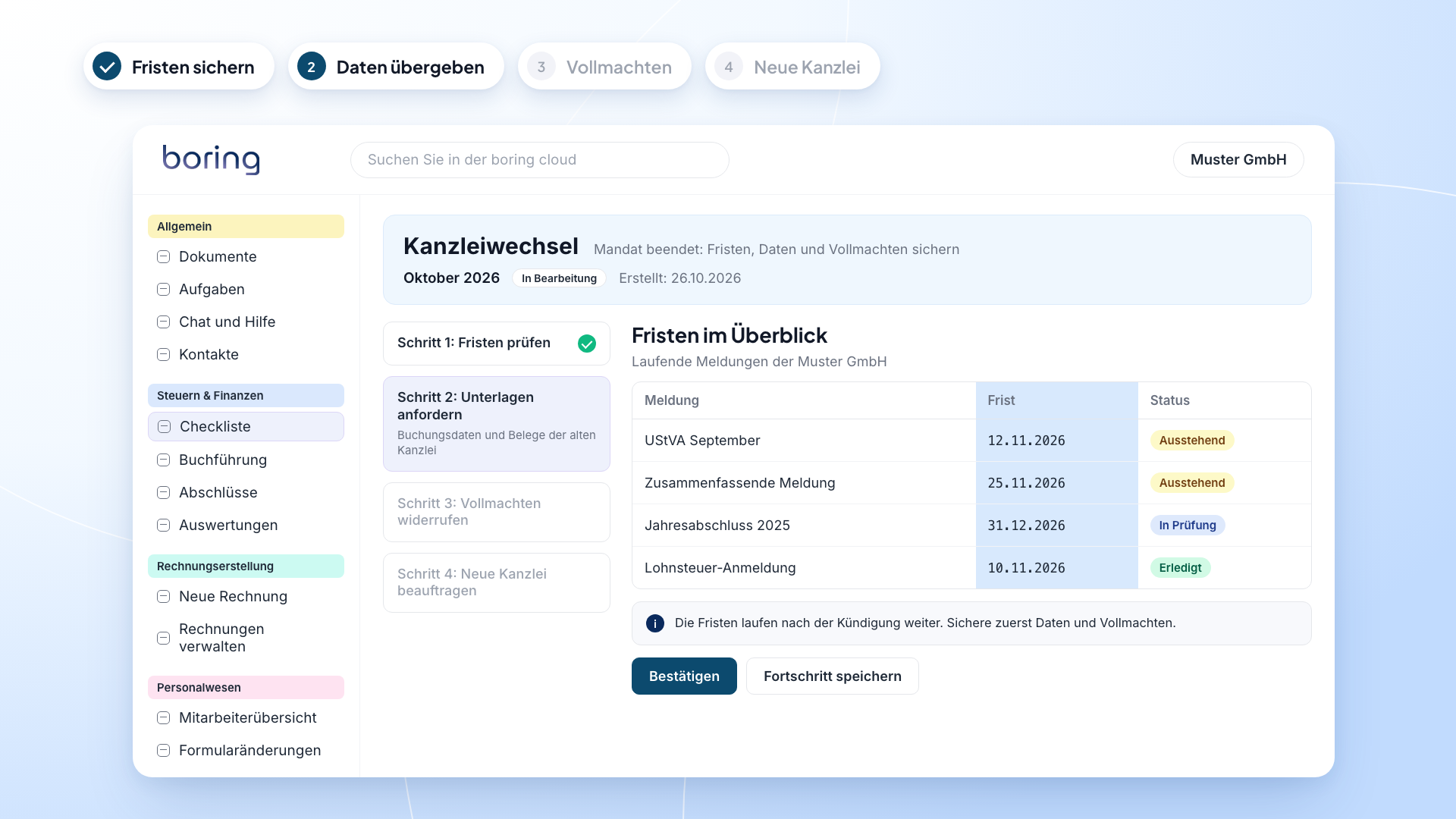
Nimm dir die Woche als Fahrplan. Diese sieben Schritte halten dich handlungsfähig:
- Kündigung lesen: Prüfe Beendigungsdatum, Leistungsumfang und Hinweise auf offene Aufgaben. Bitte schriftlich um eine Liste der Vorgänge, die die Kanzlei noch erledigt.
- Fristenliste anlegen: Notiere Offenlegung, Steuererklärungen, laufende Voranmeldungen und Termine mit dem Finanzamt (Details im nächsten Abschnitt).
- Unterlagen und Daten anfordern: Fordere Handakte, Belege und die Buchungsdaten an. Bei DATEV geht das per Übertragung der Rechenzentrumsdaten an den neuen Berater.
- Honorarstand klären: Offene Rechnungen geben der alten Kanzlei ein Zurückbehaltungsrecht. Kläre vorab, was offen ist, und zahle notfalls unter Vorbehalt.
- Vollmachten ordnen: Widerrufe die Vollmacht und bitte um Löschung in der Vollmachtsdatenbank.
- Finanzamt informieren: Teile mit, dass das Mandat endet, und nenne den neuen Ansprechpartner, sobald er feststeht. Bei knappen Steuererklärungsfristen beantragst du eine Verlängerung; die Offenlegungsfrist zum 31.12.2026 ist nicht verlängerbar.
- Neue Kanzlei beauftragen: Gib ihr deine Fristenliste mit und lass dir den Auftrag schriftlich bestätigen.
Zur Vollmacht: Ein Widerruf wirkt gegenüber dem Finanzamt erst mit Zugang (§ 80 Abs. 1 AO). Wurde die Vollmacht elektronisch übermittelt, muss der Berater den Widerruf unverzüglich melden (§ 80a AO). Laut Bundessteuerberaterkammer sind Vollmachten bei Mandatsende zu löschen.
Welche Fristen laufen nach der Kündigung weiter?
Alle. Eine Kündigung stoppt keine Frist, und das Verschulden eines Vertreters wird dir zugerechnet.
Offenlegung: Für das Geschäftsjahr 2025 (Kalenderjahr) müssen die Unterlagen spätestens am 31.12.2026 übermittelt sein (§ 325 HGB, Stand 26.10.2026). Pflichtig sind die Geschäftsführer:innen. Die Frist ist nicht verlängerbar, und ein noch nicht aufgestellter Abschluss hindert das Ordnungsgeldverfahren nicht (Bundesamt für Justiz, Stand 26.10.2026). Auch wenn du eine Kanzlei beauftragst, bleibst du in der Überwachungspflicht: Erledigt ist die Offenlegung erst, wenn sie bestätigt ist.
Das Ordnungsgeld beträgt 2.500 bis 25.000 EUR (§ 335 HGB). Nach der Androhung hast du sechs Wochen Zeit. Allein das Verfahren kostet 103,50 EUR, auch bei fristgerechter Offenlegung (Bundesamt für Justiz, Stand 26.10.2026). Läuft die Frist ab, folgen die Festsetzung und zugleich eine neue Androhung, und zwar wiederholt bis zur Offenlegung.
Bei Offenlegung nach der Sechs-Wochen-Frist, aber vor der Entscheidung, kann das Ordnungsgeld sinken: auf 500 EUR nur für Kleinstkapitalgesellschaften, die ihr Recht nach § 326 Abs. 2 HGB genutzt haben, auf 1.000 EUR bei kleinen Gesellschaften. Verlass dich nicht darauf, sondern plane den Abschluss rechtzeitig.
Ein Hinweis zu Zahlungsaufforderungen: Das Bundesamt für Justiz warnt vor gefälschten Schreiben zur “Veröffentlichung des Jahresabschlusses” (Warnung vom 05.11.2025). Echte Zahlungen an das Amt gehen nur an die Bundeskasse Trier mit deutscher IBAN.
Steuererklärungen 2025 (KSt, GewSt, USt): Ohne Berater galt der 31.07.2026, diese Frist ist abgelaufen. Mit Berater endet sie am letzten Februartag 2027 (§ 149 Abs. 3 AO). Der 28.02.2027 ist ein Sonntag, deshalb endet die Frist nach unserer Ableitung am 01.03.2027 (§ 108 Abs. 3 AO). Die Tabelle im Anwendungserlass zur Abgabenordnung reicht nur bis 2024, ein ausdrücklicher Wert für 2025 liegt also nicht vor.
Rechtlich offen ist außerdem, ob die Beraterfrist gilt, wenn das Mandat vor Abgabe endet und kein neuer Berater beauftragt ist. Der Gesetzestext knüpft an “beauftragt sind” an. Eine ausdrückliche Regelung für diesen Fall haben wir im Anwendungserlass zur Abgabenordnung (AEAO zu § 149, veröffentlicht vom Bundesfinanzministerium) nicht gefunden. Das ist keine gesicherte Auskunft: Im ungünstigen Fall droht die abgelaufene Frist vom 31.07.2026.
Deshalb gilt: Beauftrage sofort einen neuen Berater oder beantrage eine Verlängerung nach § 109 AO. Fristen sind auch rückwirkend verlängerbar; in beratenen Fällen geht das über Ende Februar hinaus nur ohne Verschulden. Wer nach 14 Monaten noch nicht abgegeben hat, bekommt grundsätzlich einen Verspätungszuschlag von 0,25 % der Steuer nach Abzug der Vorauszahlungen, mindestens 25 EUR je angefangenem Monat (§ 152 AO).
Eine Übersicht aller Termine findest du im Artikel zu den Fristen für Kapitalgesellschaften.
Was muss die alte Kanzlei herausgeben?
Die Handakte und deine Daten. Nach § 66 Abs. 2 StBerG gehören dazu die Dokumente, die der Berater von dir oder für dich erhalten hat. Das gilt auch elektronisch.
Ausgenommen sind die gegenseitige Korrespondenz, Dokumente, die du schon hast, und interne Arbeitspapiere. Bei offenem Honorar darf die Kanzlei die Herausgabe verweigern, außer der Vorenthalt ist unangemessen.
Eigene Arbeitsergebnisse wie Abschlüsse, Erklärungen oder Buchungsdaten sind keine Handakte. Bei offenem Honorar darf der Berater sie Zug um Zug zurückhalten. Seine Pflicht erfüllt er laut Bundessteuerberaterkammer (Stand 03.07.2025) regelmäßig, indem er der Übertragung der Rechenzentrumsdaten an den neuen Berater zustimmt.
Unangemessen ist das Zurückhalten zum Beispiel bei geringer Forderung, als Druckmittel für eine Honorarerhöhung oder wenn du unter Vorbehalt zahlst. Sind die Honorare bezahlt, muss die Kanzlei bei kompatibler Software die vollständige Übertragung ermöglichen (Bundessteuerberaterkammer, Februar 2020).
Darf der Steuerberater zur Unzeit kündigen?
Nein, ohne wichtigen Grund darf er nicht zur Unzeit kündigen. Er muss so kündigen, dass du dir die Leistung anderweitig beschaffen kannst (§ 627 Abs. 2 BGB). Sonst haftet er für den daraus entstehenden Schaden.
Was “zur Unzeit” heißt, entscheidet sich im Einzelfall. Eine amtliche Faustregel für Vorlaufzeiten gibt es nicht, deshalb nennen wir keine feste Zeitspanne.
Nach Treu und Glauben schuldet die Kanzlei im Einzelfall noch wenige, kaum zeitintensive Schritte, etwa die Abgabe einer bereits freigegebenen Erklärung (Bundessteuerberaterkammer, 03.07.2025). Dokumentiere deshalb Datum und Wortlaut der Kündigung und alle Fristen, die du ihr genannt hattest. Bei einem Streit über Schadensersatz holst du dir rechtlichen Rat.
Warum nehmen so viele Kanzleien keine neuen Mandate an?
Die Kanzleien haben zu wenig Personal für zu viel Arbeit. Eine belastbare Quote für “Kanzleien nehmen keine Neumandate an” gibt es nicht, deshalb nennen wir keine. Die Rahmendaten sind aber eindeutig:
- Laut Berufsstatistik der Bundessteuerberaterkammer (Stand 01.01.2026) gibt es 89.549 Steuerberater:innen. Das Durchschnittsalter liegt bei 53,7 Jahren, 31,7 % der Berufsträger sind älter als 60.
- Laut STAX 2024 (Allensbach für die Bundessteuerberaterkammer, n = 5.815) blieben 59,1 % der Stellen in Einzelkanzleien unbesetzt, 2018 waren es 35,9 %.
- Laut DATEV-Seismograf (Juni 2026, n = 398 Kanzleien) sind rund 7 von 10 Kanzleien überlastet, 21 % erheblich.
Das erklärt auch eine verbreitete Folge: Wenn die Kanzlei in Rente geht oder verkauft wird, steht ein Wechsel an. Neue Mandate gibt es dort oft erst nach Wochen.
Diese Engpässe sind ein Grund, warum digitale Kanzleien mit eigener Steuerberatung entstanden sind: Sie setzen auf festes Onboarding statt auf freie Plätze in Einzelkanzleien.
Wie findest du schnell eine neue Kanzlei?
Gehe auf drei Wegen parallel vor, statt nacheinander. Frage zwei bis drei Kanzleien über den Mitgliederdienst der Steuerberaterkammer an, such dir mindestens eine digitale Kanzlei mit festem Onboarding und hol dir überall dieselben Antworten ein.
Das sind die fünf Kriterien, die über deinen Erfolg entscheiden:
- Startdatum: Wann kann die Kanzlei verbindlich anfangen, und wer hält deine Fristenliste?
- Festpreis: Gibt es einen schriftlichen Preis oder Abrechnung nach Steuerberatervergütungsverordnung (StBVV) mit offenem Ende?
- Datenübernahme: Kann sie deine Buchungsdaten direkt übernehmen, oder fängst du mit Papier an?
- Haftung: Welche Haftpflichtdeckung hat die Kanzlei, und ist sie selbst Steuerberatungsgesellschaft?
- Umfang: Sind Jahresabschluss, Offenlegung, KSt/GewSt und Lohn enthalten, oder kommen Zusatzrechnungen?
Hier der Abgleich der drei Wege (Stand Oktober 2026):
| Weg | Abrechnung | Datenübernahme | Beachte |
|---|---|---|---|
| Gesamtpaket “Mit Kanzlei + Steuerberater” | Festpreis ab 335 EUR/Monat netto, öffentlich mit Preisrechner | Buchungsdaten ins selbe Konto | Zwei Rechnungen (Plattform und Steuerkanzlei); über 1 Mio. EUR Umsatz individuell |
| Klassische Kanzlei (Kammer-Suchdienst) | Steuerberatervergütungsverordnung, oft mit Zusatzrechnungen | Meist über DATEV | Kapazität und Startdatum vorab klären |
| Nur Buchhaltungssoftware, z. B. die Stufe “Ohne Kanzlei” | Monatlicher Softwarepreis, bei “Ohne Kanzlei” ab 60 EUR/Monat netto (Software + KI-Agent, Stand Oktober 2026) | Du buchst selbst | Keine Steuerberatung und kein Jahresabschluss; dafür brauchst du zusätzlich eine Kanzlei |
Wie sich die Modelle im Alltag unterscheiden, erklärt der Vergleich klassischer Steuerberater oder digitale Kanzlei. Den Ablauf des Wechsels selbst, vom Mandatsvertrag bis zur Übergabe, beschreibt der Leitfaden zum Steuerberater wechseln als GmbH.
Was kostet eine neue Kanzlei für die GmbH?
Bei einer klassischen Kanzlei hängt der Preis von der StBVV und vom Aufwand ab. Du erfährst ihn oft erst im Angebot oder auf der Rechnung. Bei einem Festpreis kennst du ihn vorher.
Beispiel 1 (rechnerisch, kein Kundenfall): Deine Beratungs-GmbH hat 10 Mitarbeitende und 400.000 EUR Umsatz. Das Gesamtpaket “Mit Kanzlei + Steuerberater” kostet im Band bis 500.000 EUR Umsatz 705 EUR/Monat netto. Die Lohnabrechnung rechnest du als separaten Posten dazu, sie steckt nicht im Paketpreis: 20 EUR je Mitarbeitendem und Monat, also 200 EUR. Zusammen sind das 905 EUR/Monat oder 10.860 EUR im Jahr netto. Du bekommst dafür zwei Rechnungen, eine für die Plattform und eine für die Steuerkanzlei.
Beispiel 2 (rechnerisch, kein Kundenfall): Deine kleine GmbH hat 2 Mitarbeitende und 90.000 EUR Umsatz. Sie liegt im Band bis 100.000 EUR Umsatz, das Gesamtpaket kostet 335 EUR/Monat netto. Dazu kommt die Lohnabrechnung mit 2 mal 20 EUR, also 40 EUR. Zusammen sind das 375 EUR/Monat oder 4.500 EUR im Jahr netto.
Nicht enthalten sind die amtlichen Gebühren. Für die Offenlegung einer kleinen Gesellschaft zahlst du laut Justizverwaltungskostengesetz 25 EUR Einstellungsgebühr je Geschäftsjahr, dazu kommt eine Jahresgebühr von 3 EUR, wenn du § 326 HGB nutzen kannst, sonst von 6 EUR (Stand 26.10.2026). Prüfe vor jeder Entscheidung die aktuellen Preise auf der Preisseite.
So unterstützt dich boring.tax
Wenn die Kündigung kam, brauchst du vor allem zwei Dinge: ein festes Startdatum und eine Kanzlei, die haftet. Das Gesamtpaket “Mit Kanzlei + Steuerberater” bündelt beides. Genau diese Lücke reißt eine Mandatskündigung auf, und das Gesamtpaket schließt sie mit der eigenen, haftenden Kanzlei und der Buchhaltung im selben Konto.
Die eigene Steuerberatungsgesellschaft mbH (in einzelnen Fällen eine Partnerkanzlei) übernimmt die Übermittlung der Umsatzsteuervoranmeldung direkt an ELSTER, den Jahresabschluss, die Offenlegung, KSt- und GewSt-Erklärungen und die E-Bilanz, und sie berät dich. Das Preisband richtet sich nach deinem Umsatz: 335, 520, 705 oder 890 EUR/Monat netto bei bis zu 100.000, 250.000, 500.000 oder 1 Mio. EUR. Stand der Preise ist der 25.09.2026.
Deine Buchhaltungsdaten ziehen ins selbe Konto um, du musst nicht von vorn anfangen. Die KI ordnet Belege und Bankumsätze zu, du gibst frei. Nichts geht ohne deine Bestätigung ans Finanzamt, und die Daten liegen in Deutschland. Über 330 zahlende Unternehmen nutzen die Plattform (Stand August 2026).
Ehrlich gesagt: Bei dringend überfälligen Jahresabschlüssen und bei über 1 Mio. EUR Umsatz gibt es keinen Standardpreis. Dann klären wir Umfang und Preis individuell in einem Gespräch. Die Stufe “Ohne Kanzlei” (60 EUR/Monat) ist Software und KI-Agent, aber keine Steuerberatung und kein Jahresabschluss. Für dein akutes Problem ist sie nicht die Antwort.
Nicht geeignet ist das Angebot für Einzelunternehmen und Freiberufler (EÜR).
Häufige Fragen
Mein Steuerberater hat das Mandat gekündigt. Was muss ich als GmbH jetzt tun? Sichere zuerst die Fristen und beauftrage dann eine neue Kanzlei. Fordere Handakte und Buchungsdaten an, kläre offene Honorare und widerrufe die Vollmacht. Die Checkliste oben zeigt die sieben Schritte.
Welche Alternativen habe ich als Beratungs-GmbH mit 15 Mitarbeitern? Du hast drei Wege: eine klassische Kanzlei über den Kammer-Suchdienst, eine digitale Kanzlei mit Festpreis oder Software mit KI und einer Kanzlei im selben Konto. Zur Größe: Eine Kleinstkapitalgesellschaft liegt nach § 267a HGB nur vor, wenn mindestens zwei von drei Merkmalen nicht überschritten werden: 450.000 EUR Bilanzsumme, 900.000 EUR Umsatz, 10 Arbeitnehmer. Die Einstufung wechselt erst, wenn die Grenzen an zwei aufeinanderfolgenden Stichtagen über- oder unterschritten werden. Mit 15 Mitarbeitenden überschreitest du das Arbeitnehmer-Merkmal, du bleibst also nur Kleinstkapitalgesellschaft, wenn Bilanzsumme und Umsatz beide unter den Grenzen liegen. Sonst gilt § 267 HGB: Klein ist eine Gesellschaft, die zwei von drei Grenzen nicht überschreitet (7,5 Mio. EUR Bilanzsumme, 15 Mio. EUR Umsatz, 50 Arbeitnehmer). Prüfe die Werte für dein Geschäftsjahr. Meine Empfehlung je Weg: Wähle die klassische Kanzlei, wenn du eine feste Ansprechperson vor Ort willst und ein verbindliches Startdatum schriftlich bekommst. Wähle die digitale Kanzlei mit Festpreis, wenn Kosten und Start planbar sein sollen. Wähle das Gesamtpaket mit Kanzlei im selben Konto, wenn du Buchhaltung, Abschluss und Fristen aus einer Hand willst. Reine Software reicht nur, wenn du die Kanzlei bereits hast.
Welcher Steuerberater nimmt noch neue Mandanten an? Das lässt sich nicht pauschal sagen, weil es keine belastbare Übersicht über freie Kapazitäten gibt. Frage deshalb bei jeder Kanzlei das Startdatum schriftlich ab und lass dir Leistungsumfang und Preis bestätigen. Beim Gesamtpaket “Mit Kanzlei + Steuerberater” siehst du den Preis ab 335 EUR/Monat netto vorab (Stand 25.09.2026). Die Mitgliedersuche der Steuerberaterkammern hilft dir, Kanzleien in deiner Region zu finden.
Wie finde ich schnell einen Steuerberater, wenn die Kanzleien vor Ort keine Kapazität haben? Such nicht nur vor Ort. Digitale Kanzleien arbeiten bundesweit, die Beratung läuft per Videocall und die Daten per Upload oder Übertragung. Wichtig ist, dass die Kanzlei als Steuerberatungsgesellschaft haftet.
Die Kanzlei hat gekündigt, keine nimmt mich an und die Offenlegungsfrist läuft. Was jetzt? Die Frist zum 31.12.2026 ist nicht verlängerbar, deshalb zählt jede Woche. Bei einem dringend überfälligen Abschluss kannst du bei boring.tax ein Individuell-Gespräch buchen, in dem Umfang und Preis geklärt werden. Frage parallel über die Kammersuche der Steuerberaterkammer bei klassischen Kanzleien an und lass dir jeweils ein Startdatum schriftlich bestätigen. Wer nach der Androhung binnen sechs Wochen offenlegt, vermeidet das Ordnungsgeld. Die Verfahrenskosten von 103,50 EUR bleiben aber.
Mein Steuerberater ist langsam und kaum erreichbar. Wie wechsle ich am besten? Kündige selbst, sobald eine neue Kanzlei bestätigt hat. So bleibst du nie ohne Berater. Fordere die Daten an, widerrufe die Vollmacht und lass die neue Kanzlei die Fristen übernehmen.
Mein Steuerberater geht in Rente und die Kanzlei wird verkauft. Bleiben oder wechseln? Bleibe nur, wenn der Nachfolger schriftlich Preis, Leistungsumfang und Startdatum zusagt. Sonst wechsle rechtzeitig, am besten zum Jahreswechsel und mit Übergabe der Daten. Bei einem Verkauf kann sich der Preis ändern. Bei boring.tax gilt der veröffentlichte Preisstand vom 25.09.2026 auf der Preisseite; eine Preisgarantie für die Zukunft ist das nicht.
Bereit, es auszuprobieren?
Die Kündigung ist ärgerlich, aber lösbar: Mit Fristenliste, Datenübernahme und einer Kanzlei mit festem Startdatum bist du in wenigen Wochen wieder abgesichert. Teste das Gesamtpaket 14 Tage kostenlos, ohne Kreditkarte und ohne Verkaufsgespräch.
Fristen gesichert. Daten übernommen. So soll Steuer sein: boring.
Noch kein boring.tax-Kunde? Jetzt kostenlos starten →
Tax advisor terminated your engagement: What your GmbH needs to do now and how to find a new firm fast
The letter has arrived, and the engagement is ending. The deadlines keep running anyway. And the three firms near you “unfortunately have no capacity.”
If your tax advisor has terminated the engagement, use the first seven days to secure deadlines, data and powers of attorney, then hire a new firm quickly. The “Mit Kanzlei + Steuerberater” full package from boring.tax differs from a traditional firm in that its own liable tax firm (EUR 4 million professional liability coverage) works in the same account as your bookkeeping. The fixed, public price starts at EUR 335/month net. You can test it free for 14 days, with no credit card and no sales call.
This article gives you the checklist, your rights against the old firm, the deadlines and the costs.
What is a termination of the engagement by the tax advisor?
A termination of the engagement means the firm ends the tax advisory contract. For services of a higher kind that rest on special trust, Section 627(1) of the German Civil Code (BGB) allows termination without good cause.
The Federal Court of Justice generally treats tax advice as such a service. The engagement can therefore end “at any time and without stating reasons, with immediate effect” (BGH, February 11, 2010, IX ZR 114/09). Legally, the termination is usually valid, even if it catches you off guard.
What do you need to do in the first 7 days?
Treat the week as your roadmap. These seven steps keep you able to act:
- Read the termination: Check the end date, the scope of services and any notes on open tasks. Ask in writing for a list of the items the firm will still complete.
- Create a deadline list: Note the disclosure filing, tax returns, ongoing advance returns and appointments with the tax office (details in the next section).
- Request documents and data: Request the client file, receipts and bookkeeping data. With DATEV, this works by transferring the data center data to the new advisor.
- Clarify the fee status: Outstanding invoices give the old firm a right of retention. Find out in advance what is open and, if necessary, pay under reservation.
- Sort out powers of attorney: Revoke the power of attorney and ask for its deletion from the power of attorney database.
- Inform the tax office: Tell them the engagement is ending and name the new contact as soon as it is settled. If tax return deadlines are tight, apply for an extension. The disclosure deadline of December 31, 2026 cannot be extended.
- Engage a new firm: Give them your deadline list and have the engagement confirmed in writing.
On the power of attorney: a revocation takes effect toward the tax office only upon receipt (Section 80(1) AO). If the power of attorney was transmitted electronically, the advisor must report the revocation without delay (Section 80a AO). According to the German Federal Chamber of Tax Advisors, powers of attorney must be deleted when the engagement ends.
Which deadlines keep running after the termination?
All of them. A termination does not stop any deadline, and a representative’s fault is attributed to you.
Disclosure filing: For the 2025 financial year (calendar year), the documents must be submitted by December 31, 2026 at the latest (Section 325 HGB, as of October 26, 2026). The managing directors are responsible. The deadline cannot be extended, and annual accounts that have not yet been prepared do not prevent the administrative fine proceedings (Federal Office of Justice, as of October 26, 2026). Even if you engage a firm, you remain responsible for monitoring: the disclosure is only done once it has been confirmed.
The administrative fine ranges from EUR 2,500 to EUR 25,000 (Section 335 HGB). After the warning notice, you have six weeks. The proceedings alone cost EUR 103.50, even if you file on time (Federal Office of Justice, as of October 26, 2026). If the deadline passes, the fine is imposed and a new warning notice is issued at the same time, repeatedly until you file.
If you file after the six-week period but before the decision, the fine can drop: to EUR 500 only for micro-entities that have used their right under Section 326(2) HGB, and to EUR 1,000 for small companies. Do not count on this. Plan the annual accounts in good time instead.
A note on payment demands: the Federal Office of Justice warns of forged letters about the “publication of the annual accounts” (warning of November 5, 2025). Genuine payments to the office go only to the Bundeskasse Trier with a German IBAN.
Tax returns for 2025 (corporate income tax, trade tax, VAT): Without an advisor, the deadline was July 31, 2026, and it has passed. With an advisor, it ends on the last day of February 2027 (Section 149(3) AO). February 28, 2027 is a Sunday, so by our reading the deadline ends on March 1, 2027 (Section 108(3) AO). The table in the Federal Ministry of Finance’s application decree on the Fiscal Code only runs to 2024, so there is no explicit value for 2025.
It is also legally unresolved whether the advisor deadline applies if the engagement ends before filing and no new advisor has been engaged. The statute is tied to “are engaged.” We found no explicit rule for this case in the application decree on the Fiscal Code (AEAO on Section 149, published by the Federal Ministry of Finance). This is not reliable guidance: in the worst case, the expired deadline of July 31, 2026 applies.
So the rule is: engage a new advisor immediately or apply for an extension under Section 109 AO. Deadlines can also be extended retroactively. In advised cases, going beyond the end of February works only if you are not at fault. If you have not filed after 14 months, you generally face a late filing surcharge of 0.25% of the tax after deducting prepayments, at least EUR 25 for each month begun (Section 152 AO).
You can find an overview of all dates in the article on deadlines for corporations.
What must the old firm hand over?
The client file and your data. Under Section 66(2) StBerG, this includes the documents the advisor received from you or for you. This also applies electronically.
Excluded are the correspondence between you and the firm, documents you already have, and internal working papers. If fees are outstanding, the firm may refuse to hand over the file unless withholding it would be unreasonable.
Their own work products such as financial statements, returns or bookkeeping data are not part of the client file. If fees are outstanding, the advisor may withhold them in exchange for payment. According to the German Federal Chamber of Tax Advisors (as of July 3, 2025), the advisor usually fulfills this duty by agreeing to the transfer of the data center data to the new advisor.
Withholding is unreasonable, for example, when the claim is small, when it is used as leverage for a fee increase, or when you pay under reservation. Once the fees are paid, the firm must enable a complete transfer if the software is compatible (German Federal Chamber of Tax Advisors, February 2020).
Can the tax advisor terminate at an inopportune time?
No, not without good cause. The advisor must terminate in a way that lets you obtain the service elsewhere (Section 627(2) BGB). Otherwise they are liable for the resulting damage.
What counts as an “inopportune time” is decided case by case. There is no official rule of thumb for lead times, so we do not name a fixed period.
Under the principle of good faith, the firm may still owe a few steps that take little time, such as submitting a return that has already been approved (German Federal Chamber of Tax Advisors, July 3, 2025). So document the date and wording of the termination and all deadlines you had told the firm about. If there is a dispute over damages, get legal advice.
Why do so many firms not accept new clients?
The firms have too little staff for too much work. There is no reliable figure for “firms not accepting new clients,” so we do not cite one. The general data is clear, though:
- According to the professional statistics of the German Federal Chamber of Tax Advisors (as of January 1, 2026), there are 89,549 tax advisors. The average age is 53.7 years, and 31.7% of practitioners are older than 60.
- According to STAX 2024 (Allensbach for the German Federal Chamber of Tax Advisors, n = 5,815), 59.1% of positions in solo practices went unfilled, compared with 35.9% in 2018.
- According to the DATEV Seismograf (June 2026, n = 398 firms), around 7 in 10 firms are overloaded, 21% severely.
This also explains a common consequence: when a firm’s owner retires or the firm is sold, a transition follows. New engagements there are often only possible after weeks.
These bottlenecks are one reason digital firms with their own tax advisory arm have emerged. They rely on fixed onboarding instead of open slots in solo practices.
How do you find a new firm quickly?
Pursue three routes in parallel rather than one after another. Ask two to three firms through the member directory of the tax advisors’ chamber, find at least one digital firm with fixed onboarding, and get the same answers from everyone.
These are the five criteria that decide your success:
- Start date: When can the firm start on a binding basis, and who holds your deadline list?
- Fixed price: Is there a written price, or billing under the tax advisor fee ordinance (StBVV) with an open end?
- Data transfer: Can it take over your bookkeeping data directly, or do you start with paper?
- Liability: What professional liability coverage does the firm have, and is it itself a tax advisory company?
- Scope: Are annual accounts, disclosure, corporate income tax/trade tax and payroll included, or do extra invoices follow?
Here is a comparison of the three routes (as of October 2026):
| Route | Billing | Data transfer | Keep in mind |
|---|---|---|---|
| Full package “Mit Kanzlei + Steuerberater” | Fixed price from EUR 335/month net, public with a price calculator | Bookkeeping data into the same account | Two invoices (platform and tax firm); individual pricing above EUR 1 million revenue |
| Traditional firm (chamber directory) | Tax advisor fee ordinance, often with extra invoices | Usually via DATEV | Clarify capacity and start date up front |
| Bookkeeping software only, e.g. the “Ohne Kanzlei” tier | Monthly software price, from EUR 60/month net for “Ohne Kanzlei” (software + AI agent, as of October 2026) | You book yourself | No tax advice and no annual accounts; you need a separate firm for that |
How the models differ in everyday work is explained in the comparison traditional tax advisor or digital firm. The switching process itself, from engagement contract to handover, is described in the guide to changing your tax advisor as a GmbH.
What does a new firm cost for your GmbH?
With a traditional firm, the price depends on the StBVV and on effort. You often only learn it in the quote or on the invoice. With a fixed price, you know it in advance.
Example 1 (calculated, not a customer case): Your consulting GmbH has 10 employees and EUR 400,000 revenue. The “Mit Kanzlei + Steuerberater” full package costs EUR 705/month net in the band up to EUR 500,000 revenue. You add payroll as a separate item, since it is not included in the package price: EUR 20 per employee per month, so EUR 200. Together that is EUR 905/month or EUR 10,860 per year net. You receive two invoices, one for the platform and one for the tax firm.
Example 2 (calculated, not a customer case): Your small GmbH has 2 employees and EUR 90,000 revenue. It falls in the band up to EUR 100,000 revenue, and the full package costs EUR 335/month net. Payroll adds 2 times EUR 20, so EUR 40. Together that is EUR 375/month or EUR 4,500 per year net.
Official fees are not included. For the disclosure of a small company, you pay EUR 25 filing fee per financial year under the Justice Administration Costs Act. An annual fee of EUR 3 is added if you can use Section 326 HGB, otherwise EUR 6 (as of October 26, 2026). Before any decision, check the current prices on the pricing page.
How boring.tax supports you
When the termination has arrived, you mainly need two things: a fixed start date and a firm that is liable. The “Mit Kanzlei + Steuerberater” full package bundles both. A termination of the engagement opens exactly this gap, and the full package closes it with its own liable firm and your bookkeeping in the same account.
The in-house tax advisory company (Steuerberatungsgesellschaft mbH), or in individual cases a partner firm, handles the submission of the VAT advance return (UStVA) directly to ELSTER, the annual accounts, the disclosure, corporate income tax and trade tax returns and the E-Bilanz, and it advises you. The price band depends on your revenue: EUR 335, 520, 705 or 890/month net for up to EUR 100,000, 250,000, 500,000 or EUR 1 million. The prices are as of September 25, 2026.
Your bookkeeping data moves into the same account, so you do not have to start from scratch. The AI matches receipts and bank transactions, and you approve. Nothing goes to the tax office without your confirmation, and the data is stored in Germany. More than 330 paying companies use the platform (as of August 2026).
To be honest: for urgently overdue annual accounts and for revenue above EUR 1 million, there is no standard price. In that case we clarify scope and price individually in a conversation. The “Ohne Kanzlei” tier (EUR 60/month) is software and an AI agent, but not tax advice and not annual accounts. It is not the answer to your acute problem.
The offer is not suitable for sole proprietors and freelancers (cash-basis accounting).
FAQ
My tax advisor terminated the engagement. What do I need to do now as a GmbH? First secure the deadlines, then engage a new firm. Request the client file and bookkeeping data, clarify open fees and revoke the power of attorney. The checklist above shows the seven steps.
What alternatives do I have as a consulting GmbH with 15 employees? You have three routes: a traditional firm via the chamber directory, a digital firm with a fixed price, or software with AI and a firm in the same account. On size: under Section 267a HGB, a micro-entity exists only if at least two of three criteria are not exceeded: EUR 450,000 balance sheet total, EUR 900,000 revenue, 10 employees. The classification changes only when the limits are exceeded or fallen below on two consecutive reporting dates. With 15 employees, you exceed the employee criterion, so you remain a micro-entity only if both balance sheet total and revenue are below the limits. Otherwise Section 267 HGB applies: a company is small if it does not exceed two of three limits (EUR 7.5 million balance sheet total, EUR 15 million revenue, 50 employees). Check the values for your financial year. My recommendation for each route: choose the traditional firm if you want a fixed contact person on site and get a binding start date in writing. Choose the digital firm with a fixed price if cost and start should be predictable. Choose the full package with a firm in the same account if you want bookkeeping, annual accounts and deadlines from one provider. Software alone is enough only if you already have a firm.
Which tax advisor is still accepting new clients? There is no general answer, because there is no reliable overview of free capacity. So ask every firm for its start date in writing and have the scope and price confirmed. With the “Mit Kanzlei + Steuerberater” full package, you see the price from EUR 335/month net up front (as of September 25, 2026). The member search of the tax advisors’ chambers helps you find firms in your region.
How do I find a tax advisor quickly if the local firms have no capacity? Do not search only locally. Digital firms work nationwide, advice runs by video call, and data goes by upload or transfer. What matters is that the firm is liable as a tax advisory company.
The firm terminated, no one will take me and the disclosure deadline is running. What now? The December 31, 2026 deadline cannot be extended, so every week counts. For urgently overdue accounts, you can book a custom consultation with boring.tax, where scope and price are clarified. In parallel, ask traditional firms through the tax advisors’ chamber search and have each confirm a start date in writing. If you file within six weeks after the warning notice, you avoid the administrative fine. The proceeding costs of EUR 103.50 remain, however.
My tax advisor is slow and hard to reach. What is the best way to switch? Terminate only once a new firm has confirmed. That way you are never without an advisor. Request the data, revoke the power of attorney and have the new firm take over the deadlines.
My tax advisor is retiring and the firm is being sold. Stay or switch? Stay only if the successor commits in writing to price, scope and start date. Otherwise switch in good time, ideally at the turn of the year and with a handover of the data. In a sale, the price can change. At boring.tax, the published price status of September 25, 2026 applies on the pricing page; it is not a price guarantee for the future.
Ready to try it out?
The termination is annoying but solvable: with a deadline list, a data transfer and a firm with a fixed start date, you are covered again within a few weeks. Test the full package free for 14 days, with no credit card and no sales call.
Deadlines secured. Data transferred. That’s how tax should be: boring.
Not yet a boring.tax user? Start for free →