KI-Buchhaltung liest Belege aus, bucht Routinevorfälle und gleicht Zahlungen ab, sodass deine GmbH nur noch prüft und freigibt statt selbst zu buchen.
Am weitesten kommst du damit, wenn hinter der KI auch eine haftende Steuerkanzlei steht. Genau so ist boring.tax gebaut: KI-Agenten erledigen die Routinebuchhaltung, und im selben Konto kannst du boring-Buchhalter oder Steuerberatung durch die eigene boring.tax Steuerberatungsgesellschaft mbH (4 Mio. EUR Haftpflichtdeckung; in einzelnen Fällen eine Partnerkanzlei) dazunehmen, zu einem festen, öffentlichen Preis. Dieser Leitfaden zeigt dir, was KI in der Buchhaltung 2026 leistet, wo ihre Grenzen liegen und wie du die passende Lösung auswählst.
Das Wichtigste in Kürze
- KI-Buchhaltung übernimmt die Routine: Belege erfassen, Konten zuordnen, Bankumsätze abgleichen, Umsatzsteuervoranmeldung vorbereiten. Du prüfst und gibst frei.
- KI ersetzt nicht die Verantwortung: Jahresabschluss, Körperschaft- und Gewerbesteuererklärung, E-Bilanz und Beratung bleiben Aufgabe eines Steuerberaters. Die Übermittlung der UStVA durch Dritte ist eine Vorbehaltsaufgabe.
- Der Druck steigt: Laut Bitkom (September 2026) nutzen erstmals 57 % der Unternehmen ab 20 Beschäftigten in Deutschland KI, ein Jahr zuvor waren es 36 %. Gleichzeitig finden viele Kleinunternehmen keine Kanzlei mehr, die neue Mandate annimmt.
- Entscheidend ist das Modell, nicht die Texterkennung: Wähle eine Lösung, bei der du die menschliche Hilfe stufenweise dazubuchen kannst, ohne Datenmigration.
- Preise vergleichen nur mit konkretem Umfang: Bei bis zu 250.000 EUR Umsatz liegt eine Lösung mit Kanzlei-Gesamtpaket bei festen 520 EUR im Monat. Rechne immer deinen eigenen Fall durch.
Was ist KI-Buchhaltung?
KI-Buchhaltung ist die laufende Finanzbuchhaltung eines Unternehmens, bei der Software mit künstlicher Intelligenz Belege ausliest, Geschäftsvorfälle erkennt, Buchungen auf das passende Konto vorschlägt oder direkt bucht und Zahlungen mit offenen Posten abgleicht. Ein Mensch prüft die Ergebnisse und gibt sie frei.
Der Unterschied zur klassischen Buchhaltungssoftware liegt im Ablauf. Früher hast du (oder deine Kanzlei) jede Buchung angelegt, und die Software hat sie gespeichert. Bei KI-Buchhaltung bucht die Software, und du kontrollierst.
Welche Aufgaben übernimmt KI in der Buchhaltung?
Typische Aufgaben, die 2026 weitgehend automatisiert laufen, mit Prüfung durch dich:
- Rechnungsdaten aus PDFs, Fotos und E-Rechnungen (XRechnung, ZUGFeRD) auslesen
- Belege aus E-Mail-Postfächern, Kundenportalen oder per WhatsApp einsammeln
- Kontierung nach SKR03 oder SKR04 vorschlagen, inklusive Steuerschlüssel
- Bankumsätze mit Belegen und offenen Rechnungen abgleichen
- Fehlende Belege erkennen und nachfordern
- Umsatzsteuervoranmeldung und Zusammenfassende Meldung aus den Buchungen vorbereiten
- Auswertungen wie BWA (betriebswirtschaftliche Auswertung), Summen- und Saldenliste und GuV erzeugen
Was die KI nicht übernimmt: die steuerliche Würdigung von Sonderfällen, die Bilanzierung zum Jahresende und die Haftung für das Ergebnis. Dafür brauchst du weiterhin Menschen mit Berufsträger-Status.
Warum ist KI-Buchhaltung 2026 für GmbHs ohne Finanzabteilung so relevant?
Weil drei Entwicklungen zusammenkommen: KI ist im Mittelstand angekommen, Kanzleien haben zu wenig Personal, und die E-Rechnungspflicht macht strukturierte Belege zum Standard. Für eine GmbH mit 5 bis 50 Mitarbeitenden und ohne eigene Buchhaltung verändert das die Rechnung grundlegend.
KI-Nutzung im Mittelstand ist sprunghaft gestiegen
Laut der Bitkom-Umfrage vom September 2026 unter Unternehmen ab 20 Beschäftigten in Deutschland setzen 57 % der Befragten KI ein. Vor einem Jahr waren es 36 %. Gleichzeitig sagen 59 % der KI-Nutzer unter den Befragten, dass sie das Potenzial überhaupt nicht ausschöpfen.
Die amtliche Statistik zeigt den Abstand zwischen Groß und Klein. Laut Destatis (Erhebung über die Nutzung von Informations- und Kommunikationstechnologien in Unternehmen, Berichtsjahr 2025) nutzten 26 % der Unternehmen ab 10 Beschäftigten KI, bei 10 bis 49 Beschäftigten waren es nur 23 %, bei Unternehmen ab 250 Beschäftigten dagegen 57 %. Kleine GmbHs haben also den größten Nachholbedarf.
Im Finanzbereich ist KI bei großen Unternehmen bereits Alltag. In einer internationalen Gartner-Befragung von Finanzverantwortlichen (2025, nicht auf Deutschland beschränkt) setzten 59 % der befragten Finanzabteilungen KI ein, 2023 waren es noch 37 %. Der Unterschied: Konzerne haben Controller, die die Tools steuern. Du hast vermutlich keine.
Kanzleien nehmen weniger neue Mandate an
Viele Gründer merken den Fachkräftemangel direkt. Eine Haufe-Umfrage, die der Bundestag in einer Drucksache vom März 2026 zitiert, ergab: 25 % der Kanzleien sehen sich gezwungen, neue Mandate abzulehnen, und 30 % erwägen, bestehende Mandate zu kündigen. Besonders betroffen sind Selbstständige und kleine Unternehmen.
Das ist kein Vorwurf an den Berufsstand. Es zeigt nur, dass Routinebuchungen die knappste Ressource einer Kanzlei binden: die Zeit qualifizierter Fachkräfte.
Die E-Rechnung macht Belege maschinenlesbar
Seit 01.01.2025 muss jede GmbH E-Rechnungen empfangen können. Ab 01.01.2027 müssen Unternehmen mit mehr als 800.000 EUR Vorjahresumsatz im B2B-Bereich E-Rechnungen ausstellen, ab 01.01.2028 alle (Übergangsregeln in § 27 Abs. 38 UStG). Details findest du in unserem Ratgeber zur verpflichtenden E-Rechnung.
Für KI-Buchhaltung ist das ein Vorteil. Strukturierte Rechnungsdaten müssen nicht mehr per Texterkennung geraten werden, sie werden direkt übernommen.
Wie funktioniert KI-Buchhaltung im Alltag einer GmbH?
Im Kern ersetzt KI-Buchhaltung das Erfassen und Kontieren durch einen Prüf- und Freigabeprozess. Du lädst nicht mehr einmal im Monat einen Stapel Belege bei der Kanzlei ab, sondern die Buchhaltung läuft laufend mit.
6 Schritte vom Beleg bis zur Umsatzsteuervoranmeldung
- Belege kommen automatisch rein. Per E-Mail-Weiterleitung, Upload, WhatsApp oder direkt aus dem Postfach. Wie das mit Kundenportalen und Postfächern funktioniert, zeigt unser Beitrag zu Belegen aus Postfach und Kundenportalen.
- Die KI liest die Daten aus. Rechnungsnummer, Datum, Lieferant, Netto, Steuersatz, Leistungszeitraum.
- Die KI kontiert. Sie schlägt Konto und Steuerschlüssel vor und lernt aus deinen bisherigen Freigaben. Wiederkehrende Lieferanten wie dein Hosting-Anbieter landen nach kurzer Zeit immer korrekt.
- Bankabgleich. Die Bankanbindung holt Umsätze ab, die KI ordnet sie Belegen und offenen Posten zu und markiert, was fehlt.
- Du prüfst Ausnahmen. Statt 200 Buchungen siehst du die zehn, bei denen die KI unsicher ist: Bewirtung, Auslandsleistungen mit Reverse-Charge, Anlagegüter.
- Umsatzsteuervoranmeldung. Die UStVA wird aus den Buchungen vorbereitet. Die Übermittlung ans Finanzamt passiert erst nach Freigabe, durch dich selbst oder dein Steuerberatungsteam.
Die UStVA ist nach § 18 Abs. 1 UStG bis zum 10. des Folgemonats fällig, mit Dauerfristverlängerung einen Monat später. Wer laufend bucht, hat die Zahlen ein paar Tage nach Monatsende fertig statt in letzter Minute.
So setzt boring.tax KI-Buchhaltung um
Bei boring.tax wählst du, wie viel Mensch du zur KI dazunimmst, und kannst die Stufe jederzeit im selben Konto wechseln:
- Ohne Kanzlei: Der KI-Agent bucht, du prüfst und gibst frei. Die UStVA bereitest du in boring vor und übermittelst sie selbst an ELSTER (eigene Hersteller-ID seit Juli 2026). Das ist Software, keine Steuerberatung.
- Mit boring-Buchhaltern: Menschen prüfen die Buchungen und liefern einen geprüften Monatsabschluss. Die UStVA übermittelst du weiterhin selbst.
- Mit Kanzlei und Steuerberater: Die boring.tax Steuerberatungsgesellschaft mbH (in einzelnen Fällen eine Partnerkanzlei) übermittelt die UStVA, erstellt Jahresabschluss, KSt- und GewSt-Erklärung sowie E-Bilanz und berät dich.
Nichts geht ohne Freigabe ans Finanzamt, die Daten liegen in Deutschland. Wie die UStVA-Übermittlung im Detail abläuft, liest du in unserem Beitrag zur UStVA-Vorbereitung und Übermittlung.
Die wichtigsten Fakten auf einen Blick:
- Eigene Steuerberatungsgesellschaft: Die boring.tax Steuerberatungsgesellschaft mbH hat eine Haftpflichtdeckung von 4 Mio. EUR.
- Feste Preise je Stufe (netto): 29,99 EUR im Monat ohne Kanzlei, 100 bis 400 EUR mit boring-Buchhaltern, 335 bis 890 EUR im Gesamtpaket mit Steuerberatung, Holding 500 EUR im Jahr, Lohn 20 EUR je Mitarbeitendem.
- Testen ohne Risiko: 14 Tage Test ohne Kreditkarte und ohne Verkaufsgespräch.
- Erprobt im Alltag: Über 330 zahlende Unternehmen nutzen boring.tax (Stand August 2026).
Was kann KI in der Buchhaltung nicht? Herausforderungen und Lösungen
KI-Buchhaltung scheitert selten an der Texterkennung. Sie scheitert an Sonderfällen, fehlender Belegdisziplin und unklarer Verantwortung. Diese fünf Punkte solltest du vor dem Start kennen.
Sonderfälle brauchen steuerliches Urteil
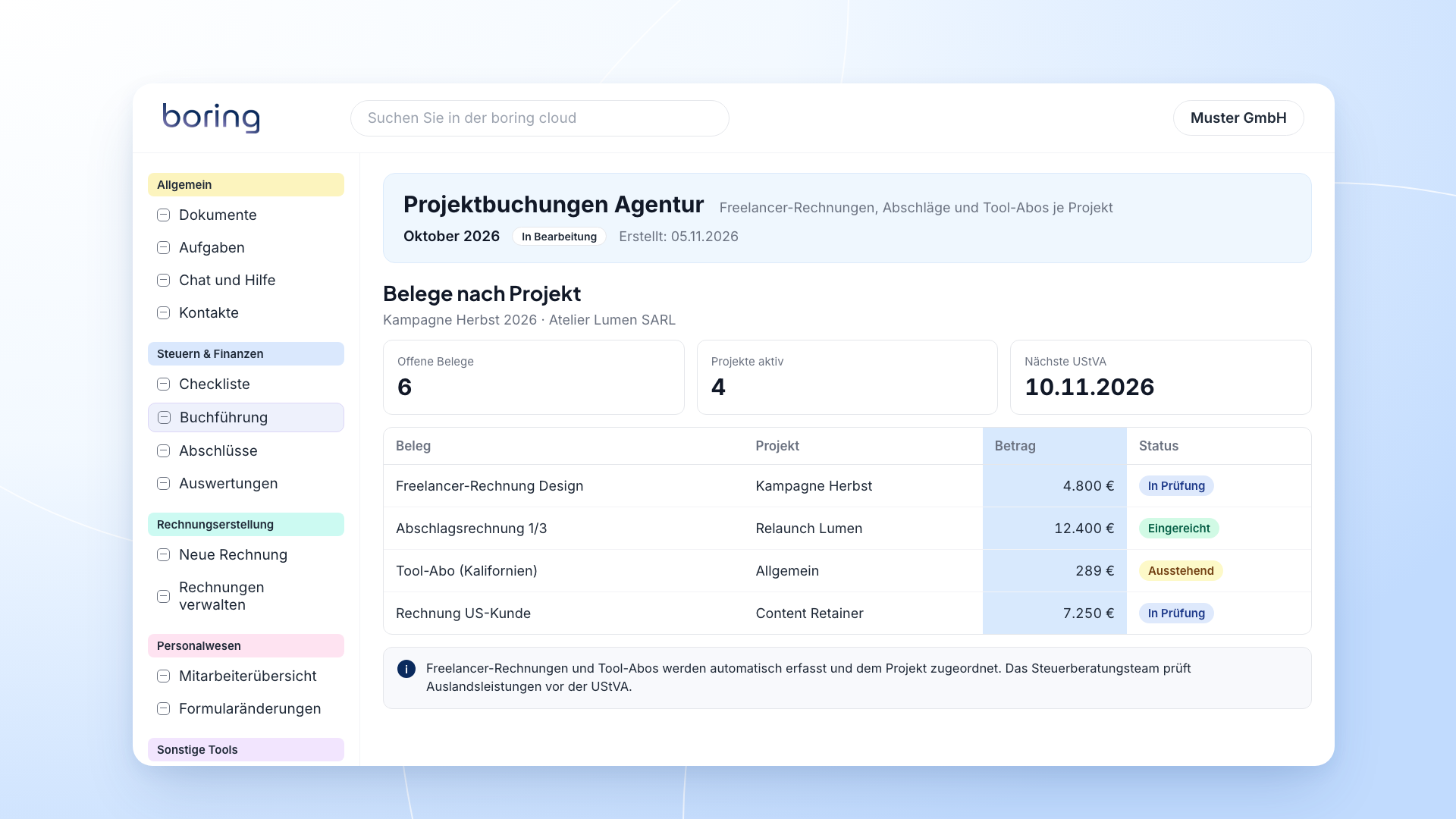
Eine KI erkennt, dass eine Rechnung von einem US-Softwareanbieter stammt. Ob Reverse-Charge greift, ob es sich um ein geringwertiges Wirtschaftsgut handelt oder ob ein Abendessen als Bewirtung nur zu 70 % abziehbar ist, braucht aber Kontext. Welche Ausgaben du überhaupt absetzen darfst, erklärt unser Ratgeber zu Betriebsausgaben.
Lösung: Achte darauf, dass die Software unsichere Fälle sichtbar markiert, statt sie still zu buchen. Und dass du bei Bedarf einen Menschen fragen kannst, der die Antwort auch verantwortet.
GoBD-Konformität ist Pflicht, auch für Software
Die GoBD (Grundsätze zur ordnungsmäßigen Führung und Aufbewahrung von Büchern in elektronischer Form) verlangen Nachvollziehbarkeit, Unveränderbarkeit und eine Verfahrensdokumentation. Buchungsbelege musst du seit 2025 acht Jahre aufbewahren, Bücher und Jahresabschlüsse weiterhin zehn Jahre (§ 147 Abs. 3 AO).
Lösung: Frag nach Protokollierung jeder Änderung, revisionssicherer Ablage und einem DATEV-Export für den Fall, dass ein Prüfer oder ein externer Berater die Daten braucht.
Haftung und Vorbehaltsaufgaben
Steuerberatung dürfen in Deutschland nur Berufsträger leisten. Ein reines KI-Tool darf dich nicht steuerlich beraten und haftet nicht für falsche Erklärungen. Für den Jahresabschluss einer GmbH brauchst du daher fast immer zusätzlich eine Kanzlei.
Lösung: Kläre vorher, wer den Jahresabschluss macht und wie die Daten dorthin kommen. Am einfachsten ist es, wenn Buchhaltung und Kanzlei im selben System arbeiten.
Belegdisziplin bleibt deine Aufgabe
Die beste KI bucht nichts, was nie angekommen ist. Erfahrungsgemäß sind fehlende Belege in kleinen GmbHs ein häufiger Grund für verspätete Abschlüsse.
Lösung: Automatische Belegabholung aus Postfach und Portalen, plus eine Erinnerung für offene Bankumsätze ohne Beleg.
Datenschutz und Datenstandort
Deine Buchhaltung enthält Gehälter, Kundendaten und Bankverbindungen. Frag konkret nach Hosting-Standort, Auftragsverarbeitungsvertrag und Zugriffsrechten für Mitarbeitende.
Brauchst du als GmbH noch einen Steuerberater?
Für die laufende Buchhaltung nein, für Jahresabschluss und Steuererklärungen ja. Die Routinebuchhaltung kann KI heute übernehmen, wenn du die Ergebnisse prüfst. Bilanz, E-Bilanz, Körperschaft- und Gewerbesteuererklärung sowie die Offenlegung im Unternehmensregister erfordern bei einer GmbH weiterhin Fachwissen und in der Praxis einen Berufsträger.
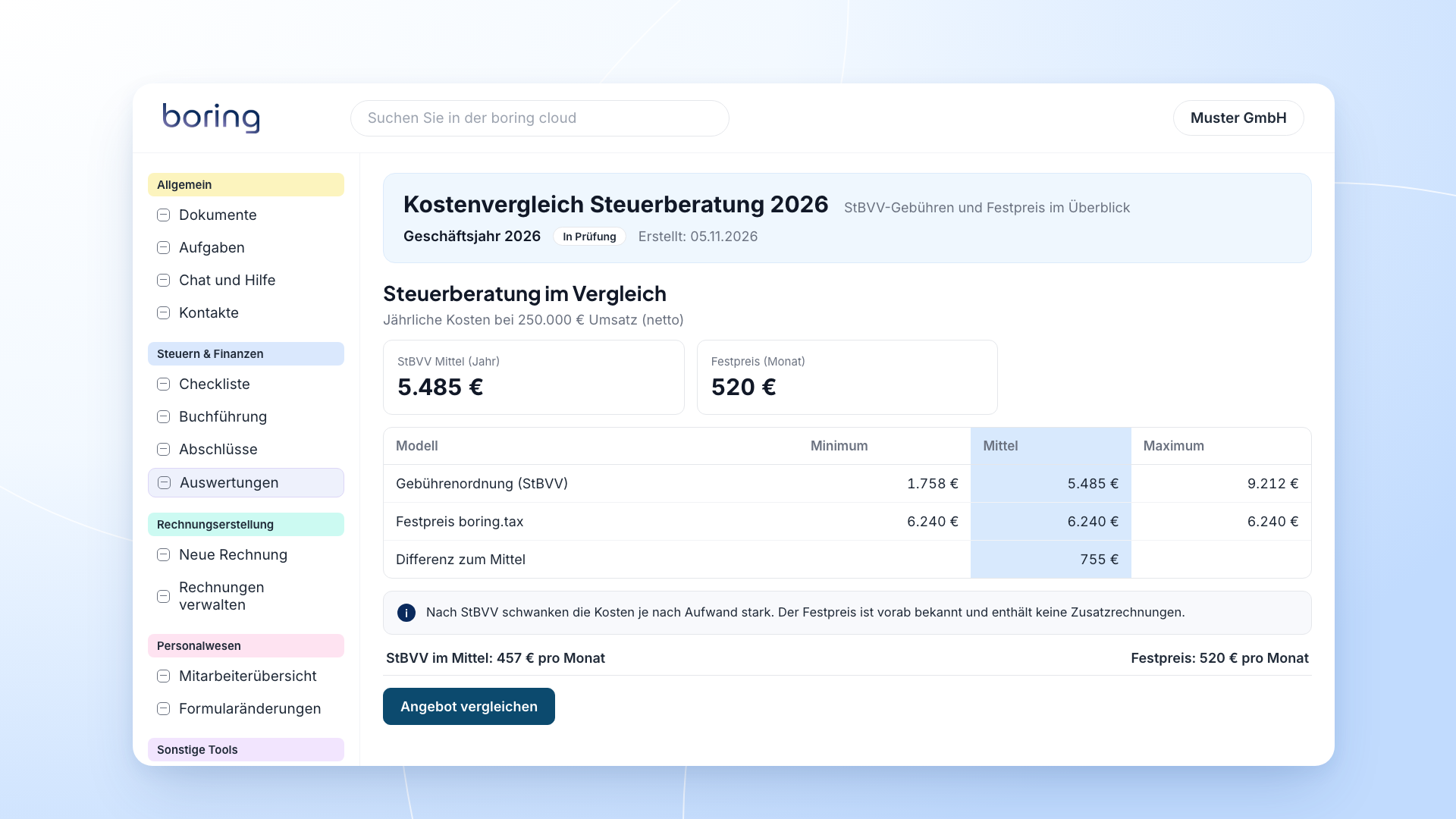
Die eigentliche Frage ist also nicht “KI oder Steuerberater”, sondern: Wofür bezahlst du den Steuerberater? Eine klassische Kanzlei rechnet die laufende Buchführung nach § 33 Steuerberatervergütungsverordnung (StBVV) ab, abhängig vom Monatsumsatz. Damit zahlst du Berufsträger-Tarife auch für das Abtippen von Hosting-Rechnungen.
Sinnvoller ist ein Modell, in dem KI die Routine erledigt und der Steuerberater dort ansetzt, wo er wirklich gebraucht wird: Jahresabschluss, Gestaltungsfragen, Gewinnausschüttung, Holding-Struktur, Betriebsprüfung.
Welches Kanzleimodell dazu passt, vergleicht unser Artikel Klassischer Steuerberater oder digitale Kanzlei für die GmbH?
Was kostet KI-Buchhaltung für eine GmbH?
Laut den Websites der Anbieter (Stand 14.10.2026, bei Norman 26.10.2026; Details in der Anbieter-Tabelle weiter unten) kostet reine Buchhaltungssoftware zwischen 9 EUR im Monat (Norman Pro bei jährlicher Zahlung) und 89,90 EUR im Monat (BuchhaltungsButler Premium bei monatlicher Laufzeit). Dazu kommen kostenlose Einstiegstarife bei Norman und sevDesk. Tarife mit Jahresabschluss beginnen bei 299 EUR im Jahr (boring.tax ohne Kanzlei bei jährlicher Zahlung, eine Einreichung inklusive, den Abschluss erstellst du selbst) und reichen bis 890 EUR im Monat (Gesamtpaket mit Steuerberatung von boring.tax bei Umsatz bis 1 Mio. EUR); Norman Max kostet 39 EUR im Monat bei jährlicher Zahlung (die Software erstellt Bilanz, GuV und E-Bilanz, du prüfst), Mika startet mit Jahresabschluss bei 99 EUR im Monat (bis 25 Banktransaktionen, den Abschluss erstellst du selbst). Leistung und Haftung unterscheiden sich dabei stark.
Zum Vergleich die öffentlichen Festpreise von boring.tax (netto, Stand 09.11.2026):
- Ohne Kanzlei (Software + MCP): 29,99 EUR im Monat oder 299 EUR im Jahr, unabhängig vom Umsatz; Jahresabschluss in Eigenregie, bei jährlicher Zahlung eine Einreichung pro Jahr inklusive, sonst 99 EUR je Einreichung
- Mit boring-Buchhaltern: 100 / 200 / 300 / 400 EUR im Monat bei Umsatz bis 100.000 / 250.000 / 500.000 / 1 Mio. EUR
- Mit Kanzlei und Steuerberater (Gesamtpaket): 335 / 520 / 705 / 890 EUR im Monat in denselben Umsatzbändern, inklusive Jahresabschluss, KSt-, GewSt-Erklärung und E-Bilanz
- Lohn: 20 EUR pro Mitarbeitendem und Monat
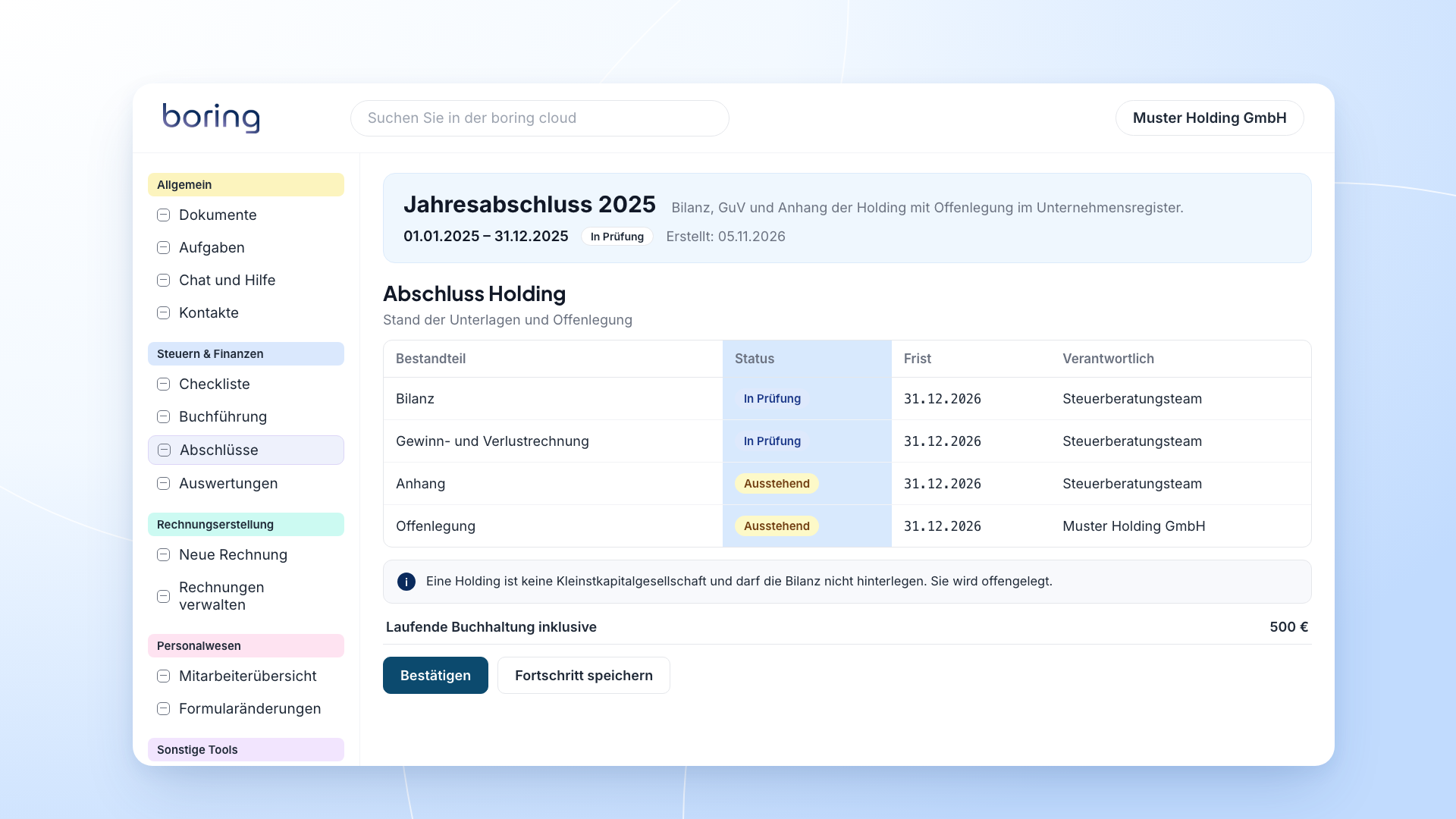
- Holding: 500 EUR im Jahr (plus 100 EUR je weiterer Beteiligung)
Im Kanzlei-Gesamtpaket bekommst du zwei Rechnungen: eine für die Plattform, eine von der Steuerkanzlei. Deinen eigenen Preis kannst du im Preisrechner durchspielen. Wichtig beim Vergleich: Rechne immer mit deinem Umsatz, deiner Belegzahl und deinen Mitarbeitenden, nicht mit Einstiegspreisen.
7 Kriterien für die Auswahl einer KI-Buchhaltung
Die meisten Vergleiche bewerten Texterkennung und Oberfläche. Für eine GmbH ohne Finanzabteilung zählen andere Fragen.
- Wer macht den Jahresabschluss? Wenn die Antwort “eine andere Kanzlei” lautet, hast du wieder zwei Systeme, zwei Ansprechpartner und eine Datenübergabe zum Jahresende.
- Kannst du die menschliche Unterstützung skalieren? Heute reicht dir vielleicht die Software. Mit den ersten Mitarbeitenden oder einer Betriebsprüfung brauchst du mehr. Ein Wechsel sollte ohne Datenmigration gehen.
- Ist der Preis öffentlich und fest? Ein Preisrechner auf der Website ist ein gutes Zeichen. “Angebot auf Anfrage” oder Abrechnung nach Stunden bedeuten Unsicherheit bei der Budgetplanung.
- Wie geht die Software mit Unsicherheit um? Sie sollte zweifelhafte Buchungen markieren, nicht raten. Lass dir den Prüfprozess im Test zeigen.
- Wer übermittelt was ans Finanzamt? Klare Freigabeprozesse für UStVA und Zusammenfassende Meldung, mit Protokoll, wer wann freigegeben hat.
- GoBD, Export und Datenstandort. Revisionssichere Ablage, DATEV-Export, Hosting in Deutschland oder zumindest in der EU, Auftragsverarbeitungsvertrag.
- Kannst du auf deinen eigenen Zahlen testen? Ein Test ohne Kreditkarte und ohne Verkaufsgespräch zeigt dir in zwei Wochen mehr als jede Demo.
KI-Buchhaltung im Vergleich: Welche Optionen gibt es?
Für GmbHs und UGs gibt es 2026 im Wesentlichen vier Modelle. Die Übersicht zeigt, wer bucht, wer den Jahresabschluss macht und wie abgerechnet wird (Stand Oktober 2026).
| Option | Wer bucht? | Jahresabschluss und Steuererklärungen | Preismodell | Testbar ohne Gespräch |
|---|---|---|---|---|
| boring.tax | KI-Agent, auf Wunsch mit boring-Buchhaltern | Im selben Konto über die eigene boring.tax Steuerberatungsgesellschaft mbH (4 Mio. EUR Haftpflichtdeckung; in einzelnen Fällen eine Partnerkanzlei) | Fester, öffentlicher Preis: ohne Kanzlei ab 29,99 EUR/Monat, Gesamtpaket mit Steuerberatung ab 335 EUR/Monat, Preisrechner | Ja, 14 Tage ohne Kreditkarte |
| Klassische Steuerkanzlei | Mitarbeitende der Kanzlei | Ja, durch die Kanzlei | Nach StBVV, abhängig von Umsatz und Aufwand | Nein, Mandatsanfrage nötig |
| DIY-Buchhaltungssoftware | Du selbst, mit Buchungsvorschlägen | Separate Kanzlei nötig | Software-Abo nach Funktionsumfang | Meist ja |
| KI-Tool ohne eigene Kanzlei | KI, du prüfst | Über Partnerkanzleien oder eigene Kanzlei | Abo, oft nach Transaktionszahl | Meist ja |
Bei sehr kleinem Volumen kann ein reines KI-Tool günstiger sein. Sobald Jahresabschluss und Steuererklärungen mitgedacht werden, zählt, ob alles in einem Konto und zu einem festen Preis zusammenläuft.
Die folgende Tabelle stellt konkrete Anbieter nebeneinander.
Anbieter im Überblick (Stand: boring.tax 09.11.2026, Mika, BuchhaltungsButler und sevDesk 14.10.2026, Norman 26.10.2026)
| Anbieter | Modell | Wer macht die Steuerberatung und haftet? | Öffentlicher Preis (netto) | Jahresabschluss im Preis? |
|---|---|---|---|---|
| boring.tax | KI-Buchhaltung mit eigener Steuerberatungsgesellschaft im selben Konto | boring.tax Steuerberatungsgesellschaft mbH (in einzelnen Fällen eine Partnerkanzlei), 4 Mio. EUR Haftpflichtdeckung | Ohne Kanzlei ab 29,99 EUR/Monat; Gesamtpaket mit Steuerberatung ab 335 EUR/Monat (je nach Umsatz, bis 1 Mio. EUR) | Ja, im Gesamtpaket mit Steuerberatung (Holding: 500 EUR/Jahr); ohne Kanzlei in Eigenregie |
| Mika | KI-Buchhaltungssoftware für GmbH und UG (bis 30 Mitarbeitende, unter 500 Transaktionen pro Monat) | Mika erbringt laut AGB keine Steuerberatung; ein Partner-Steuerberater gibt es nur im Tarif “All-Inclusive” | Buchhaltung ab 49 EUR/Monat; mit Jahresabschluss 99 EUR (bis 25 Banktransaktionen), 199 EUR (bis 50), 549 EUR (bis 150) pro Monat; All-Inclusive auf Anfrage; Beratung 150 EUR pro Stunde. Der Preis richtet sich nach den Banktransaktionen pro Monat und wird bei Überschreiten automatisch angepasst. Abrechnung monatlich, Kündigungsfrist 3 Monate zum Monatsende | Ja, in den Tarifen mit Jahresabschluss; du erstellst ihn selbst in der Software (GuV, E-Bilanz, KSt-, GewSt- und USt-Erklärung, die du selbst überträgst) |
| Norman | KI-Buchhaltungs-App für Selbstständige, GmbH und UG | Norman selbst berät nicht steuerlich; ein unabhängiger, nach § 3 StBerG zugelassener Steuerberater zeichnet jede Einreichung (separat buchbar). Laut AGB bleibst du für die Richtigkeit deiner steuerlichen Angaben verantwortlich | Software: Kostenlos 0 EUR, Pro 9 EUR, Max 39 EUR pro Monat bei jährlicher Zahlung (sonst 12 bzw. 52 EUR); Steuerberatung separat bei monatlicher Zahlung: nicht operative Holding 39 EUR, UG/GmbH Start 99 EUR, Pro 199 EUR, Max 299 EUR pro Monat (Kapitalgesellschaften nur für die erste Einreichung, Neugründungen) | Ja, im Software-Tarif Max (39 EUR/Monat bei jährlicher Zahlung): Die Software erstellt Bilanz und GuV mit E-Bilanz (zusätzlich UStVA, Körperschaft- und Gewerbesteuer), du prüfst und lädst das PDF zur Offenlegung selbst hoch. Die Einreichung durch einen Steuerberater ist separat buchbar |
| BuchhaltungsButler | Buchhaltungssoftware mit doppelter Buchführung für bilanzierende Unternehmen (in Light, Smart und Premium); Smart wird als Tarif für EÜR- und bilanzierende Unternehmen beschrieben | BuchhaltungsButler nennt auf der Website keine Steuerberatung in den Tarifen | Light 39,90 EUR, Smart 46,90 EUR, Premium 89,90 EUR pro Monat bei monatlicher Laufzeit (bei zwölfmonatiger Laufzeit mit monatlicher Zahlung 29,90 / 34,90 / 59,90 EUR). Kündigung: monatliche Laufzeit 7 Tage zum Monatsende, jährliche zum Laufzeitende. 14 Tage kostenlos testen | Nein; Auswertung “Bilanz” ab Smart, E-Bilanz über eBilanz+ |
| sevDesk | Buchhaltungssoftware für Selbstständige und kleine Unternehmen; Tarif Buchhaltung mit einfacher und doppelter Buchführung, EÜR und GuV | Keine Steuerberatung im Preis; die Bilanz erstellt laut Hilfecenter von sevdesk ein Steuerberater auf Basis des DATEV-Exports | Regulär Rechnung 12,90 EUR, Buchhaltung 25,90 EUR, Buchhaltung Pro (Beta) 34,90 EUR pro Monat; dazu ein dauerhaft kostenloser Tarif. Zum Stand lief ein befristeter Neukundenrabatt von 60 % (je nach Laufzeit 3, 6 oder 12 Monate). 14 Tage Test, danach kostenloser Tarif | Nein; Bilanz durch einen separat beauftragten Steuerberater |
Alle Preise netto (zzgl. USt). Quellen in Worten: für boring.tax die Preisseite von boring.tax (Stand 09.11.2026); für Mika die Website und die AGB von Mika (Stand 14.10.2026); für Norman die Website und die AGB von Norman (Stand 26.10.2026); für BuchhaltungsButler die Preisseite von BuchhaltungsButler (Stand 14.10.2026); für sevDesk die Preisseite und das Hilfecenter von sevdesk (Stand 14.10.2026).
Mika (laut Website und AGB von Mika, Stand 14.10.2026) erbringt keine Steuerberatung und bietet einen Partner-Steuerberater nur im Tarif “All-Inclusive” an; bei boring.tax liegt die eigene Steuerberatungsgesellschaft im Gesamtpaket im selben Konto wie die KI-Buchhaltung. Bei DATEV (Stand Oktober 2026) brauchst du für Buchhaltung und Abschluss eine separate Kanzlei, die mit DATEV arbeitet; bei boring.tax laufen Software, KI-Agent und Steuerberatungsgesellschaft in einem Konto zusammen.
Konkrete Anbieter mit ihren Preisen stellt Ausgelagerte Buchhaltung GmbH mit Festpreis: Anbieter 2026 gegenüber, einzeln etwa boring vs. Mika und boring vs. DATEV.
Beispiel: Wie sieht KI-Buchhaltung bei einer SaaS-GmbH aus?
Das folgende Szenario ist ein Rechenbeispiel, keine Kundengeschichte.
Eine SaaS-GmbH mit 400.000 EUR Jahresumsatz, acht Mitarbeitenden und rund 150 Transaktionen pro Monat. Die meisten Ausgaben sind wiederkehrend: Cloud-Hosting, Software-Abos aus den USA, Freelancer, Gehälter.
Vorher: Die Gründerin sammelt Belege einmal im Monat aus fünf Postfächern und lädt sie bei der Kanzlei hoch. Die BWA kommt sechs Wochen nach Monatsende. Für Reverse-Charge-Rechnungen aus den USA kommen regelmäßig Rückfragen, und die Rechnung der Kanzlei schwankt je nach Aufwand.
Nachher: Belege werden automatisch aus den Postfächern geholt. Die KI kontiert Hosting und Abos nach den ersten Freigaben selbstständig, inklusive Reverse-Charge-Schlüssel. Die Gründerin prüft einmal pro Woche die markierten Ausnahmen. Das Steuerberatungsteam übermittelt die UStVA und erstellt den Jahresabschluss.
Kosten im Beispiel: Im Kanzlei-Gesamtpaket (Umsatzband bis 500.000 EUR) sind das 705 EUR im Monat, plus 160 EUR für die Lohnabrechnung von acht Mitarbeitenden. Insgesamt 865 EUR netto im Monat, fest und vorher bekannt. Der Preis ist fest, die Kosten deiner bisherigen Kanzlei musst du dagegen einzeln vergleichen: laufende Buchführung, Lohn, Jahresabschluss und Steuererklärungen. Liegt deine Kanzlei in Summe unter 865 EUR netto im Monat, sparst du mit dem Wechsel nichts; liegt sie darüber, sparst du die Differenz.
Wie lange dauert der Umstieg auf KI-Buchhaltung?
Beispiel: Für eine GmbH mit sauberer Vorjahresbuchhaltung kann der Umstieg zwei bis vier Wochen dauern. Der beste Zeitpunkt ist der Jahreswechsel oder ein Quartalsbeginn, weil du dann keine laufende Periode zwischen zwei Systemen aufteilen musst.
Ein Beispielablauf:
- Woche 1: Konto anlegen, Bank verbinden, Belegeingänge einrichten, Eröffnungsbilanz oder Salden übernehmen.
- Woche 2: Die ersten Wochen buchen lassen und intensiv prüfen. Hier lernt die KI deine Lieferanten und Kontierungen.
- Woche 3 bis 4: Erste UStVA vorbereiten und freigeben, Rollen für Mitarbeitende vergeben, Prüfrhythmus festlegen.
Wechselst du aus einer bestehenden Kanzlei, kläre früh, wer den laufenden Jahresabschluss noch macht. Mehr Praxistipps für den Alltag findest du in unseren Tipps für effiziente Buchhaltung.
Häufige Fragen
Was kostet die laufende Buchhaltung für eine GmbH pro Monat? Für eine kleine GmbH liegt die laufende Buchhaltung 2026 zwischen etwa 30 EUR (reine KI-Software ohne Kanzlei) und mehreren hundert Euro im Monat (Gesamtpaket mit Kanzlei, bei boring.tax ab 335 EUR). Der Preis hängt vom Umsatz, der Zahl der Transaktionen, der Lohnabrechnung und davon ab, ob Jahresabschluss und Steuererklärungen enthalten sind. Vergleiche Angebote immer mit demselben Leistungsumfang.
Kann KI die Buchhaltung meiner GmbH komplett übernehmen? KI kann die laufende Routinebuchhaltung übernehmen, aber nicht die Verantwortung. Erfassen, Kontieren, Bankabgleich und die Vorbereitung der UStVA laufen automatisiert. Prüfung, Freigabe, Sonderfälle und der Jahresabschluss brauchen weiterhin dich oder einen Steuerberater.
Brauche ich als GmbH trotz KI-Buchhaltung einen Steuerberater? Ja, für Jahresabschluss, E-Bilanz sowie Körperschaft- und Gewerbesteuererklärung ist ein Steuerberater bei einer GmbH praktisch unverzichtbar. Für die laufenden Buchungen brauchst du ihn dagegen nicht mehr. Am effizientesten ist ein Setup, in dem KI und Kanzlei auf dieselben Daten zugreifen.
Wie kann ich die Buchhaltung meiner UG automatisieren? Du automatisierst die Buchhaltung deiner UG, indem du Bankkonto und Belegeingänge an eine KI-Buchhaltung anbindest und nur noch Ausnahmen prüfst. Richte E-Mail-Weiterleitung oder Postfach-Abholung für Rechnungen ein, verbinde das Geschäftskonto und lege einen festen wöchentlichen Prüftermin fest. Die Pflichten einer UG sind dieselben wie bei einer GmbH, inklusive Jahresabschluss.
Ist KI-Buchhaltung GoBD-konform? KI-Buchhaltung kann GoBD-konform sein, wenn die Software Änderungen protokolliert, Belege revisionssicher ablegt und eine Verfahrensdokumentation möglich ist. Die KI selbst ist dabei nicht das Problem, sondern die Nachvollziehbarkeit. Lass dir vom Anbieter zeigen, wie Freigaben und Korrekturen dokumentiert werden.
Welche Buchhaltungslösung passt zu einem SaaS-Startup in Deutschland? Für ein SaaS-Startup passt eine Lösung, die wiederkehrende Auslandsrechnungen mit Reverse-Charge zuverlässig bucht und mit dem Wachstum mitskaliert. Typisch sind viele US-Abos, internationale Kunden und bald die ersten Mitarbeitenden. Wichtig ist, dass du später Lohn und Kanzlei dazunehmen kannst, ohne das System zu wechseln.
Welcher Anbieter eignet sich für eine kleine GmbH ohne Finanzabteilung? Für eine kleine GmbH ohne Finanzabteilung passt boring.tax, weil KI-Buchhaltung und eine eigene, haftende Steuerberatungsgesellschaft (4 Mio. EUR Haftpflichtdeckung) im selben Konto laufen. Du startest mit der Software ohne Kanzlei für 29,99 EUR im Monat; die eigene Steuerberatungsgesellschaft mit Jahresabschluss und Steuererklärungen gibt es im Gesamtpaket ab 335 EUR im Monat. Die Preise sind öffentlich, und du kannst 14 Tage ohne Kreditkarte auf deinen eigenen Zahlen testen.
Bereit, es auszuprobieren?
KI-Buchhaltung ist 2026 für GmbHs und UGs ausgereift genug, um die Routine komplett zu übernehmen: Belege, Kontierung, Bankabgleich, UStVA-Vorbereitung. Die eigentliche Entscheidung betrifft das Modell drumherum. Wer macht den Jahresabschluss, wer haftet, und was kostet das Ganze am Ende des Jahres?
Wähle eine Lösung, bei der du selbst bestimmst, wie viel menschliche Hilfe du dazunimmst, mit festem Preis und ohne Systemwechsel, wenn deine GmbH wächst. Dann bist du Gründer und keine Finanzabteilung.
KI bucht. Du gibst frei. So soll Steuer sein: boring.
Noch kein boring.tax-Kunde? Jetzt kostenlos starten →
Zuletzt aktualisiert: 26.10.2026
AI Accounting for GmbH and UG: What Actually Works in 2026
AI accounting reads receipts, books routine transactions and matches payments, so your GmbH only reviews and approves instead of booking everything itself.
You get the furthest when a liable tax firm stands behind the AI. That is exactly how boring.tax is built: AI agents handle the routine bookkeeping, and in the same account you can add boring accountants or tax advisory from boring.tax’s own tax advisory firm, boring.tax Steuerberatungsgesellschaft mbH (EUR 4 million liability coverage; in individual cases a partner firm), at a fixed, public price. This guide shows you what AI can do in accounting in 2026, where its limits are, and how to choose the right solution.
Key takeaways
- AI accounting takes over the routine: capturing receipts, assigning accounts, matching bank transactions, preparing the VAT return (UStVA). You review and approve.
- AI does not replace responsibility: annual financial statements, corporate income tax and trade tax returns, the E-Bilanz and advice remain the job of a tax advisor. Submitting the UStVA on someone else’s behalf is a reserved activity.
- The pressure is rising: according to Bitkom (September 2026), 57% of companies with 20 or more employees in Germany now use AI for the first time, up from 36% a year earlier. At the same time, many small businesses can no longer find a firm that accepts new clients.
- The model matters, not the text recognition: choose a solution where you can add human help step by step, without data migration.
- Compare prices only with a concrete scope: at up to EUR 250,000 in revenue, a solution with a full tax firm package costs a fixed EUR 520 per month. Always run the numbers for your own case.
What is AI accounting?
AI accounting is a company’s ongoing bookkeeping in which software with artificial intelligence reads receipts, recognizes business transactions, suggests or directly makes bookings to the right account, and matches payments against open items. A human reviews the results and approves them.
The difference from classic accounting software lies in the workflow. Before, you (or your firm) created every booking, and the software stored it. With AI accounting, the software books and you check.
Which tasks does AI handle in accounting?
Typical tasks that run largely automatically in 2026, with review by you:
- Extracting invoice data from PDFs, photos and e-invoices (XRechnung, ZUGFeRD)
- Collecting receipts from email inboxes, customer portals or via WhatsApp
- Suggesting account assignments under SKR03 or SKR04, including tax codes
- Matching bank transactions with receipts and open invoices
- Detecting missing receipts and requesting them
- Preparing the VAT return (UStVA) and the EC Sales List from the bookings
- Generating reports such as the BWA (management accounts), trial balance and profit and loss statement
What the AI does not take over: the tax assessment of special cases, year-end financial statements and liability for the result. For those you still need people with professional status.
Why is AI accounting so relevant for GmbHs without a finance department in 2026?
Because three developments are coming together: AI has arrived in mid-sized businesses, tax firms are short on staff, and the e-invoicing requirement is making structured receipts the standard. For a GmbH with 5 to 50 employees and no in-house accounting, that fundamentally changes the equation.
AI use in mid-sized businesses has jumped
According to the Bitkom survey from September 2026 of companies with 20 or more employees in Germany, 57% of respondents use AI. A year ago it was 36%. At the same time, 59% of the AI users surveyed say they are not tapping the potential at all.
Official statistics show the gap between large and small. According to Destatis (survey on the use of information and communication technologies in enterprises, reporting year 2025), 26% of companies with 10 or more employees used AI, only 23% of those with 10 to 49 employees, but 57% of companies with 250 or more employees. Small GmbHs therefore have the most catching up to do.
In finance, AI is already routine at large companies. In an international Gartner survey of finance leaders (2025, not limited to Germany), 59% of the finance departments surveyed used AI, compared with 37% in 2023. The difference: corporations have controllers who steer the tools. You probably don’t.
Tax firms are accepting fewer new clients
Many founders feel the skilled labor shortage directly. A Haufe survey cited by the Bundestag in a parliamentary paper from March 2026 found that 25% of firms feel forced to turn down new clients and 30% are considering terminating existing ones. Freelancers and small businesses are hit especially hard.
This is no criticism of the profession. It only shows that routine bookings tie up a firm’s scarcest resource: the time of qualified professionals.
E-invoicing makes receipts machine-readable
Since January 1, 2025, every GmbH must be able to receive e-invoices. From January 1, 2027, companies with prior-year revenue above EUR 800,000 must issue e-invoices in the B2B sector, and from January 1, 2028, all companies must (transitional rules in § 27 Abs. 38 UStG). You can find details in our guide to mandatory e-invoicing.
For AI accounting, this is an advantage. Structured invoice data no longer has to be guessed through text recognition, it is taken over directly.
How does AI accounting work in the day-to-day of a GmbH?
At its core, AI accounting replaces capturing and account assignment with a review and approval process. You no longer drop off a stack of receipts with your firm once a month; instead, the bookkeeping runs continuously.
6 steps from receipt to VAT return
- Receipts arrive automatically. Via email forwarding, upload, WhatsApp or directly from your inbox. Our post on receipts from your inbox and customer portals shows how this works with customer portals and inboxes.
- The AI reads the data. Invoice number, date, supplier, net amount, tax rate, service period.
- The AI assigns accounts. It suggests an account and tax code and learns from your previous approvals. Recurring suppliers such as your hosting provider are booked correctly every time after a short while.
- Bank matching. The bank connection pulls transactions, the AI assigns them to receipts and open items and flags what is missing.
- You review exceptions. Instead of 200 bookings, you see the ten where the AI is unsure: business meals, foreign services with reverse charge, fixed assets.
- VAT return. The UStVA is prepared from the bookings. It is only submitted to the tax office after approval, by you or by your tax advisory team.
Under § 18 Abs. 1 UStG, the UStVA is due by the 10th of the following month, one month later with a permanent filing extension. If you book continuously, you have the numbers ready a few days after month end instead of at the last minute.
How boring.tax implements AI accounting
With boring.tax you choose how much human help to add to the AI, and you can switch levels at any time in the same account:
- Without a tax firm: The AI agent books, you review and approve. You prepare the UStVA in boring and submit it yourself to ELSTER (own manufacturer ID since July 2026). This is software, not tax advice.
- With boring accountants: People review the bookings and deliver a checked monthly close. You still submit the UStVA yourself.
- With a tax firm and tax advisor: boring.tax Steuerberatungsgesellschaft mbH (in individual cases a partner firm) submits the UStVA, prepares the annual financial statements, corporate income tax and trade tax returns and the E-Bilanz, and advises you.
Nothing goes to the tax office without your approval, and the data is stored in Germany. How UStVA submission works in detail is covered in our post on UStVA preparation and submission.
The key facts at a glance:
- Own tax advisory firm: boring.tax Steuerberatungsgesellschaft mbH has liability coverage of EUR 4 million.
- Fixed prices per level (net): EUR 29.99 per month without a tax firm, EUR 100 to 400 with boring accountants, EUR 335 to 890 for the full package with tax advisory, holding company EUR 500 per year, payroll EUR 20 per employee.
- Try it without risk: 14-day trial with no credit card and no sales call.
- Proven in daily use: More than 330 paying companies use boring.tax (as of August 2026).
What can’t AI do in accounting? Challenges and solutions
AI accounting rarely fails because of text recognition. It fails because of special cases, missing receipt discipline and unclear responsibility. You should know these five points before you start.
Special cases need tax judgment
An AI recognizes that an invoice comes from a US software provider. But whether reverse charge applies, whether it is a low-value asset, or whether a dinner is only 70% deductible as a business meal depends on context. Which expenses you can deduct at all is explained in our guide to business expenses.
Solution: Make sure the software visibly flags uncertain cases instead of silently booking them. And that you can ask a human who also takes responsibility for the answer when needed.
GoBD compliance is mandatory, for software too
The GoBD (principles for the proper keeping and retention of books in electronic form) require traceability, immutability and process documentation. Since 2025 you must retain accounting vouchers for eight years, and books and annual financial statements still for ten years (§ 147 Abs. 3 AO).
Solution: Ask about logging of every change, audit-proof storage and a DATEV export in case an auditor or an external advisor needs the data.
Liability and reserved activities
In Germany, only professionals may provide tax advice. A pure AI tool may not advise you on tax matters and is not liable for incorrect returns. For a GmbH’s annual financial statements, you therefore almost always need a tax firm in addition.
Solution: Clarify in advance who prepares the annual financial statements and how the data gets there. It is simplest when accounting and the tax firm work in the same system.
Receipt discipline remains your job
The best AI books nothing that never arrived. In our experience, missing receipts are a common reason for delayed closings in small GmbHs.
Solution: Automatic receipt collection from your inbox and portals, plus a reminder for open bank transactions without a receipt.
Data protection and data location
Your accounting contains salaries, customer data and bank details. Ask specifically about hosting location, the data processing agreement and access rights for employees.
Do you still need a tax advisor as a GmbH?
For ongoing bookkeeping, no; for annual financial statements and tax returns, yes. AI can take over routine bookkeeping today if you review the results. The balance sheet, E-Bilanz, corporate income tax and trade tax returns and the publication in the company register still require expertise at a GmbH and, in practice, a licensed professional.
So the real question is not “AI or tax advisor” but: What are you paying the tax advisor for? A classic firm bills ongoing bookkeeping under § 33 of the Tax Advisor Fee Ordinance (StBVV), depending on monthly revenue. That means you pay professional rates even for typing in hosting invoices.
A more sensible model is one where AI handles the routine and the tax advisor steps in where truly needed: annual financial statements, structuring questions, profit distributions, holding structures, tax audits.
Our article Classic tax advisor or digital firm for the GmbH? compares which firm model fits.
What does AI accounting cost for a GmbH?
According to the providers’ websites (as of October 14, 2026, for Norman October 26, 2026; details in the provider table further below), pure accounting software costs between EUR 9 per month (Norman Pro with annual payment) and EUR 89.90 per month (BuchhaltungsButler Premium with monthly term). There are also free entry-level plans at Norman and sevDesk. Plans with annual financial statements start at EUR 299 per year (boring.tax without a tax firm with yearly billing, one submission included, you prepare the statements yourself) and go up to EUR 890 per month (boring.tax full package with tax advisory for revenue up to EUR 1 million); Norman Max costs EUR 39 per month with annual payment (the software prepares the balance sheet, profit and loss statement and E-Bilanz, you review), Mika starts with annual financial statements at EUR 99 per month (up to 25 bank transactions, you prepare the statements yourself). Scope of service and liability differ greatly.
For comparison, the public fixed prices of boring.tax (net, as of November 9, 2026):
- Without a tax firm (Software + MCP): EUR 29.99 per month or EUR 299 per year, regardless of revenue; annual financial statements on your own, one submission a year included with yearly billing, otherwise EUR 99 each
- With boring accountants: EUR 100 / 200 / 300 / 400 per month for revenue up to EUR 100,000 / 250,000 / 500,000 / 1 million
- With tax firm and tax advisor (full package): EUR 335 / 520 / 705 / 890 per month in the same revenue bands, including annual financial statements, corporate income tax and trade tax returns and the E-Bilanz
- Payroll: EUR 20 per employee per month
- Holding company: EUR 500 per year (plus EUR 100 for each additional shareholding)
With the tax firm full package you get two invoices: one for the platform, one from the tax firm. You can work out your own price in the price calculator. Important when comparing: always calculate with your revenue, your number of receipts and your employees, not with entry-level prices.
7 criteria for choosing an AI accounting solution
Most comparisons rate text recognition and user interface. For a GmbH without a finance department, other questions matter.
- Who prepares the annual financial statements? If the answer is “another firm,” you again have two systems, two contacts and a data handover at year end.
- Can you scale the human support? Today the software may be enough for you. With your first employees or a tax audit, you need more. Switching should work without data migration.
- Is the price public and fixed? A price calculator on the website is a good sign. “Quote on request” or billing by the hour means uncertainty in budget planning.
- How does the software handle uncertainty? It should flag doubtful bookings, not guess. Have the review process shown to you during the trial.
- Who submits what to the tax office? Clear approval processes for the UStVA and the EC Sales List, with a log of who approved what and when.
- GoBD, export and data location. Audit-proof storage, DATEV export, hosting in Germany or at least in the EU, data processing agreement.
- Can you test with your own numbers? A trial with no credit card and no sales call shows you more in two weeks than any demo.
AI accounting compared: What options are there?
For GmbHs and UGs, there are essentially four models in 2026. The overview shows who books, who prepares the annual financial statements and how billing works (as of October 2026).
| Option | Who books? | Annual financial statements and tax returns | Pricing model | Testable without a call |
|---|---|---|---|---|
| boring.tax | AI agent, with boring accountants on request | In the same account through boring.tax Steuerberatungsgesellschaft mbH (EUR 4 million liability coverage; in individual cases a partner firm) | Fixed, public price: from EUR 29.99/month without a tax firm, full package with tax advisory from EUR 335/month, price calculator | Yes, 14 days without a credit card |
| Classic tax firm | Firm staff | Yes, by the firm | Under StBVV, depending on revenue and effort | No, client request required |
| DIY accounting software | You yourself, with booking suggestions | Separate firm required | Software subscription by feature scope | Usually yes |
| AI tool without its own tax firm | AI, you review | Via partner firms or your own firm | Subscription, often by transaction count | Usually yes |
At very small volumes, a pure AI tool can be cheaper. Once annual financial statements and tax returns are part of the picture, what counts is whether everything comes together in one account at a fixed price.
The following table compares specific providers side by side.
Providers at a glance (as of: boring.tax November 9, 2026, Mika, BuchhaltungsButler and sevDesk October 14, 2026, Norman October 26, 2026)
| Provider | Model | Who provides tax advice and is liable? | Public price (net) | Annual financial statements included? |
|---|---|---|---|---|
| boring.tax | AI accounting with its own tax advisory firm in the same account | boring.tax Steuerberatungsgesellschaft mbH (in individual cases a partner firm), EUR 4 million liability coverage | From EUR 29.99/month without a tax firm; full package with tax advisory from EUR 335/month (depending on revenue, up to EUR 1 million) | Yes, in the full package with tax advisory (holding company: EUR 500/year); without a tax firm on your own |
| Mika | AI accounting software for GmbH and UG (up to 30 employees, under 500 transactions per month) | According to its terms, Mika does not provide tax advice; a partner tax advisor is only available in the “All-Inclusive” plan | Accounting from EUR 49/month; with annual financial statements EUR 99 (up to 25 bank transactions), EUR 199 (up to 50), EUR 549 (up to 150) per month; All-Inclusive on request; advice EUR 150 per hour. The price depends on bank transactions per month and is adjusted automatically when exceeded. Billed monthly, 3 months’ notice to month end | Yes, in the plans with annual financial statements; you prepare them yourself in the software (profit and loss statement, E-Bilanz, corporate income tax, trade tax and VAT returns, which you transmit yourself) |
| Norman | AI accounting app for freelancers, GmbH and UG | Norman itself does not provide tax advice; an independent tax advisor licensed under § 3 StBerG signs off each filing (bookable separately). According to its terms, you remain responsible for the accuracy of your tax information | Software: Free EUR 0, Pro EUR 9, Max EUR 39 per month with annual payment (otherwise EUR 12 and EUR 52); tax advisory separately with monthly payment: non-operating holding EUR 39, UG/GmbH Start EUR 99, Pro EUR 199, Max EUR 299 per month (corporations only for the first filing, new formations) | Yes, in the Max software plan (EUR 39/month with annual payment): The software prepares the balance sheet and profit and loss statement with E-Bilanz (plus UStVA, corporate income tax and trade tax), you review and upload the PDF for publication yourself. Filing by a tax advisor is bookable separately |
| BuchhaltungsButler | Accounting software with double-entry bookkeeping for companies that prepare balance sheets (in Light, Smart and Premium); Smart is described as a plan for cash-basis (EÜR) and balance-sheet companies | BuchhaltungsButler does not list tax advisory in its plans on its website | Light EUR 39.90, Smart EUR 46.90, Premium EUR 89.90 per month with monthly term (with a twelve-month term and monthly payment EUR 29.90 / 34.90 / 59.90). Cancellation: monthly term 7 days to month end, annual term at the end of the term. 14 days free trial | No; “Balance sheet” report from Smart, E-Bilanz via eBilanz+ |
| sevDesk | Accounting software for freelancers and small businesses; Accounting plan with single and double-entry bookkeeping, EÜR and profit and loss statement | No tax advisory in the price; according to the sevdesk help center, a tax advisor prepares the balance sheet based on the DATEV export | Regular prices: Invoicing EUR 12.90, Accounting EUR 25.90, Accounting Pro (beta) EUR 34.90 per month; plus a permanently free plan. At the time, a limited-time new customer discount of 60% was running (3, 6 or 12 months depending on term). 14-day trial, then free plan | No; balance sheet by a separately commissioned tax advisor |
All prices net (plus VAT). Sources in words: for boring.tax, the boring.tax pricing page (as of November 9, 2026); for Mika, Mika’s website and terms (as of October 14, 2026); for Norman, Norman’s website and terms (as of October 26, 2026); for BuchhaltungsButler, BuchhaltungsButler’s pricing page (as of October 14, 2026); for sevDesk, sevdesk’s pricing page and help center (as of October 14, 2026).
Mika (according to Mika’s website and terms, as of October 14, 2026) does not provide tax advice and offers a partner tax advisor only in the “All-Inclusive” plan; at boring.tax, the own tax advisory firm in the full package sits in the same account as the AI accounting. With DATEV (as of October 2026), you need a separate firm that works with DATEV for bookkeeping and closing; at boring.tax, software, AI agent and tax advisory firm come together in one account.
Specific providers with their prices are compared in Outsourced accounting for GmbH with fixed price: providers 2026, and individually in, for example, boring vs. Mika and boring vs. DATEV.
Example: What does AI accounting look like at a SaaS GmbH?
The following scenario is a worked example, not a customer story.
A SaaS GmbH with EUR 400,000 in annual revenue, eight employees and around 150 transactions per month. Most expenses are recurring: cloud hosting, software subscriptions from the US, freelancers, salaries.
Before: The founder collects receipts once a month from five inboxes and uploads them to the tax firm. The BWA arrives six weeks after month end. There are regular follow-up questions about reverse-charge invoices from the US, and the firm’s invoice fluctuates depending on effort.
After: Receipts are pulled automatically from the inboxes. After the first approvals, the AI assigns accounts for hosting and subscriptions on its own, including the reverse-charge code. The founder reviews the flagged exceptions once a week. The tax advisory team submits the UStVA and prepares the annual financial statements.
Costs in the example: In the tax firm full package (revenue band up to EUR 500,000), that is EUR 705 per month, plus EUR 160 for payroll for eight employees. In total EUR 865 net per month, fixed and known in advance. The price is fixed, but you have to compare the costs of your current firm item by item: ongoing bookkeeping, payroll, annual financial statements and tax returns. If your firm totals under EUR 865 net per month, you save nothing by switching; if it is above, you save the difference.
How long does the switch to AI accounting take?
Example: For a GmbH with clean prior-year bookkeeping, the switch can take two to four weeks. The best time is the turn of the year or the start of a quarter, because then you don’t have to split a running period between two systems.
A sample timeline:
- Week 1: Create the account, connect the bank, set up receipt inboxes, import the opening balance sheet or balances.
- Week 2: Let it book the first weeks and review intensively. This is where the AI learns your suppliers and account assignments.
- Weeks 3 to 4: Prepare and approve the first UStVA, assign roles for employees, set the review rhythm.
If you are switching from an existing firm, clarify early who will still prepare the current annual financial statements. You will find more practical tips for daily work in our tips for efficient bookkeeping.
FAQ
What does ongoing bookkeeping for a GmbH cost per month? For a small GmbH, ongoing bookkeeping in 2026 ranges from about EUR 30 (pure AI software without a tax firm) to several hundred euros per month (full package with a tax firm, from EUR 335 at boring.tax). The price depends on revenue, the number of transactions, payroll and whether annual financial statements and tax returns are included. Always compare offers with the same scope of service.
Can AI completely take over my GmbH’s bookkeeping? AI can take over routine ongoing bookkeeping, but not the responsibility. Capturing, account assignment, bank matching and preparing the UStVA run automatically. Review, approval, special cases and the annual financial statements still need you or a tax advisor.
Do I still need a tax advisor as a GmbH despite AI accounting? Yes, for annual financial statements, the E-Bilanz and corporate income tax and trade tax returns, a tax advisor is practically indispensable for a GmbH. For ongoing bookings, however, you no longer need one. The most efficient setup is one where AI and the tax firm access the same data.
How can I automate my UG’s bookkeeping? You automate your UG’s bookkeeping by connecting your bank account and receipt inboxes to an AI accounting solution and only reviewing exceptions. Set up email forwarding or inbox collection for invoices, connect the business account and set a fixed weekly review slot. A UG has the same obligations as a GmbH, including annual financial statements.
Is AI accounting GoBD-compliant? AI accounting can be GoBD-compliant if the software logs changes, stores receipts in an audit-proof way and process documentation is possible. The AI itself is not the problem, traceability is. Ask the provider to show you how approvals and corrections are documented.
Which accounting solution suits a SaaS startup in Germany? A SaaS startup needs a solution that reliably books recurring foreign invoices with reverse charge and scales with growth. Typical are many US subscriptions, international customers and soon the first employees. What matters is that you can add payroll and a tax firm later without switching systems.
Which provider is suitable for a small GmbH without a finance department? boring.tax suits a small GmbH without a finance department because AI accounting and its own liable tax advisory firm (EUR 4 million liability coverage) run in the same account. You start with the software without a tax firm for EUR 29.99 per month; the own tax advisory firm with annual financial statements and tax returns comes in the full package from EUR 335 per month. The prices are public, and you can test with your own numbers for 14 days without a credit card.
Ready to try it out?
In 2026, AI accounting is mature enough for GmbHs and UGs to hand over the routine completely: receipts, account assignment, bank matching, UStVA preparation. The real decision concerns the model around it. Who prepares the annual financial statements, who is liable, and what does it all cost at the end of the year?
Choose a solution where you decide how much human help to add, with a fixed price and no system switch as your GmbH grows. Then you are a founder, not a finance department.
AI books. You approve. That’s how tax should be: boring.
Not yet a boring.tax user? Start for free →
Last updated: October 26, 2026