Klassischer Steuerberater oder digitale Kanzlei für die GmbH?
Klassischer Steuerberater oder digitale Steuerkanzlei wie boring.tax: Spätestens wenn die Kanzlei drei Wochen nicht antwortet, fragen sich viele Geschäftsführer:innen einer GmbH, welches Modell besser passt. Der Jahresabschluss für 2025 liegt irgendwo im Stapel. Die Belege schickst du als ZIP-Datei, und die Rechnung kommt später, mit Positionen, die du nicht ganz verstehst. Vielleicht hast du auch gerade gegründet und fragst dich, ob deine GmbH überhaupt noch eine klassische Kanzlei braucht.
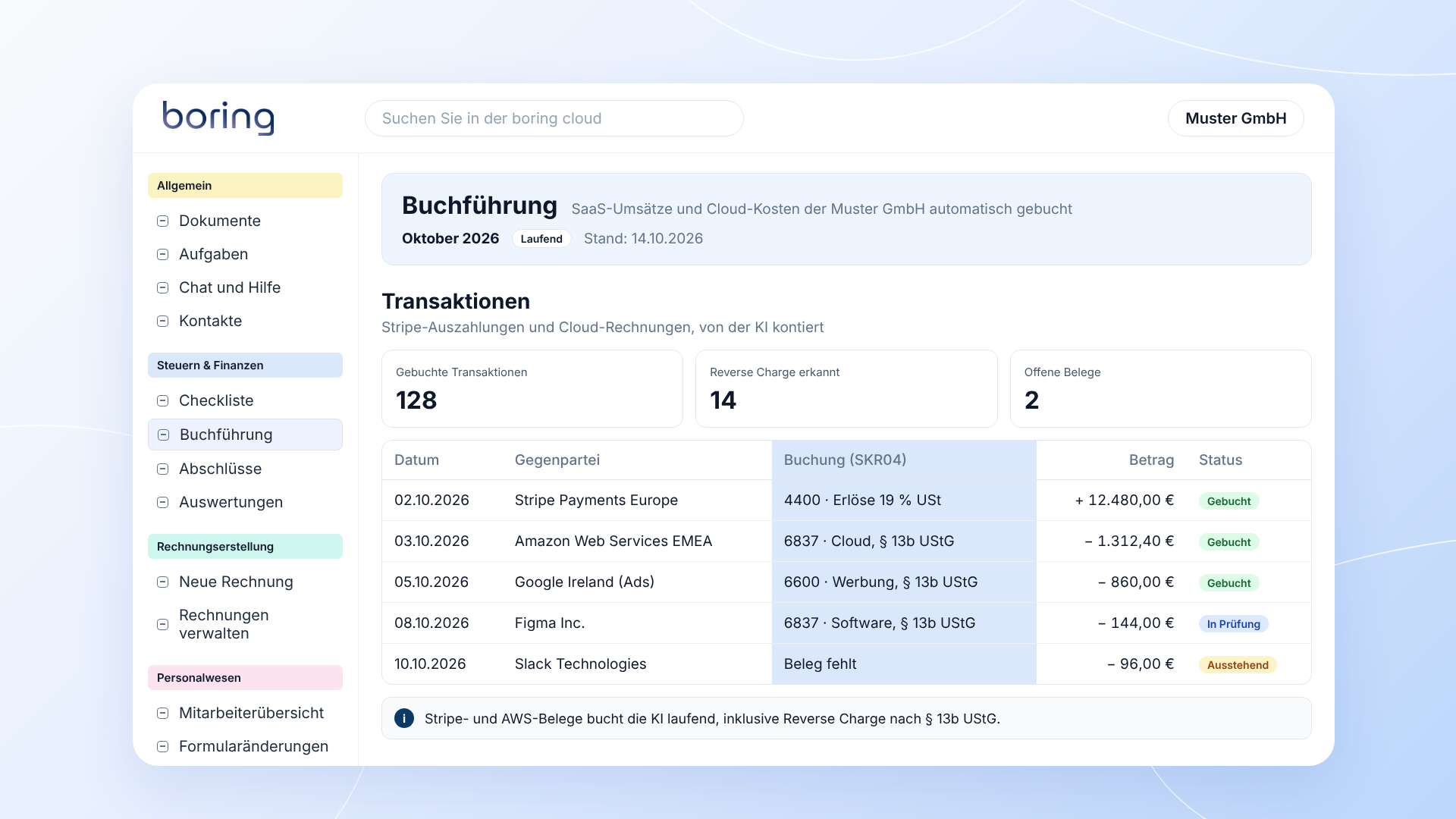
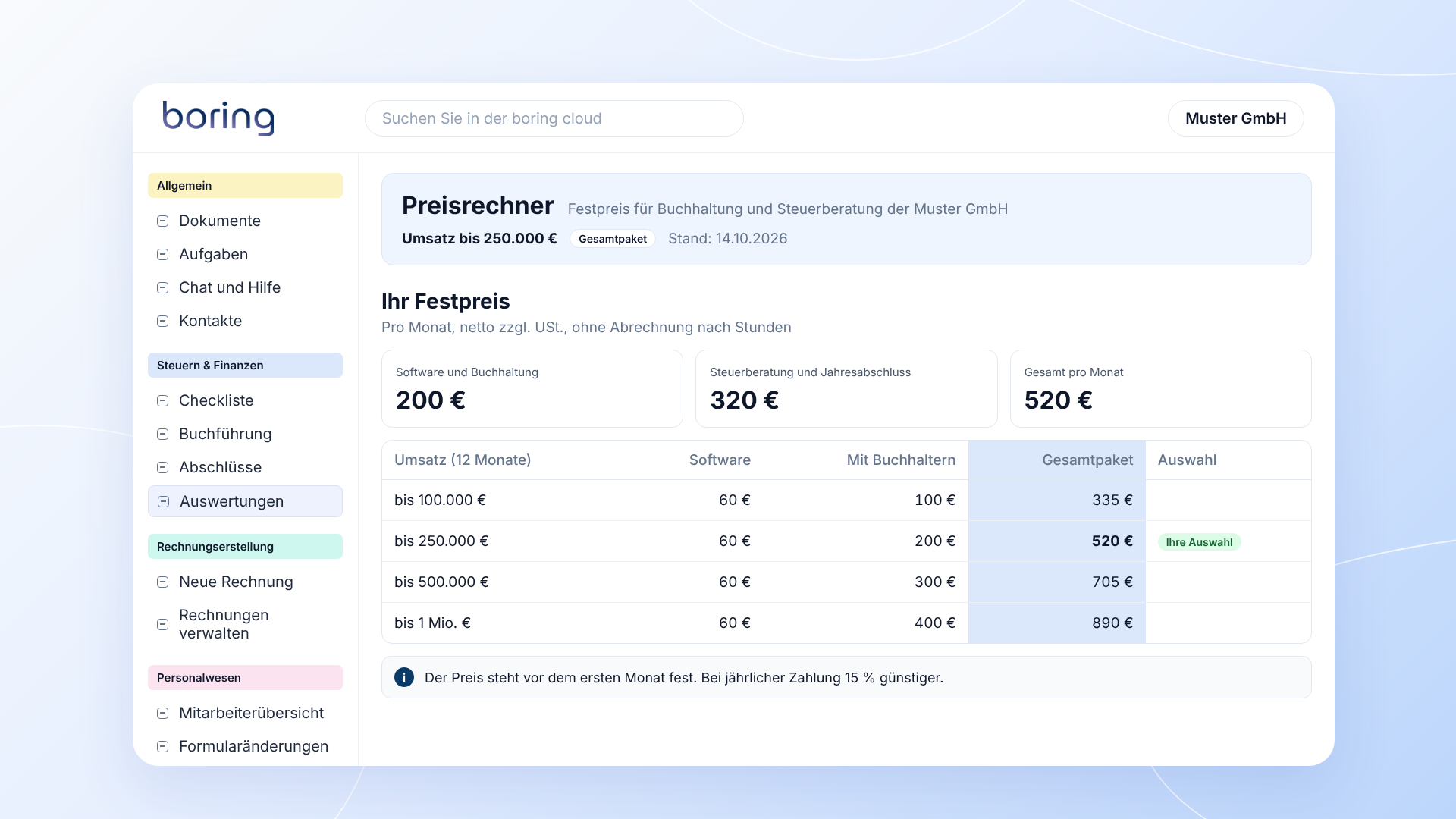
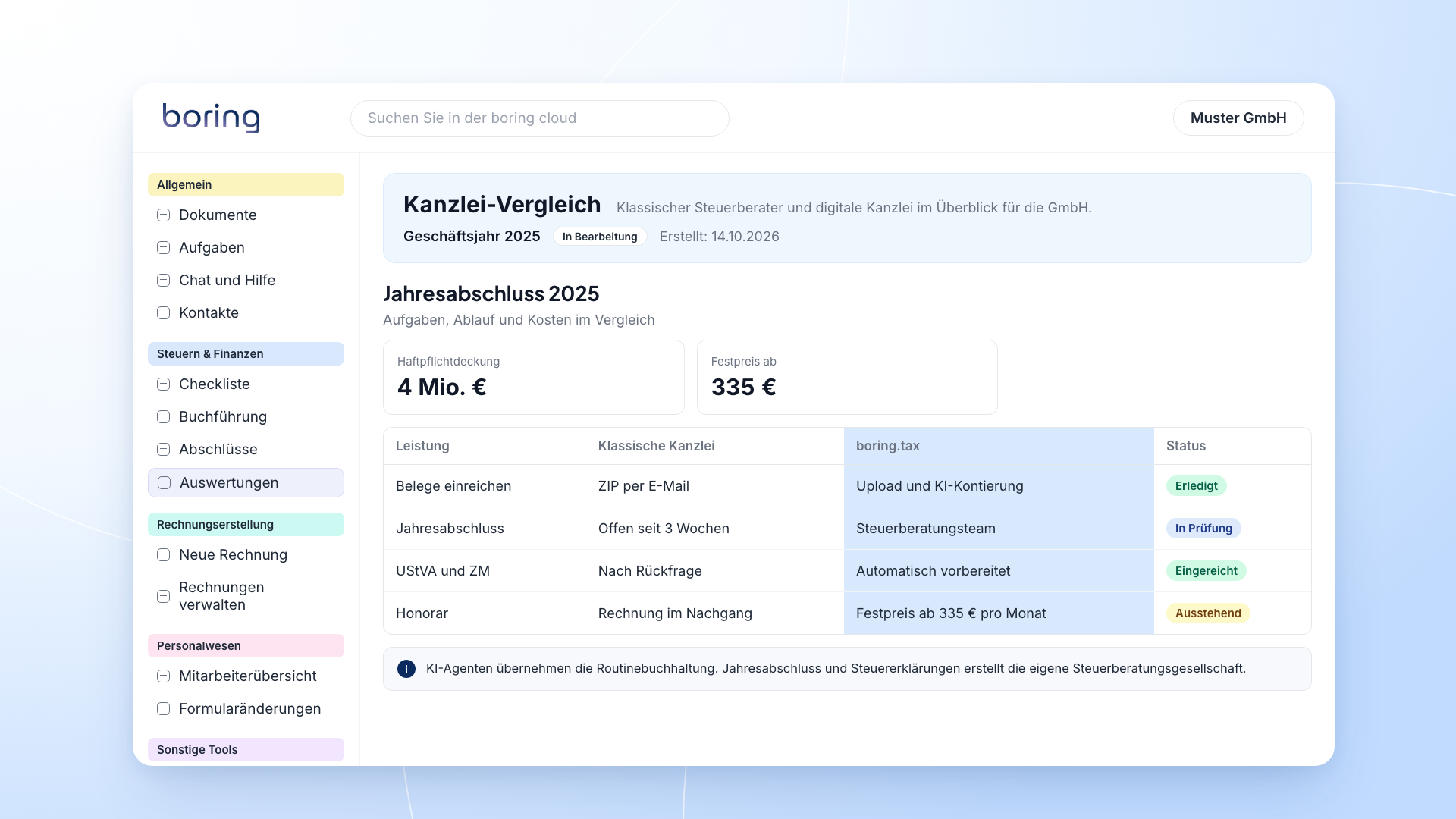
Die kurze Antwort: Für inhabergeführte GmbHs ohne Finanzabteilung passt eine digitale Steuerkanzlei mit festem Preis meist besser, wenn du laufend aktuelle Zahlen, vorab bekannte Kosten und eine haftende Kanzlei in einem Konto willst. Wichtig ist, dass dahinter echte, haftende Steuerberater:innen stehen und nicht nur ein Buchhaltungstool. boring.tax verbindet beides in einem Konto: KI-Agenten übernehmen die Routinebuchhaltung, und die eigene boring.tax Steuerberatungsgesellschaft mbH (4 Mio. EUR Haftpflichtdeckung) übernimmt Jahresabschluss und Steuererklärungen. Das gibt es zu einem öffentlichen Festpreis: ab 60 EUR pro Monat für die Software, ab 335 EUR pro Monat mit Kanzlei und Steuerberater:in (netto, Stand Oktober 2026).
Dieser Artikel zeigt dir, worin sich die Modelle unterscheiden, was eine GmbH wirklich braucht und woran du einen guten Anbieter erkennst. Und für welche GmbHs boring.tax passt und für welche eher eine klassische Kanzlei.
Was ist der Unterschied zwischen klassischem Steuerberater und digitaler Steuerkanzlei?
Eine klassische Steuerkanzlei betreut Mandant:innen überwiegend mit Papier- oder PDF-Belegen, Abrechnung nach der Steuerberatervergütungsverordnung (StBVV) und persönlichen Terminen. Eine digitale Steuerkanzlei erfüllt dieselben gesetzlichen Aufgaben, arbeitet aber mit Belegerfassung per App, Bankanbindung, automatisierter Vorkontierung und meist mit festen Monatspreisen.
Was ist eine digitale Steuerkanzlei?
Eine digitale Steuerkanzlei ist eine zugelassene Steuerberatungskanzlei, die Belege, Bankdaten und Buchungen vollständig digital verarbeitet und Steuererklärungen elektronisch ans Finanzamt übermittelt. Sie unterliegt denselben Berufspflichten wie jede andere Kanzlei: Zulassung durch die Steuerberaterkammer, Verschwiegenheit und Berufshaftpflicht nach dem Steuerberatungsgesetz.
Rechtlich gibt es also keinen Unterschied. Beide sind Steuerberater:innen oder Steuerberatungsgesellschaften, beide dürfen Vorbehaltsaufgaben übernehmen, etwa die Übermittlung von Steuererklärungen, und beide haften über ihre Berufshaftpflicht.
Der Unterschied liegt im Ablauf und im Preismodell. Und genau dort entscheidet sich, wie viel Zeit du als Geschäftsführer:in mit Buchhaltung verbringst.
Eine dritte Gruppe: KI-Buchhaltung ohne Kanzlei
Seit 2024 gibt es zusätzlich Tools, die Buchhaltung per KI erledigen, aber selbst keine Steuerberater sind. Sie buchen, bereiten vor und gleichen ab. Den Jahresabschluss, die Körperschaftsteuer- und Gewerbesteuererklärung und die Beratung übernimmt dann ein Partner oder deine bestehende Kanzlei.
Das ist kein Nachteil an sich. Du solltest nur wissen, welches der drei Modelle du gerade kaufst.
| Modell | Typischer Ablauf | Preislogik | Wer haftet für Steuererklärungen? |
|---|---|---|---|
| Klassische Steuerkanzlei | Belege per Post, PDF oder Upload, Kanzlei bucht nach | StBVV oder individuelle Pauschale | Die Kanzlei |
| Digitale Steuerkanzlei | App, Bankanbindung, automatisierte Vorkontierung | Meist Festpreis pro Monat | Die Kanzlei |
| KI-Buchhaltungstool ohne Kanzlei | KI bucht, du prüfst | Software-Abo | Externer Partner oder deine eigene Kanzlei |
Welche Pflichten muss deine GmbH abdecken, egal bei wem?
Bevor du Anbieter vergleichst, lohnt ein Blick auf die Pflichten. Eine GmbH oder UG ist Kapitalgesellschaft und damit nach § 238 HGB zur doppelten Buchführung verpflichtet. Eine Einnahmen-Überschuss-Rechnung gibt es für dich nicht.
Das gehört zum Pflichtprogramm:
- Laufende Finanzbuchhaltung nach den GoBD, also vollständig, zeitnah und nachvollziehbar.
- Umsatzsteuervoranmeldung (UStVA), die monatliche oder vierteljährliche Meldung der Umsatzsteuer ans Finanzamt, bei EU-Geschäften zusätzlich die Zusammenfassende Meldung.
- Jahresabschluss mit Bilanz, GuV und bei Bedarf Anhang. Die Regelfrist für die Aufstellung beträgt drei Monate nach Geschäftsjahresende. Kleine Kapitalgesellschaften dürfen sich bis zu sechs Monate Zeit nehmen, wenn das einem ordnungsgemäßen Geschäftsgang entspricht (§ 264 Abs. 1 HGB).
- E-Bilanz, die elektronische Übermittlung von Bilanz und GuV ans Finanzamt (§ 5b EStG).
- Körperschaftsteuer- und Gewerbesteuererklärung.
- Offenlegung des Jahresabschlusses im Unternehmensregister, spätestens zwölf Monate nach Geschäftsjahresende (§ 325 HGB).
- Lohnabrechnung, sobald du Mitarbeitende hast.
Die Offenlegung wird gern vergessen, ist aber teuer. Das Bundesamt für Justiz leitet bei verspäteter Offenlegung ein Ordnungsgeldverfahren ein, das Ordnungsgeld beträgt nach § 335 HGB mindestens 2.500 EUR und höchstens 25.000 EUR (§ 335 HGB).
Die genauen Termine hängen davon ab, ob du beraten wirst oder nicht. Eine Übersicht findest du in unserem Artikel zu den Fristen für Kapitalgesellschaften.
Wichtig für deine Entscheidung: Für den Jahresabschluss, die E-Bilanz und die Steuererklärungen brauchst du in der Praxis fast immer Steuerberater:innen. Die Frage ist also selten “Kanzlei ja oder nein”, sondern “welche Kanzlei, und was macht sie selbst”.
Warum ist die Entscheidung für Gründer:innen gerade jetzt so wichtig?
Weil das Angebot an Steuerberater:innen kaum wächst und die Routinearbeit gleichzeitig besser automatisierbar wird. Beides verändert, was du für dein Geld bekommst.
Laut Berufsstatistik der Bundessteuerberaterkammer (BStBK) gab es zum 1.1.2026 bundesweit 89.549 Steuerberater:innen als natürliche Personen, nur 0,6 % mehr als im Vorjahr (BStBK-Berufsstatistik, berichtet von IWW). Die Zahl der Auszubildenden zu Steuerfachangestellten sank laut derselben Statistik um 1,3 % auf 17.081.
Das ist kein Mangel im Sinne eines leeren Marktes, aber ein Markt, der kaum wächst. Wie schnell eine Kanzlei antwortet und ob sie Kapazität für neue Mandate hat, unterscheidet sich von Kanzlei zu Kanzlei. Als Gründer:in solltest du das früh klären, am besten schon vor der ersten Buchung, damit der erste Jahresabschluss nicht an fehlender Kapazität hängt.
Gleichzeitig ist ein großer Teil der Arbeit, für die du bezahlst, Routine: Belege zuordnen, Banktransaktionen abgleichen, Umsatzsteuer vorbereiten. Genau diese Teile lassen sich heute automatisieren.
Wie rechnet eine klassische Kanzlei ab?
Klassische Kanzleien rechnen häufig nach der StBVV ab. Für die laufende Buchführung sieht § 33 StBVV eine Monatsgebühr von 2/10 bis 12/10 einer vollen Gebühr nach Tabelle C vor, abhängig von einem Gegenstandswert wie dem Jahresumsatz (§ 33 StBVV). Jahresabschluss und Steuererklärungen kommen als eigene Positionen dazu.
Das ist legitim und transparent geregelt. Für dich als Geschäftsführer:in ist es trotzdem schwer, die Jahreskosten vorab zu kennen. Viele Kanzleien bieten deshalb Pauschalvereinbarungen an. Frag danach, bevor du unterschreibst.
Wie verändert KI die Arbeit zwischen dir und deiner Steuerkanzlei?
KI übernimmt die Routinebuchhaltung, Steuerberater:innen kümmern sich um Abschluss, Erklärungen und Beratung. So lässt sich die Arbeit sauber aufteilen.
Konkret sieht das so aus:
- Belege kommen von selbst rein. Per E-Mail, WhatsApp, Upload oder direkt aus dem Postfach und aus Kundenportalen.
- Banktransaktionen werden automatisch zugeordnet. Die KI schlägt Konto, Steuerschlüssel und Gegenbuchung vor, du oder die Buchhaltung bestätigen.
- Die UStVA ist vorbereitet, bevor du an die Frist denkst.
- Fehlende Belege fallen sofort auf, nicht erst beim Jahresabschluss im nächsten Sommer.
Seit 2025 kommt ein weiterer Grund dazu: die E-Rechnung im B2B-Bereich. Laut Bundesministerium der Finanzen (BMF-Schreiben vom 15.10.2024) muss jedes inländische Unternehmen seit dem 1.1.2025 E-Rechnungen empfangen können. Ab dem 1.1.2027 müssen Unternehmen mit mehr als 800.000 EUR Vorjahresumsatz E-Rechnungen ausstellen, ab dem 1.1.2028 alle (BMF zur E-Rechnung).
Strukturierte Rechnungsdaten lassen sich viel besser automatisch verbuchen als eingescannte PDFs. Was das für deine GmbH bedeutet, steht in unserem Artikel zur verpflichtenden E-Rechnung.
Was KI nicht ersetzt: die Haftung für Steuererklärungen, die Beurteilung von Sonderfällen und die Beratung zu Gehalt, Gewinnausschüttung oder Holding-Struktur. Dafür brauchst du weiterhin Menschen mit Berufszulassung. Ein gutes Modell gibt dir beides, ohne dass du für die Routine Kanzleistunden bezahlst.
Typische Probleme beim Wechsel und wie du sie löst
Der Wechsel ist meist einfacher als befürchtet. Diese Stolpersteine solltest du aber kennen.
Laufendes Mandat und Kündigungsfrist. Prüf deinen Steuerberatungsvertrag. Der Jahreswechsel ist der sauberste Zeitpunkt, ein Wechsel unter dem Jahr funktioniert aber auch, wenn Eröffnungsbilanz und Saldenvorträge klar übergeben werden.
Offener Jahresabschluss. Kläre, wer den letzten Abschluss macht. Oft schließt die alte Kanzlei das Vorjahr ab, und die neue übernimmt ab dem neuen Geschäftsjahr.
Datenübernahme. Viele Kanzleien arbeiten mit DATEV. Lass dir den DATEV-Export, die Summen- und Saldenliste, die Offene-Posten-Listen und die Kontenpläne geben. Damit startet die neue Buchhaltung mit korrekten Anfangsbeständen, und Forderungen oder Verbindlichkeiten aus dem Vorjahr gehen nicht verloren.
Vollmachten beim Finanzamt. Die neue Kanzlei braucht eine Vollmacht im Vollmachtsdatenbank-Verfahren, die alte wird widerrufen. Das ist Formsache, sollte aber vor der nächsten Frist erledigt sein.
Die Sorge, Kontrolle abzugeben. Bei digitalen Modellen siehst du deine Zahlen meist in Echtzeit, statt auf die nächste BWA zu warten. Achte darauf, dass nichts ohne deine Freigabe ans Finanzamt geht.
Wie bewertest du eine Steuerkanzlei für deine GmbH?
Mit klaren Kriterien statt mit dem Bauchgefühl aus dem Erstgespräch. Diese sieben Punkte trennen gute von mittelmäßigen Angeboten.
- Haftung und Berufszulassung. Wer übermittelt deine Steuererklärungen, und unter wessen Berufshaftpflicht? Bei Tools ohne eigene Kanzlei steht hier ein Partner, den du kennen solltest.
- Preis vorab kennen. Gibt es einen öffentlichen Preis oder einen Preisrechner? Oder erfährst du die Kosten erst mit der ersten Rechnung?
- Umfang schriftlich. Sind Jahresabschluss, E-Bilanz, KSt- und GewSt-Erklärung und Offenlegung im Preis enthalten? Was kostet Lohn pro Mitarbeitendem?
- Tempo. Wie schnell sind Belege gebucht und Fragen beantwortet? Ein Monatsabschluss bis Mitte des Folgemonats ist ein guter Richtwert.
- Datenzugang für dich. Siehst du BWA, Summen- und Saldenliste und offene Posten jederzeit selbst?
- Flexibilität. Kannst du mehr oder weniger Unterstützung buchen, ohne Anbieter und Daten zu wechseln? Gerade nach der Gründung ändert sich der Bedarf schnell.
- Holding und operative GmbH. Wenn du eine Holding hast oder planst: Werden beide Gesellschaften aus einer Hand betreut?
Teste das Angebot nach Möglichkeit mit deinen eigenen Zahlen. Eine Demo mit Beispieldaten sagt wenig darüber, wie gut die Belegzuordnung bei deinen Lieferanten funktioniert.
So sieht es in der Praxis aus: ein Beispiel
Beispiel: Eine Beratungs-GmbH mit 400.000 EUR Jahresumsatz, sechs Mitarbeitenden und einer Holding, die 100 % der Anteile hält. Bisher betreut von einer klassischen Kanzlei, die Belege gehen monatlich als PDF-Sammlung raus.
Vorher (typische Erfahrung, kein Messwert): Die Geschäftsführerin sammelt am Monatsende Belege aus drei Postfächern, zwei Kundenportalen und der Firmenkreditkarte. Die BWA kommt oft erst Wochen später. Für den Jahresabschluss gibt es Rückfragen zu Belegen aus dem Frühjahr, die niemand mehr findet. Die Jahreskosten schwanken, weil Zusatzarbeiten einzeln abgerechnet werden.
Nachher (digitales Modell mit eigener Kanzlei): Belege landen automatisch in der Buchhaltung, fehlende werden sofort angemahnt. Die UStVA ist vor der Frist vorbereitet, das Steuerberatungsteam prüft und übermittelt. Der Jahresabschluss für GmbH und Holding entsteht aus denselben Daten.
Die Kosten in diesem Beispiel, bei boring.tax nach öffentlicher Preisliste (netto, Stand Oktober 2026). Mit 400.000 EUR Jahresumsatz liegt die GmbH in der Umsatzklasse bis 500.000 EUR, für die das Gesamtpaket 705 EUR pro Monat kostet:
| Position | Preis |
|---|---|
| Gesamtpaket mit Kanzlei und Steuerberater:in, Umsatz bis 500.000 EUR | 705 EUR pro Monat |
| Lohn für 6 Mitarbeitende (je 20 EUR) | 120 EUR pro Monat |
| Holding, eine Beteiligung | 500 EUR pro Jahr |
| Summe pro Jahr | 10.400 EUR |
Im Gesamtpaket enthalten sind Buchhaltung, Übermittlung der UStVA, Jahresabschluss, KSt- und GewSt-Erklärung, E-Bilanz und Beratung. Du arbeitest in einem Konto mit einer Oberfläche, bekommst aber zwei Rechnungen: eine von boring.tax für die Software und eine von der boring.tax Steuerberatungsgesellschaft mbH für die Steuerberatung. Der Grund ist, dass beide Leistungen von zwei getrennten Gesellschaften erbracht werden. Die Summe der beiden Rechnungen entspricht dem Preis aus der Tabelle. Den aktuellen Preis für deine Umsatzklasse findest du im Preisrechner.
Vergleich: Welches Modell passt zu deiner GmbH?
Für inhabergeführte GmbHs zwischen 250.000 und 2 Mio. EUR Umsatz ohne eigene Finanzabteilung sieht der Vergleich so aus. Die Tabelle ist eine allgemeine Markteinschätzung mit Stand Oktober 2026, keine Aussage über einzelne Anbieter. Einzelne Kanzleien und Tools weichen ab, prüf deshalb immer das konkrete Angebot.
| Kriterium | boring.tax | Klassische Kanzlei | DIY-Software plus Kanzlei | KI-Tool mit Partnerkanzlei | Digitale Kanzlei ohne Software-Stufe |
|---|---|---|---|---|---|
| Wer bucht? | KI-Agent, wahlweise mit boring-Buchhalter:innen | Kanzlei | Du selbst | KI, du prüfst | Kanzlei mit Software |
| Eigene, haftende Kanzlei | Ja, im selben Konto | Ja | Extern, über die gewählte Kanzlei | Über einen Partner | Ja |
| Preis öffentlich | Ja, mit Preisrechner | Selten | Software meist ja, Kanzlei selten | Meist ja | Oft auf Anfrage |
| Stufe wechseln ohne Datenmigration | Ja, im selben Konto | Meist nicht vorgesehen | Je nach Kombination unterschiedlich | Je nach Partner unterschiedlich | Je nach Anbieter unterschiedlich |
| Holding und operative GmbH aus einer Hand | Ja | Meist ja | Abhängig von der Kanzlei | Abhängig vom Partner | Abhängig vom Anbieter |
| Test mit eigenen Zahlen | 14 Tage, ohne Kreditkarte (Details im Preisrechner) | Selten | Meist ja | Meist ja | Selten |
Ehrlich gesagt: Bei sehr kleinem Volumen sind reine KI-Buchhaltungstools teils günstiger. Sobald du aber Jahresabschluss, Steuererklärungen und Beratung brauchst, also ab dem ersten Geschäftsjahr, zählt das Gesamtpaket. Und dort entscheidet, ob Software und haftende Kanzlei zusammengehören oder ob du zwei Anbieter koordinierst.
Wo sich boring.tax von einer klassischen Kanzlei unterscheidet
Im direkten Vergleich mit einer klassischen Kanzlei unterscheidet sich boring.tax an vier Stellen, die du jeden Monat spürst.
1. Tempo: aktueller Buchungsstand statt Warten auf die BWA. Bei klassischen Kanzleien kommt die BWA nach typischer Erfahrung oft erst Wochen nach Monatsende; wie schnell, hängt stark von Kanzlei und Belegeingang ab. Bei boring.tax werden Belege und Banktransaktionen laufend vorkontiert. Du siehst den aktuellen Buchungsstand jederzeit selbst, ohne auf die nächste BWA zu warten, und die UStVA ist vorbereitet, bevor die Frist näher rückt.
2. Kosten: vorher bekannt statt hinterher überrascht. Bei der Abrechnung nach StBVV hängen die Kosten von Gegenstandswerten und Zusatzpositionen ab. boring.tax hat einen öffentlichen Festpreis: ab 60 EUR pro Monat für die Software, ab 100 EUR mit boring-Buchhalter:innen, ab 335 EUR mit Kanzlei und Steuerberater:in. Im Beispiel oben sind das 10.400 EUR im Jahr für GmbH, Holding und sechs Mitarbeitende, ohne nachträgliche Einzelpositionen.
3. Funktionen: ein Konto statt zwei Anbieter. Software, Buchhaltung und haftende Steuerkanzlei sind bei boring.tax in einem Konto zusammengeführt. Du wechselst die Stufe, ohne Daten zu migrieren. Holding und operative GmbH laufen aus einer Hand. Die UStVA geht mit eigener Hersteller-ID direkt an ELSTER.
4. Zeit: Belege sammeln fällt weg. Statt am Monatsende Belege aus Postfächern, Kundenportalen und Kreditkartenabrechnungen zusammenzusuchen, landen sie automatisch in der Buchhaltung. Fehlende Belege werden sofort angemahnt, nicht erst Monate später beim Jahresabschluss. Für viele Geschäftsführer:innen ist das ein spürbarer Teil des monatlichen Aufwands.
| Dimension | Klassische Kanzlei | boring.tax |
|---|---|---|
| Aktuelle Zahlen | BWA häufig Wochen nach Monatsende (typische Erfahrung) | Laufend, jederzeit einsehbar |
| Preis | StBVV oder Pauschale auf Anfrage | Öffentlich, ab 60 EUR pro Monat |
| Software und Kanzlei | Meist getrennt | Im selben Konto |
| Belege sammeln | Du schickst sie gesammelt | Kommen automatisch rein |
Wann passt eine klassische Kanzlei besser?
Eine klassische Kanzlei kann die bessere Lösung sein, wenn du komplexe Konzernstrukturen oder internationale Sachverhalte hast und eine Kanzlei mit passender Spezialisierung brauchst. Das Gleiche gilt, wenn dir persönliche Termine vor Ort wichtig sind oder wenn deine bestehende Kanzlei schnell, transparent und zu einem Preis arbeitet, den du kennst. Dann spricht wenig für einen Wechsel.
So unterstützt dich boring.tax
boring.tax ist für genau diese Lage gebaut: GmbHs und UGs, oft mit Holding, ohne Finanzabteilung. Du wählst, wie viel menschliche Hilfe du willst, und kannst jederzeit im selben Konto wechseln.
- Ohne Kanzlei (ab 60 EUR pro Monat): Der KI-Agent bucht, du prüfst und gibst frei. Die UStVA bereitest du in boring vor und übermittelst sie selbst an ELSTER. Das ist Software, keine Steuerberatung.
- Mit boring-Buchhalter:innen (ab 100 EUR pro Monat): Menschen prüfen die Buchhaltung und erstellen einen geprüften Monatsabschluss.
- Mit Kanzlei und Steuerberater:in (ab 335 EUR pro Monat): Die boring.tax Steuerberatungsgesellschaft mbH übernimmt UStVA-Übermittlung, Jahresabschluss, KSt- und GewSt-Erklärung, E-Bilanz und Beratung.
Ein paar Fakten dazu: Die UStVA geht seit Juli 2026 direkt an ELSTER, mit eigener Hersteller-ID. Die Daten liegen in Deutschland. Und nichts geht ans Finanzamt, ohne dass du oder das Steuerberatungsteam es freigegeben habt. Wie die Übermittlung im Detail abläuft, zeigt der Artikel UStVA in boring vorbereiten und ans Finanzamt übermitteln. Welche Leistungen in welcher Stufe enthalten sind, siehst du auf der Preisseite.
Gut zu wissen: Den Jahresabschluss erstellt das Steuerberatungsteam auf Basis deiner Buchhaltung in boring. Wenn du deine bisherige Kanzlei behalten willst, geht das auch. Du nutzt dann die Software-Stufe und gibst deiner Kanzlei Zugriff.
Häufige Fragen
Braucht eine GmbH zwingend einen Steuerberater? Nein, gesetzlich ist das keine Pflicht. In der Praxis erstellen aber fast alle GmbHs Jahresabschluss, E-Bilanz und Steuererklärungen mit Steuerberater:innen, weil der Aufwand und das Haftungsrisiko für Geschäftsführer:innen sonst hoch sind.
Ist eine digitale Steuerkanzlei genauso sicher wie eine klassische? Das hängt weniger vom Modell ab als vom einzelnen Anbieter, und du kannst es prüfen. Beim Datenschutz solltest du einen Auftragsverarbeitungsvertrag nach Art. 28 DSGVO verlangen und fragen, wo die Daten gehostet werden (idealerweise in Deutschland oder der EU). Beim Zugriffsschutz zählen ein Rollen- und Rechtekonzept, Zwei-Faktor-Authentifizierung und die Frage, wer im Anbieterteam auf deine Daten zugreifen darf. Rechtlich gelten für digitale und klassische Kanzleien dieselben Regeln: Zulassung durch die Steuerberaterkammer, Verschwiegenheitspflicht und Berufshaftpflicht. Prüf im Zweifel das Steuerberaterverzeichnis der Bundessteuerberaterkammer und frag nach der Deckungssumme.
Was ist der Unterschied zwischen einer digitalen Steuerkanzlei und einer Buchhaltungssoftware? Eine Software unterstützt dich beim Buchen, eine Steuerkanzlei übernimmt Vorbehaltsaufgaben wie Steuererklärungen und haftet dafür. Viele KI-Buchhaltungstools sind keine Steuerberater und arbeiten für Jahresabschluss und Erklärungen mit Partnern zusammen.
Wann ist der beste Zeitpunkt, die Steuerkanzlei zu wechseln? Am einfachsten zum Jahreswechsel, weil das neue Geschäftsjahr dann sauber startet. Ein Wechsel unter dem Jahr geht auch, wenn die alte Kanzlei Saldenvorträge und den DATEV-Export übergibt.
Was kostet eine Steuerkanzlei für eine GmbH pro Jahr? Eine pauschale Spanne wäre irreführend, weil die Kosten stark von deinem Fall abhängen. Bei klassischen Kanzleien bestimmen vor allem der Gegenstandswert (meist der Jahresumsatz) nach § 33 StBVV, das Buchungsvolumen, die Belegqualität, die Zahl der Mitarbeitenden und die Zusatzleistungen wie Jahresabschluss und Steuererklärungen die Rechnung. Digitale Anbieter rechnen meist zu Festpreisen pro Monat, die an Umsatzklasse und Leistungsumfang hängen. Zur Orientierung ein Beispiel, kein Marktdurchschnitt: Bei boring.tax kostet das Gesamtpaket für eine GmbH mit 400.000 EUR Umsatz, sechs Mitarbeitenden und Holding 10.400 EUR netto im Jahr (Stand Oktober 2026). Hol dir für den Vergleich von jeder Kanzlei ein schriftliches Angebot mit denselben Eckdaten.
Kann ich Holding und operative GmbH bei verschiedenen Kanzleien lassen? Ja, aber du verlierst dabei Übersicht. Beteiligungserträge, Gewinnausschüttungen und Verrechnungskonten betreffen beide Gesellschaften. Aus einer Hand lassen sie sich leichter abstimmen.
Kann ich mit boring.tax starten und die Kanzlei später dazubuchen? Ja. Du startest in der Software-Stufe ab 60 EUR pro Monat und wechselst später im selben Konto zu Buchhalter:innen oder Kanzlei. Deine Daten bleiben, wo sie sind, eine Migration ist nicht nötig.
Bereit, es auszuprobieren?
Wenn du zwischen klassischem Steuerberater und digitaler Steuerkanzlei schwankst, teste es auf deinen eigenen Zahlen. Verbinde dein Bankkonto, lade ein paar Belege hoch und schau, wie die Buchhaltung aussieht, bevor du irgendetwas kündigst.
Die Kanzlei kannst du jederzeit dazubuchen. Oder du startest gleich mit dem Gesamtpaket.
Belege rein. Steuerkanzlei dazu. So soll Steuer sein: boring.
Noch kein boring.tax-Kunde? Jetzt kostenlos starten →
Traditional Tax Advisor or Digital Tax Firm for Your GmbH?
Traditional tax advisor or digital tax firm like boring.tax: when your firm hasn’t replied in three weeks, many managing directors of a GmbH start asking which model fits better. The 2025 annual financial statements are somewhere in the pile. You send your receipts as a ZIP file, and the invoice arrives later, with line items you don’t quite understand. Maybe you have just founded your company and wonder whether your GmbH needs a traditional firm at all.
The short answer: for owner-managed GmbHs without a finance department, a digital tax firm with a fixed price usually fits better if you want up-to-date numbers, costs you know in advance, and a liable firm in one account. What matters is that real, liable tax advisors stand behind it and not just an accounting tool. boring.tax combines both in one account: AI agents handle routine bookkeeping, and the in-house boring.tax Steuerberatungsgesellschaft mbH (EUR 4 million professional liability coverage) handles annual financial statements and tax returns. All of it comes at a public fixed price: from EUR 60 per month for the software, from EUR 335 per month with a tax firm and tax advisor (net, as of October 2026).
This article shows you how the models differ, what a GmbH really needs, and how to recognize a good provider. It also covers which GmbHs boring.tax suits and which are better off with a traditional firm.
What is the difference between a traditional tax advisor and a digital tax firm?
A traditional tax firm mostly works with clients using paper or PDF receipts, bills under the German tax advisor fee ordinance (StBVV), and holds in-person meetings. A digital tax firm fulfills the same legal duties, but works with receipt capture via app, bank connection, automated pre-coding, and usually fixed monthly prices.
What is a digital tax firm?
A digital tax firm is a licensed tax advisory firm that processes receipts, bank data, and bookings entirely digitally and submits tax returns electronically to the tax office. It is subject to the same professional duties as any other firm: licensing by the tax advisor chamber, confidentiality, and professional liability insurance under the German Tax Advisory Act.
Legally, then, there is no difference. Both are tax advisors or tax advisory companies, both may carry out reserved tasks such as submitting tax returns, and both are liable through their professional liability insurance.
The difference lies in the workflow and the pricing model. And that is exactly where it is decided how much time you spend on bookkeeping as a managing director.
A third group: AI bookkeeping without a firm
Since 2024 there have also been tools that do bookkeeping with AI but are not tax advisors themselves. They book, prepare, and reconcile. The annual financial statements, the corporate income tax and trade tax returns, and the advice are then handled by a partner or your existing firm.
That is not a disadvantage in itself. You just need to know which of the three models you are buying.
| Model | Typical workflow | Pricing logic | Who is liable for tax returns? |
|---|---|---|---|
| Traditional tax firm | Receipts by post, PDF or upload, firm books afterwards | StBVV or individual flat fee | The firm |
| Digital tax firm | App, bank connection, automated pre-coding | Usually a fixed monthly price | The firm |
| AI bookkeeping tool without a firm | AI books, you review | Software subscription | External partner or your own firm |
Which obligations does your GmbH have to meet, no matter who helps?
Before you compare providers, it is worth looking at the obligations. A GmbH or UG is a corporation and is therefore required to keep double-entry books under section 238 of the German Commercial Code (HGB). A cash-basis profit calculation is not available to you.
This is the mandatory program:
- Ongoing bookkeeping in line with the GoBD, meaning complete, timely, and traceable.
- VAT return (UStVA), the monthly or quarterly VAT filing to the tax office, plus the EC Sales List for EU business.
- Annual financial statements with balance sheet, profit and loss statement, and notes where required. The standard deadline for preparing them is three months after the end of the financial year. Small corporations may take up to six months if that is consistent with proper business practice (section 264 (1) HGB).
- E-balance sheet, the electronic submission of balance sheet and profit and loss statement to the tax office (section 5b EStG).
- Corporate income tax and trade tax returns.
- Publication of the annual financial statements in the Unternehmensregister (German company register), no later than twelve months after the end of the financial year (section 325 HGB).
- Payroll, as soon as you have employees.
Publication is easily forgotten, but it is expensive. If you publish late, the Federal Office of Justice starts a fine proceeding, and under section 335 HGB the fine is at least EUR 2,500 and at most EUR 25,000 (§ 335 HGB).
The exact deadlines depend on whether you have an advisor or not. You can find an overview in our article on deadlines for corporations.
Important for your decision: for the annual financial statements, the e-balance sheet, and the tax returns you almost always need tax advisors in practice. So the question is rarely “firm or no firm”, but “which firm, and what does it do itself”.
Why is this decision so important for founders right now?
Because the supply of tax advisors is barely growing, while routine work is becoming easier to automate at the same time. Both change what you get for your money.
According to the professional statistics of the German Federal Chamber of Tax Advisors (BStBK), there were 89,549 tax advisors as natural persons nationwide on 1 January 2026, only 0.6% more than the year before (BStBK professional statistics, reported by IWW). According to the same statistics, the number of trainees to become tax assistants fell by 1.3% to 17,081.
That is not a shortage in the sense of an empty market, but it is a market that barely grows. How quickly a firm replies and whether it has capacity for new clients differs from firm to firm. As a founder you should clarify this early, ideally before your first booking, so that your first annual financial statements don’t depend on missing capacity.
At the same time, a large part of the work you pay for is routine: assigning receipts, reconciling bank transactions, preparing VAT. These are exactly the parts that can be automated today.
How does a traditional firm bill?
Traditional firms often bill under the StBVV. For ongoing bookkeeping, section 33 StBVV provides a monthly fee of 2/10 to 12/10 of a full fee under table C, depending on a value of the matter such as annual revenue (§ 33 StBVV). Annual financial statements and tax returns are added as separate items.
That is legitimate and transparently regulated. Still, it is hard for you as a managing director to know the annual costs in advance. Many firms therefore offer flat-fee agreements. Ask about that before you sign.
How does AI change the work between you and your tax firm?
AI takes over routine bookkeeping, while tax advisors take care of the closing, returns, and advice. This is a clean way to split the work.
In concrete terms, it looks like this:
- Receipts arrive on their own. By email, WhatsApp, upload, or straight from your inbox and customer portals.
- Bank transactions are matched automatically. The AI suggests the account, tax code, and counter-entry, and you or the bookkeeping team confirm.
- The VAT return is prepared before you even think about the deadline.
- Missing receipts stand out immediately, not only at the annual closing next summer.
Since 2025 there is another reason: B2B e-invoicing. According to the Federal Ministry of Finance (BMF letter of 15 October 2024), every domestic business has had to be able to receive e-invoices since 1 January 2025. From 1 January 2027, businesses with prior-year revenue above EUR 800,000 must issue e-invoices, and from 1 January 2028 all businesses must (BMF on e-invoicing).
Structured invoice data can be booked automatically far better than scanned PDFs. What this means for your GmbH is covered in our article on mandatory e-invoicing.
What AI does not replace: liability for tax returns, the assessment of special cases, and advice on salary, profit distribution, or holding structure. For that you still need people with a professional license. A good model gives you both, without you paying for firm hours on routine work.
Typical problems when switching, and how to solve them
Switching is usually easier than feared. But you should know these stumbling blocks.
Existing engagement and notice period. Check your tax advisory contract. The turn of the year is the cleanest time, but switching mid-year also works if the opening balance sheet and balance carryforwards are handed over clearly.
Open annual financial statements. Clarify who prepares the last statements. Often the old firm closes the prior year, and the new one takes over from the new financial year.
Data transfer. Many firms work with DATEV. Ask for the DATEV export, the trial balance, the open item lists, and the charts of accounts. This lets the new bookkeeping start with correct opening balances, and receivables or liabilities from the prior year are not lost.
Powers of attorney with the tax office. The new firm needs a power of attorney in the power-of-attorney database procedure, and the old one is revoked. This is a formality, but it should be done before the next deadline.
The worry of giving up control. With digital models you usually see your numbers in real time instead of waiting for the next management report (BWA). Make sure nothing goes to the tax office without your approval.
How do you evaluate a tax firm for your GmbH?
With clear criteria instead of the gut feeling from the first call. These seven points separate good offers from mediocre ones.
- Liability and professional license. Who submits your tax returns, and under whose professional liability insurance? With tools that have no firm of their own, there is a partner here that you should get to know.
- Know the price upfront. Is there a public price or a price calculator? Or do you only learn the cost with the first invoice?
- Scope in writing. Are annual financial statements, e-balance sheet, corporate and trade tax returns, and publication included in the price? What does payroll cost per employee?
- Speed. How quickly are receipts booked and questions answered? A monthly closing by the middle of the following month is a good benchmark.
- Data access for you. Can you see the BWA, trial balance, and open items yourself at any time?
- Flexibility. Can you book more or less support without changing provider and data? Right after founding, your needs change quickly.
- Holding and operating GmbH. If you have a holding or plan one: are both companies handled by one provider?
If possible, test the offer with your own numbers. A demo with sample data says little about how well receipt matching works with your suppliers.
What it looks like in practice: an example
Example: A consulting GmbH with EUR 400,000 in annual revenue, six employees, and a holding that owns 100% of the shares. Previously handled by a traditional firm, with receipts sent out monthly as a PDF collection.
Before (typical experience, not a measured value): The managing director collects receipts at the end of the month from three inboxes, two customer portals, and the company credit card. The BWA often arrives only weeks later. For the annual financial statements there are queries about receipts from the spring that nobody can find anymore. Annual costs fluctuate because additional work is billed item by item.
After (digital model with its own firm): Receipts land in the bookkeeping automatically, and missing ones are chased immediately. The VAT return is prepared before the deadline, and the tax advisory team reviews and submits it. The annual financial statements for the GmbH and the holding are produced from the same data.
The costs in this example, at boring.tax according to the public price list (net, as of October 2026). With EUR 400,000 in annual revenue, the GmbH falls into the revenue bracket up to EUR 500,000, for which the full package costs EUR 705 per month:
| Item | Price |
|---|---|
| Full package with firm and tax advisor, revenue up to EUR 500,000 | EUR 705 per month |
| Payroll for 6 employees (EUR 20 each) | EUR 120 per month |
| Holding, one participation | EUR 500 per year |
| Total per year | EUR 10,400 |
The full package includes bookkeeping, VAT return submission, annual financial statements, corporate and trade tax returns, e-balance sheet, and advice. You work in one account with one interface, but you receive two invoices: one from boring.tax for the software and one from boring.tax Steuerberatungsgesellschaft mbH for the tax advisory. The reason is that the two services are provided by two separate companies. The sum of the two invoices matches the price in the table. You can find the current price for your revenue bracket in the price calculator.
Comparison: which model fits your GmbH?
For owner-managed GmbHs with revenue between EUR 250,000 and EUR 2 million and no finance department of their own, the comparison looks like this. The table is a general market assessment as of October 2026, not a statement about individual providers. Individual firms and tools differ, so always check the specific offer.
| Criterion | boring.tax | Traditional firm | DIY software plus firm | AI tool with partner firm | Digital firm without a software tier |
|---|---|---|---|---|---|
| Who books? | AI agent, optionally with boring bookkeepers | Firm | You yourself | AI, you review | Firm with software |
| Own liable firm | Yes, in the same account | Yes | External, via the firm you choose | Via a partner | Yes |
| Public price | Yes, with price calculator | Rarely | Software usually yes, firm rarely | Usually yes | Often on request |
| Change tier without data migration | Yes, in the same account | Usually not provided | Varies by combination | Varies by partner | Varies by provider |
| Holding and operating GmbH from one source | Yes | Usually yes | Depends on the firm | Depends on the partner | Depends on the provider |
| Test with your own numbers | 14 days, no credit card (details in the price calculator) | Rarely | Usually yes | Usually yes | Rarely |
To be honest: at very small volumes, pure AI bookkeeping tools are sometimes cheaper. But as soon as you need annual financial statements, tax returns, and advice, meaning from the first financial year on, the full package counts. And what decides it there is whether software and a liable firm belong together or whether you coordinate two providers.
Where boring.tax differs from a traditional firm
Compared directly with a traditional firm, boring.tax differs in four places that you feel every month.
1. Speed: a current booking status instead of waiting for the BWA. With traditional firms, the BWA often arrives only weeks after month-end, in typical experience; how fast depends heavily on the firm and receipt intake. At boring.tax, receipts and bank transactions are pre-coded continuously. You can see the current booking status yourself at any time, without waiting for the next BWA, and the VAT return is prepared before the deadline gets close.
2. Costs: known in advance instead of surprised afterwards. When billing under the StBVV, costs depend on values of the matter and additional items. boring.tax has a public fixed price: from EUR 60 per month for the software, from EUR 100 with boring bookkeepers, from EUR 335 with a firm and tax advisor. In the example above, that is EUR 10,400 a year for a GmbH, a holding, and six employees, with no extra items added afterwards.
3. Features: one account instead of two providers. At boring.tax, software, bookkeeping, and a liable tax firm are combined in one account. You change tiers without migrating data. The holding and the operating GmbH run from one source. The VAT return goes straight to ELSTER with our own manufacturer ID.
4. Time: no more collecting receipts. Instead of hunting for receipts in inboxes, customer portals, and credit card statements at month-end, they land in the bookkeeping automatically. Missing receipts are chased immediately, not months later at the annual closing. For many managing directors, this is a noticeable part of their monthly effort.
| Dimension | Traditional firm | boring.tax |
|---|---|---|
| Current numbers | BWA often weeks after month-end (typical experience) | Continuous, viewable at any time |
| Price | StBVV or flat fee on request | Public, from EUR 60 per month |
| Software and firm | Usually separate | In the same account |
| Collecting receipts | You send them in batches | They arrive automatically |
When does a traditional firm fit better?
A traditional firm can be the better solution if you have complex group structures or international matters and need a firm with the right specialization. The same applies if in-person meetings on site matter to you, or if your existing firm works quickly, transparently, and at a price you know. Then there is little reason to switch.
How boring.tax supports you
boring.tax is built for exactly this situation: GmbHs and UGs, often with a holding, without a finance department. You choose how much human help you want, and you can switch at any time in the same account.
- Without a firm (from EUR 60 per month): The AI agent books, you review and approve. You prepare the VAT return in boring and submit it to ELSTER yourself. This is software, not tax advice.
- With boring bookkeepers (from EUR 100 per month): People review the bookkeeping and create a reviewed monthly closing.
- With a firm and tax advisor (from EUR 335 per month): boring.tax Steuerberatungsgesellschaft mbH handles VAT return submission, annual financial statements, corporate and trade tax returns, e-balance sheet, and advice.
A few facts on this: since July 2026, the VAT return goes straight to ELSTER with our own manufacturer ID. The data is stored in Germany. And nothing goes to the tax office unless you or the tax advisory team have approved it. How the submission works in detail is shown in the article Preparing a VAT return in boring and submitting it to the tax office. You can see which services are included in which tier on the pricing page.
Good to know: the tax advisory team prepares the annual financial statements based on your bookkeeping in boring. If you want to keep your current firm, that works too. You then use the software tier and give your firm access.
FAQ
Does a GmbH absolutely need a tax advisor? No, it is not a legal requirement. In practice, though, almost all GmbHs prepare annual financial statements, the e-balance sheet, and tax returns with tax advisors, because otherwise the effort and the liability risk for managing directors are high.
Is a digital tax firm as secure as a traditional one? That depends less on the model than on the individual provider, and you can check it. For data protection, you should ask for a data processing agreement under Art. 28 GDPR and ask where the data is hosted (ideally in Germany or the EU). For access protection, a roles and permissions concept, two-factor authentication, and the question of who on the provider’s team may access your data all count. Legally, the same rules apply to digital and traditional firms: licensing by the tax advisor chamber, confidentiality duty, and professional liability insurance. If in doubt, check the tax advisor directory of the Federal Chamber of Tax Advisors and ask about the coverage amount.
What is the difference between a digital tax firm and accounting software? Software supports you with bookkeeping, while a tax firm takes over reserved tasks such as tax returns and is liable for them. Many AI bookkeeping tools are not tax advisors and work with partners for annual financial statements and returns.
When is the best time to switch tax firms? Most simply at the turn of the year, because the new financial year then starts cleanly. Switching mid-year also works if the old firm hands over balance carryforwards and the DATEV export.
What does a tax firm cost for a GmbH per year? A flat range would be misleading, because costs depend heavily on your case. With traditional firms, the bill is determined mainly by the value of the matter (usually annual revenue) under § 33 StBVV, the booking volume, receipt quality, the number of employees, and additional services such as annual financial statements and tax returns. Digital providers usually bill fixed monthly prices tied to revenue bracket and scope of services. For orientation, here is an example, not a market average: at boring.tax, the full package for a GmbH with EUR 400,000 in revenue, six employees, and a holding costs EUR 10,400 net per year (as of October 2026). For comparison, get a written offer from every firm based on the same key data.
Can I keep the holding and the operating GmbH with different firms? Yes, but you lose overview. Participation income, profit distributions, and current accounts affect both companies. They are easier to reconcile when handled by one provider.
Can I start with boring.tax and add the firm later? Yes. You start in the software tier from EUR 60 per month and later switch to bookkeepers or a firm in the same account. Your data stays where it is, and no migration is needed.
Ready to try it out?
If you are torn between a traditional tax advisor and a digital tax firm, test it on your own numbers. Connect your bank account, upload a few receipts, and see what the bookkeeping looks like before you cancel anything.
You can add the firm at any time. Or you can start right away with the full package.
Receipts in. Tax firm on top. That’s how tax should be: boring.
Not yet a boring.tax user? Start for free →