Pro Mitarbeiter und Monat kostet die Lohnabrechnung beim Steuerberater nach StBVV 6 bis 30 Euro, bei Online-Lohnservices ab 14,95 Euro und bei boring.tax 20 Euro netto.
Der erste Mitarbeiter ist eingestellt, der Arbeitsvertrag unterschrieben. Und wer rechnet jetzt den Lohn ab, meldet ihn an und führt die Lohnsteuer ab?
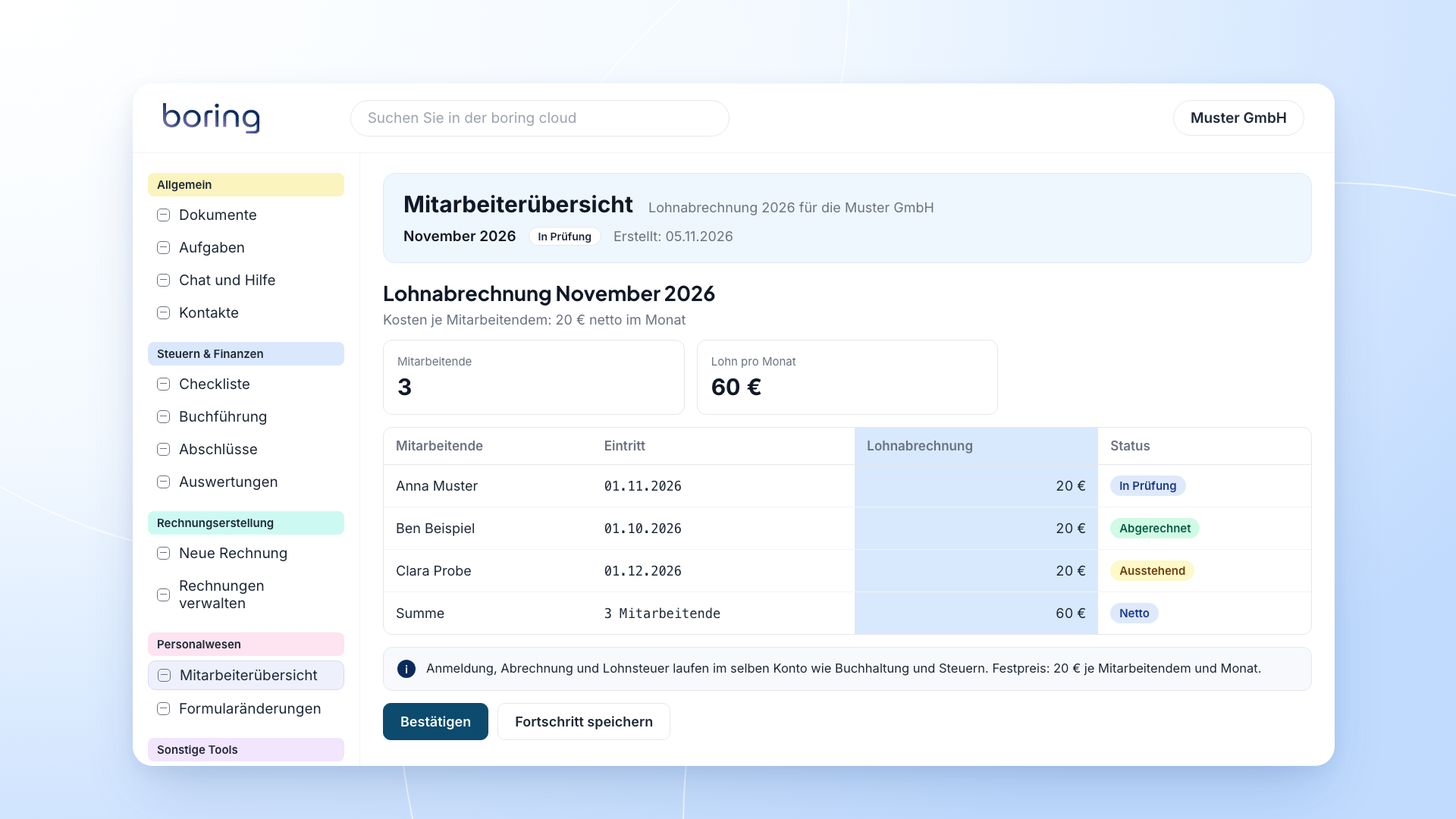
Bei boring.tax läuft die Lohnabrechnung für 20 Euro je Mitarbeitendem und Monat im selben Konto wie Buchhaltung und Steuern, zum festen Preis. Die 60 Euro im Monat der Stufe “Ohne Kanzlei” meinen nur die Software mit KI-Agent, ohne Steuerberatung und ohne Jahresabschluss; Lohn kommt mit 20 Euro je Mitarbeitendem dazu. Der Preisnachteil: Reine Software wie Lexware ist bei mehreren Mitarbeitenden günstiger, dafür rechnest du selbst.
Dieser Ratgeber zeigt die drei Wege (Steuerberatung, Software, Lohnservice), die Pflichten ab dem ersten Tag und wann der Jahreswechsel der beste Zeitpunkt für einen Wechsel ist. Alle Preise netto, Stand 05.11.2026.
Was kostet die Lohnabrechnung pro Mitarbeiter 2026?
Pro Kopf und Monat liegt die Lohnabrechnung beim Steuerberater nach StBVV bei 6 bis 30 Euro, bei den Lohnservices OnlineBilanz und firma.de bei 14,95 bis 19,99 Euro und bei boring.tax bei 20 Euro. Software wie Lexware wird nicht pro Kopf, sondern nach Mitarbeiter-Staffel bezahlt. Die Gesamtkosten im Monat hängen von der Teamgröße ab; Rechenbeispiele für 5 und 30 Mitarbeitende folgen weiter unten. Der Spielraum kommt daher, dass die Anbieter unterschiedlich viel übernehmen: nur rechnen oder auch melden, zahlen und haften. Die Details:
-
Steuerberater nach StBVV: Laut § 34 StBVV kostet die Führung der Lohnkonten und die Lohnabrechnung 6 bis 30 Euro je Arbeitnehmer und Abrechnungszeitraum. Die einmalige Einrichtung der Lohnkonten liegt bei 6 bis 19 Euro je Arbeitnehmer. Die Lohnsteuer-Anmeldung ist in diesen Gebühren enthalten.
Was ist die StBVV?
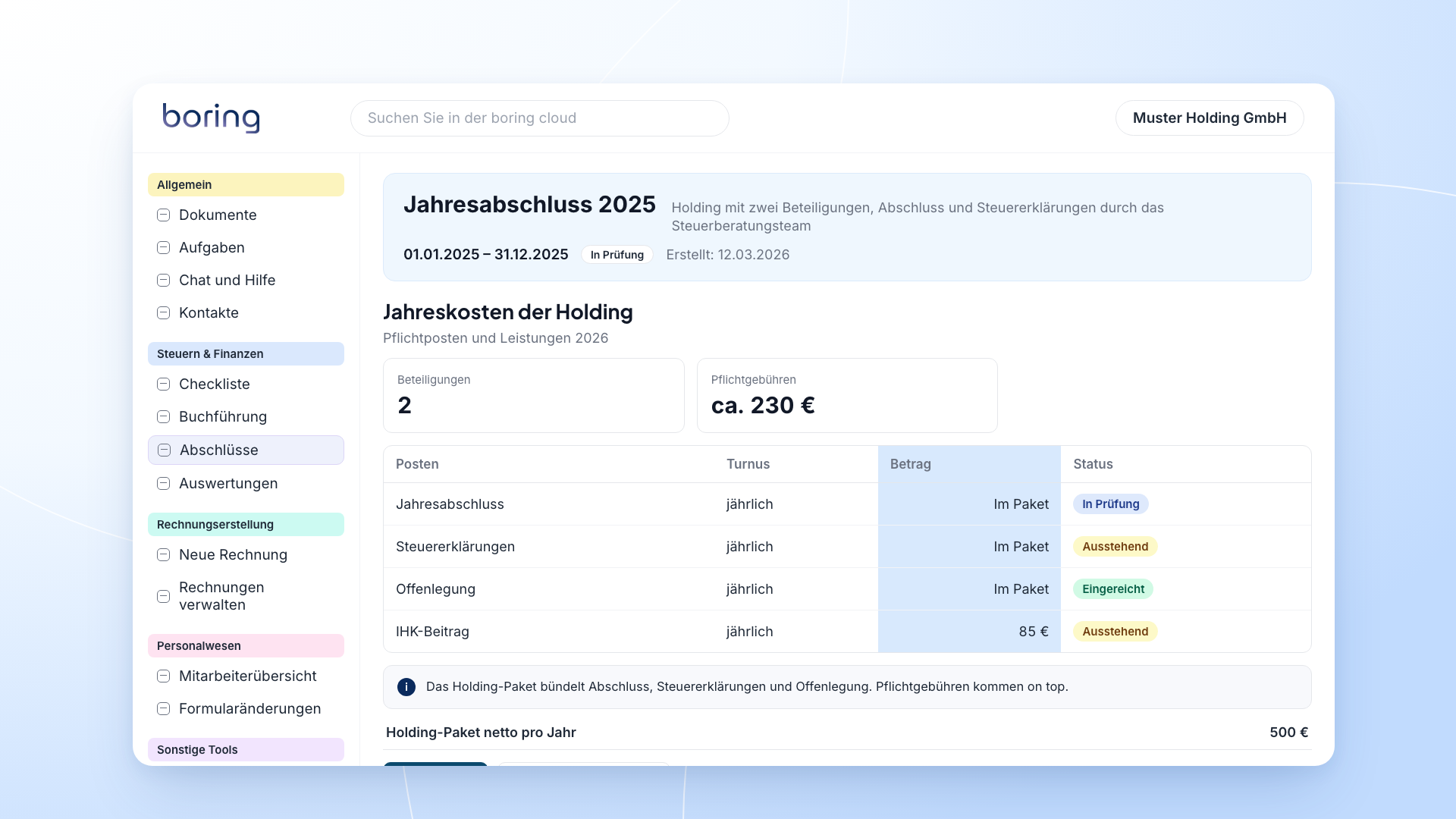
Die Gebührenverordnung regelt die Gebühren für Steuerberater nach Leistungsart. Der Spielraum von 6 bis 30 Euro je Mitarbeiter und Monat zeigt, dass die tatsächliche Gebühr vom Anbieter und der Fallkomplexität abhängt.
-
Software zum Selbstabrechnen: Lexware Office Lohn & Gehalt kostet laut Website von Lexware (Stand 05.11.2026) pauschal nach Staffel: 12,90 Euro im Monat für bis zu 2 Mitarbeitende, 25,90 Euro für bis zu 5, 109,90 Euro für bis zu 30 und 199,90 Euro für bis zu 50. Verantwortlich bleibst du als Arbeitgeber:in, denn es ist Software und keine Beratung.
-
Lohnservice: OnlineBilanz nimmt laut eigener Website (Stand 05.11.2026) 14,95 Euro je Mitarbeiter und Abrechnungsmonat. firma.de nennt laut eigener Website (Stand 05.11.2026) 19,99 Euro für 1 Mitarbeiter, 16,99 Euro für 2 bis 4 und 14,99 Euro je Mitarbeiter ab 5 Mitarbeitern.
Die Lohnabrechnung kostet bei boring.tax 20 Euro je Mitarbeitendem und Monat und läuft im selben Konto wie Buchhaltung und Steuern. Mehr zu Mitarbeitern, Lohndaten und Onboarding findest du im Beitrag Personalwesen: Mitarbeiter, Lohndaten und Onboarding. Die Software-Stufe “Ohne Kanzlei” startet bei 60 Euro im Monat, ohne Steuerberatung und ohne Jahresabschluss; alle Stufen und Preise findest du auf der Preisseite.
Was ist die Lohnabrechnung in der GmbH?
Die Lohnabrechnung ist die monatliche Berechnung von Brutto, Lohnsteuer, Sozialversicherungsbeiträgen und Netto je Beschäftigtem, samt allen Meldungen an Finanzamt und Krankenkassen. Sie umfasst auch das Lohnkonto, den Beitragsnachweis und die Zahlung der Abgaben.
Für die GmbH gilt: Du bist der Arbeitgeber, auch wenn du die Rechenarbeit abgibst. Fristen und Zahlungen laufen auf deine Gesellschaft.
Welche Pflichten hast du beim ersten Mitarbeiter?
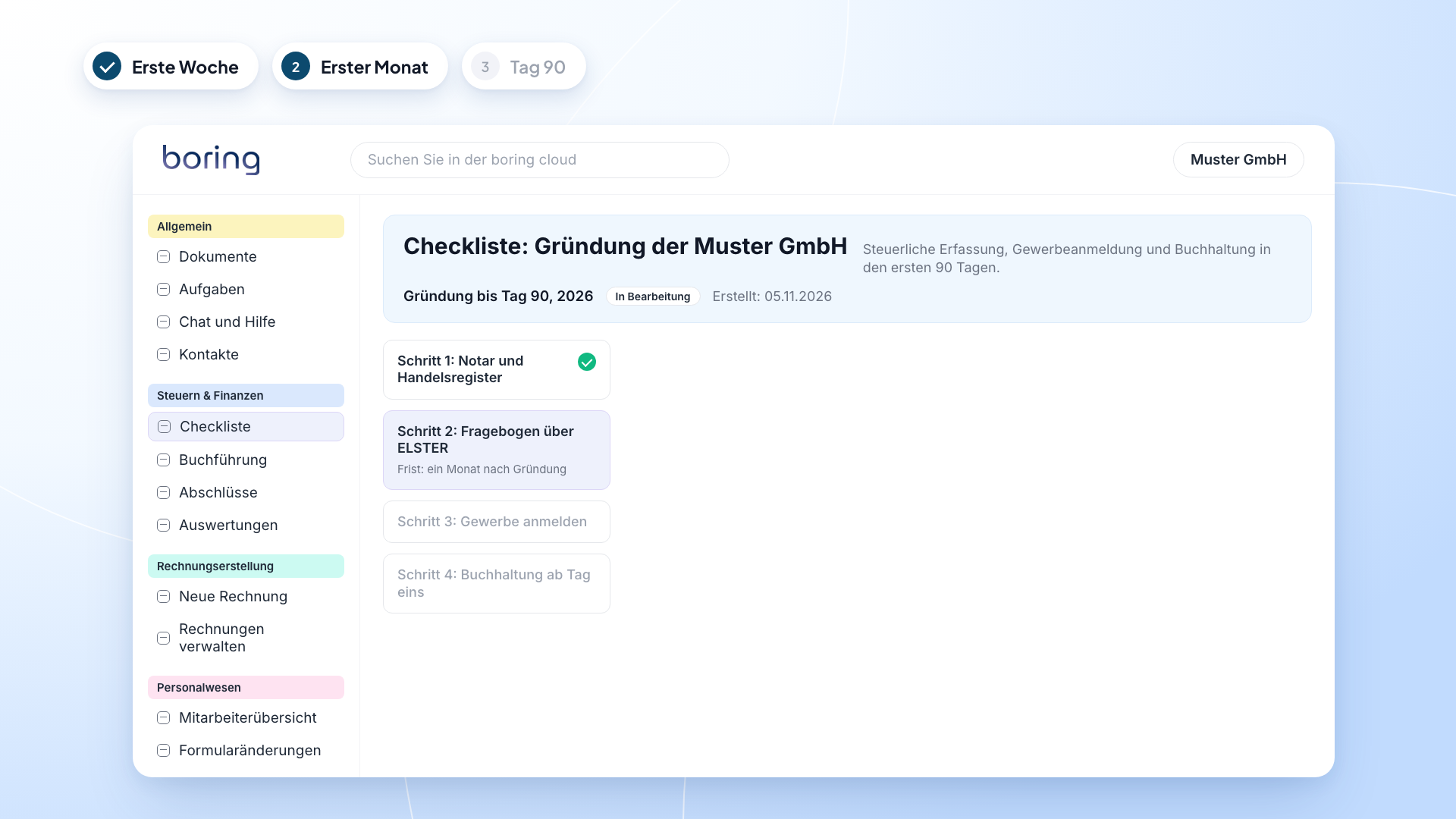
Mit dem ersten Beschäftigten brauchst du einen Arbeitsvertrag, eine Betriebsnummer, die Anmeldung bei der Krankenkasse und ein laufendes Lohnkonto. Die Checkliste in zeitlicher Reihenfolge:
- Arbeitsvertrag und Nachweis. Die Niederschrift darf laut § 2 NachwG in Textform elektronisch übermittelt werden, zum Beispiel per E-Mail mit Empfangsbestätigung. Parteien, Entgelt und Arbeitszeit gehören spätestens an den ersten Arbeitstag. Ein Verstoß kostet bis zu 2.000 Euro Bußgeld.
- Mindestlohn einhalten. Er beträgt seit 01.01.2026 13,90 Euro brutto je Stunde, ab 01.01.2027 14,60 Euro.
- Betriebsnummer beantragen. Du brauchst sie erst mit dem ersten Beschäftigten, auch bei Minijobbern und Azubis. Beantragt wird sie online bei der Bundesagentur für Arbeit. Sie hat 8 Ziffern, eine Wunschnummer gibt es nicht.
- Unfallversicherung informieren. Den zuständigen Träger musst du laut § 192 SGB VII binnen einer Woche nach Beginn des Unternehmens informieren. Eine Gewerbeanzeige erfüllt die Pflicht.
- Lohnsteuer-Merkmale abrufen. Dafür registrierst du dich einmalig in Mein ELSTER und meldest jeden Mitarbeiter mit Steuer-ID und Geburtsdatum an. Macht ein Dienstleister die Abrechnung, entfällt die Registrierung. Die Merkmale stehen spätestens 5 Werktage später bereit.
- Bei der Krankenkasse anmelden. Die Anmeldung erfolgt mit der ersten Lohnabrechnung, spätestens binnen sechs Wochen nach Beginn (§ 6 DEÜV). Eine Sofortmeldung ist nur in bestimmten Branchen Pflicht (Bau, Gastronomie, Logistik und weitere). Typische Agentur-, Software- oder Beratungs-GmbHs fallen nicht darunter.
- Arbeitszeit aufzeichnen (Minijobber). Beginn, Ende und Dauer trägst du bis zum 7. Tag nach dem Arbeitstag ein und bewahrst sie 2 Jahre auf (§ 17 MiLoG).
- Lohnkonto führen. Du brauchst eines je Arbeitnehmer und Kalenderjahr. Aufbewahrt wird es bis zum Ablauf des sechsten Kalenderjahres, das auf die zuletzt eingetragene Lohnzahlung folgt.
- Beiträge melden und zahlen. Der Beitragsnachweis geht zwei Arbeitstage vor Fälligkeit raus. Die Beiträge sind in voraussichtlicher Höhe am drittletzten Bankarbeitstag des Monats fällig, in dem gearbeitet wird; ein Restbetrag folgt am drittletzten Bankarbeitstag des Folgemonats.
- Lohnsteuer anmelden und abführen. Das geschieht spätestens am 10. Tag nach Ablauf des Anmeldungszeitraums (§ 41a EStG). Über 5.000 Euro Lohnsteuer im Vorjahr ist es monatlich, über 1.080 bis 5.000 Euro vierteljährlich, bis 1.080 Euro jährlich.
Die Schritte 1 bis 4 bleiben bei dir als Arbeitgeber:in, egal welchen Weg du wählst. Die monatliche Abrechnung mit Krankenkassen-Anmeldung, Beitragsnachweis, Lohnkonto und Lohnsteuer-Anmeldung (Schritte 6, 8, 9 und 10) deckt die Lohnabrechnung für 20 Euro je Mitarbeitendem ab. Die Arbeitszeitaufzeichnung bei Minijobbern (Schritt 7) bleibt bei dir.
Steuerberater, Software oder Lohnservice: Welcher Weg passt?
Für 3 bis 20 Mitarbeitende lohnt sich Auslagern fast immer, weil Fehler bei Meldungen und Fristen teurer werden als jede Abrechnungsgebühr. Selbst rechnen funktioniert nur, wenn du die Pflichten oben sicher im Griff hast.
Steuerberater nach StBVV. Du bekommst Beratung bei Sonderfällen, zahlst aber nach Gebührenspanne und Aufwand. Öffentliche Festpreise gibt es meist nicht. Bei DATEV-Abrechnung durch die Kanzlei gilt die Vereinbarung mit der Kanzlei bzw. § 34 StBVV. Der Unterschied zu boring.tax: Der Lohnpreis steht öffentlich fest (20 Euro je Mitarbeitendem und Monat), und im Gesamtpaket “Mit Kanzlei + Steuerberater” gehört die boring.tax Steuerberatungsgesellschaft mbH (in einzelnen Fällen eine Partnerkanzlei) zum selben Konto.
Software selbst. Das ist die günstigste Variante bei kleinen Teams. Lexware Office Lohn & Gehalt übermittelt laut Website von Lexware Meldungen, Lohnsteuer-Anmeldung und Beitragsnachweise, schließt aber etwa Tantiemen aus. Der Unterschied zu boring.tax: Lexware ist reine Software ohne Beratung, du rechnest selbst ab und bleibst verantwortlich; bei boring.tax liegt Lohn im selben Konto wie Buchhaltung und Steuern. DATEV Lohn und Gehalt classic kostet laut Website von DATEV ab 15,86 Euro im Monat und setzt eine DATEV-Systemumgebung voraus. Der Unterschied: Bei boring.tax nennst du den Preis je Mitarbeitendem vorab (20 Euro) und führst den Lohn im selben Konto wie die Buchhaltung. Dazu kommt bei beiden Softwarewegen das Risiko: Du bleibst verantwortlich.
Lohnservice. Du lieferst Daten, ein Dienstleister rechnet und meldet. OnlineBilanz lässt jeden Lohnlauf laut eigener Website von einem Steuerberater oder Wirtschaftsprüfer freigeben. Der Unterschied: Der Lohnservice ist ein getrennter Dienst, bei boring.tax läuft der Lohn im selben Konto wie die Buchhaltung. Bei firma.de übernimmt laut eigener Website eine nicht genannte, unabhängige Kanzlei die Abrechnung. Im Gesamtpaket ist die Steuerberatungsgesellschaft dagegen die eigene.
Wer schon HR-Software nutzt, sollte genau hinsehen. Papershift und Factorial erstellen laut ihren Websites nur vorbereitende Lohndaten, Meldungen laufen über Steuerberater oder Payroll-Dienstleister; bei boring.tax ist die Lohnabrechnung für 20 Euro je Mitarbeitendem im Konto enthalten. sevDesk hat laut Hilfecenter keine eigene Lohnabrechnung und verweist auf project b. Auch mika rechnet laut eigener Website über den Partner Project B ab, die Plattform dagegen führt Lohn im selben Konto wie die Buchhaltung. Personio Payroll nennt keine öffentlichen Preise, der Lohnpreis hier ist öffentlich.
Kostenübersicht (Stand 05.11.2026, netto)
| Anbieter / Weg | Preis | Was dahinter steckt | Unterschied zu boring.tax |
|---|---|---|---|
| boring.tax | 20 EUR je Mitarbeitendem und Monat | Lohn im selben Konto wie Buchhaltung und Steuern; Software-Stufe “Ohne Kanzlei” ab 60 EUR/Monat (ohne Steuerberatung und Jahresabschluss) | Referenz |
| Steuerberater (StBVV) | 6 bis 30 EUR je Mitarbeiter und Monat, einmalig 6 bis 19 EUR | Gebührenspanne, Lohnsteuer-Anmeldung enthalten | Kein öffentlicher Festpreis; bei boring.tax fester Lohnpreis und eigene Steuerberatungsgesellschaft im Gesamtpaket |
| Lexware Office Lohn & Gehalt | 12,90 EUR (bis 2), 25,90 EUR (bis 5), 109,90 EUR (bis 30), 199,90 EUR (bis 50 Mitarbeitende) im Monat | Selbst abrechnen, Software ohne Beratung | Software ohne Beratung, du rechnest selbst ab und bleibst verantwortlich |
| DATEV Lohn und Gehalt classic | ab 15,86 EUR im Monat | Software, setzt DATEV-Systemumgebung voraus | Software mit Systemumgebung; bei boring.tax Lohn im selben Konto wie Buchhaltung |
| OnlineBilanz | 14,95 EUR je Mitarbeiter und Monat | Lohnservice, Freigabe durch Steuerberater oder Wirtschaftsprüfer | Lohn als getrennter Dienst, nicht im Buchhaltungs-Konto |
| firma.de | 19,99 EUR (1), 16,99 EUR (2 bis 4), 14,99 EUR (ab 5) je Mitarbeiter und Monat | Abrechnung über unabhängige, nicht genannte Kanzlei | Kanzlei nicht benannt; bei boring.tax eigene Steuerberatungsgesellschaft im Gesamtpaket |
| mika | 20 EUR je Mitarbeiter und Monat | Abrechnung über Partner Project B | Abrechnung über Partner; bei boring.tax Lohn im selben Konto wie Buchhaltung |
| bsteuern | Lohn nicht im Festpreis | Aufpreis auf Anfrage | Bei boring.tax fester Lohnpreis von 20 EUR je Mitarbeitendem |
| Fideus | individuelles Angebot | Lohn nur im Paket “Operatives Unternehmen” zubuchbar | Bei boring.tax öffentlicher Lohnpreis |
| Personio Payroll | keine öffentlichen Preise | Angebot nach Webdemo | Bei boring.tax öffentlicher Lohnpreis |
Quelle der Anbieterangaben: jeweils Website des Anbieters, Stand 05.11.2026. Bei mika bleibt offen, ob der Preis netto oder brutto gemeint ist.
Was kostet die Lohnabrechnung bei 5 und bei 30 Mitarbeitern?
Bei 5 Mitarbeitenden liegen die laufenden Kosten bei 25,90 bis 150 Euro im Monat. Bei 30 Mitarbeitenden sind es laufend 109,90 bis 900 Euro im Monat; beim Steuerberater kommen einmalig 180 bis 570 Euro für die Einrichtung der Lohnkonten dazu. Für die anderen Anbieter sind in den hier verwendeten Angaben keine Einrichtungsgebühren enthalten, die Beispiele rechnen sie nicht ein.
Beispiel: GmbH mit 5 Mitarbeitenden, ein Lohnlauf im Monat.
- Steuerberater nach StBVV: 30 bis 150 Euro im Monat, einmalig 30 bis 95 Euro Einrichtung
- Lexware (Staffel bis 5 Mitarbeitende, Stand 05.11.2026): 25,90 Euro im Monat, du rechnest selbst
- OnlineBilanz: 74,75 Euro im Monat (5 × 14,95)
- firma.de: 74,95 Euro im Monat (5 × 14,99)
- boring.tax: 100 Euro im Monat (5 × 20)
Beispiel: GmbH mit 30 Mitarbeitenden.
- Steuerberater nach StBVV: 180 bis 900 Euro im Monat, einmalig 180 bis 570 Euro Einrichtung
- Lexware (Staffel bis 30 Mitarbeitende, Stand 05.11.2026): 109,90 Euro im Monat, du rechnest selbst
- OnlineBilanz: 448,50 Euro im Monat
- firma.de: 449,70 Euro im Monat
- boring.tax: 600 Euro im Monat
Ehrlich gesagt: Bei vielen Mitarbeitenden ist reine Software deutlich günstiger. Der Preis ist dann der Tausch gegen Arbeit und Haftungsrisiko.
Wie rechnest du Minijob, Werkstudent und Geschäftsführergehalt ab?
Alle drei Fälle haben eigene Regeln bei Sozialversicherung und Steuer.
Minijob. Die Verdienstgrenze liegt 2026 bei 603 Euro im Monat bzw. 7.236 Euro im Jahr, laut Minijob-Zentrale entspricht das bei 13,90 Euro Stundenlohn 43,38 Stunden. 2027 steigt sie auf 633 Euro. Du zahlst als Arbeitgeber 31,17 %, die Unfallversicherung kommt dazu. Der Minijobber trägt 3,6 % Rentenversicherung, kann sich aber befreien lassen. Einzugsstelle ist die Minijob-Zentrale.
Werkstudent. Bis 20 Wochenstunden gilt die Vermutung, dass das Studium im Vordergrund steht. Dann sind Kranken-, Pflege- und Arbeitslosenversicherung frei. Über 603 Euro wird Rentenversicherung fällig. Zwischen 603,01 und 2.000 Euro kann der Werkstudentenjob ein Midijob (Übergangsbereich) mit geringeren Beiträgen für den Werkstudenten sein.
Geschäftsführergehalt. Laut Deutscher Rentenversicherung (DRV) ist ein Gesellschafter-Geschäftsführer nicht abhängig beschäftigt, wenn er mindestens 50 % des Stammkapitals hält oder eine umfassende Sperrminorität im Gesellschaftsvertrag hat. Ein Fremdgeschäftsführer ohne Beteiligung ist in der Regel sozialversicherungspflichtig. Im Zweifel klärt die DRV den Status im Statusfeststellungsverfahren nach § 7a SGB IV. SV-frei heißt nicht steuerfrei: Das Gehalt läuft in der Regel über die Lohnabrechnung mit Lohnsteuer.
Zum Rechnen: Der Arbeitgeberanteil zur Sozialversicherung liegt 2026 rechnerisch bei 21,15 % des Bruttos bis zu den Beitragsbemessungsgrenzen (KV bei 2,9 % durchschnittlichem Zusatzbeitrag). Die Beitragstragung regeln § 249 SGB V, § 58 SGB XI, § 168 SGB VI und § 346 SGB III. Bei 3.000 Euro brutto sind das 634,50 Euro, dazu 4,50 Euro Insolvenzgeldumlage, plus U1/U2 und Unfallversicherung.
Wann lohnt sich der Wechsel des Lohnanbieters?
Der Jahreswechsel ist der sauberste Zeitpunkt, weil Lohnkonten ohnehin je Kalenderjahr geführt werden. So gehst du vor:
- Alle Lohnkonten und Abrechnungen 2026 vom alten Anbieter exportieren.
- Stammdaten prüfen: Steuer-ID, Krankenkasse, Steuerklasse, Wochenstunden.
- Zum 01.01.2027 Mindestlohn (14,60 Euro) und Minijob-Grenze (633 Euro) prüfen.
- Beitragsnachweise im Dezember und Januar im Blick behalten: Laut Minijob-Zentrale ist der Nachweis für Dezember 2026 bis 21.12. fällig (Zahlung 28.12.), für Januar 2027 bis 24.01. (Zahlung 27.01.).
- Die Rechengrößen 2027 gelten vorbehaltlich Bundesrat: RV/AV 8.850 Euro, KV 6.375 Euro im Monat.
Wie das bei der Kanzlei läuft, zeigt unser Beitrag Steuerberater wechseln als GmbH.
So unterstützt dich boring.tax
Die Lohnabrechnung kostet hier 20 Euro je Mitarbeitendem und Monat und läuft im selben Konto wie deine Buchhaltung.
Drei Stufen, die du im selben Konto wechseln kannst:
- Ohne Kanzlei ab 60 Euro im Monat: Software mit KI-Agent, ohne Steuerberatung und ohne Jahresabschluss.
- Mit boring-Buchhaltern ab 100 Euro im Monat bis 100.000 Euro Umsatz.
- Gesamtpaket mit Kanzlei und Steuerberater ab 335 Euro im Monat bis 100.000 Euro Umsatz, mit eigener Steuerberatungsgesellschaft (in einzelnen Fällen eine Partnerkanzlei) und 4 Mio. Euro Haftpflichtdeckung.
Das Gesamtpaket enthält Jahresabschluss, E-Bilanz, Offenlegung und KSt/GewSt-Erklärungen. Die Daten liegen in Deutschland gehostet. Bei firma.de übernimmt eine nicht genannte, unabhängige Kanzlei die Abrechnung, bei OnlineBilanz gibt ein Steuerberater oder Wirtschaftsprüfer jeden Lohnlauf frei. Lohn kommt mit 20 Euro je Mitarbeitendem dazu. Die Preise im Überblick findest du auf der Preisseite.
Wo es nicht passt: Für Einzelunternehmen und Freiberufler (EÜR) ist die Plattform nicht gedacht. Und wer 30 Mitarbeitende reine Routine abrechnen will, zahlt bei Software wie Lexware weniger. Auch pro Kopf ist der Lohn mit 20 Euro teurer als bei OnlineBilanz (14,95 Euro) oder firma.de (ab 14,99 Euro) und liegt über der Untergrenze der StBVV-Spanne von 6 Euro. Dafür bekommst du für GmbHs mit bis zu etwa 20 Mitarbeitern Lohn und Buchhaltung im selben Konto zum Festpreis. Für GmbHs mit 3 bis etwa 20 Mitarbeitern vereint sie Lohn, Buchhaltung und optional Steuerberatung zum Festpreis im selben Konto.
Wenn du bereits eine Kanzlei hast: Die Lohn-Pflichten lassen sich getrennt klären. Mehr zu den Kosten ausgelagerter Buchhaltung findest du in unserem Vergleich zur ausgelagerten Buchhaltung mit Festpreis.
Häufige Fragen
Wer macht die Lohnabrechnung in der GmbH, wenn wir die ersten Mitarbeiter einstellen? Du entscheidest zwischen Steuerberatung, Lohnservice und Software, verantwortlich bleibst du als Arbeitgeber:in. Beim Steuerberater zahlst du 6 bis 30 Euro je Mitarbeiter und Monat nach StBVV. Die Betriebsnummer und die Anmeldung musst du in jedem Fall zum Start vorbereiten.
Was kostet die Lohnabrechnung pro Mitarbeiter beim Steuerberater? Sie kostet 6 bis 30 Euro netto je Arbeitnehmer und Abrechnungszeitraum, laut § 34 Abs. 2 StBVV. Dazu kommen einmalig 6 bis 19 Euro für die Einrichtung des Lohnkontos. Sonstige Hilfeleistungen werden nach Zeit abgerechnet.
Lohnabrechnung auslagern oder selbst mit Software machen: Was ist bei 5 Mitarbeitern besser? Auslagern, wenn du keine Zeit für Fristen und Meldungen hast; Software, wenn du die Pflichten sicher beherrschst. Lexware kostet in der Staffel bis 5 Mitarbeitende laut Website 25,90 Euro im Monat (Stand 05.11.2026), ein Lohnservice wie OnlineBilanz etwa 75 Euro. Der Unterschied ist die Arbeit und das Risiko, das du übernimmst.
Was kostet die Lohnbuchhaltung für eine GmbH mit 30 Mitarbeitern im Monat? Sie kostet laufend je nach Weg 109,90 bis 900 Euro im Monat. Bei boring.tax sind es 600 Euro (30 × 20 Euro), Lexware kostet in der Staffel bis 30 Mitarbeitende 109,90 Euro (Stand 05.11.2026), beim Steuerberater nach StBVV 180 bis 900 Euro. Beim Steuerberater kommen einmalig 180 bis 570 Euro für die Einrichtung der Lohnkonten dazu.
Gibt es Buchhaltung und Lohnabrechnung aus einer Hand zum Festpreis? Ja, bei boring.tax im selben Konto. Die 60 Euro im Monat gelten nur für die Software-Stufe “Ohne Kanzlei”, also ohne Steuerberatung und ohne Jahresabschluss; Lohn kommt mit 20 Euro je Mitarbeitendem dazu. Steuerberatung und Jahresabschluss gibt es erst im Gesamtpaket “Mit Kanzlei + Steuerberater” ab 335 Euro im Monat. firma.de bietet Lohn laut eigener Website zubuchbar mit Buchhaltung, bei bsteuern ist Lohn dagegen nicht im Festpreis.
Wer macht die Lohnabrechnung für ein Startup mit Werkstudenten und Minijobbern zum Festpreis? Ein Lohnservice mit Festpreis je Kopf, zum Beispiel OnlineBilanz mit 14,95 Euro laut eigener Website (Stand 05.11.2026), oder boring.tax mit 20 Euro je Mitarbeitendem und Monat im selben Konto wie die Buchhaltung. Wichtig ist, dass der Dienstleister die Minijob-Meldungen an die Minijob-Zentrale übernimmt; frag das vor Vertragsabschluss ab.
Wie wird das Geschäftsführergehalt in einer GmbH abgerechnet und versteuert? In der Regel über die Lohnabrechnung mit Lohnsteuerabzug. Ob Sozialversicherung anfällt, hängt von Beteiligung und Sperrminorität ab: ab 50 % Anteil oder mit umfassender Sperrminorität nicht, ein Fremdgeschäftsführer in der Regel schon. Im Zweifel klärt die DRV den Status nach § 7a SGB IV.
Lohnabrechnung mit Personio, DATEV oder über den Steuerberater: Was passt für ein Startup? Mit wenigen Mitarbeitenden ist der Steuerberater oder ein Lohnservice mit Festpreis am einfachsten. DATEV-Software setzt eine DATEV-Systemumgebung voraus, Personio nennt keine öffentlichen Preise. Prüfe vor der Entscheidung, wer Meldungen und Zahlungen übernimmt.
Bereit, es auszuprobieren?
Wenn du den ersten Mitarbeiter einstellst, lege Betriebsnummer, Vertrag und Abrechnungsweg fest, bevor der erste Lohn fällig wird. Mit festem Preis je Mitarbeitendem weißt du vorher, was der Lohn kostet.
Mitarbeiter rein. Lohn raus. So soll Steuer sein: boring.
Noch kein boring.tax-Kunde? Jetzt kostenlos starten →
Payroll for a GmbH: Cost per Employee and What to Do When You Hire Your First One
Payroll costs 6 to 30 euros per employee per month at a tax advisor under the StBVV (the German fee schedule for tax advisors), from 14.95 euros at online payroll services, and 20 euros net at boring.tax.
The first employee is hired, the employment contract is signed. Now who runs the payroll, registers them, and pays the wage tax?
At boring.tax, payroll costs 20 euros per employee per month, runs in the same account as your bookkeeping and taxes, and has a fixed price. The 60 euros per month of the “Without Firm” tier covers only the software with the AI agent, without tax advice and without annual financial statements; payroll comes on top at 20 euros per employee. The price downside: pure software like Lexware is cheaper with several employees, but then you run the payroll yourself.
This guide shows the three options (tax advisor, software, payroll service), your obligations from day one, and when the turn of the year is the best time to switch. All prices are net, as of 05.11.2026.
What does payroll cost per employee in 2026?
Per head and month, payroll costs 6 to 30 euros at a tax advisor under the StBVV, 14.95 to 19.99 euros at the payroll services OnlineBilanz and firma.de, and 20 euros at boring.tax. Software like Lexware is not paid per head but by employee tier. Total monthly costs depend on team size; worked examples for 5 and 30 employees follow below. The range exists because providers take on different amounts of work: just calculating, or also reporting, paying, and carrying liability. The details:
-
Tax advisor under the StBVV: According to § 34 StBVV, keeping payroll accounts and running payroll costs 6 to 30 euros per employee and payroll period. The one-time setup of payroll accounts costs 6 to 19 euros per employee. The wage tax return is included in these fees.
What is the StBVV?
This fee schedule sets the fees for tax advisors by type of service. The range of 6 to 30 euros per employee and month shows that the actual fee depends on the provider and the complexity of the case.
-
Software for doing it yourself: According to Lexware’s website (as of 05.11.2026), Lexware Office Lohn & Gehalt is priced as a flat fee by tier: 12.90 euros per month for up to 2 employees, 25.90 euros for up to 5, 109.90 euros for up to 30, and 199.90 euros for up to 50. You remain responsible as the employer, because it is software and not advice.
-
Payroll service: According to its own website (as of 05.11.2026), OnlineBilanz charges 14.95 euros per employee and payroll month. According to its own website (as of 05.11.2026), firma.de charges 19.99 euros for 1 employee, 16.99 euros for 2 to 4, and 14.99 euros per employee from 5 employees.
At boring.tax, payroll costs 20 euros per employee per month and runs in the same account as bookkeeping and taxes. You can find more on employees, payroll data, and onboarding in the article HR: Employees, Payroll Data, and Onboarding. The software tier “Without Firm” starts at 60 euros per month, without tax advice and without annual financial statements; all tiers and prices are on the pricing page.
What is payroll in a GmbH?
Payroll is the monthly calculation of gross pay, wage tax, social security contributions, and net pay per employee, including all reports to the tax office and health insurers. It also covers the payroll account, the contribution statement, and the payment of the levies.
For a GmbH this means: you are the employer, even if you hand off the calculation work. Deadlines and payments run through your company.
What obligations do you have with your first employee?
With your first employee you need an employment contract, an establishment number, registration with the health insurer, and a running payroll account. The checklist in chronological order:
- Employment contract and written record. According to § 2 NachwG, the record of the key contract terms may be sent electronically in text form, for example by email with confirmation of receipt. The parties, pay, and working hours must be provided by the first working day at the latest. A violation can cost up to 2,000 euros in fines.
- Comply with the minimum wage. Since January 1, 2026 it is 13.90 euros gross per hour, and from January 1, 2027 it is 14.60 euros.
- Apply for an establishment number. You only need it once you have your first employee, including for mini-jobbers and apprentices. You apply online at the Federal Employment Agency. It has 8 digits, and you cannot choose your own number.
- Notify the accident insurer. According to § 192 SGB VII, you must notify the responsible insurer within one week of the start of your business. A trade registration fulfills this obligation.
- Retrieve wage tax attributes. For this you register once in Mein ELSTER and register each employee with their tax ID and date of birth. If a service provider runs your payroll, the registration is not needed. The attributes are available no later than 5 working days later.
- Register with the health insurer. The registration is made with the first payroll run, at the latest within six weeks of the start (§ 6 DEÜV). An immediate notification is mandatory only in certain industries (construction, hospitality, logistics, and others). Typical agency, software, or consulting GmbHs are not covered.
- Record working hours (mini-jobbers). You record start, end, and duration by the 7th day after the working day and keep the records for 2 years (§ 17 MiLoG).
- Keep a payroll account. You need one per employee and calendar year. It must be kept until the end of the sixth calendar year following the last entered wage payment.
- Report and pay contributions. The contribution statement is due two working days before the payment date. Contributions are due in their expected amount on the third-to-last banking day of the month in which the work is done; any remainder follows on the third-to-last banking day of the following month.
- File and pay wage tax. This happens no later than the 10th day after the end of the filing period (§ 41a EStG). With more than 5,000 euros of wage tax in the previous year, it is monthly; from over 1,080 up to 5,000 euros, quarterly; up to 1,080 euros, annually.
Steps 1 to 4 stay with you as the employer, whichever option you choose. The monthly payroll with health insurer registration, contribution statement, payroll account, and wage tax return (steps 6, 8, 9, and 10) is covered by payroll at 20 euros per employee. Recording working hours for mini-jobbers (step 7) stays with you.
Tax advisor, software, or payroll service: which option fits?
For 3 to 20 employees, outsourcing almost always pays off, because mistakes in reports and deadlines get more expensive than any payroll fee. Doing it yourself only works if you have the obligations above firmly under control.
Tax advisor under the StBVV. You get advice on special cases, but you pay according to a fee range and effort. Public fixed prices are usually not available. If the firm runs payroll through DATEV, the agreement with the firm or § 34 StBVV applies. The difference from boring.tax: the payroll price is publicly fixed (20 euros per employee per month), and in the full package “With Firm + Tax Advisor”, our own boring.tax Steuerberatungsgesellschaft mbH (in some cases a partner firm) is part of the same account.
Software on your own. This is the cheapest option for small teams. According to Lexware’s website, Lexware Office Lohn & Gehalt submits reports, wage tax returns, and contribution statements, but excludes things like profit-based bonuses (Tantiemen). The difference from boring.tax: Lexware is pure software without advice, you run payroll yourself and remain responsible; at boring.tax, payroll sits in the same account as bookkeeping and taxes. According to DATEV’s website, DATEV Lohn und Gehalt classic costs from 15.86 euros per month and requires a DATEV system environment. The difference: at boring.tax you know the price per employee up front (20 euros) and run payroll in the same account as bookkeeping. With both software options there is also the risk: you remain responsible.
Payroll service. You deliver data, a service provider calculates and reports. According to its own website, OnlineBilanz has every payroll run approved by a tax advisor or auditor. The difference: the payroll service is a separate service, whereas at boring.tax payroll runs in the same account as bookkeeping. According to its own website, at firma.de an unnamed, independent firm handles the payroll. In the full package, by contrast, the tax advisory firm is our own.
If you already use HR software, look closely. According to their websites, Papershift and Factorial only prepare payroll data, and reports run through a tax advisor or payroll provider; at boring.tax, payroll at 20 euros per employee is included in the account. According to its help center, sevDesk has no payroll of its own and refers to project b. According to its own website, mika also runs payroll through its partner Project B, whereas the platform runs payroll in the same account as bookkeeping. Personio Payroll lists no public prices; the payroll price here is public.
Cost overview (as of 05.11.2026, net)
| Provider / option | Price | What is behind it | Difference from boring.tax |
|---|---|---|---|
| boring.tax | 20 EUR per employee and month | Payroll in the same account as bookkeeping and taxes; software tier “Without Firm” from 60 EUR/month (without tax advice and annual financial statements) | Reference |
| Tax advisor (StBVV) | 6 to 30 EUR per employee and month, one-time 6 to 19 EUR | Fee range, wage tax return included | No public fixed price; at boring.tax a fixed payroll price and our own tax advisory firm in the full package |
| Lexware Office Lohn & Gehalt | 12.90 EUR (up to 2), 25.90 EUR (up to 5), 109.90 EUR (up to 30), 199.90 EUR (up to 50 employees) per month | Do it yourself, software without advice | Software without advice, you run payroll yourself and remain responsible |
| DATEV Lohn und Gehalt classic | from 15.86 EUR per month | Software, requires a DATEV system environment | Software with system environment; at boring.tax payroll in the same account as bookkeeping |
| OnlineBilanz | 14.95 EUR per employee and month | Payroll service, approval by tax advisor or auditor | Payroll as a separate service, not in the bookkeeping account |
| firma.de | 19.99 EUR (1), 16.99 EUR (2 to 4), 14.99 EUR (from 5) per employee and month | Payroll through an independent, unnamed firm | Firm not named; at boring.tax our own tax advisory firm in the full package |
| mika | 20 EUR per employee and month | Payroll through partner Project B | Payroll through a partner; at boring.tax payroll in the same account as bookkeeping |
| bsteuern | Payroll not in the fixed price | Surcharge on request | At boring.tax a fixed payroll price of 20 EUR per employee |
| Fideus | individual quote | Payroll can only be added in the “Operatives Unternehmen” package | At boring.tax a public payroll price |
| Personio Payroll | no public prices | Offer after a web demo | At boring.tax a public payroll price |
Source for provider data: each provider’s website, as of 05.11.2026. For mika, it is unclear whether the price is meant net or gross.
What does payroll cost with 5 and with 30 employees?
With 5 employees, running costs are 25.90 to 150 euros per month. With 30 employees, running costs are 109.90 to 900 euros per month; at a tax advisor, a one-time 180 to 570 euros for setting up the payroll accounts comes on top. For the other providers, the figures used here include no setup fees, so the examples do not count them.
Example: GmbH with 5 employees, one payroll run per month.
- Tax advisor under the StBVV: 30 to 150 euros per month, one-time 30 to 95 euros setup
- Lexware (tier up to 5 employees, as of 05.11.2026): 25.90 euros per month, you run payroll yourself
- OnlineBilanz: 74.75 euros per month (5 × 14.95)
- firma.de: 74.95 euros per month (5 × 14.99)
- boring.tax: 100 euros per month (5 × 20)
Example: GmbH with 30 employees.
- Tax advisor under the StBVV: 180 to 900 euros per month, one-time 180 to 570 euros setup
- Lexware (tier up to 30 employees, as of 05.11.2026): 109.90 euros per month, you run payroll yourself
- OnlineBilanz: 448.50 euros per month
- firma.de: 449.70 euros per month
- boring.tax: 600 euros per month
Frankly: with many employees, pure software is much cheaper. The price is then the trade-off against work and liability risk.
How do you run payroll for a mini-job, a working student, and a managing director’s salary?
All three cases have their own rules for social security and tax.
Mini-job. The earnings limit in 2026 is 603 euros per month or 7,236 euros per year; according to the Minijob-Zentrale, at an hourly wage of 13.90 euros this equals 43.38 hours. In 2027 it rises to 633 euros. As the employer you pay 31.17 %, with accident insurance on top. The mini-jobber bears 3.6 % pension insurance but can opt out. The collecting body is the Minijob-Zentrale.
Working student. Up to 20 hours per week, it is presumed that studies come first. Health, long-term care, and unemployment insurance are then exempt. Above 603 euros, pension insurance becomes due. Between 603.01 and 2,000 euros, the working student job can be a midi-job (transition range) with lower contributions for the working student.
Managing director’s salary. According to the German Pension Insurance (DRV), a shareholder-managing director is not in dependent employment if they hold at least 50 % of the share capital or have a comprehensive blocking minority in the articles of association. A managing director without a stake is generally subject to social security contributions. In case of doubt, the DRV clarifies the status in a status determination procedure under § 7a SGB IV. Exempt from social security does not mean tax-free: the salary generally runs through payroll with wage tax.
For the math: in 2026 the employer share of social security is computationally 21.15 % of gross pay up to the contribution assessment ceilings (health insurance at an average additional contribution of 2.9 %). Who bears the contributions is regulated by § 249 SGB V, § 58 SGB XI, § 168 SGB VI, and § 346 SGB III. At 3,000 euros gross that is 634.50 euros, plus 4.50 euros insolvency levy, plus U1/U2 and accident insurance.
When does it make sense to switch payroll providers?
The turn of the year is the cleanest time, because payroll accounts are kept per calendar year anyway. Here is how to go about it:
- Export all 2026 payroll accounts and payslips from the old provider.
- Check master data: tax ID, health insurer, tax class, weekly hours.
- As of 01.01.2027, check the minimum wage (14.60 euros) and the mini-job limit (633 euros).
- Keep an eye on contribution statements in December and January: according to the Minijob-Zentrale, the statement for December 2026 is due by 21.12. (payment 28.12.), and for January 2027 by 24.01. (payment 27.01.).
- The 2027 reference values apply subject to the Bundesrat: pension/unemployment insurance 8,850 euros, health insurance 6,375 euros per month.
How this works with the firm is shown in our article Switching Tax Advisors as a GmbH.
How boring.tax supports you
Payroll here costs 20 euros per employee per month and runs in the same account as your bookkeeping.
Three tiers that you can switch between in the same account:
- Without Firm from 60 euros per month: software with an AI agent, without tax advice and without annual financial statements.
- With boring bookkeepers from 100 euros per month up to 100,000 euros in revenue.
- Full package with firm and tax advisor from 335 euros per month up to 100,000 euros in revenue, with our own boring.tax Steuerberatungsgesellschaft mbH (in some cases a partner firm) and 4 million euros of liability coverage.
The full package includes annual financial statements, e-balance sheet, public disclosure filing, and corporate and trade tax returns. Data is hosted in Germany. At firma.de an unnamed, independent firm handles payroll, and at OnlineBilanz a tax advisor or auditor approves every payroll run. Payroll comes on top at 20 euros per employee. You can find an overview of prices on the pricing page.
Where it does not fit: the platform is not intended for sole proprietors and freelancers (cash-basis accounting). And if you want to run purely routine payroll for 30 employees, you pay less with software like Lexware. Per head, payroll at 20 euros is also more expensive than at OnlineBilanz (14.95 euros) or firma.de (from 14.99 euros) and sits above the lower end of the StBVV range of 6 euros. In return, for GmbHs with up to about 20 employees you get payroll and bookkeeping in the same account at a fixed price. For GmbHs with 3 to about 20 employees, it combines payroll, bookkeeping, and optional tax advice in the same account at a fixed price.
If you already have a firm: the payroll obligations can be clarified separately. You can find more on the costs of outsourced bookkeeping in our comparison of outsourced bookkeeping with a fixed price.
FAQ
Who runs payroll in the GmbH when we hire our first employees? You choose between a tax advisor, a payroll service, and software; you remain responsible as the employer. At a tax advisor you pay 6 to 30 euros per employee and month under the StBVV. You must prepare the establishment number and the registration in any case before the start.
What does payroll cost per employee at a tax advisor? It costs 6 to 30 euros net per employee and payroll period, according to § 34 para. 2 StBVV. On top comes a one-time 6 to 19 euros for setting up the payroll account. Other assistance services are billed by time.
Outsource payroll or do it yourself with software: what is better with 5 employees? Outsource if you have no time for deadlines and reports; use software if you have the obligations firmly under control. According to its website, Lexware costs 25.90 euros per month in the tier up to 5 employees (as of 05.11.2026), and a payroll service like OnlineBilanz about 75 euros. The difference is the work and the risk you take on.
What does payroll accounting cost for a GmbH with 30 employees per month? Depending on the option, running costs are 109.90 to 900 euros per month. At boring.tax it is 600 euros (30 × 20 euros), Lexware costs 109.90 euros in the tier up to 30 employees (as of 05.11.2026), and a tax advisor under the StBVV costs 180 to 900 euros. At a tax advisor, a one-time 180 to 570 euros for setting up the payroll accounts comes on top.
Is there bookkeeping and payroll from a single provider at a fixed price? Yes, at boring.tax in the same account. The 60 euros per month applies only to the software tier “Without Firm”, so without tax advice and without annual financial statements; payroll comes on top at 20 euros per employee. Tax advice and annual financial statements only come with the full package “With Firm + Tax Advisor” from 335 euros per month. According to its own website, firma.de offers payroll as an add-on to bookkeeping, whereas at bsteuern payroll is not in the fixed price.
Who runs payroll at a fixed price for a startup with working students and mini-jobbers? A payroll service with a fixed price per head, for example OnlineBilanz at 14.95 euros according to its own website (as of 05.11.2026), or boring.tax at 20 euros per employee per month in the same account as bookkeeping. What matters is that the provider handles the mini-job reports to the Minijob-Zentrale; ask about this before signing a contract.
How is a managing director’s salary in a GmbH processed and taxed? Generally through payroll with wage tax withholding. Whether social security applies depends on shareholding and blocking minority: not from a 50 % stake or with a comprehensive blocking minority, but generally yes for a managing director without a stake. In case of doubt, the DRV clarifies the status under § 7a SGB IV.
Payroll with Personio, DATEV, or through the tax advisor: what fits a startup? With few employees, the tax advisor or a payroll service with a fixed price is simplest. DATEV software requires a DATEV system environment, and Personio lists no public prices. Before deciding, check who handles reports and payments.
Ready to try it out?
When you hire your first employee, settle the establishment number, contract, and payroll route before the first wage is due. With a fixed price per employee, you know in advance what payroll costs.
Employee in. Payroll out. That’s how tax should be: boring.
Not yet a boring.tax user? Start for free →