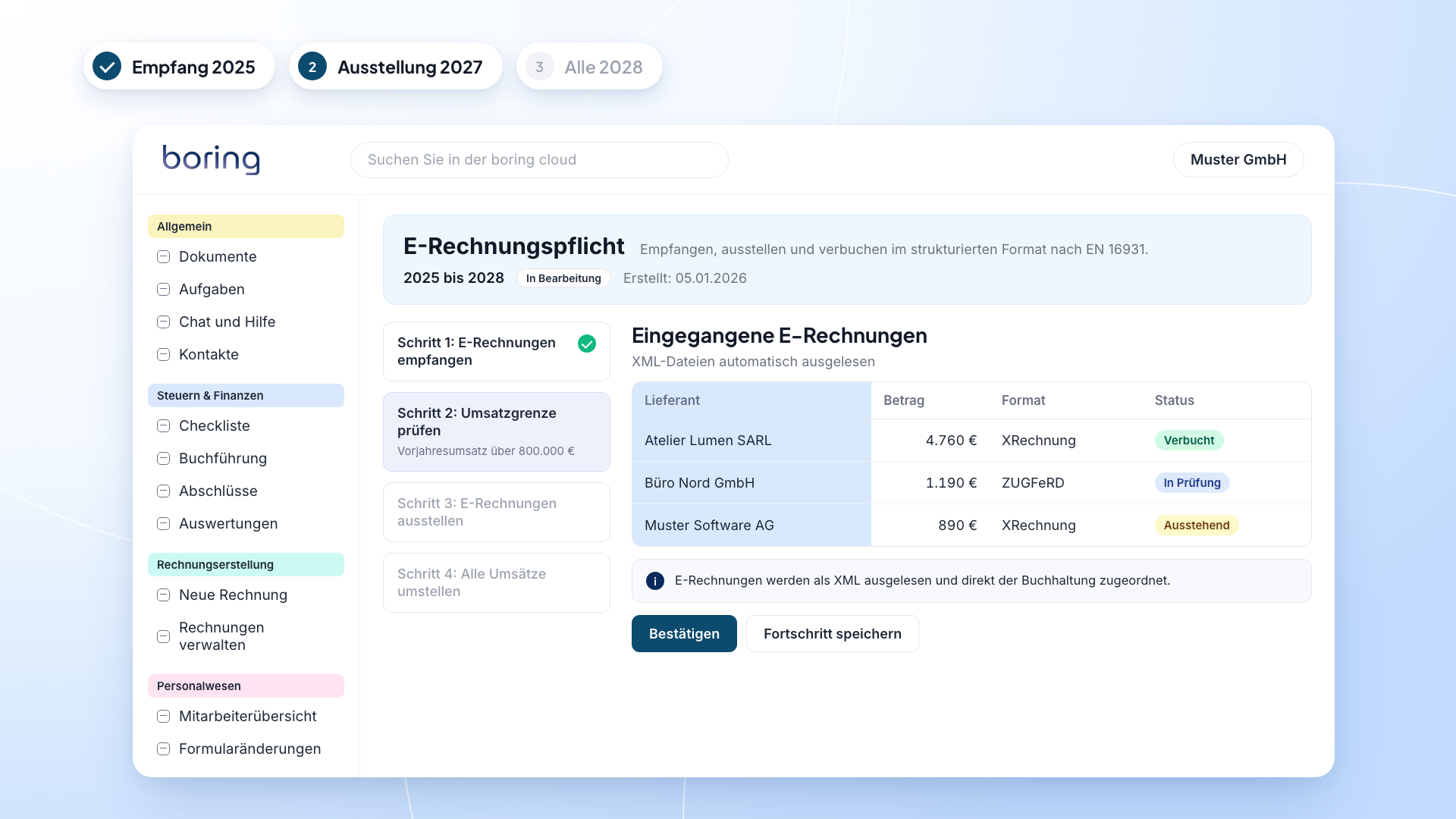
Seit 1.1.2025 musst du als GmbH E-Rechnungen empfangen, ab 1.1.2027 stellst du sie bei über 800.000 EUR Vorjahresumsatz aus, ab 1.1.2028 alle.
Eingang im Postfach: eine XML-Datei statt PDF. Ausgang: Kunden, die ab 2027 nichts anderes mehr akzeptieren. Und dazwischen die Frage, was davon dich wann betrifft.
Dieser Ratgeber klärt die E-Rechnungspflicht für die GmbH Schritt für Schritt: Fristen, Formate, Ausnahmen, Archivierung und eine Checkliste. Bei boring.tax sind E-Rechnungen schon in der Software-Stufe “Ohne Kanzlei” ab 29,99 EUR/Monat enthalten, UStVA übermittelst du dort direkt an ELSTER, und die haftende boring.tax Steuerberatungsgesellschaft mbH (4 Mio. EUR Haftpflichtdeckung) kannst du im selben Konto dazuholen.
Was ist eine E-Rechnung?
Eine E-Rechnung ist eine Rechnung, die in einem strukturierten elektronischen Format ausgestellt, übermittelt und empfangen wird und sich elektronisch weiterverarbeiten lässt. Das Format muss der europäischen Norm EN 16931 entsprechen oder mit ihr interoperabel sein (§ 14 UStG, gesetze-im-internet.de, Stand 26.10.2026).
Zulässig sind laut Bundesfinanzministerium insbesondere XRechnung und ZUGFeRD ab Version 2.0.1, ausgenommen die Profile MINIMUM und BASIC-WL (BMF-FAQ E-Rechnung, Stand März 2026). Die aktuelle ZUGFeRD-Version ist 2.5.2 vom 04.08.2026 (laut FeRD, Stand 04.08.2026).
Ein einfaches PDF ist keine E-Rechnung. Es zählt als “sonstige Rechnung”, genau wie Papier.
Wann gilt welche Pflicht? Der Zeitplan bis 2028
Die E-Rechnungspflicht kommt in Stufen. Empfangen müssen alle sofort, ausstellen müssen zuerst nur größere Unternehmen.
| Zeitraum | Empfangen | Ausstellen (inländisches B2B) |
|---|---|---|
| Seit 1.1.2025 | Pflicht für alle Unternehmen | Übergang: Papier immer erlaubt, PDF mit Zustimmung des Empfängers |
| 2026 | Pflicht | Übergang wie 2025 (nur bei Übermittlung bis 31.12.2026) |
| 2027 | Pflicht | E-Rechnung bei Gesamtumsatz im Vorjahr über 800.000 EUR; bei höchstens 800.000 EUR weiter Papier oder PDF mit Zustimmung |
| Ab 1.1.2028 | Pflicht | E-Rechnung für alle Unternehmen |
Quellen: § 27 UStG (Stand 26.10.2026) und BMF-FAQ (Stand März 2026). Maßgeblich ist der Gesamtumsatz nach § 19 Abs. 2 UStG. EDI-Verfahren, die keine E-Rechnung sind, bleiben bis 31.12.2027 mit Zustimmung des Empfängers zulässig, unabhängig vom Umsatz.
Für GmbH-spezifische Fristen siehe Fristen für Kapitalgesellschaften.
Die Zustimmung zur PDF-Rechnung ist formfrei. Sie kann auch stillschweigend erfolgen, etwa durch widerspruchslose Annahme oder über AGB (BMF-Schreiben vom 15.10.2025, abrufbar über die BMF-FAQ zur E-Rechnung).
Eine Unsicherheit bleibt: Das Gesetzgebungsverfahren zum Jahressteuergesetz 2026 läuft noch. Der Regierungsentwurf (BR-Drs. 447/26 vom 14.08.2026) ändert § 27 Abs. 38 UStG nicht. Plane deshalb mit 1.1.2027 und 1.1.2028.
Muss meine GmbH E-Rechnungen schon empfangen können?
Ja, seit 1.1.2025 und ohne Ausnahme, auch für Kleinunternehmer. Praktisch reicht dafür ein E-Mail-Postfach; ein eigenes Postfach nur für E-Rechnungen ist nicht nötig (BMF-FAQ, Stand März 2026).
Zwischen inländischen Unternehmern braucht eine E-Rechnung keine Zustimmung des Empfängers. Wer sie nicht lesen kann oder die Annahme verweigert, hat keinen Anspruch auf eine Papier- oder PDF-Rechnung (BMF-Schreiben vom 15.10.2025).
Die Finanzverwaltung stellt unter e-rechnung.elster.de einen kostenlosen Viewer für XRechnung und ZUGFeRD bereit. Für gelegentliche Rechnungen genügt das. Bei mehr als einer Handvoll pro Monat willst du, dass deine Buchhaltung die XML-Datei automatisch ausliest.
XRechnung oder ZUGFeRD: Welches Format passt für deine GmbH?
Für GmbH im B2B ist ZUGFeRD ab Version 2.0.1 die Standardwahl, weil dein Kunde sowohl PDF als auch XML erhält. Die XRechnung ist reines XML und stammt aus dem Behördenbereich.
| Format | Dateistruktur | Ideal für | Layout-Lesbarkeit |
|---|---|---|---|
| ZUGFeRD | Hybrid aus PDF und eingebettetem XML; nutze mindestens Version 2.0.1, nicht die Profile MINIMUM oder BASIC-WL | Rechnungen an andere Unternehmen (B2B) | Menschen lesen das PDF, Software liest das XML |
| XRechnung | Reines XML ohne Layout | Kunden, die sie ausdrücklich verlangen, und Lieferungen an Behörden | Nur mit Viewer oder Software lesbar |
Wichtig: Bei ZUGFeRD ist der strukturierte Teil führend. Weichen XML und PDF voneinander ab, gelten die XML-Daten (BMF-FAQ). Alle umsatzsteuerlichen Pflichtangaben müssen im XML stehen; ein Verweis auf eine Anlage oder ein Link genügt nicht (BMF-Schreiben vom 15.10.2025).
Rechnungen an Behörden laufen getrennt über die ERechV (seit 27.11.2020). Im B2B-Bereich brauchst du keine Leitweg-ID.
Welche Ausnahmen gibt es?
Es gibt drei praktische Ausnahmen für die Ausstellungspflicht, die Empfangspflicht gilt immer.
- Kleinbetragsrechnungen bis 250 EUR brutto: Sie dürfen immer als sonstige Rechnung gestellt werden. Maßgeblich ist der Gesamtbetrag (§ 33 UStDV). Das gilt auch für Fahrausweise (§ 34 UStDV).
- Kleinunternehmer nach § 19 UStG: Seit 2025 liegt die Grenze bei höchstens 25.000 EUR im Vorjahr und höchstens 100.000 EUR im laufenden Jahr. Sie dürfen sonstige Rechnungen ausstellen, müssen E-Rechnungen aber empfangen können (§ 34a UStDV). Wechseln sie zur Regelbesteuerung, gilt die Pflicht.
- Kein inländisches B2B-Geschäft: Keine Pflicht gibt es bei Rechnungen an Privatkunden, bei vielen steuerfreien Umsätzen nach § 4 Nr. 8 bis 29 UStG, bei Leistungen an juristische Personen ohne Unternehmereigenschaft und wenn ein Beteiligter nicht im Inland ansässig ist.
Für eine operative GmbH mit Geschäftskunden greift meist keine davon. Und die Gründer:innen-GmbH ohne Umsatz? Auch sie muss empfangen können.
Was passiert, wenn meine GmbH ab 2027 keine E-Rechnung ausstellt?
Besteht die Pflicht und du stellst trotzdem eine sonstige Rechnung aus, ist sie nicht ordnungsgemäß und berechtigt deinen Kunden dem Grunde nach nicht zum Vorsteuerabzug. Solange eine sonstige Rechnung noch erlaubt ist (Übergangszeit), gilt sie dagegen weiter als ordnungsgemäß. Die drei Teile unten trennen Folgen, Heilung und den Umgang mit fehlerhaften Dateien.
1. Folgen und Risiken
Das eigentliche Risiko ist der Vorsteuerabzug deines Kunden. Er wird dich um eine Korrektur bitten.
Eine sonstige Rechnung statt einer Pflicht-E-Rechnung ist keine Ordnungswidrigkeit nach § 26a Abs. 2 Nr. 1 UStG (BMF-Schreiben vom 15.10.2026). Ärger gibt es trotzdem: Rückfragen, Korrekturen, verzögerte Zahlungen.
2. Heilung und Nachweis
Laut BMF-Schreiben vom 15.10.2025 lässt sich der Fehler auf zwei Wegen beheben:
- Du stellst eine nachträgliche E-Rechnung aus, die sich eindeutig auf die ursprüngliche bezieht.
- Dein Kunde führt einen Nachweis nach Abschnitt 15.2a Abs. 1a UStAE. Bei einer inhaltlich richtigen und vollständigen sonstigen Rechnung gelingt das “regelmäßig”.
3. Fehlerbehandlung in Systemen
So behandelt die Finanzverwaltung fehlerhafte Dateien (BMF-Schreiben vom 15.10.2026):
- Eine Datei mit Formatfehler gilt umsatzsteuerlich als sonstige Rechnung.
- Ein Geschäftsregelfehler lässt die E-Rechnung bestehen.
- Nur wenn ein Fehler eine Pflichtangabe betrifft, liegt ein Inhaltsfehler vor.
- Eine fehlende “Buyer reference” (BT-10) ist unbeachtlich.
Auf das Ergebnis einer geeigneten Validierung darfst du dich verlassen. Bewahre den Validierungsbericht auf. Außerdem gilt eine Nichtbeanstandung: E-Rechnungen, die bis 31.12.2026 ausgestellt werden und den Schreiben von 2024/2025 entsprechen, werden auch beim Vorsteuerabzug nicht beanstandet, selbst wenn sie die neuen Vorgaben von 2026 nicht erfüllen.
Wie verbuchst und archivierst du E-Rechnungen GoBD-konform?
Bewahre mindestens die XML-Datei unverändert im Original auf, und zwar 8 Jahre, nicht mehr 10 (§ 14b UStG, § 147 AO, Viertes Bürokratieentlastungsgesetz; § 14b UStG). Das gilt für alle Rechnungen, deren Frist am 31.12.2024 noch nicht abgelaufen war. Die Finanzverwaltung muss die Datei maschinell auswerten können.
Nach den GoBD des Bundesfinanzministeriums (Fassung vom 14.07.2025) reicht der strukturierte Teil. Den PDF-Teil einer ZUGFeRD-Rechnung musst du nur aufbewahren, wenn er zusätzliche oder abweichende steuerlich relevante Informationen enthält, zum Beispiel Buchungsvermerke. Das XML darf nicht durch Umwandlung (etwa in TIFF) verloren gehen.
Zum Vorsteuerabzug: Den bekommst du nur aus dem strukturierten Teil. Enthält der Bildteil abweichende Pflichtangaben, kann er sogar als weitere Rechnung gelten (Risiko nach § 14c UStG).
Wer E-Rechnungen außerhalb eines GoBD-konformen Systems speichert, verstößt laut BMF allein deshalb umsatzsteuerlich regelmäßig nicht gegen § 14b UStG. Die GoBD gelten für andere Zwecke aber weiter. Ein Ordner “Rechnungen” auf dem Desktop ist also keine Lösung.
Praxis-Checkliste: 6 Schritte für eine kleine GmbH
- Postfach prüfen: Läuft dein Rechnungsempfang über eine zentrale Adresse, die jemand wirklich liest? Ein normales E-Mail-Postfach genügt.
- Eingang automatisieren: Lass XML-Rechnungen von deiner Buchhaltung auslesen, statt sie abzutippen oder als PDF zu behandeln.
- Ausgang umstellen: Prüfe deine Rechnungssoftware auf ZUGFeRD ab 2.0.1 oder XRechnung. Lag dein Umsatz 2026 über 800.000 EUR, muss das ab 1.1.2027 stehen.
- Kunden und Lieferanten fragen: Welches Format wollen sie? Wer will weiter PDF, muss zustimmen (bis Ende 2027, wenn du höchstens 800.000 EUR Vorjahresumsatz hattest).
- Archiv klären: XML unverändert ablegen, 8 Jahre, auswertbar.
- Stammdaten aufräumen: Steuernummer oder USt-IdNr., Anschrift, Leistungsbeschreibung und Zahlungsangaben müssen im XML sauber stehen.
Anzahlungs- und Abschlagsrechnungen, die du vor Beginn deiner eigenen Pflicht stellst, müssen noch keine E-Rechnung sein (BMF-Schreiben vom 15.10.2026). Weitere Regeln zu Rabatten, Bauleistungen, Rechnungskorrekturen und Bruttopreisrechnungen stehen im selben Schreiben.
Welche Software kann E-Rechnungen empfangen, auslesen und verbuchen?
Prüfe jede Software an fünf Kriterien, bevor du dich festlegst:
- Empfängt sie XRechnung und ZUGFeRD ab 2.0.1?
- Liest sie das XML automatisch aus?
- Archiviert sie das XML unverändert?
- Erstellt sie selbst ZUGFeRD und XRechnung?
- Ist der Preis öffentlich und planbar?
boring.tax deckt laut eigener Website die Kriterien 1, 2 und 4 ab: E-Rechnungen erstellen, eingehende E-Rechnungen automatisch auslesen, Konvertierung nach ZUGFeRD und XRechnung. Du prüfst und gibst frei. Zu Kriterium 3 (unveränderte XML-Archivierung) liegt mir keine belegte Aussage vor; kläre das vor der Entscheidung direkt mit dem boring.tax-Support. Beim Preis gilt: fest und öffentlich, mit Preisrechner. Nicht abgedeckt: Die Stufe “Ohne Kanzlei” enthält keine Steuerberatung und den Jahresabschluss nur in Eigenregie, und das Gesamtpaket passt nicht für Einzelunternehmen und Freiberufler mit EÜR.
Das Team entwickelt außerdem aktiv an mustangproject mit, einer Open-Source-Bibliothek zum Erstellen und Prüfen von ZUGFeRD/Factur-X und XRechnung. Ehrlich gesagt: Das ist kein Garant für fehlerfreie Rechnungen, aber du siehst, dass das Thema im Haus gelebt wird.
Zu anderen Anbietern (Stand Oktober 2026): DATEV ist vor allem über Steuerkanzleien verbreitet; die Software und die steuerliche Beratung kommen dort in der Regel von getrennten Parteien, während bei boring.tax Software, KI-Agent und die eigene haftende Steuerberatungsgesellschaft im selben Konto liegen. Lexware Office ist laut Website eine Software für die eigene Buchhaltung ohne eigene Steuerkanzlei; bei boring.tax kannst du die Kanzlei im selben Konto dazubuchen, zu festen öffentlichen Preisen.
Klassische Kanzlei oder boring.tax: Was kostet die Umstellung?
Die Umstellung auf E-Rechnungen ist technisch klein. Teuer wird sie nur, wenn jemand Rechnung für Rechnung manuell nacharbeitet.
| Option | Was du bekommst | Preis (netto, Stand 09.11.2026) |
|---|---|---|
| boring.tax “Ohne Kanzlei” | Software + MCP, E-Rechnung erstellen und empfangen, keine Steuerberatung, Jahresabschluss nur in Eigenregie (bei jährlicher Zahlung eine Einreichung pro Jahr inklusive, sonst 99 EUR je Einreichung) | ab 29,99 EUR/Monat |
| boring.tax “Mit boring-Buchhaltern” | Menschliche Buchhaltung, geprüfter Monatsabschluss | 100 bis 400 EUR/Monat je nach Umsatz |
| boring.tax Gesamtpaket “Mit Kanzlei + Steuerberater” | UStVA, Jahresabschluss, KSt/GewSt, E-Bilanz, Beratung | 335 bis 890 EUR/Monat je nach Umsatz |
| Klassische Steuerkanzlei | Individuell, meist Abrechnung nach Gebührenordnung | Auf Anfrage |
Beispiel: Eine GmbH mit 250.000 EUR Umsatz zahlt für drei klar getrennte Leistungen unterschiedlich. “Ohne Kanzlei” (nur Software + MCP, ohne Steuerberatung, Jahresabschluss nur in Eigenregie) kostet 29,99 EUR/Monat oder 299 EUR/Jahr bei Jahreszahlung; dann ist eine Einreichung des Jahresabschlusses pro Jahr enthalten, bei monatlicher Zahlung kostet jede 99 EUR. “Mit boring-Buchhaltern” (menschliche Buchhaltung) liegt in diesem Umsatzband bei 200 EUR/Monat. Steuerberatung und Jahresabschluss gibt es nur im Gesamtpaket “Mit Kanzlei + Steuerberater”, das bei diesem Umsatz 520 EUR/Monat kostet. Die aktuellen Preise findest du auf der Preisseite.
Der Unterschied zur klassischen Kanzlei: Bei boring.tax siehst du den Preis vorab öffentlich und kannst ihn mit dem Preisrechner selbst ermitteln. Eine klassische Kanzlei rechnet meist nach Gebührenordnung ab, die Kosten ergeben sich also erst aus Umfang und Aufwand. Vergleiche deshalb ein konkretes Angebot deiner Kanzlei mit den festen Stufen.
So unterstützt dich boring.tax
In der Stufe “Ohne Kanzlei” (ab 29,99 EUR/Monat, Stand 09.11.2026) bekommst du Software und KI-Agenten für die laufende Buchhaltung. Das ist keine Steuerberatung; den Jahresabschluss machst du dort nur in Eigenregie (bei jährlicher Zahlung eine Einreichung pro Jahr inklusive, sonst 99 EUR je Einreichung). Belege kommen per E-Mail, WhatsApp, Upload, API oder Qonto rein, die Bank hängt über finAPI dran.
Was im Hintergrund für dich arbeitet: Eingehende XML-Rechnungen werden automatisch ausgelesen. Eigene Rechnungen schreibst du in boring und erzeugst sie als ZUGFeRD oder XRechnung; auch Mahnwesen und wiederkehrende Rechnungen sind dabei. Mehr dazu im Artikel zum Debitorenmanagement.
Du behältst die Kontrolle: Nichts geht ohne deine Freigabe ans Finanzamt. In der Software-Stufe bereitest du die UStVA in boring vor und übermittelst sie selbst direkt an ELSTER (so funktioniert es). Die Daten liegen in Deutschland, und über 330 zahlende Unternehmen nutzen boring.tax (Stand August 2026).
Und wenn du deine Kanzlei behalten willst? Dann bleibt sie. Mit der Stufe “Mit Kanzlei + Steuerberater” übernimmt die boring.tax Steuerberatungsgesellschaft mbH (in einzelnen Fällen eine Partnerkanzlei) UStVA, Jahresabschluss und Beratung, ohne Datenmigration.
Ein Blick auf die weiteren Fristen lohnt sich ebenfalls: Fristen für Kapitalgesellschaften.
Was kommt nach 2028?
Die EU hat das ViDA-Paket (Richtlinie (EU) 2025/516) am 11.03.2025 beschlossen und am 25.03.2025 veröffentlicht, seit 14.04.2025 ist es in Kraft. Seitdem dürfen Mitgliedstaaten unter Bedingungen eine E-Rechnungspflicht einführen. Ab 01.07.2030 gelten digitale Meldepflichten für grenzüberschreitende B2B-Umsätze; bis 01.01.2035 müssen bestehende nationale Meldesysteme an das EU-Modell angeglichen sein (EU-Kommission, Stand 26.10.2026).
Das deutsche Meldesystem folgt laut BMF “zu einem späteren Zeitpunkt”. Im Finanzausschuss sprach die Koalition davon, dass es “europarechtlich ab 2030 zwingend” sei (Bundestagsdrucksache 21/7070, Stand 09.07.2026). Ein konkretes deutsches Startdatum ist amtlich nicht belegt. Saubere XML-Daten sind aber so oder so die Grundlage.
Häufige Fragen
Was bedeutet die E-Rechnungspflicht für meine GmbH ab 2025, 2027 und 2028? Seit 2025 musst du E-Rechnungen empfangen, ab 1.1.2027 ausstellen, wenn dein Vorjahresumsatz über 800.000 EUR lag, und ab 1.1.2028 gilt die Ausstellungspflicht für alle. In den Übergangsjahren bleiben Papier und (mit Zustimmung) PDF erlaubt.
Ab wann muss ich E-Rechnungen ausstellen und wie lange reicht noch eine PDF-Rechnung? Bei über 800.000 EUR Gesamtumsatz im Vorjahr ab 1.1.2027, sonst ab 1.1.2028. Bis dahin reicht ein PDF nur mit Zustimmung des Empfängers, die auch stillschweigend erfolgen kann.
Muss meine GmbH E-Rechnungen schon empfangen können? Ja, seit 1.1.2025 ohne Ausnahme. Ein normales E-Mail-Postfach reicht, den ELSTER-Viewer kannst du kostenlos zum Lesen nutzen.
XRechnung oder ZUGFeRD: Welches Format sollte meine GmbH nutzen? ZUGFeRD ab Version 2.0.1 (nicht MINIMUM oder BASIC-WL), weil du so XML und lesbares PDF in einer Datei lieferst. Die XRechnung nimmst du, wenn dein Kunde sie verlangt oder du Behörden belieferst.
Wie archiviere ich E-Rechnungen GoBD-konform? Speichere das XML unverändert und maschinell auswertbar für 8 Jahre. Den PDF-Teil brauchst du nur, wenn er zusätzliche oder abweichende steuerlich relevante Angaben enthält.
Was passiert, wenn meine GmbH ab 2027 keine E-Rechnung ausstellt? Wenn die Pflicht besteht, ist die sonstige Rechnung nicht ordnungsgemäß und berechtigt den Kunden dem Grunde nach nicht zum Vorsteuerabzug. Du kannst sie durch eine nachträgliche E-Rechnung heilen. Eine Ordnungswidrigkeit ist es laut BMF nicht.
Wir bekommen immer mehr E-Rechnungen als XML. Wer stellt unsere Buchhaltung darauf um? boring.tax liest eingehende XML-Rechnungen automatisch aus, und du gibst sie frei. Eigene Rechnungen erzeugst du als ZUGFeRD oder XRechnung. Wenn du die laufende Buchhaltung lieber abgeben willst, nimm “Mit boring-Buchhaltern” (ab 100 EUR/Monat) oder das Gesamtpaket mit Steuerberatungsteam (ab 335 EUR/Monat).
Gibt es einen Buchhaltungsservice, der die Umstellung auf E-Rechnungen komplett übernimmt? Im Gesamtpaket “Mit Kanzlei + Steuerberater” übernimmt das Steuerberatungsteam Buchhaltung, UStVA und Jahresabschluss, während die Software eingehende E-Rechnungen ausliest und eigene als ZUGFeRD oder XRechnung erzeugt. Bei über 1 Mio. EUR Umsatz oder überfälligen Jahresabschlüssen bekommst du ein individuelles Angebot nach einem Gespräch.
Bereit, es auszuprobieren?
Teste boring.tax 14 Tage kostenlos, ohne Kreditkarte und ohne Verkaufsgespräch. Lade eine echte Eingangsrechnung als XML hoch und schau, ob das Auslesen stimmt.
E-Rechnung rein. Buchung raus. So soll Steuer sein: boring.
Noch kein boring.tax-Kunde? Jetzt kostenlos starten →
E-Invoicing Mandate 2025, 2027 and 2028: What Your GmbH Now Has to Receive, Issue and Book
Since 1 January 2025, your GmbH has to be able to receive e-invoices. From 1 January 2027 you must issue them if your prior-year revenue exceeded EUR 800,000, and from 1 January 2028 everyone must.
Incoming: an XML file instead of a PDF. Outgoing: customers who from 2027 will accept nothing else. And in between, the question of what applies to you and when.
This guide walks you through the e-invoicing mandate for a GmbH step by step: deadlines, formats, exceptions, archiving and a checklist. At boring.tax, e-invoices are already included in the software tier “Ohne Kanzlei” from EUR 29.99/month, you submit your VAT return (UStVA) directly to ELSTER there, and you can add the liable boring.tax Steuerberatungsgesellschaft mbH (EUR 4 million liability insurance cover) in the same account.
What is an e-invoice?
An e-invoice is an invoice that is issued, transmitted and received in a structured electronic format and can be processed electronically. The format must comply with the European standard EN 16931 or be interoperable with it (§ 14 UStG, gesetze-im-internet.de, as of 26.10.2026).
According to the Federal Ministry of Finance, XRechnung and ZUGFeRD from version 2.0.1 are in particular permitted, except for the MINIMUM and BASIC-WL profiles (BMF FAQ on e-invoicing, as of March 2026). The current ZUGFeRD version is 2.5.2 of 04.08.2026 (according to FeRD, as of 04.08.2026).
A plain PDF is not an e-invoice. It counts as an “other invoice” (sonstige Rechnung), just like paper.
Which obligation applies when? The timeline to 2028
The e-invoicing mandate arrives in stages. Everyone has to receive immediately, while only larger companies have to issue at first.
| Period | Receiving | Issuing (domestic B2B) |
|---|---|---|
| Since 1.1.2025 | Mandatory for all companies | Transition: paper always allowed, PDF with the recipient’s consent |
| 2026 | Mandatory | Transition as in 2025 (only for invoices sent by 31.12.2026) |
| 2027 | Mandatory | E-invoice if total revenue in the prior year exceeded EUR 800,000; at EUR 800,000 or less, paper or PDF with consent still works |
| From 1.1.2028 | Mandatory | E-invoice for all companies |
Sources: § 27 UStG (as of 26.10.2026) and BMF FAQ (as of March 2026). What counts is total revenue under § 19 Abs. 2 UStG. EDI procedures that are not e-invoices remain permitted until 31.12.2027 with the recipient’s consent, regardless of revenue.
For deadlines specific to a GmbH, see deadlines for corporations.
Consent to a PDF invoice needs no particular form. It can also be given tacitly, for example by accepting the invoice without objection or through general terms and conditions (BMF letter of 15.10.2025, available via the BMF FAQ on e-invoicing).
One uncertainty remains: the legislative process for the Annual Tax Act 2026 (Jahressteuergesetz 2026) is still ongoing. The government draft (BR-Drs. 447/26 of 14.08.2026) does not change § 27 Abs. 38 UStG. So plan with 1 January 2027 and 1 January 2028.
Does my GmbH already have to be able to receive e-invoices?
Yes, since 1 January 2025 and without exception, including for small businesses (Kleinunternehmer). In practice, an email inbox is enough; you do not need a separate inbox just for e-invoices (BMF FAQ, as of March 2026).
Between domestic businesses, an e-invoice needs no consent from the recipient. Anyone who cannot read it or refuses to accept it has no claim to a paper or PDF invoice (BMF letter of 15.10.2025).
The tax authorities provide a free viewer for XRechnung and ZUGFeRD at e-rechnung.elster.de. For occasional invoices that is enough. Once you get more than a handful per month, you will want your bookkeeping to read the XML file automatically.
XRechnung or ZUGFeRD: Which format fits your GmbH?
For a GmbH in B2B, ZUGFeRD from version 2.0.1 is the standard choice, because your customer receives both a PDF and XML. XRechnung is pure XML and comes from the public-sector world.
| Format | File structure | Ideal for | Readability of layout |
|---|---|---|---|
| ZUGFeRD | Hybrid of PDF and embedded XML; use at least version 2.0.1, not the MINIMUM or BASIC-WL profiles | Invoices to other businesses (B2B) | People read the PDF, software reads the XML |
| XRechnung | Pure XML without layout | Customers who explicitly require it, and deliveries to public authorities | Readable only with a viewer or software |
Important: with ZUGFeRD, the structured part takes precedence. If XML and PDF differ, the XML data applies (BMF FAQ). All mandatory VAT details must be in the XML; a reference to an attachment or a link is not enough (BMF letter of 15.10.2025).
Invoices to public authorities run separately under the ERechV (since 27.11.2020). In B2B you do not need a Leitweg-ID.
What exceptions are there?
There are three practical exceptions to the obligation to issue; the obligation to receive always applies.
- Small-amount invoices up to EUR 250 gross: They may always be issued as an other invoice. The total amount is what counts (§ 33 UStDV). This also applies to tickets (§ 34 UStDV).
- Small businesses under § 19 UStG: Since 2025, the threshold is at most EUR 25,000 in the prior year and at most EUR 100,000 in the current year. They may issue other invoices but must be able to receive e-invoices (§ 34a UStDV). If they switch to standard taxation, the obligation applies.
- No domestic B2B transaction: There is no obligation for invoices to private customers, for many tax-exempt transactions under § 4 Nr. 8 to 29 UStG, for services to legal entities that are not businesses, or when a party is not resident in Germany.
For an operating GmbH with business customers, none of these usually applies. And what about the founder-run GmbH with no revenue? It also has to be able to receive.
What happens if my GmbH does not issue an e-invoice from 2027?
If the obligation applies and you issue an other invoice anyway, it is not a proper invoice and in principle does not entitle your customer to deduct input VAT. As long as an other invoice is still permitted (transition period), it continues to count as proper. The three parts below separate the consequences, the cure and the handling of faulty files.
1. Consequences and risks
The real risk is your customer’s input VAT deduction. They will ask you for a correction.
Issuing an other invoice instead of a mandatory e-invoice is not an administrative offense under § 26a Abs. 2 Nr. 1 UStG (BMF letter of 15.10.2026). You can still expect trouble: follow-up questions, corrections, delayed payments.
2. Cure and proof
According to the BMF letter of 15.10.2025, the error can be fixed in two ways:
- You issue a subsequent e-invoice that clearly refers to the original one.
- Your customer provides proof under Abschnitt 15.2a Abs. 1a UStAE. With an other invoice that is correct and complete in content, this “regularly” succeeds.
3. Error handling in systems
This is how the tax authorities treat faulty files (BMF letter of 15.10.2026):
- A file with a format error counts as an other invoice for VAT purposes.
- A business rule error leaves the e-invoice intact.
- Only if an error affects a mandatory detail is there a content error.
- A missing “Buyer reference” (BT-10) is irrelevant.
You may rely on the result of a suitable validation. Keep the validation report. There is also a non-objection rule: e-invoices issued by 31.12.2026 that comply with the letters of 2024/2025 will not be challenged, including for input VAT deduction, even if they do not meet the new 2026 requirements.
How do you book and archive e-invoices in a GoBD-compliant way?
Keep at least the XML file unchanged in its original form, for 8 years, no longer 10 (§ 14b UStG, § 147 AO, Fourth Bureaucracy Relief Act; § 14b UStG). This applies to all invoices whose retention period had not yet expired on 31.12.2024. The tax authorities must be able to evaluate the file by machine.
According to the GoBD of the Federal Ministry of Finance (version of 14.07.2025), the structured part is sufficient. You only have to keep the PDF part of a ZUGFeRD invoice if it contains additional or differing tax-relevant information, for example booking notes. The XML must not be lost through conversion (for instance to TIFF).
On input VAT deduction: you only get it from the structured part. If the image part contains differing mandatory details, it can even count as a further invoice (risk under § 14c UStG).
According to the BMF, anyone who stores e-invoices outside a GoBD-compliant system does not, for that reason alone, regularly violate § 14b UStG for VAT purposes. The GoBD continue to apply for other purposes, though. So a folder called “Invoices” on the desktop is not a solution.
Practical checklist: 6 steps for a small GmbH
- Check your inbox: Does your invoice intake run through a central address that someone actually reads? A normal email inbox is enough.
- Automate intake: Have your bookkeeping read XML invoices instead of retyping them or treating them as PDFs.
- Switch outgoing invoices: Check whether your invoicing software supports ZUGFeRD from 2.0.1 or XRechnung. If your revenue in 2026 was over EUR 800,000, this must be in place from 1.1.2027.
- Ask customers and suppliers: Which format do they want? Anyone who wants to stay with PDF must consent (until the end of 2027 if your prior-year revenue was EUR 800,000 or less).
- Sort out the archive: Store the XML unchanged, for 8 years, machine-readable.
- Clean up master data: Tax number or VAT ID, address, service description and payment details must be correct in the XML.
Down payment and partial payment invoices that you issue before your own obligation begins do not yet have to be e-invoices (BMF letter of 15.10.2026). Further rules on discounts, construction services, invoice corrections and gross-price invoices are in the same letter.
Which software can receive, read and book e-invoices?
Check any software against five criteria before you commit:
- Does it receive XRechnung and ZUGFeRD from 2.0.1?
- Does it read the XML automatically?
- Does it archive the XML unchanged?
- Does it create ZUGFeRD and XRechnung itself?
- Is the price public and predictable?
According to its own website, boring.tax covers criteria 1, 2 and 4: creating e-invoices, automatically reading incoming e-invoices, and conversion to ZUGFeRD and XRechnung. You review and approve. For criterion 3 (unchanged XML archiving), I have no verified statement; clarify this directly with boring.tax support before deciding. On price: fixed and public, with a price calculator. Not covered: the “Ohne Kanzlei” tier includes no tax advice and annual financial statements only on your own, and the full package is not a fit for sole proprietors and freelancers with simple cash-basis accounting (EÜR).
The team also actively contributes to mustangproject, an open-source library for creating and validating ZUGFeRD/Factur-X and XRechnung. To be honest: that is no guarantee of error-free invoices, but it shows that the topic is taken seriously in-house.
On other providers (as of October 2026): DATEV is mainly distributed through tax firms; there, the software and the tax advice usually come from separate parties, whereas at boring.tax the software, AI agent and the in-house liable tax advisory firm sit in the same account. According to its website, Lexware Office is software for your own bookkeeping without an in-house tax firm; with boring.tax you can add the firm in the same account, at fixed public prices.
Traditional tax firm or boring.tax: What does the switch cost?
Switching to e-invoices is technically small. It only gets expensive if someone reworks invoices manually, one by one.
| Option | What you get | Price (net, as of 09.11.2026) |
|---|---|---|
| boring.tax “Ohne Kanzlei” | Software + MCP, create and receive e-invoices, no tax advice, annual financial statements only on your own (one submission a year included with yearly billing, otherwise EUR 99 each) | from EUR 29.99/month |
| boring.tax “Mit boring-Buchhaltern” | Human bookkeeping, reviewed monthly close | EUR 100 to 400/month depending on revenue |
| boring.tax full package “Mit Kanzlei + Steuerberater” | UStVA, annual financial statements, corporate and trade tax, E-Bilanz, advice | EUR 335 to 890/month depending on revenue |
| Traditional tax firm | Individual, usually billed under the fee schedule | On request |
Example: a GmbH with EUR 250,000 revenue pays different amounts for three clearly separate services. “Ohne Kanzlei” (Software + MCP only, without tax advice, annual financial statements only on your own) costs EUR 29.99/month or EUR 299/year with annual payment; that includes one annual financial statements submission a year, while with monthly payment each costs EUR 99. “Mit boring-Buchhaltern” (human bookkeeping) is EUR 200/month in this revenue band. Tax advice and annual financial statements are only available in the full package “Mit Kanzlei + Steuerberater”, which costs EUR 520/month at this revenue. You can find current prices on the pricing page.
The difference from a traditional tax firm: at boring.tax you see the price publicly up front and can work it out yourself with the price calculator. A traditional firm usually bills under the fee schedule, so costs only emerge from scope and effort. That is why you should compare a concrete quote from your firm with the fixed tiers.
How boring.tax supports you
In the “Ohne Kanzlei” tier (from EUR 29.99/month, as of 09.11.2026) you get software and AI agents for day-to-day bookkeeping. It is not tax advice; annual financial statements are only on your own (one submission a year included with yearly billing, otherwise EUR 99 each). Receipts arrive by email, WhatsApp, upload, API or Qonto, and your bank connects via finAPI.
What works in the background for you: Incoming XML invoices are read automatically. You write your own invoices in boring and generate them as ZUGFeRD or XRechnung; dunning and recurring invoices are included too. More in the article on receivables management.
You stay in control: Nothing goes to the tax office without your approval. In the software tier, you prepare the UStVA in boring and submit it yourself directly to ELSTER (here is how it works). Your data is stored in Germany, and over 330 paying companies use boring.tax (as of August 2026).
And if you want to keep your tax firm? Then it stays. With the “Mit Kanzlei + Steuerberater” tier, the boring.tax Steuerberatungsgesellschaft mbH (in individual cases a partner firm) takes over the UStVA, annual financial statements and advice, without data migration.
A look at the other deadlines is worthwhile too: deadlines for corporations.
What comes after 2028?
The EU adopted the ViDA package (Directive (EU) 2025/516) on 11.03.2025 and published it on 25.03.2025; it has been in force since 14.04.2025. Since then, member states may introduce an e-invoicing mandate under certain conditions. From 01.07.2030, digital reporting obligations apply to cross-border B2B transactions; by 01.01.2035, existing national reporting systems must be aligned with the EU model (EU Commission, as of 26.10.2026).
According to the BMF, the German reporting system will follow “at a later point in time”. In the Finance Committee, the governing coalition said it was “mandatory under European law from 2030” (Bundestagsdrucksache 21/7070, as of 09.07.2026). A concrete German start date is not officially documented. Clean XML data is the foundation either way.
FAQ
What does the e-invoicing mandate mean for my GmbH from 2025, 2027 and 2028? Since 2025 you have to receive e-invoices, from 1.1.2027 you have to issue them if your prior-year revenue was over EUR 800,000, and from 1.1.2028 the obligation to issue applies to everyone. During the transition years, paper and (with consent) PDF remain allowed.
When do I have to issue e-invoices, and how long can I still use a PDF invoice? From 1.1.2027 if total revenue in the prior year was over EUR 800,000, otherwise from 1.1.2028. Until then, a PDF is only enough with the recipient’s consent, which can also be given tacitly.
Does my GmbH already have to be able to receive e-invoices? Yes, since 1.1.2025 without exception. A normal email inbox is enough, and you can use the ELSTER viewer for free to read them.
XRechnung or ZUGFeRD: Which format should my GmbH use? ZUGFeRD from version 2.0.1 (not MINIMUM or BASIC-WL), because that way you deliver XML and a readable PDF in one file. Use XRechnung when your customer requires it or you supply public authorities.
How do I archive e-invoices in a GoBD-compliant way? Store the XML unchanged and machine-readable for 8 years. You only need the PDF part if it contains additional or differing tax-relevant details.
What happens if my GmbH does not issue an e-invoice from 2027? If the obligation applies, the other invoice is not a proper invoice and in principle does not entitle the customer to deduct input VAT. You can cure it with a subsequent e-invoice. According to the BMF, it is not an administrative offense.
We are receiving more and more e-invoices as XML. Who will switch our bookkeeping over? boring.tax reads incoming XML invoices automatically, and you approve them. You generate your own invoices as ZUGFeRD or XRechnung. If you would rather hand off day-to-day bookkeeping, choose “Mit boring-Buchhaltern” (from EUR 100/month) or the full package with a tax advisory team (from EUR 335/month).
Is there a bookkeeping service that fully takes over the switch to e-invoices? In the full package “Mit Kanzlei + Steuerberater”, the tax advisory team takes over bookkeeping, UStVA and annual financial statements, while the software reads incoming e-invoices and generates your own as ZUGFeRD or XRechnung. For revenue over EUR 1 million or overdue annual financial statements, you get an individual quote after a conversation.
Ready to try it out?
Try boring.tax free for 14 days, with no credit card and no sales call. Upload a real incoming invoice as XML and see whether the extraction is right.
E-invoice in. Booking out. That’s how tax should be: boring.
Not yet a boring.tax user? Start for free →