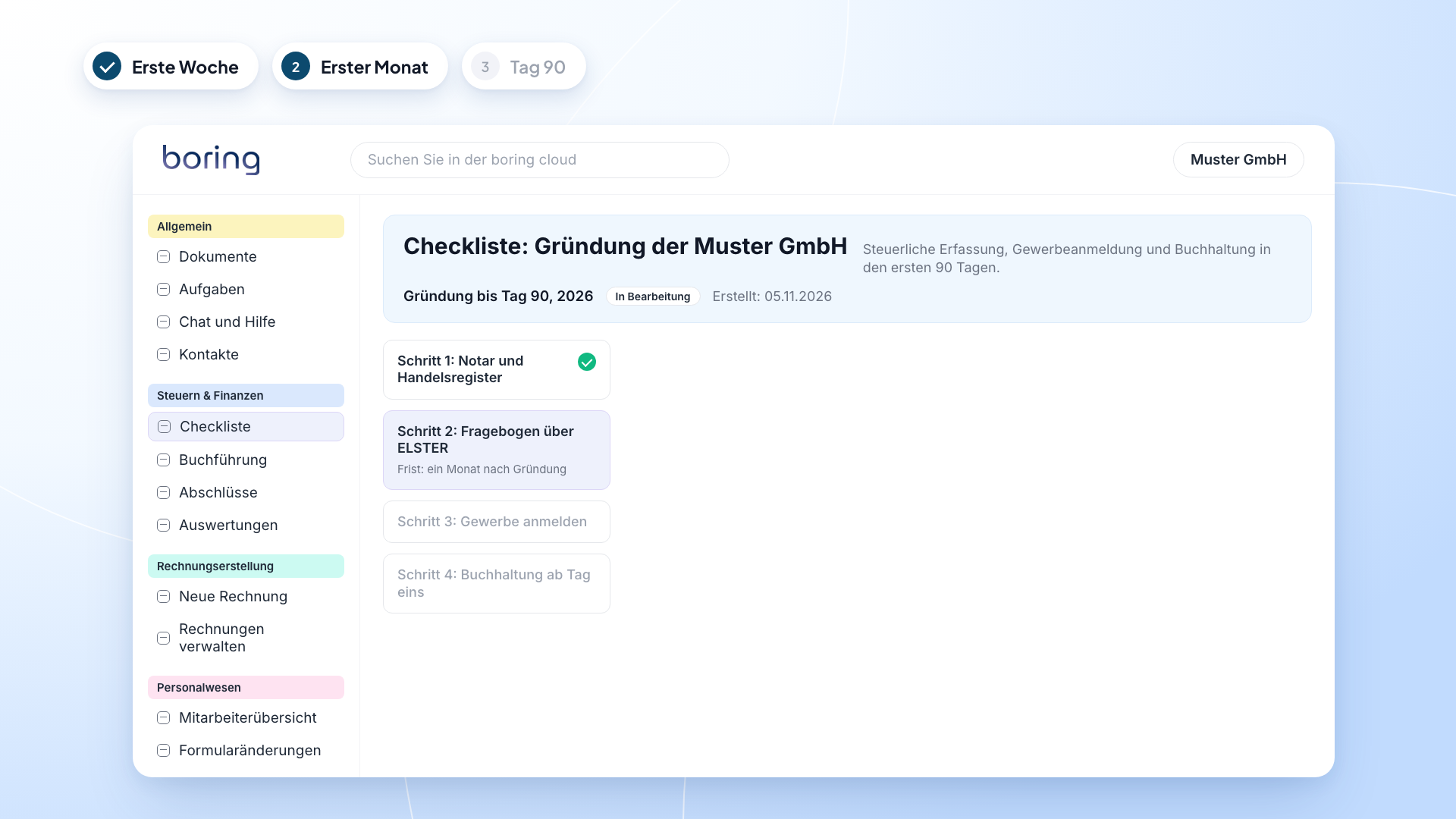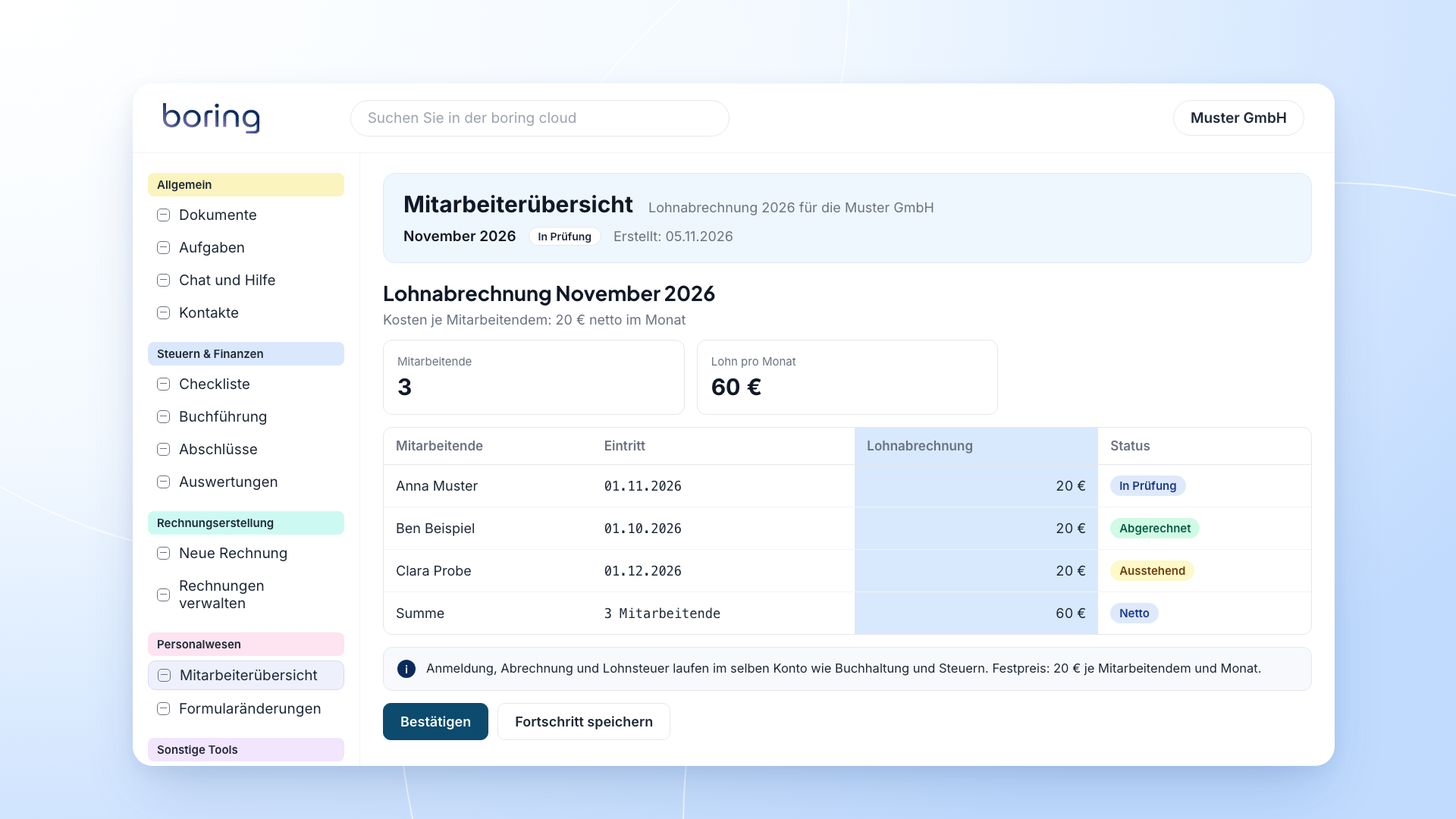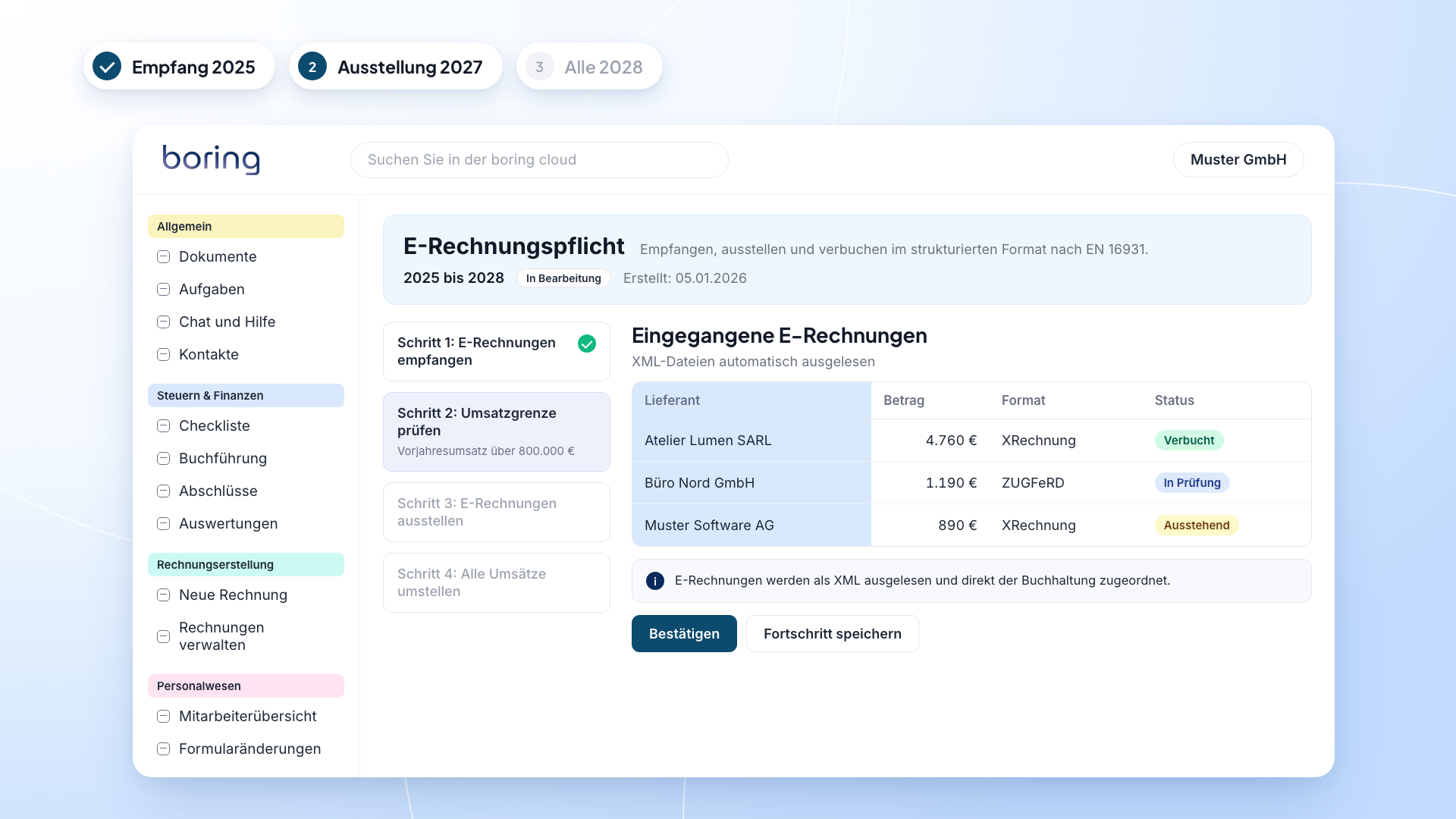
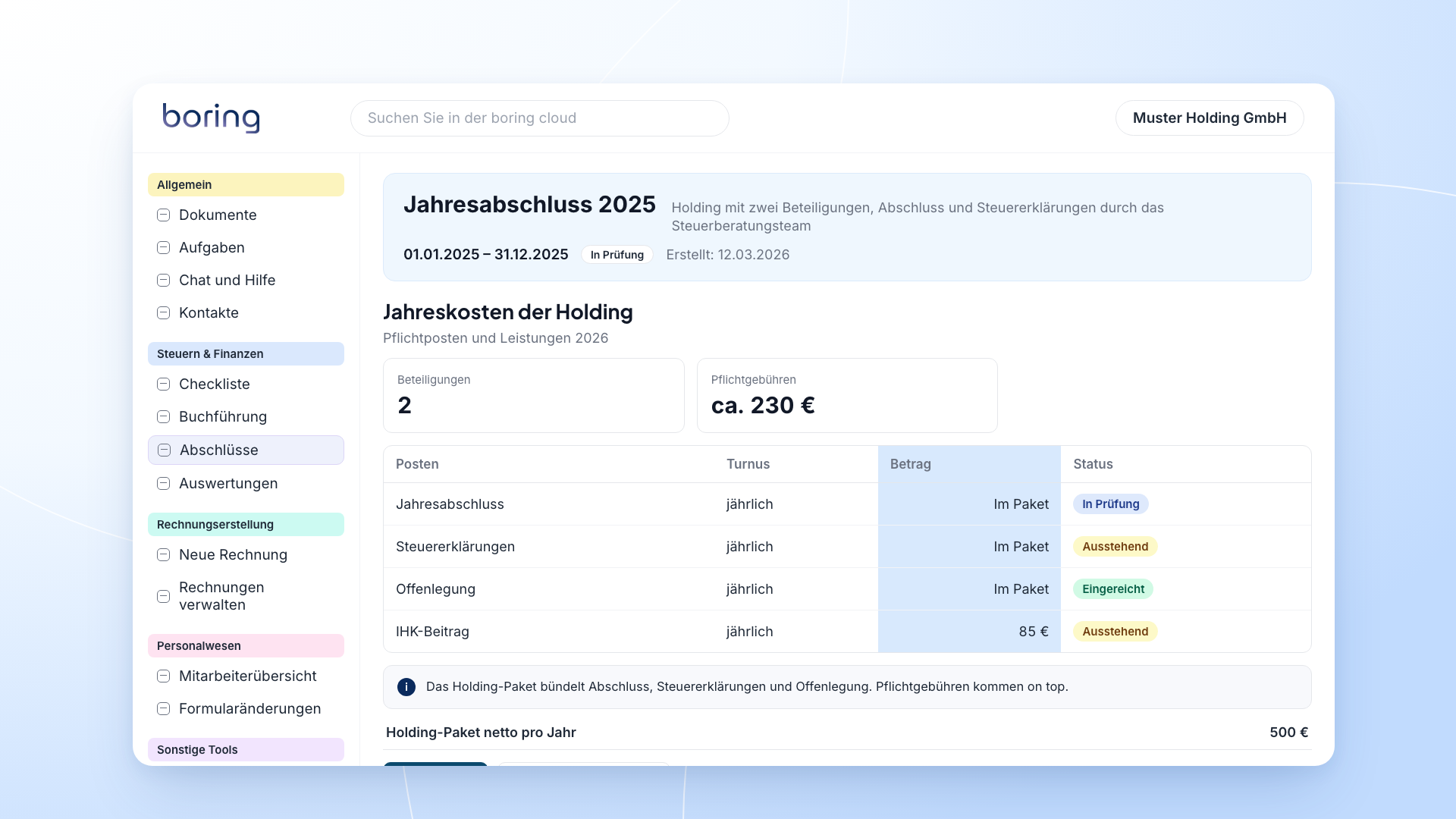
Eine Holding mit ein paar Beteiligungen und kaum Buchungen. Trotzdem kommt jedes Jahr Post: Jahresabschluss, Steuererklärungen, Offenlegung, Rechnungen von IHK und Register.
Holding-GmbH Kosten pro Jahr: etwa 200 bis 260 EUR Pflichtgebühren, dazu Abschluss und Steuererklärungen ab 389 EUR im Festpreis (laut Website von Resolvio, Stand 05.11.2026) oder 500 EUR im Holding-Paket von boring.tax. Bei boring.tax läuft die operative GmbH im selben Konto mit derselben Steuerberatungsgesellschaft, ohne Datenumzug zwischen zwei Dienstleistern.
Bei boring.tax kostet das Holding-Paket 500 EUR pro Jahr netto für eine Beteiligung (Stand 25.09.2026), erstellt von der boring.tax Steuerberatungsgesellschaft mbH (in einzelnen Fällen eine Partnerkanzlei) mit 4 Mio. EUR Haftpflichtdeckung. Über 330 zahlende Unternehmen nutzen boring.tax (Stand August 2026). Hier siehst du, welche Posten unvermeidbar sind, was die Steuerberatung nach Gebührenordnung kosten kann und ab wann sich die Holding rechnet.
Was ist eine Holding-GmbH?
Eine Holding-GmbH ist eine Kapitalgesellschaft, die Anteile an anderen Unternehmen hält, verwaltet und verkauft, meist an deiner operativen GmbH. Rechtlich ist sie eine ganz normale GmbH: Nach § 13 GmbHG gilt sie als Handelsgesellschaft und ist voll buchführungspflichtig, auch mit nur drei Buchungen im Jahr.
Das ist der Kern der Kosten. Eine Befreiung wie bei Einzelkaufleuten (§ 241a HGB) gibt es für die GmbH nicht.
Welche Pflichten hat eine Holding-GmbH jedes Jahr?
Jede Holding-GmbH hat sieben feste Jahrespflichten:
- Buchführung nach § 238 HGB, laufend übers Jahr.
- Jahresabschluss aus Bilanz, GuV und Anhang, bei kleinen Gesellschaften bis zu sechs Monate nach Jahresende (§ 264 HGB).
- Körperschaftsteuererklärung, elektronisch. Mit Steuerberatung endet die Frist am letzten Tag des Februars des zweiten Folgejahres (§ 149 Abs. 3 AO). Für 2025 wäre das der 28.02.2027, ein Sonntag, also gilt der 01.03.2027.
- Gewerbesteuererklärung: Die Kapitalgesellschaft gilt “stets und in vollem Umfang” als Gewerbebetrieb (§ 2 Abs. 2 GewStG), auch als reine Holding.
- E-Bilanz mit unverdichteten Kontennachweisen, schon für 2025 (§ 5b EStG).
- Offenlegung: Spätestens ein Jahr nach dem Abschlussstichtag übermittelst du die Unterlagen elektronisch an die das Unternehmensregister führende Stelle, die sie dort veröffentlicht (§ 325 HGB). Für 2025 endet die Frist am 31.12.2026.
- Transparenzregister: Die Angaben zu den wirtschaftlich Berechtigten müssen aktuell sein (§ 20 GwG).
Beim Punkt Offenlegung gibt es eine Besonderheit. Eine reine Beteiligungsholding darf ihre Bilanz nicht hinterlegen, sie muss Bilanz und Anhang veröffentlichen (§ 267a Abs. 3 Nr. 3 HGB). Die Kleinstkapitalgesellschaft-Erleichterungen entfallen also, wenn die Holding nur Anteile hält und nicht in die Verwaltung der Töchter eingreift. Hinterlegen darf nur eine Holding, die mehr tut als Anteile zu halten, zum Beispiel weil sie der Tochter Managementleistungen erbringt. Was “eingreifen” genau heißt, ist amtlich nicht geklärt; lass das im Einzelfall von deiner Steuerberatung einordnen.
Muss eine Holding-GmbH eine Umsatzsteuervoranmeldung abgeben?
Eine reine Finanzholding gibt keine Umsatzsteuervoranmeldung ab, weil sie umsatzsteuerlich kein Unternehmer ist. Nach dem Umsatzsteuer-Anwendungserlass (Abschn. 2.3, Stand 02.06.2026) des BMF ist das bloße Halten von Beteiligungen keine unternehmerische Tätigkeit, Dividenden sind kein Entgelt.
Anders sieht es bei einer Führungsholding aus. Berechnet sie ihrer Tochter zum Beispiel eine Management-Fee, ist sie Unternehmer. Dann gelten Voranmeldung (meist quartalsweise) und USt-Jahreserklärung nach § 18 UStG. Das Standard-Holding-Paket von boring.tax setzt eine Holding ohne operativen Geschäftsbetrieb voraus; bei Management-Fee brauchst du ein individuelles Angebot.
Was kosten die Pflichtgebühren pro Jahr?
Diese Posten fallen an, egal wer deine Bücher macht. Die Beträge beziehen sich auf das Geschäftsjahr 2025, Stand 05.11.2026:
- Unternehmensregister: 25 EUR Einstellung plus 3 EUR Jahresgebühr, zusammen 28 EUR für eine reine Finanzholding (JVKostG). Dazu kommt einmalig die Identitätsprüfung (7,60 bis 22 EUR).
- Transparenzregister: 19,80 EUR pro Jahr (TrGebV).
- IHK: Pflichtmitglied ist jede gewerbesteuerpflichtige GmbH (§ 2 IHKG). Der Grundbeitrag liegt je Kammer bei etwa 150 bis 200 EUR (2026: Karlsruhe 150 EUR, Darmstadt 200 EUR), plus eine Umlage von rund 0,2 % des Gewerbeertrags. Jede IHK legt ihre Beiträge selbst fest.
Das ergibt etwa 200 bis 260 EUR pro Jahr (abgeleitet). Nicht enthalten sind Steuerberatung, die Gewerbesteuer selbst, Bankgebühren und Notarkosten bei Änderungen.
Was kostet die Steuerberatung: StBVV oder Festpreis?
Nach der Steuerberatervergütungsverordnung (StBVV) berechnet die Kanzlei Gebühren aus einem Gegenstandswert. Seit 01.07.2025 gelten höhere Tabellen, die Zeitgebühr liegt bei 66 bis 164 EUR pro Stunde (§ 13 StBVV). Alternativ lässt sich eine Pauschale vereinbaren; seit 01.07.2025 gibt es keine Sonderregeln für Pauschalen mehr. Was ein Jahresabschluss bei Festpreis-Anbietern kostet, vergleicht der Artikel Jahresabschluss GmbH: Kosten 2026 und Festpreis-Anbieter.
Beispiel (eigene Rechnung, gesetzliche Rahmen, netto ohne Auslagen und USt): Eine Holding mit 190.000 EUR Bilanzsumme und 10.000 EUR Jahresleistung, ohne Kleinst-Erleichterung, also mit Anhang. Der Gegenstandswert für den Jahresabschluss ist der Mittelwert aus Bilanzsumme und Jahresleistung, hier (190.000 + 10.000) / 2 = 100.000 EUR. Dafür nennt die Tabelle B in der Anlage 2 zur StBVV eine volle Gebühr von 369 EUR; den Abschluss rechnet die Kanzlei mit 10/10 bis 40/10 davon ab, den Anhang mit 2/10 bis 12/10.
| Position | Niedrigster Satz | Mittel | Höchster Satz |
|---|---|---|---|
| Jahresabschluss (Nr. 1a) | 369,00 EUR | 922,50 EUR | 1.476,00 EUR |
| Anhang (Nr. 1b) | 73,80 EUR | 258,30 EUR | 442,80 EUR |
| Körperschaftsteuer (Mindestwert 16.000 EUR) | 141,00 EUR | 352,50 EUR | 564,00 EUR |
| Gewerbesteuer (Mindestwert 8.000 EUR) | 51,40 EUR | 179,90 EUR | 308,40 EUR |
| Summe | 635,20 EUR | 1.713,20 EUR | 2.791,20 EUR |
Die laufende Buchführung (§ 33 StBVV) und die E-Bilanz sind hier nicht eingerechnet; für die E-Bilanz nennt die StBVV keinen eigenen Tatbestand. Das “Mittel” ist der Mittelwert des Rahmens. Abgerechnet wird innerhalb des Rahmens nach billigem Ermessen. Das Ergebnis kann also deutlich über dem Festpreis eines Spezialisten liegen.
Wie wird die Holding besteuert, wenn sie Dividenden bekommt?
Dividenden der Tochter bleiben bei der Holding zu 95 % steuerfrei, 5 % gelten als nicht abziehbare Betriebsausgaben (§ 8b KStG). Dasselbe gilt für Gewinne aus dem Verkauf von Anteilen. Die Körperschaftsteuer beträgt 15 % bis 2027, danach sinkt sie schrittweise auf 10 % ab 2032.
Beispiel: 100.000 EUR Dividende, 2026, Hebesatz 400 %. Die Belastung hängt von der Beteiligungshöhe zu Jahresbeginn ab.
Beteiligung mindestens 15 %:
- Steuerpflichtig sind 5.000 EUR (5 % der Dividende).
- Körperschaftsteuer: 15 % von 5.000 EUR = 750 EUR.
- Solidaritätszuschlag: 5,5 % von 750 EUR = 41,25 EUR.
- Gewerbesteuer: 5.000 EUR mal 3,5 % Messzahl = 175 EUR, mal 400 % Hebesatz = 700 EUR.
- Zusammen 1.491,25 EUR, also 1,49 %.
Beteiligung unter 10 %: Die Dividende ist voll steuerpflichtig.
- Steuerpflichtig sind 100.000 EUR.
- Körperschaftsteuer: 15 % von 100.000 EUR = 15.000 EUR.
- Solidaritätszuschlag: 5,5 % von 15.000 EUR = 825 EUR.
- Gewerbesteuer: 100.000 EUR mal 3,5 % = 3.500 EUR, mal 400 % = 14.000 EUR.
- Zusammen 29.825 EUR, also 29,83 %.
Beteiligung von 10 bis unter 15 %: Körperschaftsteuer wie bei 15 %, aber ohne gewerbesteuerliche Kürzung.
- Körperschaftsteuer: 750 EUR auf 5.000 EUR.
- Solidaritätszuschlag: 41,25 EUR.
- Gewerbesteuer: 100.000 EUR mal 3,5 % = 3.500 EUR, mal 400 % = 14.000 EUR.
- Zusammen 14.791,25 EUR, also 14,79 %.
Die Tochter behält bei der Ausschüttung zunächst 25 % Kapitalertragsteuer plus Soli ein. Die Holding bekommt sie erst mit dem KSt-Bescheid zurück.
Wie bekomme ich Geld aus der Holding heraus?
Schüttet die Holding an dich als Gesellschafter:in aus, gelten 25 % Abgeltungsteuer plus Solidaritätszuschlag (§ 32d EStG). Der Vorteil der Holding liegt also im Aufschieben: Geld, das in der Holding bleibt, wird dort nur mit rund 1,5 % belastet statt mit gut 26 %.
Ab wann lohnt sich die Holding?
Die Holding lohnt sich, wenn Gewinne der operativen GmbH dauerhaft in der Holding bleiben, etwa für Beteiligungen, Rücklagen oder Investitionen. Wer ohnehin alles privat entnimmt, spart keine Steuer und zahlt zusätzlich die Fixkosten.
Beispiel (abgeleitet, keine Steuerberatung im Einzelfall):
- Fixkosten: 500 EUR Holding-Paket plus rund 230 EUR Pflichtgebühren (Mitte der Spanne von 200 bis 260 EUR) = 730 EUR pro Jahr.
- Steuerersparnis pro 100.000 EUR Dividende, die in der Holding bleibt: 26.375 EUR private Belastung minus 1.491,25 EUR in der Holding = 24.883,75 EUR, also rund 24,9 %.
- Break-even: 730 EUR geteilt durch 24,9 % ergibt rund 2.950 EUR Dividende pro Jahr.
Ab etwa 2.950 EUR Dividende, die dauerhaft in der Holding bleibt, trägt sich die Holding also rechnerisch. Spätere Ausschüttungen an dich werden trotzdem versteuert.
Welche Anbieter gibt es für die Holding-Betreuung?
Die Angaben stammen von den Websites der Anbieter, Stand 05.11.2026 bzw. 26.10.2026 (jahresabschluss.io), boring.tax: 25.09.2026; alle Preise netto.
| Anbieter | Preis pro Jahr | Enthalten | Grenzen | Holding und operative GmbH |
|---|---|---|---|---|
| boring.tax Holding-Paket | 500 EUR, +100 EUR je weitere Beteiligung | laufende Buchhaltung, Jahresabschluss, KSt/GewSt, E-Bilanz, Veröffentlichung | höchstens 50 Buchungen, Bilanzsumme bis 500.000 EUR, kein operativer Betrieb; sonst individuelles Angebot | ja, im selben Konto |
| Resolvio | 389 EUR bei Beauftragung mindestens vier Wochen vor Fristablauf, sonst Pflicht-Fast-Track plus 199 EUR (zusammen 588 EUR) | Jahresabschluss, KSt/GewSt, E-Bilanz, Offenlegung, Feststellungsbeschluss | nur rein vermögensverwaltende Beteiligungsholdings ohne Umsatzsteuerpflicht, keine Aktien-, ETF- oder Krypto-Depots; Vertragspartner ist die Partnerkanzlei SOLVING TAX | nein, nur der Holding-Abschluss |
| Fideus Holding Lite | ab 600 EUR | 40 Transaktionen, bis 3 Beteiligungen, Abschluss, KSt/GewSt, E-Bilanz, Offenlegung | Bilanzsumme bis 150.000 EUR; keine reinen Depot- und Immobilien-GmbHs, kein Aktien/ETF; Software-Unternehmen mit zwei unabhängigen Kanzleien | ja, je Gesellschaft ein eigenes Angebot |
| OnlineBilanz | Jahresabschluss ab 499,95 EUR | Bilanz, GuV, Anhang, KSt-, GewSt-, USt-Erklärung, E-Bilanz, Offenlegung | für ruhende und kleine Gesellschaften; Holding-Preis nennt OnlineBilanz auf der Website nicht | laut Website nicht angegeben |
| jahresabschluss.io | Software; erster Abschluss kostenlos, jeder weitere ab 250 EUR (Micro, Kleinst) bis 5.000 EUR (Groß) | HGB-Abschluss per KI, E-Bilanz, Steuermodul | keine Steuerberatung | ja, Software für Kapitalgesellschaften allgemein (Abschluss, Buchhaltung und Steuermodul); keine Steuerberatung |
| Klassische Kanzlei (StBVV) | Beispiel oben: 635 bis 2.791 EUR plus Buchführung | nach Gebührenordnung | Abrechnung nach Gegenstandswert |
Die Unterschiede zu boring.tax (Stand November 2026): Resolvio ist laut eigener Website kein Steuerberater, sondern Plattformbetreiber; Vertragspartner für Abschluss und Steuererklärungen ist ausschließlich die Partnerkanzlei SOLVING TAX, und das Angebot gilt nur für rein vermögensverwaltende Beteiligungsholdings (GmbH/UG) ohne Umsatzsteuerpflicht und ohne Aktien-, ETF- oder Krypto-Depots. boring.tax arbeitet in der Regel mit der eigenen Steuerberatungsgesellschaft und kann die operative GmbH im selben Konto führen. Einen sachlichen Vergleich gibt es zu Resolvio.
Fideus ist laut Website ein Software-Unternehmen; Mandat und Vorbehaltsaufgaben liegen bei einer zugelassenen Steuerberatungsgesellschaft, über die Plattform arbeiten zwei unabhängige Kanzleien. Holding Lite kostet ab 600 EUR netto pro Jahr bei Bilanzsumme bis 150.000 EUR, das boring.tax-Paket gilt bis 500.000 EUR. Die Laufzeit richtet sich laut Website nach dem Angebot, und Holding und operative GmbH bekommen getrennte Angebote. Mehr dazu im Vergleich mit Fideus.
OnlineBilanz erbringt laut Impressum selbst keine Steuer- oder Rechtsberatung; Mandate bestehen zwischen Kunde und kooperierendem Steuerberater. Für Holdings nennt OnlineBilanz auf der Website keinen Preis, boring.tax veröffentlicht 500 EUR pro Jahr. jahresabschluss.io ist laut Website reine Software und leistet keine Steuerberatung; die fachliche Würdigung bleibt bei dir oder deiner Steuerberatung. Bei boring.tax unterschreibt die Steuerberatungsgesellschaft mit 4 Mio. EUR Haftpflichtdeckung.
So unterstützt dich boring.tax
Das Holding-Paket kostet 500 EUR pro Jahr für eine Beteiligung, jede weitere 100 EUR, jährlich abgerechnet. Es enthält laufende Buchhaltung, Jahresabschluss, Körperschaft- und Gewerbesteuererklärung, E-Bilanz und Veröffentlichung. Die Steuerberatung liegt bei der eigenen Steuerberatungsgesellschaft mit 4 Mio. EUR Haftpflichtdeckung, nichts geht ohne deine Freigabe ans Finanzamt, die Daten liegen in Deutschland. Über 330 zahlende Unternehmen vertrauen boring.tax (Stand August 2026).
Das Paket gilt für Holdings ohne operativen Geschäftsbetrieb mit Bilanzsumme bis 500.000 EUR, Anlagevermögen nur aus direkten Beteiligungen an Kapitalgesellschaften und Umlaufvermögen nur aus Forderungen und flüssigen Mitteln. Dazu kommen höchstens 50 Buchungen pro Jahr und keine Mitunternehmerschaften wie atypisch stille Beteiligungen. Ein ETF-Depot passt damit nicht ins Standardpaket; in dem Fall gibt es ein individuelles Angebot. Mehr dazu auf der Holding-Seite.
Der Unterschied zu den Spezialisten: Deine operative GmbH bucht eine der drei Stufen im selben Konto. “Ohne Kanzlei” (Software und KI-Agent, keine Steuerberatung, kein Jahresabschluss) startet bei 60 EUR pro Monat. Das Gesamtpaket “Mit Kanzlei + Steuerberater” beginnt bei 335 EUR pro Monat (bei Umsatz bis 100.000 EUR). Alle Preise findest du auf der Preisseite und im Preisrechner. Wie sich eine klassische Kanzlei von einer digitalen unterscheidet, steht im Artikel Klassischer Steuerberater oder digitale Kanzlei für die GmbH.
Worauf achte ich bei der Wahl der Steuerberatung für die Holding?
Diese fünf Kriterien helfen bei der Auswahl:
- Fester Preis mit klarem Umfang: Steht schriftlich drin, ob Buchführung, E-Bilanz und Offenlegung enthalten sind?
- Passende Holding-Art: Finanzholding, Führungsholding oder Depot? Prüf die Ausschlüsse des Anbieters.
- Haftende Kanzlei: Wer unterschreibt und haftet?
- Frist-Disziplin: Wer überwacht die Offenlegung? Du bleibst als Geschäftsführer:in verantwortlich.
- Anschluss an die operative GmbH: Zwei Dienstleister bedeuten zwei Datenbestände.
So schneidet boring.tax bei den fünf Kriterien ab: Der Preis (1) ist fest, 500 EUR pro Jahr plus 100 EUR je weitere Beteiligung, und der Umfang ist oben aufgelistet; Grenze sind 50 Buchungen und 500.000 EUR Bilanzsumme. Bei der Holding-Art (2) deckt das Standardpaket nur direkte Beteiligungen ohne operativen Betrieb ab, Depots, ETFs und Führungsholdings mit Umsatzsteuer brauchen ein individuelles Angebot. Bei der Haftung (3) unterschreibt die Steuerberatungsgesellschaft mit 4 Mio. EUR Haftpflichtdeckung, in einzelnen Fällen eine Partnerkanzlei. Bei den Fristen (4) ist die Veröffentlichung im Paket enthalten und du gibst sie frei; die Verantwortung als Geschäftsführer:in bleibt bei dir. Beim Anschluss (5) liegt die Holding im selben Konto wie deine operative GmbH, die ab 60 EUR pro Monat (“Ohne Kanzlei”, ohne Jahresabschluss) oder ab 335 EUR pro Monat mit Kanzlei läuft.
Das Holding-Paket gilt für Holdings ohne eigenen operativen Geschäftsbetrieb mit höchstens 50 Buchungen im Jahr und höchstens 500.000 EUR Bilanzsumme; für komplexere Strukturen, etwa mit atypisch stillen Beteiligungen, gibt es ein individuelles Angebot.
Mein Jahresabschluss der Holding ist überfällig: Was jetzt?
Die Offenlegung ist nicht verlängerbar: Für 2025 endet sie am 31.12.2026. Danach droht das Bundesamt für Justiz mit Ordnungsgeld von 2.500 bis 25.000 EUR, schon die Androhung kostet 103,50 EUR Verfahrenskosten (§ 335 HGB). Was bei einer verpassten Frist passiert, steht im Artikel Offenlegung des Jahresabschlusses verpasst: Ordnungsgeld bei der GmbH.
Bei einer Holding mit wenigen Buchungen geht es schnell: Resolvio nennt laut eigener Website für den Holding-Jahresabschluss 389 EUR, bei zu kurzer Frist plus Pflicht-Fast-Track 199 EUR, zusammen 588 EUR (Stand 05.11.2026). Bei boring.tax läuft der Abschluss über das Holding-Paket für 500 EUR, die aktuellen Preise aller Stufen findest du im Preisrechner.
Häufige Fragen
Was kostet eine Holding-GmbH pro Jahr an Buchhaltung, Jahresabschluss und Steuererklärungen? Mit Festpreis-Anbieter etwa 389 bis 600 EUR netto (laut Websites von Resolvio und Fideus, Stand 05.11.2026), nach Gebührenordnung im Beispiel zwischen rund 635 und 2.791 EUR plus Buchführung. Beim Holding-Paket von boring.tax sind es 500 EUR pro Jahr für eine Beteiligung mit laufender Buchhaltung. Dazu kommen 200 bis 260 EUR Pflichtgebühren.
Was muss eine Holding-GmbH jedes Jahr beim Finanzamt und im Unternehmensregister einreichen? Beim Finanzamt gehören Körperschaftsteuer-, Gewerbesteuererklärung und E-Bilanz dazu, im Unternehmensregister die Offenlegung von Bilanz und Anhang. Für 2025 ist das bis 01.03.2027 (Steuern, mit Berater) und 31.12.2026 (Offenlegung).
Muss eine Holding-GmbH eine Umsatzsteuervoranmeldung abgeben? Eine reine Finanzholding nicht, weil das bloße Halten von Beteiligungen keine unternehmerische Tätigkeit ist. Berechnet die Holding ihrer Tochter eine Management-Fee, ist sie Unternehmer und gibt Voranmeldungen und eine Jahreserklärung ab.
Was kostet die steuerliche Betreuung einer vermögensverwaltenden Holding mit ETFs und Beteiligungen? Das lässt sich nicht pauschal sagen, weil ETFs bei den Festpreis-Anbietern meist ausgeschlossen sind. Resolvio und Fideus schließen Aktien- und ETF-Depots laut ihren Websites aus. Das Standard-Holding-Paket von boring.tax deckt nur direkte Beteiligungen ab; bei ETFs gibt es ein individuelles Angebot.
Wie wird die Holding-GmbH besteuert, wenn sie Dividenden bekommt? 95 % der Dividende bleiben steuerfrei (§ 8b KStG), bei mindestens 15 % Beteiligung entsteht eine Belastung von rund 1,5 %. Unter 10 % Beteiligung zu Jahresbeginn wird die Dividende voll besteuert.
Ab welchem Gewinn lohnt sich eine Holding-GmbH? Sie lohnt sich, wenn Gewinne dauerhaft in der Holding bleiben. Im Beispiel mit 730 EUR Fixkosten trägt sich die Holding rechnerisch ab rund 2.950 EUR Dividende, die nicht privat entnommen wird (abgeleitet).
Wie viel kostet das Entnehmen aus der Holding? Die Ausschüttung an dich unterliegt 25 % Abgeltungsteuer plus Soli, also 26,375 %. Die Holding verschiebt diese Steuer nur, sie spart sie nicht.
Gibt es einen schnellen, günstigen Weg bei überfälligem Abschluss? Ja, bei Holdings mit wenigen Buchungen gibt es Festpreise: laut Website von Resolvio 389 EUR (bei kurzer Frist 588 EUR inklusive Pflicht-Fast-Track, Stand 05.11.2026) oder 500 EUR im Holding-Paket von boring.tax. Die Offenlegungsfrist ist nicht verlängerbar; beauftrage den Abschluss also vor dem 31.12.2026.
Bereit, es auszuprobieren?
Die Holding verursacht jedes Jahr dieselben Pflichten, ob sie einen Euro oder eine Million bewegt. Mit festem Preis und klarem Umfang weißt du vorher, was sie kostet.
Beteiligungen rein. Abschluss raus. So soll Steuer sein: boring.
Noch kein boring.tax-Kunde? Jetzt kostenlos starten →
What does a holding GmbH cost per year? Bookkeeping, annual accounts and taxes 2026
A holding with a few shareholdings and hardly any transactions. Still, mail arrives every year: annual accounts, tax returns, public disclosure, invoices from the chamber of commerce and the register.
Holding GmbH costs per year: roughly 200 to 260 EUR in mandatory fees, plus annual accounts and tax returns from 389 EUR at a fixed price (according to the Resolvio website, as of November 5, 2026) or 500 EUR in the boring.tax holding package. With boring.tax, your operating GmbH runs in the same account with the same tax advisory firm, with no data migration between two providers.
At boring.tax, the holding package costs 500 EUR net per year for one shareholding (as of September 25, 2026), prepared by boring.tax Steuerberatungsgesellschaft mbH (in individual cases a partner firm) with 4 million EUR of professional liability cover. Over 330 paying companies use boring.tax (as of August 2026). Here you can see which items are unavoidable, what tax advice can cost under the fee schedule, and when a holding pays off.
What is a holding GmbH?
A holding GmbH is a corporation that holds, manages and sells shares in other companies, usually your operating GmbH. Legally it is an ordinary GmbH: under § 13 GmbHG it counts as a commercial company and is fully subject to bookkeeping obligations, even with only three transactions a year.
That is the core of the costs. There is no exemption for the GmbH like the one for sole traders (§ 241a HGB).
What obligations does a holding GmbH have every year?
Every holding GmbH has seven fixed annual obligations:
- Bookkeeping under § 238 HGB, ongoing throughout the year.
- Annual accounts consisting of balance sheet, profit and loss statement and notes, due up to six months after year-end for small companies (§ 264 HGB).
- Corporate income tax return, filed electronically. With a tax advisor, the deadline ends on the last day of February of the second following year (§ 149 para. 3 AO). For 2025 that would be February 28, 2027, a Sunday, so the deadline is March 1, 2027.
- Trade tax return: a corporation is “always and in full” treated as a commercial business (§ 2 para. 2 GewStG), even as a pure holding.
- E-Bilanz (electronic balance sheet) with unaggregated account details, already for 2025 (§ 5b EStG).
- Public disclosure: no later than one year after the balance sheet date, you submit the documents electronically to the body that operates the company register, which publishes them there (§ 325 HGB). For 2025 the deadline ends on December 31, 2026.
- Transparency register: the information on beneficial owners must be up to date (§ 20 GwG).
Public disclosure has a special feature. A pure shareholding holding may not merely deposit its balance sheet; it must publish balance sheet and notes (§ 267a para. 3 no. 3 HGB). So the relief for micro-sized corporations does not apply if the holding only holds shares and does not intervene in the management of its subsidiaries. Only a holding that does more than hold shares may deposit, for example because it provides management services to the subsidiary. What exactly “intervene” means has not been officially clarified; have your tax advisor assess it in your individual case.
Does a holding GmbH have to file a VAT return (UStVA)?
A pure financial holding does not file a VAT return (UStVA), because it is not a business for VAT purposes. According to the BMF’s VAT Application Decree (section 2.3, as of June 2, 2026), merely holding shareholdings is not a business activity, and dividends are not consideration.
It is different for a management holding. If it charges its subsidiary a management fee, for example, it is a business. Then advance VAT returns (usually quarterly) and an annual VAT return apply under § 18 UStG. The standard boring.tax holding package assumes a holding without operating business; with a management fee you need an individual quote.
What do the mandatory fees cost per year?
These items apply no matter who does your books. The amounts refer to the 2025 financial year, as of November 5, 2026:
- Company register: 25 EUR filing fee plus 3 EUR annual fee, together 28 EUR for a pure financial holding (JVKostG). In addition there is a one-time identity check (7.60 to 22 EUR).
- Transparency register: 19.80 EUR per year (TrGebV).
- IHK (chamber of commerce): every GmbH subject to trade tax is a mandatory member (§ 2 IHKG). The base contribution is around 150 to 200 EUR per chamber (2026: Karlsruhe 150 EUR, Darmstadt 200 EUR), plus a levy of roughly 0.2% of trade income. Each IHK sets its own contributions.
That adds up to roughly 200 to 260 EUR per year (derived). Not included are tax advice, the trade tax itself, bank fees and notary costs for changes.
What does tax advice cost: StBVV or fixed price?
Under the German Tax Advisor Fee Ordinance (StBVV), the firm calculates fees from an object value. Higher tables have applied since July 1, 2025, and the hourly rate is 66 to 164 EUR (§ 13 StBVV). Alternatively, a flat fee can be agreed; since July 1, 2025 there are no special rules for flat fees any more. What annual accounts cost with fixed-price providers is compared in the article Annual accounts for a GmbH: costs 2026 and fixed-price providers.
Example (own calculation, statutory ranges, net excluding expenses and VAT): A holding with total assets of 190,000 EUR and annual output of 10,000 EUR, without micro-entity relief, so with notes. The object value for the annual accounts is the average of total assets and annual output, here (190,000 + 10,000) / 2 = 100,000 EUR. For this, table B in Annex 2 to the StBVV gives a full fee of 369 EUR; the firm bills the accounts at 10/10 to 40/10 of that, and the notes at 2/10 to 12/10.
| Item | Lowest rate | Midpoint | Highest rate |
|---|---|---|---|
| Annual accounts (no. 1a) | 369.00 EUR | 922.50 EUR | 1,476.00 EUR |
| Notes (no. 1b) | 73.80 EUR | 258.30 EUR | 442.80 EUR |
| Corporate income tax (minimum value 16,000 EUR) | 141.00 EUR | 352.50 EUR | 564.00 EUR |
| Trade tax (minimum value 8,000 EUR) | 51.40 EUR | 179.90 EUR | 308.40 EUR |
| Total | 635.20 EUR | 1,713.20 EUR | 2,791.20 EUR |
Ongoing bookkeeping (§ 33 StBVV) and the E-Bilanz are not included here; the StBVV has no separate item for the E-Bilanz. The “midpoint” is the average of the range. Billing within the range is at reasonable discretion. So the result can be well above the fixed price of a specialist.
How is the holding taxed when it receives dividends?
Dividends from the subsidiary remain 95% tax-free at the holding, and 5% count as non-deductible business expenses (§ 8b KStG). The same applies to gains from the sale of shares. Corporate income tax is 15% through 2027, then falls gradually to 10% from 2032.
Example: 100,000 EUR dividend, 2026, municipal multiplier 400%. The burden depends on the size of the shareholding at the beginning of the year.
Shareholding of at least 15%:
- 5,000 EUR is taxable (5% of the dividend).
- Corporate income tax: 15% of 5,000 EUR = 750 EUR.
- Solidarity surcharge: 5.5% of 750 EUR = 41.25 EUR.
- Trade tax: 5,000 EUR times the 3.5% base rate = 175 EUR, times the 400% multiplier = 700 EUR.
- Total 1,491.25 EUR, i.e. 1.49%.
Shareholding below 10%: the dividend is fully taxable.
- 100,000 EUR is taxable.
- Corporate income tax: 15% of 100,000 EUR = 15,000 EUR.
- Solidarity surcharge: 5.5% of 15,000 EUR = 825 EUR.
- Trade tax: 100,000 EUR times 3.5% = 3,500 EUR, times 400% = 14,000 EUR.
- Total 29,825 EUR, i.e. 29.83%.
Shareholding of 10% to below 15%: corporate income tax as at 15%, but without the trade tax deduction.
- Corporate income tax: 750 EUR on 5,000 EUR.
- Solidarity surcharge: 41.25 EUR.
- Trade tax: 100,000 EUR times 3.5% = 3,500 EUR, times 400% = 14,000 EUR.
- Total 14,791.25 EUR, i.e. 14.79%.
On distribution, the subsidiary first withholds 25% capital gains tax plus solidarity surcharge. The holding gets it back only with the corporate income tax assessment.
How do I get money out of the holding?
If the holding distributes to you as a shareholder, 25% flat-rate withholding tax plus solidarity surcharge applies (§ 32d EStG). So the advantage of the holding lies in deferral: money that stays in the holding is taxed there at only about 1.5% instead of a good 26%.
When does a holding pay off?
A holding pays off when profits of the operating GmbH stay in the holding permanently, for example for shareholdings, reserves or investments. If you withdraw everything privately anyway, you save no tax and additionally pay the fixed costs.
Example (derived, not tax advice for your individual case):
- Fixed costs: 500 EUR holding package plus roughly 230 EUR mandatory fees (middle of the 200 to 260 EUR range) = 730 EUR per year.
- Tax saving per 100,000 EUR of dividend that stays in the holding: 26,375 EUR private burden minus 1,491.25 EUR in the holding = 24,883.75 EUR, i.e. roughly 24.9%.
- Break-even: 730 EUR divided by 24.9% gives roughly 2,950 EUR of dividend per year.
So from about 2,950 EUR of dividend that stays in the holding permanently, the holding pays for itself on paper. Later distributions to you are still taxed.
Which providers are there for holding support?
The information comes from the providers’ websites, as of November 5, 2026 or October 26, 2026 (jahresabschluss.io); boring.tax: September 25, 2026; all prices net.
| Provider | Price per year | Included | Limits | Holding and operating GmbH |
|---|---|---|---|---|
| boring.tax holding package | 500 EUR, +100 EUR per additional shareholding | ongoing bookkeeping, annual accounts, corporate income tax/trade tax, E-Bilanz, publication | at most 50 transactions, total assets up to 500,000 EUR, no operating business; otherwise individual quote | yes, in the same account |
| Resolvio | 389 EUR if commissioned at least four weeks before the deadline, otherwise mandatory fast track plus 199 EUR (together 588 EUR) | annual accounts, corporate income tax/trade tax, E-Bilanz, disclosure, shareholder resolution | only purely asset-managing shareholding holdings without VAT liability, no stock, ETF or crypto accounts; contractual partner is the partner firm SOLVING TAX | no, only the holding accounts |
| Fideus Holding Lite | from 600 EUR | 40 transactions, up to 3 shareholdings, accounts, corporate income tax/trade tax, E-Bilanz, disclosure | total assets up to 150,000 EUR; no pure securities-account or real estate GmbHs, no stocks/ETFs; software company with two independent firms | yes, a separate quote per company |
| OnlineBilanz | annual accounts from 499.95 EUR | balance sheet, P&L, notes, corporate income tax, trade tax and VAT returns, E-Bilanz, disclosure | for dormant and small companies; OnlineBilanz does not state a holding price on its website | not stated on the website |
| jahresabschluss.io | Software; first accounts free, each further one from 250 EUR (micro, very small) to 5,000 EUR (large) | HGB accounts via AI, E-Bilanz, tax module | no tax advice | yes, software for corporations in general (accounts, bookkeeping and tax module); no tax advice |
| Traditional firm (StBVV) | Example above: 635 to 2,791 EUR plus bookkeeping | per fee schedule | billing by object value |
The differences from boring.tax (as of November 2026): according to its own website, Resolvio is not a tax advisor but a platform operator; the contractual partner for accounts and tax returns is exclusively the partner firm SOLVING TAX, and the offer applies only to purely asset-managing shareholding holdings (GmbH/UG) without VAT liability and without stock, ETF or crypto accounts. boring.tax generally works with its own tax advisory firm and can run the operating GmbH in the same account. There is a factual comparison with Resolvio.
According to its website, Fideus is a software company; the engagement and reserved tasks lie with a licensed tax advisory firm, and two independent firms work through the platform. Holding Lite costs from 600 EUR net per year for total assets up to 150,000 EUR, while the boring.tax package applies up to 500,000 EUR. According to its website, the term follows the quote, and the holding and the operating GmbH receive separate quotes. More in the comparison with Fideus.
According to its legal notice, OnlineBilanz does not itself provide tax or legal advice; engagements exist between the customer and a cooperating tax advisor. OnlineBilanz states no price for holdings on its website, while boring.tax publishes 500 EUR per year. According to its website, jahresabschluss.io is pure software and provides no tax advice; the professional assessment remains with you or your tax advisor. At boring.tax, the tax advisory firm signs with 4 million EUR of professional liability cover.
How boring.tax supports you
The holding package costs 500 EUR per year for one shareholding, each additional one 100 EUR, billed annually. It includes ongoing bookkeeping, annual accounts, corporate income tax and trade tax returns, E-Bilanz and publication. Tax advice is provided by the in-house tax advisory firm with 4 million EUR of professional liability cover, nothing goes to the tax office without your approval, and the data is stored in Germany. Over 330 paying companies trust boring.tax (as of August 2026).
The package applies to holdings without operating business with total assets up to 500,000 EUR, fixed assets consisting only of direct shareholdings in corporations, and current assets consisting only of receivables and cash. In addition there are at most 50 transactions per year and no partnerships such as atypical silent partnerships. An ETF portfolio therefore does not fit the standard package; in that case there is an individual quote. More on the holding page.
The difference from the specialists: your operating GmbH books one of three tiers in the same account. “Without firm” (software and AI agent, no tax advice, no annual accounts) starts at 60 EUR per month. The full package “With firm + tax advisor” starts at 335 EUR per month (for revenue up to 100,000 EUR). You can find all prices on the pricing page and in the price calculator. How a traditional firm differs from a digital one is covered in the article Traditional tax advisor or digital firm for the GmbH.
What should I look for when choosing a tax advisor for the holding?
These five criteria help with the selection:
- Fixed price with a clear scope: Does it state in writing whether bookkeeping, E-Bilanz and disclosure are included?
- Fitting holding type: Financial holding, management holding or securities account? Check the provider’s exclusions.
- Liable firm: Who signs and who is liable?
- Deadline discipline: Who monitors the disclosure? You remain responsible as managing director.
- Connection to the operating GmbH: Two providers mean two data sets.
Here is how boring.tax measures up on the five criteria: the price (1) is fixed, 500 EUR per year plus 100 EUR per additional shareholding, and the scope is listed above; the limits are 50 transactions and 500,000 EUR of total assets. On holding type (2), the standard package covers only direct shareholdings without operating business; securities accounts, ETFs and management holdings with VAT need an individual quote. On liability (3), the tax advisory firm signs with 4 million EUR of professional liability cover, in individual cases a partner firm. On deadlines (4), publication is included in the package and you approve it; responsibility as managing director stays with you. On connection (5), the holding sits in the same account as your operating GmbH, which runs from 60 EUR per month (“Without firm”, without annual accounts) or from 335 EUR per month with a firm.
The holding package applies to holdings without their own operating business with at most 50 transactions per year and at most 500,000 EUR of total assets; for more complex structures, such as those with atypical silent partnerships, there is an individual quote.
My holding’s annual accounts are overdue: what now?
Disclosure cannot be extended: for 2025 it ends on December 31, 2026. After that, the Federal Office of Justice threatens an administrative fine of 2,500 to 25,000 EUR, and the threat alone costs 103.50 EUR in procedural costs (§ 335 HGB). What happens after a missed deadline is covered in the article Missed disclosure of annual accounts: administrative fine for the GmbH.
For a holding with few transactions, it goes quickly: according to its own website, Resolvio quotes 389 EUR for the holding annual accounts, plus the mandatory fast track of 199 EUR if the deadline is too short, together 588 EUR (as of November 5, 2026). At boring.tax, the accounts run through the holding package for 500 EUR; you can find the current prices for all tiers in the price calculator.
FAQ
What does a holding GmbH cost per year for bookkeeping, annual accounts and tax returns? With a fixed-price provider roughly 389 to 600 EUR net (according to the Resolvio and Fideus websites, as of November 5, 2026), under the fee schedule in the example between roughly 635 and 2,791 EUR plus bookkeeping. With the boring.tax holding package it is 500 EUR per year for one shareholding including ongoing bookkeeping. On top come 200 to 260 EUR in mandatory fees.
What does a holding GmbH have to file with the tax office and the company register every year? At the tax office this means the corporate income tax return, trade tax return and E-Bilanz; in the company register, the disclosure of balance sheet and notes. For 2025 that is by March 1, 2027 (taxes, with an advisor) and December 31, 2026 (disclosure).
Does a holding GmbH have to file a VAT return (UStVA)? A pure financial holding does not, because merely holding shareholdings is not a business activity. If the holding charges its subsidiary a management fee, it is a business and files advance returns and an annual return.
What does tax support cost for an asset-managing holding with ETFs and shareholdings? That cannot be answered with a flat figure, because ETFs are usually excluded by fixed-price providers. According to their websites, Resolvio and Fideus exclude stock and ETF accounts. The standard boring.tax holding package covers only direct shareholdings; for ETFs there is an individual quote.
How is the holding GmbH taxed when it receives dividends? 95% of the dividend stays tax-free (§ 8b KStG), and with a shareholding of at least 15% the burden is roughly 1.5%. With a shareholding below 10% at the beginning of the year, the dividend is fully taxed.
At what profit does a holding GmbH pay off? It pays off when profits stay in the holding permanently. In the example with 730 EUR of fixed costs, the holding pays for itself on paper from roughly 2,950 EUR of dividend that is not withdrawn privately (derived).
How much does it cost to take money out of the holding? The distribution to you is subject to 25% flat-rate withholding tax plus solidarity surcharge, i.e. 26.375%. The holding only defers this tax; it does not save it.
Is there a quick, inexpensive route for overdue accounts? Yes, for holdings with few transactions there are fixed prices: according to the Resolvio website 389 EUR (588 EUR with the mandatory fast track on a short deadline, as of November 5, 2026) or 500 EUR in the boring.tax holding package. The disclosure deadline cannot be extended, so commission the accounts before December 31, 2026.
Ready to try it out?
The holding creates the same obligations every year, whether it moves one euro or a million. With a fixed price and a clear scope, you know in advance what it costs.
Shareholdings in. Annual accounts out. That’s how tax should be: boring.
Not yet a boring.tax user? Start for free →