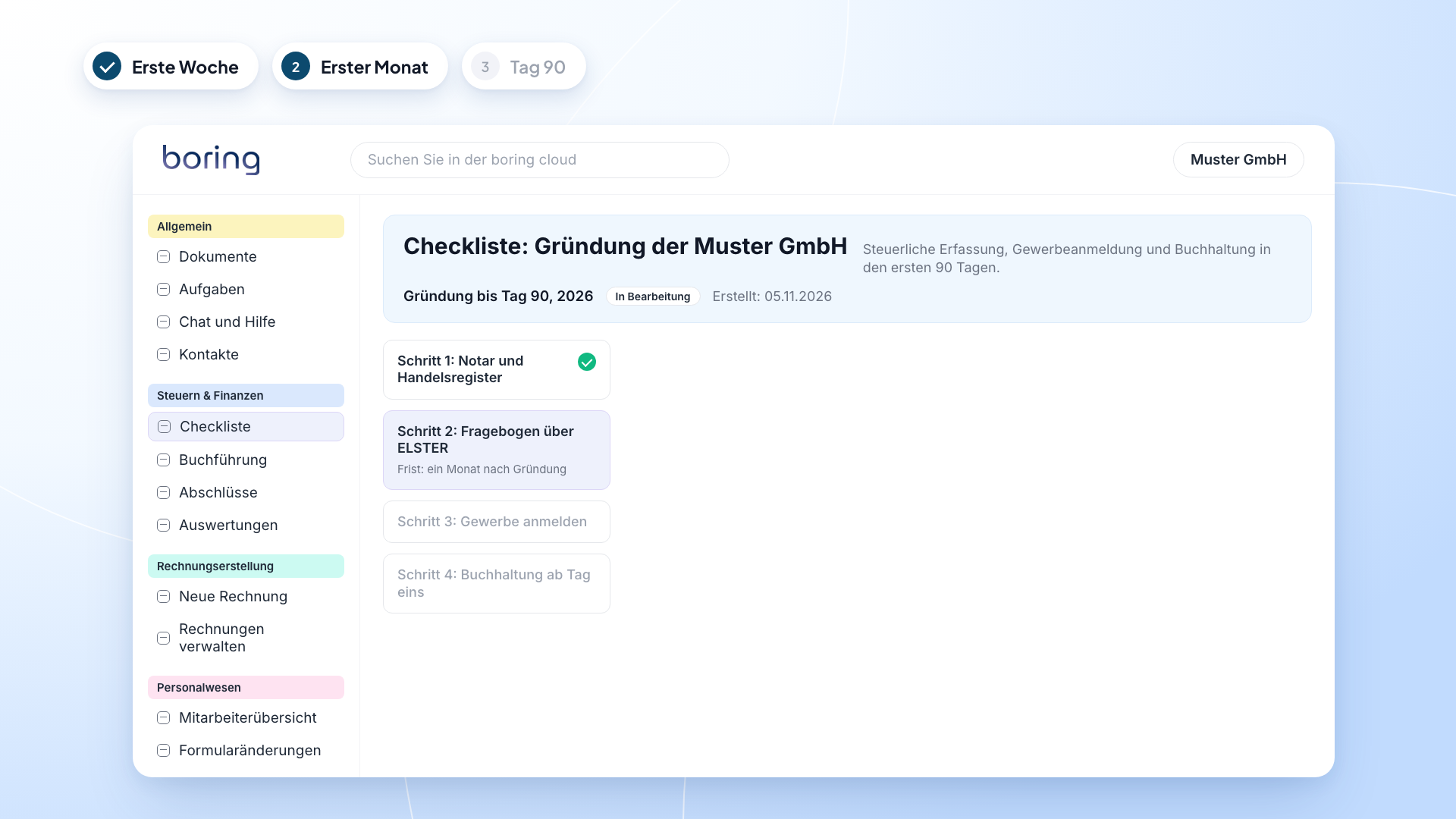
Nach der Gründung gilt: Fragebogen zur steuerlichen Erfassung binnen eines Monats über ELSTER abgeben, Gewerbe anmelden und Buchhaltung ab Tag eins führen.
Notarvertrag unterschrieben, Handelsregister läuft, und das Postfach füllt sich mit Fristen. Steuernummer? Konto? Belege? Wer das als Geschäftsführer:in allein stemmt, braucht eine klare Reihenfolge. Für die Buchhaltung ab Tag eins gibt es bei boring.tax die Stufe “Ohne Kanzlei” ab 60 EUR/Monat (Software + KI-Agent, ohne Steuerberatung). Die eigene boring.tax Steuerberatungsgesellschaft mbH haftet mit 4 Mio. EUR Haftpflichtdeckung, und du testest 14 Tage ohne Kreditkarte und ohne Verkaufsgespräch. Später wechselst du im selben Konto zu boring-Buchhaltern oder zum Gesamtpaket, ohne Datenumzug.
Diese Checkliste führt dich entlang der Zeit: erste Woche, erster Monat, bis Tag 90. Alles gilt auch für die UG (haftungsbeschränkt). Rechtsstand: 05.11.2026.
Was ist die GmbH in Gründung und warum zählt sie steuerlich schon?
Die GmbH in Gründung (Vorgesellschaft) ist die Gesellschaft zwischen notarieller Beurkundung und Handelsregistereintrag; sie ist steuerlich bereits pflichtig, auch wenn die GmbH “als solche” erst mit der Eintragung entsteht.
Laut den Körperschaftsteuer-Hinweisen (KStH 2026, H 1.1; veröffentlicht vom Bundesfinanzministerium) beginnt die Körperschaftsteuerpflicht schon mit dem notariellen Gesellschaftsvertrag. Wer vor der Eintragung im Namen der Gesellschaft handelt, haftet nach § 11 Abs. 2 GmbHG persönlich und solidarisch (GmbHG § 11).
Die Vorgründungsgesellschaft (von der Vereinbarung bis zur Beurkundung) ist weder mit der Vorgesellschaft noch mit der späteren GmbH identisch und in der Regel nicht körperschaftsteuerpflichtig. Steuerlich beginnt die Pflicht schon mit der Beurkundung, nicht erst mit der Eintragung. Auf welchen Tag du die Eröffnungsbilanz aufstellst (Beurkundung, Einzahlung oder Geschäftsbeginn), regelt das Gesetz nicht ausdrücklich. Beginne daher vorsichtshalber mit der Buchführung ab der Beurkundung.
Wie läuft die Gründung zeitlich ab? Die Übersicht
| Aufgabe | Frist | Zuständig | Rechtsgrundlage |
|---|---|---|---|
| Fragebogen zur steuerlichen Erfassung (ELSTER) | 1 Monat nach Aufnahme der Tätigkeit | Geschäftsführung | § 138 Abs. 1b, 4 AO |
| Gewerbeanzeige | gleichzeitig mit Beginn der Tätigkeit | Geschäftsführung | § 14 Abs. 1 GewO |
| Meldung an die Berufsgenossenschaft | 1 Woche nach Beginn (gilt mit Gewerbeanzeige als erfüllt) | Geschäftsführung | § 192 SGB VII |
| Transparenzregister | unverzüglich | Geschäftsführung | § 20 GwG |
| Eröffnungsbilanz | zu Beginn des Handelsgewerbes | Geschäftsführung | § 242 HGB |
| Umsatzsteuer-Voranmeldung | Gründerregel: Besteuerungszeitraum nach erwarteter Steuer, quartalsweise bis 9.000 EUR, darüber monatlich; Abgabe bis zum 10. Tag nach Ablauf des Zeitraums | Geschäftsführung | § 18 UStG |
| KSt-Vorauszahlung | 10.03., 10.06., 10.09., 10.12. | Geschäftsführung | § 37 EStG |
| GewSt-Vorauszahlung | 15.02., 15.05., 15.08., 15.11. | Geschäftsführung | § 19 GewStG |
| Jahresabschluss | Aufstellung in den ersten 3 Monaten nach Geschäftsjahresende; kleine Kapitalgesellschaften dürfen sich bis zu 6 Monate Zeit lassen, wenn es einem ordnungsmäßigen Geschäftsgang entspricht | Geschäftsführung | § 264 Abs. 1 HGB |
| Buchhaltungslösung für Tag eins | ab Tag eins | Geschäftsführung, z. B. mit der Plattform-Stufe “Ohne Kanzlei” ab 60 EUR/Monat | § 238 HGB, § 146 AO |
Verantwortlich bleibt rechtlich immer die Geschäftsführung (§ 41 GmbHG), auch wenn du Aufgaben delegierst.
Was musst du in der ersten Woche erledigen?
- Steuerliche Erfassung vorbereiten. Der Notar schickt dem Finanzamt binnen zwei Wochen eine beglaubigte Abschrift des Gründungsvertrags (§ 54 EStDV). Den Fragebogen ersetzt das nicht.
- ELSTER-Zugang registrieren. Das Zertifikat aus der E-Mail-Registrierung reicht für den Fragebogen; nach Erhalt der Steuernummer wandelst du es in ein vollwertiges Konto um.
- Gewerbe anmelden. Laut IHK Berlin zeigen bei der GmbH die Geschäftsführer an, in der Regel mit Handelsregisterauszug. Die Gebühr liegt in Berlin bei 31 EUR (13 EUR je weiterem Vertreter), andernorts gelten andere Beträge. Ohne Anzeige droht ein Bußgeld bis 1.000 EUR nach § 146 GewO (GewO § 146).
- Berufsgenossenschaft melden. Die Pflicht gilt als erfüllt, wenn du binnen einer Woche die Gewerbeanzeige erstattest. Welche BG zuständig ist, entscheidet ihr Bescheid, auch ohne Beschäftigte.
- Geschäftskonto eröffnen und das Stammkapital einzahlen.
Wie bekommst du schnell Steuernummer und USt-IdNr.?
Du beantragst beides im ELSTER-Fragebogen “Gründung einer Kapitalgesellschaft” und gibst ihn spätestens einen Monat nach Aufnahme der Tätigkeit ab (ELSTER). Je früher der Fragebogen raus ist, desto früher kommt die Steuernummer, per Post, nach Prüfung. Eine amtliche Bearbeitungsdauer gibt es nicht.
Zuständig ist das Finanzamt am Ort der Geschäftsleitung. Im Fragebogen machst du u. a. diese Angaben:
- Art der Tätigkeit, Betriebsstätten, Bankverbindung
- voraussichtliche Lohnsteuer
- geschätzte Umsätze und Zahllast
- Soll- oder Ist-Versteuerung
- Antrag auf USt-IdNr.
Die USt-IdNr. kreuzt du im Fragebogen an. Das Finanzamt leitet den Antrag an das BZSt weiter; laut BZSt können dabei einige Wochen vergehen, mitgeteilt wird sie ausschließlich per Post.
Die Wirtschafts-IdNr. vergibt das BZSt seit November 2024 ohne Antrag. Sie kommt bei neuer Tätigkeit ins ELSTER-Postfach.
Was gehört in den ersten Monat?
Bis Tag 30 stehen Transparenzregister, Buchhaltung und Umsatzsteuer an.
Transparenzregister. Der Handelsregistereintrag genügt seit 01.08.2021 nicht mehr. Du meldest wirtschaftlich Berechtigte (mehr als 25 % der Anteile oder Stimmrechte) “unverzüglich” (§ 20 GwG). Eine feste Tagesfrist nennt das Gesetz nicht, und wann “unverzüglich” bei einer neuen GmbH beginnt, regelt es ebenfalls nicht. Melde deshalb so früh wie möglich. Die Mitteilung ist gebührenfrei, die Jahresgebühr beträgt 19,80 EUR (TrGebV). Bei Verstößen drohen Bußgelder nach § 56 GwG (GwG § 56), laut IHK Berlin bis 100.000 EUR, bei schwerwiegenden Verstößen bis 1 Mio. EUR.
Buchhaltung ab Tag eins. Die GmbH gilt als Handelsgesellschaft (§ 13 Abs. 3 GmbHG), also gilt Buchführungspflicht nach § 238 HGB. Du brauchst eine Eröffnungsbilanz (§ 242 HGB), und die Befreiung nach § 241a HGB gilt nur für Einzelkaufleute. Auch sie geht als E-Bilanz ans Finanzamt (§ 5b EStG).
Nach den GoBD (BMF-Schreiben, Fassung 14.07.2025) ist es unbedenklich, unbare Vorgänge binnen zehn Tagen zu erfassen. Bares hältst du täglich fest. Belege bewahrst du 8 Jahre auf, Bücher und Abschlüsse 10 Jahre (§ 147 AO).
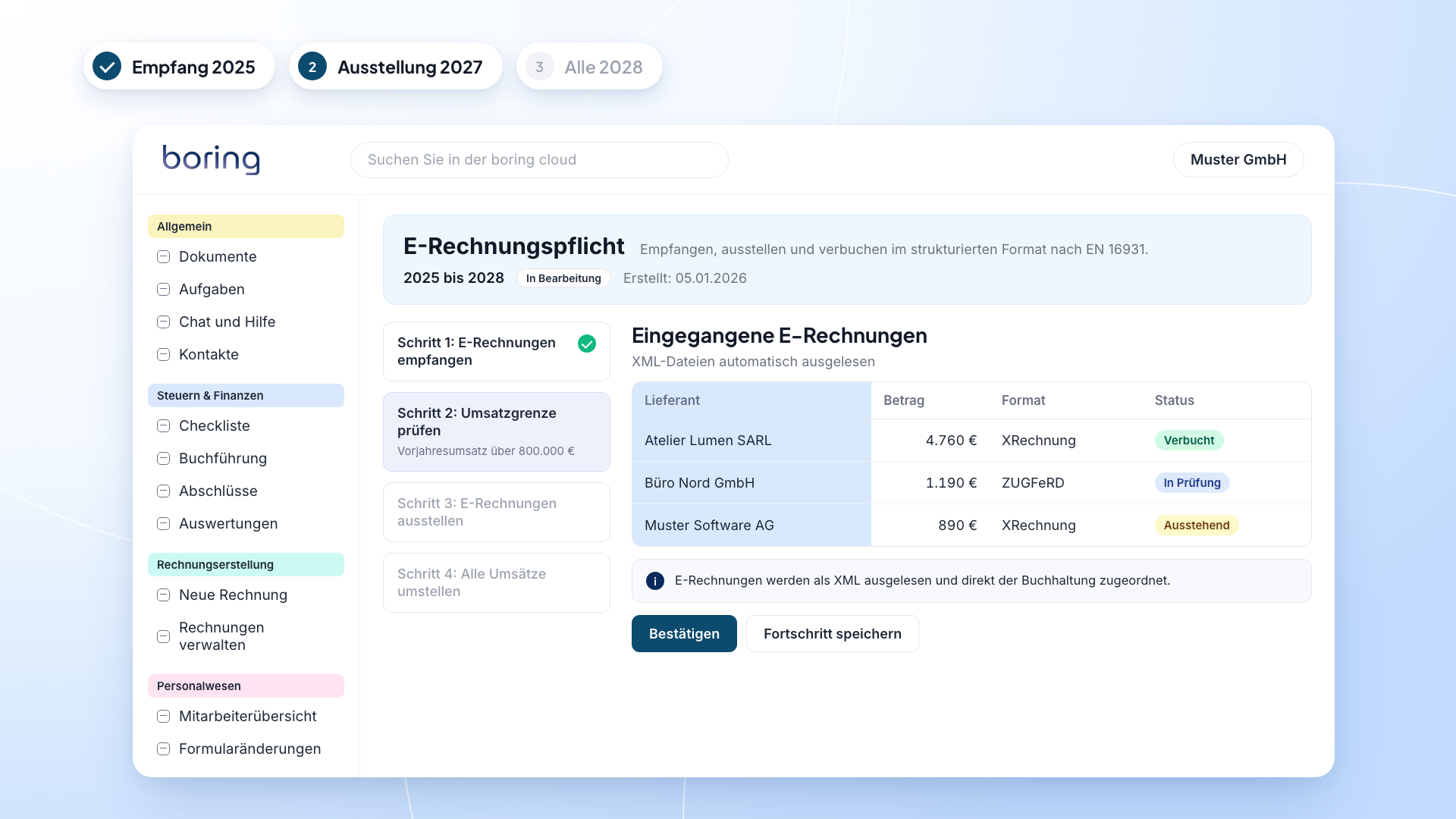
E-Rechnungen empfangen. Seit 01.01.2025 muss jedes inländische Unternehmen E-Rechnungen empfangen können; laut BMF reicht dafür ein E-Mail-Postfach. Ein einfaches PDF ist keine E-Rechnung. Beim Ausstellen gilt bis 31.12.2026 eine Übergangsregel. Für Umsätze 2027 darfst du weiter Papier oder (mit Zustimmung des Empfängers) PDF nutzen, wenn dein Vorjahresumsatz höchstens 800.000 EUR betrug (UStG § 27 Abs. 38). Die Details stehen in unserem Beitrag zur E-Rechnungspflicht.
Wie oft muss eine neue GmbH die Umsatzsteuervoranmeldung abgeben?
Nach § 18 Abs. 2 Satz 4 UStG melden Neugründer im Gründungsjahr und im Folgejahr monatlich an; für die Besteuerungszeiträume 2021 bis 2026 ist das nach Satz 6 ausgesetzt. Dann zählt im Gründungsjahr die voraussichtliche Steuer, die du dem Finanzamt zu Beginn schätzt (UStAE 18.7, Stand 02.06.2026), im Folgejahr die auf ein Jahr umgerechnete tatsächliche Steuer. Im Gründungs- und Folgejahr gibt es keine Befreiung von der Voranmeldung. Die Regel (UStG § 18) im Überblick:
- Vorjahressteuer über 9.000 EUR: monatlich
- sonst: vierteljährlich
- Abgabe elektronisch bis zum 10. Tag nach Zeitraumende
Der Regierungsentwurf des JStG 2026 (Kabinett 12.08.2026; Gesetzgebungsstand beim Bundesfinanzministerium) ändert § 18 Abs. 2 UStG nicht und verlängert die Aussetzung damit nicht. Eine amtliche Aussage für 2027 gibt es nicht; nach dem Wortlaut wäre dann wieder die Monatsmeldung zu erwarten. Änderungen im parlamentarischen Verfahren sind nicht geprüft. Frag vor der Planung 2027 beim Finanzamt nach.
Mit Dauerfristverlängerung verschiebt sich die Frist um einen Monat (§ 46 UStDV). Du beantragst sie elektronisch bis zum Abgabetermin der ersten betroffenen Voranmeldung und musst sie nicht jährlich wiederholen. Bei monatlicher Meldung kommt eine Sondervorauszahlung von 1/11 der Vorauszahlungen des Vorjahres dazu, im Gründungsjahr der erwarteten Vorauszahlungen (§ 47 UStDV). Sie ist jährlich bis zum 10. Februar fällig.
Kleinunternehmer-Regel: Im Gründungsjahr gilt die Grenze von 25.000 EUR, sonst 25.000 EUR im Vorjahr und 100.000 EUR im laufenden Jahr (UStG § 19). Umsätze mit Reverse Charge an EU-Unternehmen erfordern zusätzlich eine Zusammenfassende Meldung bis zum 25. Tag nach Quartalsende.
Wie funktionieren Vorauszahlungen und Gründungskosten?
Das Finanzamt setzt KSt-Vorauszahlungen per Bescheid fest, aber nur ab 400 EUR im Jahr und 100 EUR je Termin (§ 37 EStG). Für Gründer beschreibt keine amtliche Quelle, wie die erste Vorauszahlung geschätzt wird. GewSt-Vorauszahlungen setzt das Finanzamt bei Neugründung nach der voraussichtlichen Steuer fest, ab 50 EUR (§ 19 Abs. 4, 5 GewStG).
Kannst du Gründungskosten erstatten lassen, die du privat bezahlt hast? Sicher geht das nur im Rahmen dessen, was der Gesellschaftsvertrag regelt. Im Musterprotokoll trägt die Gesellschaft Gründungskosten bis 300 EUR (Anlage 1 GmbHG); darüber hinaus tragen die Gesellschafter. Übernimmt die GmbH mehr ohne bezifferte Regelung im Gesellschaftsvertrag, kann das Finanzamt eine verdeckte Gewinnausschüttung annehmen (§ 8 Abs. 3 KStG, KStG § 8; die KStH H 8.5 verweisen dazu auf ein BMF-Schreiben vom 25.06.1991). Kosten aus der Vorgründungsphase gehen nicht automatisch auf die GmbH über. Beziffere größere Posten daher vor der Beurkundung im Gesellschaftsvertrag.
Wie behandelst du dein Geschäftsführergehalt?
Sozialversicherung und Steuer werden getrennt beurteilt. Laut Deutscher Rentenversicherung liegt bei Gesellschafter-Geschäftsführern mit mindestens 50 % des Stammkapitals oder umfassender Sperrminorität keine Beschäftigung vor. Fremdgeschäftsführer sind typischerweise beschäftigt. Steuerlich ist ein Gesellschafter-Geschäftsführer nicht allein wegen seiner Organstellung Arbeitnehmer (LStH H 19.0). Bei Unsicherheit kannst du ein Statusfeststellungsverfahren bei der DRV Bund beantragen, auch schon vor Aufnahme der Tätigkeit (§ 7a SGB IV).
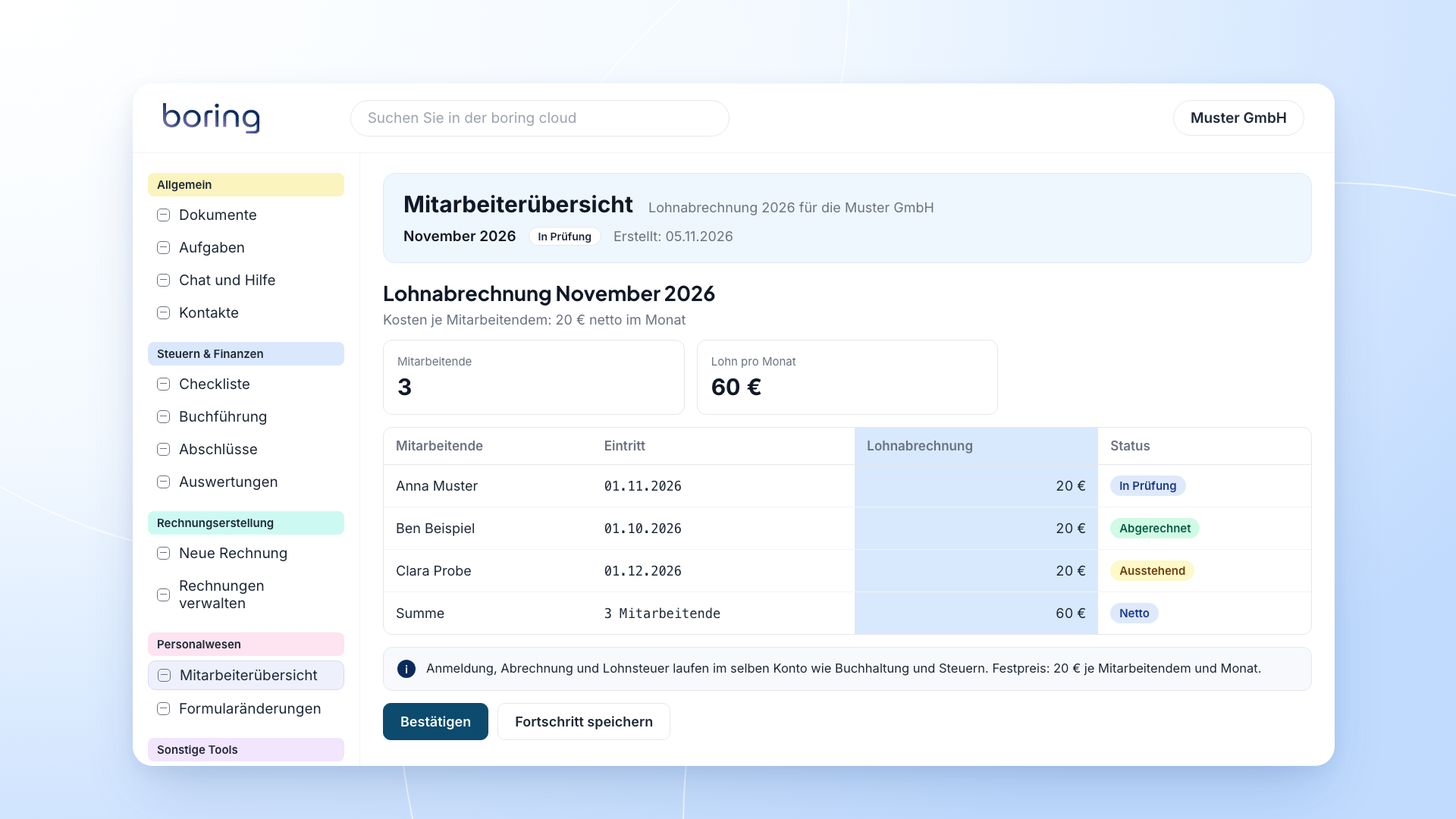
Zahlst du Arbeitslohn, behält die GmbH Lohnsteuer ein und meldet sie bis zum 10. Tag nach dem Anmeldungszeitraum an (§ 41a EStG). Beispiel: Zahlst du dir 3.000 EUR/Monat als Arbeitslohn aus, behält die GmbH Lohnsteuer und gegebenenfalls Solidaritätszuschlag und Kirchensteuer ein, meldet sie an und führt sie bis zum 10. Tag nach dem Anmeldungszeitraum ab.
Der Anmeldungszeitraum ist grundsätzlich der Monat, bei 1.080 EUR bis 5.000 EUR Lohnsteuer im Vorjahr das Quartal, bei höchstens 1.080 EUR das Jahr. Die Betriebsnummer brauchst du erst mit dem ersten Beschäftigten, und zwar nach der Unternehmensnummer der Unfallversicherung (§ 18i SGB IV). Zahlst du keinen Lohn, teilst du das dem Finanzamt mit.
Was steht bis Tag 90 und danach an?
Das Geschäftsjahr darf zwölf Monate nicht überschreiten (§ 240 Abs. 2 HGB). Gründest du unterjährig, startet ein Rumpfgeschäftsjahr bis 31.12. Für 2026 heißt das nach § 264 HGB: Aufstellung in den ersten drei Monaten nach Geschäftsjahresende, bei kleinen Kapitalgesellschaften bis zu sechs Monate, also bis 31.03. bzw. 30.06.2027. Die Offenlegung folgt nach § 325 HGB spätestens ein Jahr nach dem Abschlussstichtag, bei einem Rumpfgeschäftsjahr bis 31.12.2026 also bis 31.12.2027.
Die Steuererklärungen sind nach § 149 AO ohne Berater sieben Monate nach Ablauf des Besteuerungszeitraums fällig (AO § 149). Für 2026 ergibt sich daraus rechnerisch der 02.08.2027, weil der 31.07.2027 ein Samstag ist. Mit Berater gilt der letzte Februartag des zweiten Folgejahres, rechnerisch der 29.02.2028. Beide Daten sind abgeleitet und nicht amtlich tabelliert; bestätige sie bei Bedarf mit dem Finanzamt.
Brauchst du nach der Gründung sofort einen Steuerberater?
Nein, nicht für Fragebogen (§ 138 AO), Gewerbeanmeldung (§ 14 GewO) und die ersten Buchungen (§ 238 HGB); das schaffst du mit Software selbst. Ja, sobald du Jahresabschluss, KSt- und GewSt-Erklärung oder E-Bilanz (§ 5b EStG) nicht selbst erstellen kannst oder willst. Die UStVA bereitest du selbst vor und übermittelst sie über ELSTER; das ist nach § 18 UStG erlaubt.
Ein früher Steuerberater lohnt sich, wenn du als Gesellschafter-Geschäftsführer Gehalt festlegst (verdeckte Gewinnausschüttung, § 8 Abs. 3 KStG), Gründungskosten über 300 EUR trägst, eine Holding-Struktur planst oder Mitarbeitende einstellst. Ein späterer Wechsel ist machbar, wie unser Beitrag zum Steuerberater wechseln zeigt, kostet aber Zeit.
Was kostet das im ersten Jahr? Anbieter im Vergleich
Alle Preise netto, ab-Preise. Anbieterangaben laut den jeweiligen Websites: firma.de Stand 14.10.2026, Fideus und bsteuern Stand 05.11.2026, Mika Stand Oktober 2026.
| Anbieter | Leistung | Preis |
|---|---|---|
| boring.tax “Ohne Kanzlei” | Software + KI-Agent, ohne Steuerberatung und Jahresabschluss | 60 EUR/Monat |
| boring.tax “Mit boring-Buchhaltern” | menschliche Buchhaltung, geprüfter Monatsabschluss | 100 / 200 / 300 / 400 EUR/Monat (Umsatz bis 100.000 / 250.000 / 500.000 / 1 Mio. EUR) |
| boring.tax Gesamtpaket “Mit Kanzlei + Steuerberater” | UStVA, Jahresabschluss, E-Bilanz, KSt/GewSt, Beratung | 335 / 520 / 705 / 890 EUR/Monat (gleiche Umsatzbänder) |
| firma.de | Start: Buchführung, Gründung inklusive, UStVA wird vorbereitet, Abgabe selbst; Wachstum: fest zugeordnete Partnerkanzlei übernimmt Meldungen, Abgabe und Jahresabschluss; Betrieb: zusätzlich Lohn, KSt-, GewSt-, USt-Erklärung, E-Bilanz; Buchführung derzeit nur per Warteliste | Start ab 99, Wachstum ab 199, Betrieb ab 399 EUR/Monat |
| bsteuern | Kanzlei berät selbst; Festpreis inkl. Jahresabschluss, KSt-, GewSt-, USt-Erklärung, E-Bilanz, Offenlegung; Belege bucht die Kanzlei nur im Rundumservice; Mindestlaufzeit 12 Monate, Onboarding 399 EUR einmalig | Selbststarter ab 299, Vorsorge ab 359, Rundumservice ab 449 EUR/Monat |
| Fideus | Software-Unternehmen; Mandat und Vorbehaltsaufgaben bei einer zugelassenen Steuerberatungsgesellschaft; Gesamtpreis für Plattform und Kanzlei; Laufzeit laut Angebot; operatives Unternehmen bis 1 Mio. EUR Umsatz und 1.200 Transaktionen pro Jahr | Holding Lite ab 600, Holding Pro ab 1.450, Operatives Unternehmen ab 2.000 EUR/Jahr |
| Mika | KI-Tool, Steuerberatung über Partner | ab 49 EUR/Monat |
Der Unterschied zu boring.tax im Einzelnen:
- firma.de: Zulassungspflichtige Leistungen erbringen Partnerkanzleien, firma.de selbst berät nicht. Notar- und Registergebühren kommen laut Website hinzu (GmbH mit Musterprotokoll rund 591 EUR, UG rund 465 EUR). Bei boring.tax sitzt die eigene, haftende Steuerberatungsgesellschaft im selben Konto, mit öffentlichem Festpreis je Umsatzband.
- bsteuern: Die Kanzlei berät selbst, keine Partnerkanzlei, mit Mindestlaufzeit 12 Monate (Kündigung einen Monat vor Laufzeitende) und 399 EUR Onboarding. Gründer erhalten laut Website bis zu 50 % Rabatt im ersten Geschäftsjahr. Bei der Plattform startest du ohne Onboarding-Gebühr, und die Buchhaltung läuft in derselben Software.
- Fideus: Laut Website ist Fideus “ein Software-Unternehmen”; über die Plattform arbeiten zwei unabhängige Kanzleien, Namen nennt das Impressum nicht. E-Rechnung und DATEV-Export nennt Fideus auf der Website nicht. Holding und operative GmbH haben getrennte Angebote. Die Steuerberatungsgesellschaft mit eigener Haftpflichtdeckung gehört bei dir zum selben Konto.
- Mika: Die Steuerberatung läuft über Partner; im Gesamtpaket bekommst du sie von der eigenen Steuerberatungsgesellschaft im selben Konto.
Hauptvergleich: die klassische Steuerkanzlei. Eine Kanzlei erstellt Jahresabschluss, Steuererklärungen und berät, meist ohne Software für deine laufenden Belege. Sie rechnet nach der Steuerberatervergütungsverordnung (StBVV) ab, also nach Gegenstandswerten und Zeitaufwand, nicht zum Festpreis (StBVV). Was deine Kanzlei konkret verlangt, erfährst du nur über ein Angebot. Bei boring.tax steht der Preis je Umsatzband öffentlich auf der Preisseite.
Beispiel: Eine GmbH mit 250.000 EUR Umsatz im ersten vollen Jahr zahlt im Gesamtpaket “Mit Kanzlei + Steuerberater” 520 EUR/Monat, also 6.240 EUR netto im Jahr. Wer selbst bucht und nur die Software nutzt, zahlt in “Ohne Kanzlei” 60 EUR/Monat, also 600 EUR im Jahr, und holt den Jahresabschluss separat dazu. Eine klassische Steuerkanzlei für denselben Umfang lässt sich hier nicht beziffern, weil die Vergütung nach StBVV vom Aufwand abhängt. Hol dir dafür ein schriftliches Angebot und vergleiche es mit den 6.240 EUR.
So unterstützt dich boring.tax
Die boring.tax Steuerberatungsgesellschaft mbH (in einzelnen Fällen eine Partnerkanzlei) haftet mit 4 Mio. EUR Haftpflichtdeckung. Du startest mit “Ohne Kanzlei”: die KI ordnet Belege und Banktransaktionen zu, du prüfst und gibst frei. Die UStVA bereitest du in boring vor und übermittelst sie direkt an ELSTER. Nichts geht ohne deine Freigabe ans Finanzamt, die Daten liegen in Deutschland, getestet wird 14 Tage ohne Kreditkarte und ohne Verkaufsgespräch.
Fünf Kriterien helfen bei der Wahl der Lösung zum Start:
- Kannst du ab Tag eins Belege per E-Mail, Upload oder Bank sammeln?
- Werden E-Rechnungen empfangen und GoBD-konform abgelegt?
- Bereitet die Lösung die UStVA vor und übermittelt sie an ELSTER?
- Gibt es einen festen, öffentlichen Preis?
- Kannst du später Hilfe dazubuchen, ohne Daten umzuziehen?
Die Plattform erfüllt alle fünf. Ehrlich dazu: Bei kleinem Transaktionsvolumen sind reine KI-Tools wie Mika ab 49 EUR/Monat (Stand Oktober 2026) günstiger; dort läuft die Steuerberatung über Partner. Das Gesamtpaket gibt es im selben Konto, und eine spätere Holding kostet ab 500 EUR/Jahr (+100 EUR je weiterer Beteiligung). Nicht passend: Einzelunternehmen und Freiberufler mit EÜR. Mehr zur Software-Seite findest du im Beitrag zur KI-Buchhaltung für GmbH und UG.
Häufige Fragen
Ich habe gerade eine GmbH gegründet. Was muss ich bei Buchhaltung, Finanzamt und Steuern beachten? Gib binnen eines Monats den Fragebogen zur steuerlichen Erfassung über ELSTER ab und beginne die Buchführung am besten schon ab der Beurkundung, denn steuerlich gilt die Gesellschaft ab dann. Dazu kommen Gewerbeanmeldung, Transparenzregister und eine Buchhaltungslösung, etwa boring.tax “Ohne Kanzlei” ab 60 EUR/Monat.
Brauche ich nach der GmbH-Gründung sofort einen Steuerberater? Nein, nicht für die ersten Meldungen und Buchungen. Für Jahresabschluss, KSt, GewSt und E-Bilanz brauchst du Unterstützung, im Gesamtpaket ab 335 EUR/Monat bei Umsatz bis 100.000 EUR.
Welche Buchhaltungssoftware brauche ich von Tag eins an? Eine, die Belege GoBD-konform ablegt, E-Rechnungen empfängt und die UStVA vorbereitet. Die Stufe “Ohne Kanzlei” erfüllt das ab 60 EUR/Monat.
Was kostet ein Steuerberater für eine neue UG im ersten Jahr? Das Gesamtpaket kostet je nach Umsatzband 335 / 520 / 705 / 890 EUR/Monat (Umsatz bis 100.000 / 250.000 / 500.000 / 1 Mio. EUR; netto, Stand 25.09.2026). Bei 335 EUR/Monat sind das 4.020 EUR im Jahr. Für eine klassische Kanzlei nach StBVV gibt es keinen festen Preis; hol dir ein Angebot.
Wie bekomme ich schnell Steuernummer und USt-IdNr.? Gib den ELSTER-Fragebogen früh ab und kreuze den USt-IdNr.-Antrag an. Beide Nummern kommen per Post; eine feste Bearbeitungsdauer nennt keine Behörde.
Gibt es ein Gründungspaket mit Buchhaltung und Steuerberater zum Festpreis? Ja. boring.tax bietet das Gesamtpaket zu 335 / 520 / 705 / 890 EUR/Monat nach Umsatzband; firma.de nennt Pakete ab 99 EUR/Monat (laut Website von firma.de, Stand 14.10.2026), die Buchführung dort nur über eine Warteliste. Notar- und Registergebühren kommen separat hinzu.
Wie oft muss eine neue GmbH die UStVA abgeben? Für 2026 gilt die Gründerregel: Der Zeitraum richtet sich nach der erwarteten Steuer, also vierteljährlich bis 9.000 EUR und darüber monatlich. Für 2027 lässt der Wortlaut des § 18 UStG wieder die Monatsmeldung vermuten; amtlich bestätigt ist das nicht.
Kann meine GmbH private Auslagen vor der Kontoeröffnung erstatten? Gründungskosten bis 300 EUR trägt die GmbH laut Musterprotokoll. Darüber hinaus tragen die Gesellschafter; ohne bezifferte Regelung im Gesellschaftsvertrag kann das Finanzamt eine verdeckte Gewinnausschüttung nach § 8 Abs. 3 KStG annehmen.
Bereit, es auszuprobieren?
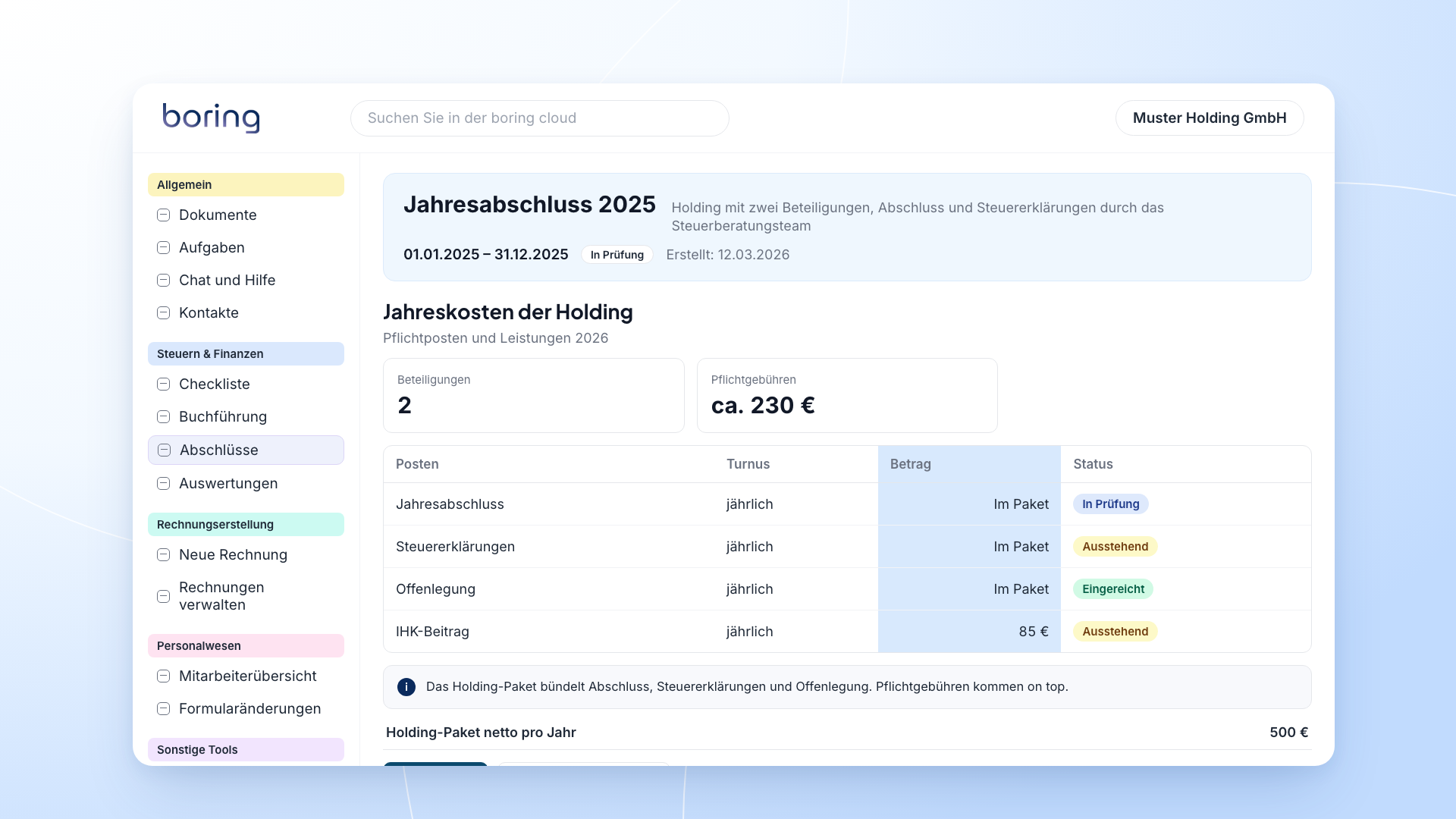
Die ersten 90 Tage bestehen aus wenigen festen Terminen. Mit einer sauberen Ablage ab Tag eins sind sie gut zu schaffen.
Belege rein. Fristen im Blick. So soll Steuer sein: boring.
Noch kein boring.tax-Kunde? Jetzt kostenlos starten →
Company formed, what now? Tax office, bookkeeping and taxes in the first 90 days
After incorporation: submit the tax registration questionnaire via ELSTER within one month, register your business, and keep your books from day one.
Notary contract signed, commercial register entry pending, and your inbox is filling up with deadlines. Tax number? Bank account? Receipts? If you’re handling this alone as managing director, you need a clear order of steps. For bookkeeping from day one, boring.tax offers the “Ohne Kanzlei” tier from EUR 60/month (software + AI agent, without tax advisory). The in-house boring.tax Steuerberatungsgesellschaft mbH carries EUR 4 million in liability insurance, and you can test for 14 days with no credit card and no sales call. Later you can switch within the same account to boring bookkeepers or the full package, without migrating any data.
This checklist walks you through the timeline: first week, first month, up to day 90. Everything also applies to the UG (haftungsbeschränkt). Legal status: 05.11.2026.
What is a GmbH in formation, and why does it already matter for tax?
The GmbH in formation (Vorgesellschaft) is the company in the period between notarization and entry in the commercial register. It is already subject to tax, even though the GmbH “as such” only comes into existence upon registration.
According to the corporate income tax guidelines (KStH 2026, H 1.1; published by the Federal Ministry of Finance), corporate income tax liability begins with the notarized articles of association. Anyone who acts on behalf of the company before registration is personally and jointly liable under § 11 para. 2 GmbHG (GmbHG § 11).
The pre-formation company (Vorgründungsgesellschaft, from the agreement to notarization) is not identical to the GmbH in formation or to the later GmbH, and as a rule is not subject to corporate income tax. For tax purposes, liability begins with notarization, not only with registration. The law does not expressly say which date you should use for the opening balance sheet (notarization, payment of capital, or start of business). To be safe, start your bookkeeping from notarization.
What does the formation timeline look like? The overview
| Task | Deadline | Responsible | Legal basis |
|---|---|---|---|
| Tax registration questionnaire (ELSTER) | 1 month after starting activity | Management | § 138 para. 1b, 4 AO |
| Business registration | simultaneously with start of activity | Management | § 14 para. 1 GewO |
| Notification to the employers’ liability insurance association (Berufsgenossenschaft) | 1 week after start (deemed fulfilled by the business registration) | Management | § 192 SGB VII |
| Transparency register | without undue delay | Management | § 20 GwG |
| Opening balance sheet | at the start of the commercial business | Management | § 242 HGB |
| VAT return (UStVA) | Founder rule: filing period depends on expected tax, quarterly up to EUR 9,000, monthly above that; filing by the 10th day after the period ends | Management | § 18 UStG |
| Corporate income tax prepayment | 10.03., 10.06., 10.09., 10.12. | Management | § 37 EStG |
| Trade tax prepayment | 15.02., 15.05., 15.08., 15.11. | Management | § 19 GewStG |
| Annual financial statements | Preparation within the first 3 months after the end of the financial year; small corporations may take up to 6 months if this corresponds to proper business practice | Management | § 264 para. 1 HGB |
| Bookkeeping solution for day one | from day one | Management, e.g. with the platform tier “Ohne Kanzlei” from EUR 60/month | § 238 HGB, § 146 AO |
Legally, responsibility always stays with the management (§ 41 GmbHG), even if you delegate tasks.
What do you need to do in the first week?
- Prepare your tax registration. The notary sends the tax office a certified copy of the articles of association within two weeks (§ 54 EStDV). This does not replace the questionnaire.
- Register your ELSTER access. The certificate from the email registration is enough for the questionnaire; once you receive your tax number, you convert it into a full account.
- Register your business. According to IHK Berlin, for a GmbH the managing directors file the registration, usually with a commercial register extract. In Berlin the fee is EUR 31 (EUR 13 per additional representative); other places charge different amounts. Without registration, you risk a fine of up to EUR 1,000 under § 146 GewO (GewO § 146).
- Notify the Berufsgenossenschaft. The obligation is deemed fulfilled if you file the business registration within one week. Which BG is responsible is determined by its notice, even if you have no employees.
- Open a business account and pay in the share capital.
How do you get your tax number and VAT ID quickly?
You apply for both in the ELSTER questionnaire “Gründung einer Kapitalgesellschaft” (formation of a corporation) and submit it no later than one month after starting your activity (ELSTER). The sooner the questionnaire is sent, the sooner the tax number arrives, by post, after review. There is no official processing time.
The tax office at the place of management is responsible. In the questionnaire you provide, among other things:
- Type of activity, business premises, bank details
- Expected payroll tax
- Estimated revenue and tax payable
- Accrual or cash-basis VAT accounting
- Application for a VAT ID
You tick the box for the VAT ID in the questionnaire. The tax office forwards the application to the BZSt (Federal Central Tax Office); according to the BZSt, this can take a few weeks, and it is communicated exclusively by post.
Since November 2024, the BZSt has assigned the business ID (Wirtschafts-IdNr.) without an application. For a new activity, it arrives in your ELSTER mailbox.
What belongs in the first month?
By day 30, the transparency register, bookkeeping and VAT are on the agenda.
Transparency register. Since 01.08.2021, the commercial register entry is no longer sufficient. You report beneficial owners (more than 25% of shares or voting rights) “without undue delay” (§ 20 GwG). The law does not specify a fixed number of days, and it also does not say when “without undue delay” starts for a new GmbH. So report as early as possible. Filing the notification is free of charge; the annual fee is EUR 19.80 (TrGebV). Violations can lead to fines under § 56 GwG (GwG § 56), according to IHK Berlin up to EUR 100,000, and up to EUR 1 million for serious violations.
Bookkeeping from day one. The GmbH counts as a commercial company (§ 13 para. 3 GmbHG), so the bookkeeping obligation under § 238 HGB applies. You need an opening balance sheet (§ 242 HGB), and the exemption under § 241a HGB applies only to sole traders. It also goes to the tax office as an electronic balance sheet (E-Bilanz, § 5b EStG).
Under the GoBD (BMF letter, version of 14.07.2025), it is acceptable to record non-cash transactions within ten days. Cash transactions you record daily. You keep receipts for 8 years, books and financial statements for 10 years (§ 147 AO).
Receiving e-invoices. Since 01.01.2025, every domestic business must be able to receive e-invoices; according to the BMF, an email inbox is enough for this. A simple PDF is not an e-invoice. For issuing invoices, a transitional rule applies until 31.12.2026. For 2027 revenue, you may continue to use paper or (with the recipient’s consent) PDF if your prior-year revenue was no more than EUR 800,000 (UStG § 27 para. 38). The details are in our article on the e-invoicing obligation.
How often must a new GmbH file the VAT return?
Under § 18 para. 2 sentence 4 UStG, new businesses file monthly in the year of formation and the following year; for the tax periods 2021 to 2026, this is suspended under sentence 6. In that case, the expected tax that you estimate for the tax office at the start counts in the year of formation (UStAE 18.7, as of 02.06.2026), and in the following year the actual tax annualized. In the year of formation and the following year, there is no exemption from the advance return. The rule (UStG § 18) at a glance:
- Prior-year tax above EUR 9,000: monthly
- Otherwise: quarterly
- Electronic filing by the 10th day after the end of the period
The government draft of the JStG 2026 (cabinet 12.08.2026; legislative status at the Federal Ministry of Finance) does not change § 18 para. 2 UStG and therefore does not extend the suspension. There is no official statement for 2027; based on the wording, monthly filing would be expected again. Changes in the parliamentary process have not been checked. Ask the tax office before planning for 2027.
With a permanent deadline extension (Dauerfristverlängerung), the deadline shifts by one month (§ 46 UStDV). You apply for it electronically by the filing deadline of the first affected advance return, and you do not need to repeat it every year. For monthly filing, a special prepayment of 1/11 of the prior year’s prepayments is added, in the year of formation of the expected prepayments (§ 47 UStDV). It is due annually by 10 February.
Small business rule: in the year of formation, the threshold is EUR 25,000; otherwise EUR 25,000 in the prior year and EUR 100,000 in the current year (UStG § 19). Reverse-charge sales to EU businesses additionally require a recapitulative statement (Zusammenfassende Meldung) by the 25th day after the end of the quarter.
How do prepayments and formation costs work?
The tax office sets corporate income tax prepayments by notice, but only from EUR 400 per year and EUR 100 per due date (§ 37 EStG). For founders, no official source describes how the first prepayment is estimated. For a new business, the tax office sets trade tax prepayments based on the expected tax, from EUR 50 (§ 19 paras. 4, 5 GewStG).
Can you have formation costs reimbursed that you paid privately? Only within what the articles of association provide for. Under the model protocol, the company bears formation costs up to EUR 300 (Anlage 1 GmbHG); above that, the shareholders bear them. If the GmbH takes on more without a specified provision in the articles of association, the tax office may assume a hidden profit distribution (§ 8 para. 3 KStG, KStG § 8; KStH H 8.5 refers to a BMF letter of 25.06.1991 on this). Costs from the pre-formation phase do not automatically transfer to the GmbH. So specify larger items in the articles of association before notarization.
How do you handle your managing director’s salary?
Social security and tax are assessed separately. According to the German Pension Insurance, shareholder-managing directors holding at least 50% of the share capital or a comprehensive blocking minority are not in employment. Non-shareholder managing directors are typically employed. For tax purposes, a shareholder-managing director is not an employee merely because of their position as a corporate body (LStH H 19.0). If you are unsure, you can apply for a status determination procedure with the DRV Bund, even before starting the activity (§ 7a SGB IV).
If you pay a salary, the GmbH withholds payroll tax and reports it by the 10th day after the reporting period (§ 41a EStG). Example: if you pay yourself EUR 3,000/month as salary, the GmbH withholds payroll tax and, where applicable, solidarity surcharge and church tax, reports it, and remits it by the 10th day after the reporting period.
The reporting period is generally the month; with EUR 1,080 to EUR 5,000 of payroll tax in the prior year it is the quarter, and with no more than EUR 1,080 it is the year. You only need the employer number (Betriebsnummer) with your first employee, and only after the company number of the accident insurance (§ 18i SGB IV). If you pay no salary, you notify the tax office of that.
What is due by day 90 and afterwards?
The financial year may not exceed twelve months (§ 240 para. 2 HGB). If you form the company during the year, a short financial year runs until 31.12. For 2026, under § 264 HGB this means: preparation within the first three months after the end of the financial year, for small corporations up to six months, so by 31.03. or 30.06.2027. Publication follows under § 325 HGB at the latest one year after the balance sheet date, so for a short financial year ending 31.12.2026, by 31.12.2027.
Under § 149 AO, tax returns without an advisor are due seven months after the end of the tax period (AO § 149). For 2026, this works out to 02.08.2027, because 31.07.2027 is a Saturday. With an advisor, the last day of February of the second following year applies, which works out to 29.02.2028. Both dates are derived and not officially tabulated; confirm them with the tax office if needed.
Do you need a tax advisor right after formation?
No, not for the questionnaire (§ 138 AO), business registration (§ 14 GewO) and the first bookings (§ 238 HGB); you can manage these yourself with software. Yes, as soon as you cannot or do not want to prepare the annual financial statements, the corporate income tax and trade tax returns, or the E-Bilanz (§ 5b EStG) yourself. You prepare the VAT return (UStVA) yourself and submit it via ELSTER; this is permitted under § 18 UStG.
An early tax advisor is worthwhile if, as a shareholder-managing director, you are setting your salary (hidden profit distribution, § 8 para. 3 KStG), bear formation costs above EUR 300, plan a holding structure, or hire employees. Switching later is possible, as our article on changing tax advisors shows, but it costs time.
What does it cost in the first year? Providers compared
All prices net, starting prices. Provider details are based on the respective websites: firma.de as of 14.10.2026, Fideus and bsteuern as of 05.11.2026, Mika as of October 2026.
| Provider | Service | Price |
|---|---|---|
| boring.tax “Ohne Kanzlei” | Software + AI agent, without tax advisory and annual financial statements | EUR 60/month |
| boring.tax “Mit boring-Buchhaltern” | Human bookkeeping, reviewed monthly close | EUR 100 / 200 / 300 / 400/month (revenue up to EUR 100,000 / 250,000 / 500,000 / 1 million) |
| boring.tax full package “Mit Kanzlei + Steuerberater” | VAT return, annual financial statements, E-Bilanz, corporate income tax/trade tax, advisory | EUR 335 / 520 / 705 / 890/month (same revenue bands) |
| firma.de | Start: bookkeeping, formation included, VAT return is prepared, you file it yourself; Growth: dedicated partner firm handles filings, submission and annual financial statements; Operations: additionally payroll, corporate income tax, trade tax and VAT returns, E-Bilanz; bookkeeping currently only via waiting list | Start from 99, Growth from 199, Operations from EUR 399/month |
| bsteuern | The firm advises directly; fixed price incl. annual financial statements, corporate income tax, trade tax and VAT returns, E-Bilanz, publication; the firm books receipts only in the all-round service; minimum term 12 months, onboarding EUR 399 one-time | Selbststarter from 299, Vorsorge from 359, Rundumservice from EUR 449/month |
| Fideus | Software company; engagement and reserved tasks with a licensed tax advisory firm; total price for platform and firm; term according to offer; operating company up to EUR 1 million revenue and 1,200 transactions per year | Holding Lite from 600, Holding Pro from 1,450, Operating company from EUR 2,000/year |
| Mika | AI tool, tax advisory via partners | from EUR 49/month |
The differences to boring.tax in detail:
- firma.de: Services requiring a license are provided by partner firms; firma.de itself does not advise. According to the website, notary and register fees are added on top (GmbH with model protocol around EUR 591, UG around EUR 465). With boring.tax, the in-house, liable tax advisory firm sits in the same account, with a public fixed price per revenue band.
- bsteuern: The firm advises directly, no partner firm, with a 12-month minimum term (termination one month before the end of the term) and EUR 399 onboarding. According to the website, founders receive up to 50% discount in the first financial year. With the platform, you start without an onboarding fee, and bookkeeping runs in the same software.
- Fideus: According to its website, Fideus is “a software company”; two independent firms work through the platform, and the legal notice does not name them. Fideus does not mention e-invoicing or DATEV export on its website. Holding and operating GmbH have separate offers. With us, the tax advisory firm with its own liability insurance belongs to the same account.
- Mika: Tax advisory runs through partners; in the full package, you get it from the in-house tax advisory firm in the same account.
Main comparison: the traditional tax firm. A firm prepares annual financial statements and tax returns and advises, usually without software for your ongoing receipts. It bills under the German tax advisor fee ordinance (StBVV), that is, by object value and time spent, not at a fixed price (StBVV). What your firm would actually charge, you only learn through a quote. With boring.tax, the price per revenue band is public on the pricing page.
Example: A GmbH with EUR 250,000 revenue in its first full year pays EUR 520/month in the full package “Mit Kanzlei + Steuerberater”, that is EUR 6,240 net per year. If you do the bookkeeping yourself and only use the software, you pay EUR 60/month in “Ohne Kanzlei”, that is EUR 600 per year, and add the annual financial statements separately. A traditional tax firm for the same scope can’t be quantified here, because the fee under the StBVV depends on effort. Get a written quote for that and compare it with the EUR 6,240.
How boring.tax supports you
The boring.tax Steuerberatungsgesellschaft mbH (in individual cases a partner firm) carries EUR 4 million in liability insurance. You start with “Ohne Kanzlei”: the AI matches receipts and bank transactions, and you review and approve. You prepare the VAT return in boring and submit it directly to ELSTER. Nothing goes to the tax office without your approval, the data is stored in Germany, and you can test for 14 days with no credit card and no sales call.
Five criteria help when choosing a solution to start with:
- Can you collect receipts by email, upload or bank from day one?
- Are e-invoices received and stored in a GoBD-compliant way?
- Does the solution prepare the VAT return and submit it to ELSTER?
- Is there a fixed, public price?
- Can you add help later without migrating data?
The platform meets all five. To be honest about it: with a small transaction volume, pure AI tools like Mika from EUR 49/month (as of October 2026) are cheaper; there, tax advisory runs through partners. The full package is available in the same account, and a later holding costs from EUR 500/year (+EUR 100 per additional shareholding). Not a fit: sole proprietors and freelancers with simple cash-basis accounting (EÜR). You can find more on the software side in the article on AI bookkeeping for GmbH and UG.
FAQ
I just formed a GmbH. What do I need to know about bookkeeping, the tax office and taxes? Submit the tax registration questionnaire via ELSTER within one month and ideally start bookkeeping from notarization, because for tax purposes the company counts from then on. In addition come business registration, the transparency register and a bookkeeping solution, for example boring.tax “Ohne Kanzlei” from EUR 60/month.
Do I need a tax advisor right after forming a GmbH? No, not for the first filings and bookings. For annual financial statements, corporate income tax, trade tax and E-Bilanz you need support, in the full package from EUR 335/month for revenue up to EUR 100,000.
What bookkeeping software do I need from day one? One that stores receipts in a GoBD-compliant way, receives e-invoices and prepares the VAT return. The “Ohne Kanzlei” tier meets this from EUR 60/month.
What does a tax advisor cost for a new UG in the first year? The full package costs EUR 335 / 520 / 705 / 890/month depending on revenue band (revenue up to EUR 100,000 / 250,000 / 500,000 / 1 million; net, as of 25.09.2026). At EUR 335/month, that is EUR 4,020 per year. For a traditional firm under the StBVV there is no fixed price; get a quote.
How do I get a tax number and VAT ID quickly? Submit the ELSTER questionnaire early and tick the VAT ID application. Both numbers arrive by post; no authority gives a fixed processing time.
Is there a formation package with bookkeeping and a tax advisor at a fixed price? Yes. boring.tax offers the full package at EUR 335 / 520 / 705 / 890/month by revenue band; firma.de lists packages from EUR 99/month (according to the firma.de website, as of 14.10.2026), with bookkeeping there only via a waiting list. Notary and register fees are added separately.
How often must a new GmbH file the VAT return? For 2026 the founder rule applies: the period depends on the expected tax, so quarterly up to EUR 9,000 and monthly above that. For 2027, the wording of § 18 UStG suggests monthly filing again; this is not officially confirmed.
Can my GmbH reimburse private expenses incurred before the account was opened? The GmbH bears formation costs up to EUR 300 under the model protocol. Above that, the shareholders bear them; without a specified provision in the articles of association, the tax office may assume a hidden profit distribution under § 8 para. 3 KStG.
Ready to try it out?
The first 90 days consist of a few fixed deadlines. With clean record-keeping from day one, they are very manageable.
Receipts in. Deadlines in view. That’s how tax should be: boring.
Not yet a boring.tax user? Start for free →