Offene Belege, ein Tool für Selbstständige, und im Frühjahr will die Kanzlei plötzlich eine Bilanz. Viele Gründer:innen merken erst beim Jahresabschluss, dass ihre Software für EÜR gebaut ist.
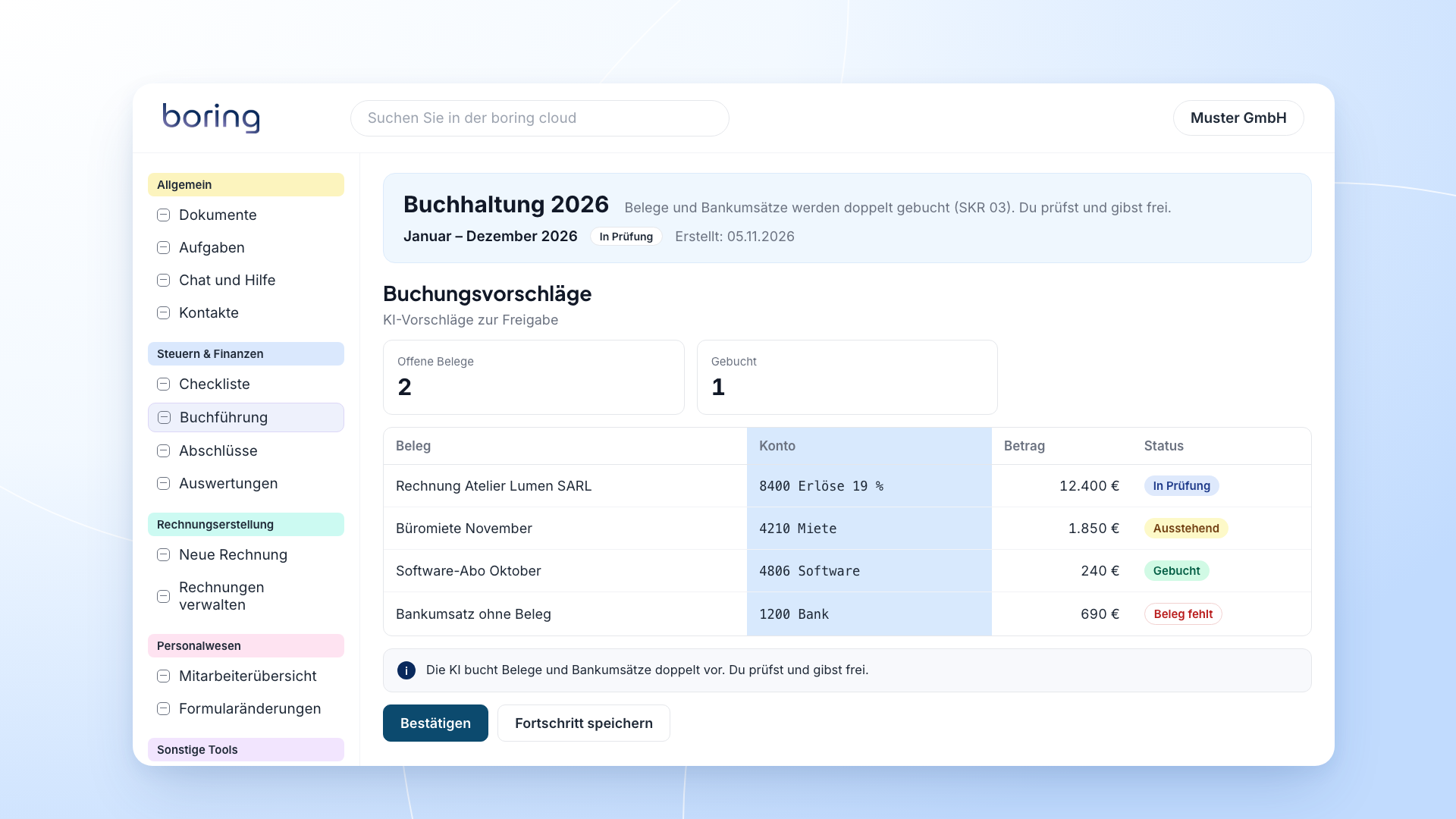
Dagegen hilft in boring.tax die KI, die Belege und Bankumsätze doppelt bucht, während du prüfst und freigibst; das gibt es schon in der Stufe “Ohne Kanzlei”.
Die beste Buchhaltungssoftware für eine GmbH ist die, die doppelte Buchführung beherrscht und sich mit der Steuerkanzlei verzahnt. boring.tax bietet Software mit doppelter Buchführung ab 29,99 EUR/Monat in der Stufe “Ohne Kanzlei”; die eigene, haftende Steuerberatungsgesellschaft im selben Konto gibt es separat im Gesamtpaket “Mit Kanzlei + Steuerberater” ab 335 EUR/Monat, ohne Datenumzug.
Dieser Ratgeber zeigt, was DATEV Unternehmen online, Lexware Office, sevDesk, BuchhaltungsButler, Norman und Mika für eine GmbH leisten und wo ihre Grenze liegt. Alle Anbieterangaben stammen von den Websites der Anbieter (Stand 05.11.2026, Mika Stand 14.10.2026).
Was ist Buchhaltungssoftware für eine GmbH?
Buchhaltungssoftware für eine GmbH erfasst Belege und Bankumsätze, bucht sie doppelt nach SKR 03 oder SKR 04 und liefert die Zahlen für Umsatzsteuervoranmeldung, BWA und Jahresabschluss. Sie unterscheidet sich von EÜR-Tools dadurch, dass sie bilanzierende Unternehmen abbildet.
Eine GmbH ist als Kapitalgesellschaft zur Buchführung und zum Jahresabschluss verpflichtet (§ 238 HGB, § 242 HGB, nachzulesen auf gesetze-im-internet.de). Eine Einnahmenüberschussrechnung reicht nicht.
Welche 7 Kriterien zählen für die GmbH?
Diese sieben Kriterien trennen GmbH-taugliche Software von Selbstständigen-Tools:
- Bilanzierung und Kontenrahmen: doppelte Buchführung mit SKR 03 oder SKR 04, Abschlussbuchungen.
- Zusammenarbeit mit der Kanzlei: Zugang für Steuerberater:innen oder sauberer DATEV-Export.
- Jahresabschluss: Ist er enthalten, oder erstellt ihn jemand anderes?
- E-Rechnung: empfangen, auslesen, verbuchen und selbst erstellen.
- Automatisierung: Wie viel buchen Software oder KI, wie viel du?
- Bankanbindung: automatischer Abruf der Umsätze.
- Preis: der Gesamtpreis inklusive Kanzlei, nicht nur die Softwaregebühr.
Kriterium 7 wird am häufigsten unterschätzt. Eine Software für 22 EUR im Monat ersetzt keine Bilanz.
Wie schlagen sich die Anbieter bei der GmbH?
1. boring.tax: Stufe wählen, Kanzlei im selben Konto
Die Stufe “Ohne Kanzlei” (Software + MCP) kostet 29,99 EUR/Monat oder 299 EUR/Jahr, netto, Stand 09.11.2026. Sie enthält keine Steuerberatung; den Jahresabschluss machst du nur in Eigenregie (bei jährlicher Zahlung eine Einreichung pro Jahr inklusive, sonst 99 EUR je Einreichung). Die KI bucht, du prüfst und gibst frei, die UStVA bereitest du in boring vor und übermittelst sie direkt an ELSTER.
Belege kommen per WhatsApp, E-Mail, Upload oder API, die Bank hängt über finAPI dran. E-Rechnungen erstellst und liest du aus, außerdem wandelst du Rechnungen nach ZUGFeRD oder XRechnung um. Wer mehr Hilfe braucht, wechselt im selben Konto zu “Mit boring-Buchhaltern” (100 bis 400 EUR/Monat) oder zum Gesamtpaket “Mit Kanzlei + Steuerberater”.
Das Gesamtpaket kostet 335 / 520 / 705 / 890 EUR/Monat bei Umsatz bis 100.000 / 250.000 / 500.000 / 1 Mio. EUR. Die boring.tax Steuerberatungsgesellschaft mbH (in einzelnen Fällen eine Partnerkanzlei) übermittelt dann die UStVA und erstellt Jahresabschluss, KSt/GewSt und E-Bilanz. Sie ist mit 4 Mio. EUR haftpflichtversichert. Dazu kommen 14 Tage Test ohne Kreditkarte und ohne Verkaufsgespräch, Datenhaltung in Deutschland und über 330 zahlende Unternehmen (Stand August 2026).
Ehrlich gesagt: Den Jahresabschluss in der Plattform machst du ohne Kanzlei selbst, ohne Steuerberatung. Für Einzelunternehmen und Freiberufler mit EÜR ist das Produkt nicht gedacht. Bei sehr kleinem Buchungsvolumen gibt es günstigere reine Software.
2. DATEV Unternehmen online: der Standard der Kanzleien
Laut Website von DATEV (Stand 05.11.2026; Preisliste Stand 08/2026) kostet Unternehmen online 11,56 EUR/Monat, Belege online 3,83 EUR je Mandant und Monat und Auftragswesen next (Rechnungsschreibung) 7,00 EUR/Monat, jeweils netto zzgl. USt. Ab 2027 steigen die laufenden Preise jährlich um 3 %. Die Nutzung ist an ein DATEV-Mitglied gebunden, in der Regel deine Steuerkanzlei. Buchführung, Jahresabschluss und E-Bilanz erstellt und berechnet die Kanzlei separat; einen öffentlichen Gesamtpreis gibt es nicht.
Bei der E-Rechnung ist DATEV stark. Der Empfang über die E-Rechnungsplattform (Peppol, TRAFFIQX, E-Mail) ist kostenfrei, die Validierung läuft nach EN 16931. Das XML von XRechnung und ZUGFeRD wird im Postfach und in Belege online visualisiert und automatisch an Unternehmen online weitergeleitet. Buchungsvorschläge aus E-Rechnungen erzeugt der Automatisierungsservice Rechnungen im Kanzlei-Rechnungswesen; als sicher eingestufte Belege kann die Kanzlei automatisch buchen lassen.
Erstellen und Versenden in ZUGFeRD 2.x, XRechnung oder Peppol BIS 3.0 geht über Auftragswesen next oder die E-Rechnungsschreibung (5,00 EUR/Jahr); der Versand aus Drittsystemen kostet 0,50 EUR je Rechnung. Einige Versandfunktionen führt DATEV laut Plattform sukzessive ein. Für den Lohn erfasst Unternehmen online die Personaldaten für die Lohnabrechnung der Kanzlei; deren Preis nennt DATEV auf der Website nicht.
- Stärken: eingespielte Zusammenarbeit mit der Kanzlei, E-Rechnungsempfang mit Validierung.
- Grenzen: ohne DATEV-Kanzlei nicht nutzbar; Gesamtkosten hängen an der Kanzlei.
- Am besten für: GmbHs, deren Kanzlei bereits auf DATEV arbeitet und die das Buchen dort belassen.
- Unterschied zu boring.tax: Du bekommst Software und Kanzlei nicht in einem Konto mit festem, öffentlichem Preis.
3. Lexware Office: günstig, aber ohne Bilanz
Laut Website von Lexware (Haufe-Lexware GmbH & Co. KG, Stand 05.11.2026) kostet Lexware Office regulär 7,90 / 12,90 / 21,90 / 32,90 EUR/Monat netto (S bis XL), nur als Monatspreise, monatlich kündbar ohne Mindestlaufzeit, 30 Tage Test. Es bietet doppelte Buchführung für die laufenden Buchungen, SKR 03/04 und DATEV-Datenservices. GuV/EÜR und UStVA gibt es erst ab Tarif L. Lohn & Gehalt ist ab 12,90 EUR/Monat zubuchbar.
Eine Bilanz ist laut Hilfecenter nicht möglich; Eröffnungs- und Abschlussarbeiten inklusive Bilanz obliegen der Steuerkanzlei. E-Rechnungen empfängst du ab S per Upload in die Belegerfassung (XRechnung 3.0.1, ZUGFeRD ab 2.0); das XML wird lesbar dargestellt und die Felder werden daraus befüllt. Automatisches Verbuchen von E-Rechnungen beschreibt die Hilfe nicht. Erstellen und Versenden von ZUGFeRD und XRechnung geht erst ab M, automatischer Belegempfang per E-Mail nur in XL.
- Stärken: niedriger Preis, monatlich kündbar, gute Bedienbarkeit.
- Grenzen: keine Bilanz, wichtige Funktionen erst in höheren Tarifen.
- Am besten für: kleine GmbHs mit wenig Buchungen, deren Kanzlei die Abschlussarbeit übernimmt.
- Unterschied zu boring.tax: Das Buchen übernimmt eine KI, und die Steuerkanzlei ist im selben Konto zubuchbar.
4. sevDesk: Rechnungen stark, Bilanz beim Steuerberater
Laut Website von sevdesk (sevDesk GmbH, Stand 05.11.2026) kostet Buchhaltung regulär 25,90 EUR/Monat bei monatlicher Laufzeit, 22,90 EUR bei 12 und 19,90 EUR bei 24 Monaten; Buchhaltung Pro 34,90 / 30,90 / 27,90 EUR, Rechnung 11,90 / 9,90 / 8,90 EUR (jeweils netto), dazu gibt es einen kostenlosen Tarif. Die Vergleichstabelle derselben Seite nennt abweichend 12,90 / 25,90 / 34,90 EUR. Der Test dauert 14 Tage. Es gibt einfache und doppelte Buchführung, SKR 03/04, UStVA und EÜR/GuV sowie DATEV-Export ab Rechnung. Die Bilanz erstellt laut Hilfecenter der Steuerberater.
E-Rechnungen erstellst du schon im kostenlosen Tarif (3 pro Monat), ab Rechnung unbegrenzt; der Versand läuft per E-Mail als ZUGFeRD oder nur als XML (XRechnung). Der Empfang per Upload beginnt erst ab Buchhaltung: Das ZUGFeRD-PDF wird angezeigt, für XML erzeugt sevdesk eine Ansicht der strukturierten Daten, und die Rechnungsdaten werden automatisch extrahiert. Automatisches Verbuchen nennt sevdesk auf der Website nicht. Lohn läuft über den Partner project b., dessen Preis die Website nicht nennt.
- Stärken: Rechnungsstellung mit E-Rechnung, schneller Einstieg, 14 Tage Test.
- Grenzen: Bilanz und Steuerberatung fehlen, Lohn nur über Partner.
- Am besten für: junge GmbHs, die vor allem Rechnungen schreiben und einen Steuerberater im Hintergrund haben.
- Unterschied zu boring.tax: Du buchst selbst, und die Kanzlei sitzt außerhalb deines Kontos.
Wie du sevDesk oder Lexware Office mit einer Kanzlei kombinierst, beschreibt unser Artikel zu sevDesk und Lexware mit Steuerberater für die GmbH.
5. BuchhaltungsButler: GmbH-tauglich, mit Kanzleizugang
Laut Website von BuchhaltungsButler (BuchhaltungsButler GmbH, Berlin, Stand 05.11.2026) kostet Light 39,90, Smart 46,90 und Premium 89,90 EUR/Monat bei monatlicher Laufzeit (jährlich 29,90 / 34,90 / 59,90 EUR), netto. Doppelte Buchführung für Bilanzierende und Abschlussbuchungen gibt es in allen drei Tarifen, ebenso SKR 03/04. Die Auswertung von Bilanz und UStVA beginnt bei Smart, die E-Bilanz läuft über den Partner eBilanz+.
Der Steuerberater-Zugang ist inklusive, der Export von Buchungssätzen und Belegen im DATEV-Format ebenfalls in allen Tarifen. E-Rechnungen sendest und empfängst du in allen Tarifen, auch mit Leitweg-ID; eingehende E-Rechnungen werden automatisch erkannt und die strukturierten Daten verarbeitet. Eine XML-Ansicht im Programm und automatisches Buchen speziell von E-Rechnungen nennt BuchhaltungsButler auf der Website nicht, die Peppol-Anbindung steht dort als “in Planung”. Lohn gibt es nur über die Integration TAXMARO, deren Preis die Website nicht nennt.
- Stärken: doppelte Buchführung für Bilanzierende in allen Tarifen, Bilanz-Auswertung ab Smart, sauberer Kanzleizugang, E-Rechnung in allen Tarifen.
- Grenzen: keine eigene Steuerberatung, E-Bilanz über Partner.
- Am besten für: GmbHs, die selbst buchen und eine eigene Kanzlei mitbringen.
- Unterschied zu boring.tax: Es gibt keine zubuchbare, haftende Steuerkanzlei im selben Konto.
6. Norman: KI-Buchhaltung mit Bilanz in der Software
Laut Website von Norman (Norman AI GmbH, Berlin, Stand 05.11.2026) gibt es für Kapitalgesellschaften drei Software-Tarife: Kostenlos (0 EUR, doppelte Buchführung, unbegrenzte E-Rechnungen), Pro 9 / 12 EUR (BWA, DATEV-Export, Steuerberater-Zugang) und Max 39 / 52 EUR (jährlich / monatlich, netto). Max enthält UStVA, KSt, GewSt, USt-Erklärung, Bilanz, GuV und E-Bilanz per ELSTER; das Offenlegungs-PDF lädst du selbst hoch. Die Tarife sind zum Ende des Abrechnungszeitraums kündbar.
E-Rechnungen empfängt Norman per Upload oder Weiterleitung, zeigt das XML lesbar an und liest Lieferant, Betrag und Umsatzsteuer aus und bucht sie, auch im kostenlosen Tarif. Jede Rechnung wird automatisch ZUGFeRD (EN 16931), XRechnung mit Leitweg-ID ist möglich. Norman erbringt selbst keine Steuerberatung. Das separate Steuerberatungsangebot (Holding ab 32 EUR/Monat bei jährlicher Zahlung) leisten unabhängige, nach § 3 StBerG befugte Steuerberater; Kapitalgesellschaften werden nur zur ersten Einreichung im ersten Geschäftsjahr aufgenommen.
- Stärken: sehr günstig, Abschluss in der Software, E-Rechnung früh und breit.
- Grenzen: Du erstellst den Abschluss selbst; Steuerberatung für bestehende Kapitalgesellschaften ist begrenzt.
- Am besten für: Gründer:innen, die den Abschluss selbst machen wollen und steuerlich sicher sind.
- Unterschied zu boring.tax: Die haftende Kanzlei ist ein getrenntes Angebot unabhängiger Steuerberater, nicht Teil eines gemeinsamen Kontos.
Mika: KI-Buchhaltung mit Preis nach Transaktionen
Laut Website von Mika (Get Mika GmbH, Stand 14.10.2026) kostet der Tarif “Buchhaltung” ab 49 EUR/Monat. “Buchhaltung und Jahresabschluss” liegt ab 99 EUR/Monat (bis 25 Banktransaktionen), 199 EUR bis 50 und 549 EUR bis 150 Transaktionen, netto zzgl. USt. Der Preis richtet sich nach den Banktransaktionen pro Monat und wird bei Überschreiten automatisch angepasst. Den Abschluss erstellst du mit der Mika-Software selbst und überträgst die Erklärungen selbst. Mika erbringt nach eigenen AGB keine Steuerberatung; ein Partner-Steuerberater gibt es nur im All-Inclusive-Tarif auf Anfrage. Die Kündigungsfrist beträgt laut AGB 3 Monate zum Monatsende.
- Stärken: Preis ab 49 EUR/Monat, bei kleinem Buchungsvolumen günstiger als das boring.tax-Gesamtpaket (Stand 14.10.2026).
- Grenzen: Du erstellst Abschluss und Erklärungen selbst; Steuerberatung nur im All-Inclusive-Tarif auf Anfrage.
- Am besten für: GmbHs mit wenigen Banktransaktionen, die Abschluss und Erklärungen selbst übernehmen.
- Unterschied zu boring.tax: Mika rechnet nach Banktransaktionen ab, das boring.tax-Gesamtpaket nach Umsatzband und enthält die haftende Kanzlei im selben Konto.
Die Details im direkten Vergleich findest du auf der Seite boring.tax und Mika.
Der Vergleich in einer Tabelle
| Option | Bilanz / Abschluss | Steuerberatung | E-Rechnung | Preis (netto) |
|---|---|---|---|---|
| boring.tax | Software: Buchen, Reports und Jahresabschluss in Eigenregie; Jahresabschluss durch das Steuerberatungsteam im Gesamtpaket | Eigene Steuerberatungsgesellschaft im selben Konto (ab Gesamtpaket) | Erstellen, Auslesen, Konvertieren nach ZUGFeRD/XRechnung | Ohne Kanzlei 29,99 EUR/Monat; Gesamtpaket ab 335 EUR/Monat (Stand 09.11.2026) |
| DATEV Unternehmen online | Durch die Kanzlei | Nur über DATEV-Mitglied | Empfang mit Validierung, Erstellen über Auftragswesen next oder E-Rechnungsschreibung | 11,56 EUR/Monat plus Kanzlei (Stand 08/2026) |
| Lexware Office | Keine Bilanz, Kanzlei erstellt sie | Nein | Empfang ab S, Erstellen ab M | 7,90 bis 32,90 EUR/Monat (Stand 05.11.2026) |
| sevDesk | Bilanz durch Steuerberater | Nein | Erstellen ab kostenlosem Tarif, Empfang ab Buchhaltung | kostenloser Tarif; Rechnung ab 8,90, Buchhaltung ab 19,90 EUR/Monat bei 24 Monaten (Stand 05.11.2026) |
| BuchhaltungsButler | Doppelte Buchführung für Bilanzierende in allen Tarifen, Bilanz-Auswertung ab Smart, E-Bilanz über Partner | Nein, Kanzleizugang inklusive | Senden und Empfangen in allen Tarifen | 29,90 bis 89,90 EUR/Monat (Stand 05.11.2026) |
| Norman | Bilanz, GuV, E-Bilanz in Max | Separat, unabhängige Steuerberater | Empfang und Erstellen auch im Gratis-Tarif | 0 bis 52 EUR/Monat (Stand 05.11.2026) |
| Mika | Selbst erstellt im Tarif mit Jahresabschluss | Nein (Partner nur im All-Inclusive-Tarif) | Mika nennt E-Rechnung auf der Website nicht (Stand 14.10.2026) | ab 49 EUR/Monat, nach Transaktionen (Stand 14.10.2026) |
Warum reicht Software allein bei der GmbH nicht?
Weil bei der GmbH drei Pflichtaufgaben über das Buchen hinausgehen. Der Jahresabschluss, die Steuererklärungen (KSt, GewSt) und die Offenlegung im Bundesanzeiger brauchen entweder Steuerberater:innen oder dein eigenes Fachwissen. Die Offenlegungspflicht für Kapitalgesellschaften regelt § 325 HGB (nachzulesen auf gesetze-im-internet.de).
Die Software liefert nur die Zahlen. Wer den Abschluss selbst erstellt, haftet für Fehler. Wer ihn an eine Kanzlei gibt, braucht einen sauberen Datenaustausch, sonst korrigiert die Kanzlei jedes Jahr alles neu.
Welche Wege gibt es aus dem Problem?
Es gibt drei realistische Wege:
- Tool plus eigene Kanzlei: Du behältst Lexware Office, sevDesk oder BuchhaltungsButler und klärst mit der Kanzlei den Austausch (DATEV-Export oder Zugang). Das ist günstig, wenn die Kanzlei deine Exporte ohne Nacharbeit übernimmt.
- Selbst machen mit Norman oder Mika: Du erstellst den Abschluss mit der Software. Das lohnt sich nur, wenn du die Steuererklärungen sicher beherrschst.
- Software und Steuerkanzlei in einem Konto: Du startest mit der Software und holst Buchhalter oder die Steuerkanzlei dazu, ohne Datenumzug.
Einen weiteren Vergleich von Software mit eingebautem Steuerberater findest du im Artikel Buchhaltungssoftware mit integriertem Steuerberater im Vergleich 2026.
Beispiel: Eine GmbH mit 250.000 EUR Umsatz und 2 Mitarbeitenden zahlt im Gesamtpaket 520 EUR im Monat, also 6.240 EUR netto im Jahr. Dazu kommen 20 EUR je Mitarbeitendem und Monat für Lohn, bei 2 Personen 480 EUR im Jahr. Dem gegenüber stehen 262,80 EUR im Jahr für Lexware Office L (21,90 EUR x 12). Die Rechnung der Kanzlei fällt bei Lexware extern an und ist hier nicht beziffert, weil du ihre Höhe erst im Angebot erfährst. Vergleiche immer die Summe, nicht die Softwaregebühr. Eigene Zahlen rechnest du im Preisrechner.
Was gilt bei der E-Rechnung?
Seit 1.1.2025 muss jedes inländische Unternehmen E-Rechnungen empfangen können, ein E-Mail-Postfach genügt (laut BMF-FAQ zur E-Rechnung, Stand März 2026). Ein einfaches PDF ist keine E-Rechnung.
Beim Ausstellen gilt nach § 27 Abs. 38 UStG (gesetze-im-internet.de, Stand 26.10.2026): 2026 darf jedes Unternehmen noch eine sonstige Rechnung stellen, Papier ist immer erlaubt, ein PDF nur mit Zustimmung des Empfängers. 2027 gilt das nur bei höchstens 800.000 EUR Vorjahresumsatz. Ab 1.1.2028 ist die E-Rechnung für alle inländischen B2B-Umsätze Pflicht. Kleinbetragsrechnungen bis 250 EUR brutto dürfen weiter als sonstige Rechnung gestellt werden.
Für die Auswahl heißt das: Empfangen und Auslesen brauchst du jetzt, Erstellen spätestens 2027 oder 2028. Details findest du im Artikel zur E-Rechnungspflicht.
Tool-Fazit nach den Anbieterangaben: Norman liest und bucht E-Rechnungen schon im Gratis-Tarif aus. DATEV, BuchhaltungsButler und sevDesk empfangen und verarbeiten sie, Lexware Office bietet den Empfang ab S. Automatisches Verbuchen von E-Rechnungen nennen Lexware, sevDesk und BuchhaltungsButler auf ihren Websites nicht. Mika nennt E-Rechnung auf der Website (Stand 14.10.2026) nicht.
Häufige Fragen
Was ist besser für eine GmbH: DATEV, Lexware Office oder sevDesk? Für eine GmbH mit Kanzlei passt DATEV, wenn die Kanzlei darauf arbeitet; Lexware Office und sevDesk sind günstiger, enden aber vor der Bilanz. Lexware Office kann laut Hilfecenter keine Bilanz, bei sevDesk erstellt sie der Steuerberater. Wer Software und Kanzlei in einem Konto will, nimmt boring.tax: “Ohne Kanzlei” ab 29,99 EUR/Monat, später das Gesamtpaket mit eigener Steuerberatungsgesellschaft ab 335 EUR/Monat.
Ist Lexware Office für eine bilanzierende GmbH geeignet? Nur eingeschränkt, denn die Bilanz erstellt laut Hilfecenter die Steuerkanzlei. Laufende Buchungen mit SKR 03/04 und DATEV-Datenservices funktionieren. Für den Abschluss brauchst du eine Kanzlei oder eine andere Lösung.
Welche Alternative zu DATEV Unternehmen online gibt es für kleine GmbHs? BuchhaltungsButler oder Norman, wenn du unabhängig von einer DATEV-Kanzlei buchen willst. Beide bieten doppelte Buchführung; DATEV-Export gibt es bei BuchhaltungsButler in allen Tarifen, bei Norman ab dem Tarif Pro. Eine Kanzlei im selben Konto bietet boring.tax im Gesamtpaket; den Vergleich findest du auf den Seiten DATEV und Lexware Office und DATEV und sevDesk.
Gibt es eine Buchhaltungssoftware, bei der ich später ohne Datenumzug einen Steuerberater dazubuchen kann? Ja: Bei boring.tax wechselst du von “Ohne Kanzlei” (29,99 EUR/Monat) zu “Mit boring-Buchhaltern” oder zum Gesamtpaket (ab 335 EUR/Monat) im selben Konto, ohne Datenmigration. Bei den anderen Tools bleibt die Kanzlei außerhalb und braucht Export oder Zugang.
Welche Buchhaltungssoftware kann E-Rechnungen empfangen, auslesen und automatisch verbuchen? Norman liest und bucht E-Rechnungen laut Website schon im Gratis-Tarif. DATEV erzeugt Buchungsvorschläge über einen Automatisierungsservice im Kanzlei-Rechnungswesen. Lexware Office, sevDesk und BuchhaltungsButler nennen automatisches Verbuchen auf ihren Websites nicht.
Buchhaltungssoftware oder Buchhaltungsservice für eine kleine GmbH: was ist besser? Software spart Geld, wenn du Zeit und Buchhaltungswissen hast; ein Service lohnt sich ab dem Punkt, an dem Abschluss und Steuererklärungen nicht mehr nebenbei laufen. Ein Service übernimmt das Buchen, eine digitale Steuerkanzlei zusätzlich Jahresabschluss und Beratung. Entscheidend ist der Gesamtpreis inklusive Kanzlei.
Ich gründe gerade eine GmbH. Welche Buchhaltungssoftware brauche ich von Tag eins an? Eine mit doppelter Buchführung, Bankanbindung und E-Rechnungsempfang, denn der Empfang ist seit 1.1.2025 Pflicht. Der Rest wächst mit: Steuerberatung brauchst du spätestens zum ersten Jahresabschluss. Mehr zum Start findest du in unserem Artikel zur Gesellschaftsgründung.
Was ist der Unterschied zwischen Buchhaltungssoftware, Buchhaltungsservice und digitaler Steuerkanzlei? Software bucht du selbst, ein Buchhaltungsservice bucht für dich, eine digitale Steuerkanzlei haftet zusätzlich für Abschluss, Erklärungen und Beratung. Die geschäftsmäßige Hilfeleistung in Steuersachen ist nach dem Steuerberatungsgesetz grundsätzlich Steuerberater:innen und anderen befugten Personen vorbehalten (§§ 2, 3 StBerG, nachzulesen auf gesetze-im-internet.de). Die UStVA im Auftrag eines Unternehmens zu übermitteln, ist deshalb Sache der Kanzlei; du selbst übermittelst deine UStVA mit Software oder per ELSTER-Zugang.
Bereit, es auszuprobieren?
Wähle die Stufe, die zu deiner GmbH passt, und wechsle, wenn sich dein Bedarf ändert. Du testest 14 Tage ohne Kreditkarte und ohne Verkaufsgespräch.
Belege rein. Bilanz raus. So soll Steuer sein: boring.
Noch kein boring.tax-Kunde? Jetzt kostenlos starten →
Accounting Software for a GmbH in 2026: DATEV, Lexware Office, sevDesk and More Compared
Open receipts, a tool built for freelancers, and in spring your tax firm suddenly wants a balance sheet. Many founders only realize at year-end closing that their software was built for cash-basis accounting (EÜR).
boring.tax’s answer is AI that books receipts and bank transactions with double-entry bookkeeping while you review and approve. You already get this in the “Without Tax Firm” tier.
The best accounting software for a GmbH is one that handles double-entry bookkeeping and works smoothly with your tax firm. boring.tax offers double-entry software from 29.99 EUR/month in the “Without Tax Firm” tier. Its own liable tax advisory company, in the same account, is available separately in the “With Tax Firm + Tax Advisor” full package from 335 EUR/month, with no data migration.
This guide shows what DATEV Unternehmen online, Lexware Office, sevDesk, BuchhaltungsButler, Norman and Mika can do for a GmbH, and where their limits are. All vendor details come from the vendors’ websites (as of Nov 5, 2026; Mika as of Oct 14, 2026).
What is accounting software for a GmbH?
Accounting software for a GmbH captures receipts and bank transactions, books them with double-entry bookkeeping using SKR 03 or SKR 04, and provides the figures for the VAT return (UStVA), management reports (BWA) and annual financial statements. It differs from EÜR tools in that it supports companies that must prepare a balance sheet.
As a corporation, a GmbH is required to keep books and prepare annual financial statements (§ 238 HGB, § 242 HGB, available at gesetze-im-internet.de). A cash-basis income statement is not enough.
Which 7 criteria matter for a GmbH?
These seven criteria separate software suited to a GmbH from freelancer tools:
- Balance sheet accounting and chart of accounts: double-entry bookkeeping with SKR 03 or SKR 04, closing entries.
- Collaboration with the tax firm: access for tax advisors or a clean DATEV export.
- Annual financial statements: Are they included, or does someone else prepare them?
- E-invoicing: receive, read, book and create invoices yourself.
- Automation: How much do the software or AI book, and how much do you?
- Bank connection: automatic retrieval of transactions.
- Price: the total price including the tax firm, not just the software fee.
Criterion 7 is the one most often underestimated. Software for 22 EUR a month does not replace a balance sheet.
How do the vendors perform for a GmbH?
1. boring.tax: choose a tier, tax firm in the same account
The “Without Tax Firm” tier (Software + MCP) costs 29.99 EUR/month or 299 EUR/year, net, as of Nov 9, 2026. It includes no tax advice; annual financial statements only on your own (one submission a year included with yearly billing, otherwise 99 EUR each). The AI books, you review and approve, and you prepare the UStVA in boring and submit it directly to ELSTER.
Receipts arrive via WhatsApp, email, upload or API, and your bank connects through finAPI. You create and read e-invoices, and you can also convert invoices to ZUGFeRD or XRechnung. If you need more help, you switch within the same account to “With boring Bookkeepers” (100 to 400 EUR/month) or to the “With Tax Firm + Tax Advisor” full package.
The full package costs 335 / 520 / 705 / 890 EUR/month for revenue up to 100,000 / 250,000 / 500,000 / 1 million EUR. The boring.tax Steuerberatungsgesellschaft mbH (in some cases a partner firm) then submits the UStVA and prepares the annual financial statements, corporate income tax and trade tax returns, and the E-Bilanz. It carries 4 million EUR in professional liability insurance. You also get a 14-day trial with no credit card and no sales call, data hosting in Germany and over 330 paying companies (as of August 2026).
To be honest: without a tax firm you prepare the annual financial statements in the platform yourself, without tax advice. The product is not intended for sole proprietors and freelancers using EÜR. For very low booking volumes, cheaper software-only options exist.
2. DATEV Unternehmen online: the tax firm standard
According to DATEV’s website (as of Nov 5, 2026; price list as of 08/2026), Unternehmen online costs 11.56 EUR/month, Belege online 3.83 EUR per client and month, and Auftragswesen next (invoicing) 7.00 EUR/month, each net plus VAT. From 2027, ongoing prices rise by 3% per year. Use is tied to a DATEV member, usually your tax firm. The tax firm prepares and bills bookkeeping, annual financial statements and E-Bilanz separately; there is no public total price.
DATEV is strong on e-invoicing. Receiving via the e-invoice platform (Peppol, TRAFFIQX, email) is free of charge, and validation follows EN 16931. The XML of XRechnung and ZUGFeRD is visualized in the inbox and in Belege online and forwarded automatically to Unternehmen online. The automation service Rechnungen in the firm’s accounting system generates booking suggestions from e-invoices; the tax firm can have receipts classified as safe booked automatically.
Creating and sending in ZUGFeRD 2.x, XRechnung or Peppol BIS 3.0 works through Auftragswesen next or the e-invoice creation service (5.00 EUR/year); sending from third-party systems costs 0.50 EUR per invoice. According to the platform, DATEV is introducing some sending functions step by step. For payroll, Unternehmen online captures the employee data for the tax firm’s payroll processing; DATEV does not state its price on the website.
- Strengths: well-established collaboration with the tax firm, e-invoice receiving with validation.
- Limits: not usable without a DATEV tax firm; total costs depend on the firm.
- Best for: GmbHs whose tax firm already works on DATEV and who leave the bookkeeping there.
- Difference from boring.tax: You don’t get software and tax firm in one account at a fixed, public price.
3. Lexware Office: affordable, but no balance sheet
According to Lexware’s website (Haufe-Lexware GmbH & Co. KG, as of Nov 5, 2026), Lexware Office regularly costs 7.90 / 12.90 / 21.90 / 32.90 EUR/month net (S to XL), monthly pricing only, cancelable monthly with no minimum term, 30-day trial. It offers double-entry bookkeeping for ongoing bookings, SKR 03/04 and DATEV data services. Profit and loss/EÜR and UStVA are only available from tier L. Payroll can be added from 12.90 EUR/month.
According to the help center, a balance sheet is not possible; opening and closing work including the balance sheet is left to the tax firm. You can receive e-invoices from S via upload into receipt capture (XRechnung 3.0.1, ZUGFeRD from 2.0); the XML is displayed in readable form and the fields are filled from it. The help center does not describe automatic booking of e-invoices. Creating and sending ZUGFeRD and XRechnung only works from M, and automatic receipt capture by email only in XL.
- Strengths: low price, cancelable monthly, easy to use.
- Limits: no balance sheet, important functions only in higher tiers.
- Best for: small GmbHs with few bookings whose tax firm handles the closing work.
- Difference from boring.tax: An AI does the booking, and the tax firm can be added in the same account.
4. sevDesk: strong invoicing, balance sheet with the tax advisor
According to sevdesk’s website (sevDesk GmbH, as of Nov 5, 2026), Buchhaltung regularly costs 25.90 EUR/month on a monthly term, 22.90 EUR on 12 months and 19.90 EUR on 24 months; Buchhaltung Pro 34.90 / 30.90 / 27.90 EUR, Rechnung 11.90 / 9.90 / 8.90 EUR (each net), plus a free tier. The comparison table on the same page gives different figures of 12.90 / 25.90 / 34.90 EUR. The trial lasts 14 days. It offers simple and double-entry bookkeeping, SKR 03/04, UStVA and EÜR/profit and loss, plus DATEV export from Rechnung. According to the help center, the tax advisor prepares the balance sheet.
You can create e-invoices even in the free tier (3 per month), unlimited from Rechnung; sending works by email as ZUGFeRD or as XML only (XRechnung). Receiving via upload only starts with Buchhaltung: the ZUGFeRD PDF is displayed, sevdesk generates a view of the structured data for XML, and invoice data is extracted automatically. sevdesk does not mention automatic booking on its website. Payroll runs through the partner project b., whose price the website does not state.
- Strengths: invoicing with e-invoices, quick start, 14-day trial.
- Limits: no balance sheet or tax advice, payroll only via a partner.
- Best for: young GmbHs that mainly write invoices and have a tax advisor in the background.
- Difference from boring.tax: You do the booking yourself, and the tax firm sits outside your account.
To see how to combine sevDesk or Lexware Office with a tax firm, read our article on sevDesk and Lexware with a tax advisor for the GmbH.
5. BuchhaltungsButler: suited to a GmbH, with tax firm access
According to BuchhaltungsButler’s website (BuchhaltungsButler GmbH, Berlin, as of Nov 5, 2026), Light costs 39.90, Smart 46.90 and Premium 89.90 EUR/month on a monthly term (annual 29.90 / 34.90 / 59.90 EUR), net. Double-entry bookkeeping for companies that prepare a balance sheet and closing entries are included in all three tiers, as is SKR 03/04. Balance sheet and UStVA reporting starts at Smart, and the E-Bilanz runs through the partner eBilanz+.
Tax advisor access is included, and so is the export of journal entries and receipts in DATEV format, in all tiers. You send and receive e-invoices in all tiers, including with a Leitweg-ID; incoming e-invoices are recognized automatically and the structured data is processed. BuchhaltungsButler does not mention an in-app XML view or automatic booking of e-invoices specifically on its website, and Peppol connectivity is listed there as “planned”. Payroll is only available through the TAXMARO integration, whose price the website does not state.
- Strengths: double-entry bookkeeping for balance-sheet companies in all tiers, balance sheet reporting from Smart, clean tax firm access, e-invoicing in all tiers.
- Limits: no tax advisory of its own, E-Bilanz via a partner.
- Best for: GmbHs that do their own bookkeeping and bring their own tax firm.
- Difference from boring.tax: There is no liable tax firm you can add in the same account.
6. Norman: AI accounting with the balance sheet in the software
According to Norman’s website (Norman AI GmbH, Berlin, as of Nov 5, 2026), there are three software tiers for corporations: Free (0 EUR, double-entry bookkeeping, unlimited e-invoices), Pro 9 / 12 EUR (BWA, DATEV export, tax advisor access) and Max 39 / 52 EUR (annual / monthly, net). Max includes UStVA, corporate income tax, trade tax, VAT return, balance sheet, profit and loss and E-Bilanz via ELSTER; you upload the disclosure PDF yourself. The tiers can be canceled at the end of the billing period.
Norman receives e-invoices via upload or forwarding, displays the XML in readable form, reads out supplier, amount and VAT, and books them, even in the free tier. Every invoice is automatically created as ZUGFeRD (EN 16931), and XRechnung with a Leitweg-ID is possible. Norman does not provide tax advice itself. The separate tax advisory offering (holding companies from 32 EUR/month with annual payment) is provided by independent tax advisors authorized under § 3 StBerG; corporations are only accepted for the first filing in the first fiscal year.
- Strengths: very affordable, closing in the software, early and broad e-invoice support.
- Limits: You prepare the closing yourself; tax advice for existing corporations is limited.
- Best for: founders who want to do the closing themselves and are confident with taxes.
- Difference from boring.tax: The liable tax firm is a separate offering from independent tax advisors, not part of a shared account.
Mika: AI accounting priced by transactions
According to Mika’s website (Get Mika GmbH, as of Oct 14, 2026), the “Buchhaltung” tier costs from 49 EUR/month. “Buchhaltung und Jahresabschluss” starts at 99 EUR/month (up to 25 bank transactions), 199 EUR up to 50 and 549 EUR up to 150 transactions, net plus VAT. The price depends on bank transactions per month and is adjusted automatically when you exceed the limit. You prepare the closing with the Mika software yourself and submit the returns yourself. According to its own terms, Mika does not provide tax advice; a partner tax advisor is only available in the All-Inclusive tier on request. According to the terms, the notice period is 3 months to the end of the month.
- Strengths: price from 49 EUR/month, cheaper than the boring.tax full package at low booking volumes (as of Oct 14, 2026).
- Limits: You prepare the closing and returns yourself; tax advice only in the All-Inclusive tier on request.
- Best for: GmbHs with few bank transactions that handle closing and returns themselves.
- Difference from boring.tax: Mika bills by bank transactions, while the boring.tax full package bills by revenue band and includes the liable tax firm in the same account.
For a direct comparison in detail, see the page boring.tax and Mika.
The comparison in one table
| Option | Balance sheet / closing | Tax advice | E-invoicing | Price (net) |
|---|---|---|---|---|
| boring.tax | Software: booking, reports and annual financial statements on your own; annual financial statements by the tax advisory team in the full package | Own tax advisory company in the same account (from the full package) | Create, read, convert to ZUGFeRD/XRechnung | Without Tax Firm 29.99 EUR/month; full package from 335 EUR/month (as of Nov 9, 2026) |
| DATEV Unternehmen online | By the tax firm | Only via a DATEV member | Receiving with validation, creating via Auftragswesen next or e-invoice creation | 11.56 EUR/month plus tax firm (as of 08/2026) |
| Lexware Office | No balance sheet, tax firm prepares it | No | Receiving from S, creating from M | 7.90 to 32.90 EUR/month (as of Nov 5, 2026) |
| sevDesk | Balance sheet by tax advisor | No | Creating from the free tier, receiving from Buchhaltung | free tier; Rechnung from 8.90, Buchhaltung from 19.90 EUR/month on 24 months (as of Nov 5, 2026) |
| BuchhaltungsButler | Double-entry bookkeeping for balance-sheet companies in all tiers, balance sheet reporting from Smart, E-Bilanz via partner | No, tax firm access included | Sending and receiving in all tiers | 29.90 to 89.90 EUR/month (as of Nov 5, 2026) |
| Norman | Balance sheet, profit and loss, E-Bilanz in Max | Separate, independent tax advisors | Receiving and creating even in the free tier | 0 to 52 EUR/month (as of Nov 5, 2026) |
| Mika | Self-prepared in the tier with annual financial statements | No (partner only in the All-Inclusive tier) | Mika does not mention e-invoicing on its website (as of Oct 14, 2026) | from 49 EUR/month, by transactions (as of Oct 14, 2026) |
Why isn’t software alone enough for a GmbH?
Because for a GmbH, three mandatory tasks go beyond booking. The annual financial statements, the tax returns (corporate income tax, trade tax) and the disclosure in the Bundesanzeiger require either a tax advisor or your own expertise. The disclosure obligation for corporations is governed by § 325 HGB (available at gesetze-im-internet.de).
The software only supplies the numbers. If you prepare the closing yourself, you are liable for errors. If you hand it to a tax firm, you need a clean data exchange, otherwise the firm redoes everything every year.
What are the ways out of the problem?
There are three realistic paths:
- Tool plus your own tax firm: You keep Lexware Office, sevDesk or BuchhaltungsButler and agree on the exchange with your tax firm (DATEV export or access). This is affordable if the firm takes over your exports without rework.
- Do it yourself with Norman or Mika: You prepare the closing with the software. This only pays off if you are confident with the tax returns.
- Software and tax firm in one account: You start with the software and add bookkeepers or the tax firm, with no data migration.
You can find another comparison of software with a built-in tax advisor in the article Accounting software with an integrated tax advisor compared 2026.
Example: A GmbH with 250,000 EUR in revenue and 2 employees pays 520 EUR a month in the full package, which is 6,240 EUR net per year. On top of that come 20 EUR per employee and month for payroll, which is 480 EUR per year for 2 people. Compare that with 262.80 EUR per year for Lexware Office L (21.90 EUR x 12). With Lexware, the tax firm’s invoice comes separately and is not quantified here, because you only learn its amount in a quote. Always compare the total, not the software fee. You can calculate your own numbers in the pricing calculator.
What applies to e-invoicing?
Since Jan 1, 2025, every domestic business must be able to receive e-invoices, and an email inbox is enough (according to the BMF FAQ on e-invoicing, as of March 2026). A plain PDF is not an e-invoice.
For issuing invoices, § 27 para. 38 UStG (gesetze-im-internet.de, as of Oct 26, 2026) applies: in 2026, every business may still issue another type of invoice, paper is always allowed, and a PDF only with the recipient’s consent. In 2027 this applies only with prior-year revenue of at most 800,000 EUR. From Jan 1, 2028, e-invoicing is mandatory for all domestic B2B transactions. Small-amount invoices up to 250 EUR gross may continue to be issued as another type of invoice.
For your choice, this means: you need receiving and reading now, and creating by 2027 or 2028 at the latest. You can find details in the article on the e-invoicing obligation.
Tool takeaway based on vendor information: Norman reads and books e-invoices even in the free tier. DATEV, BuchhaltungsButler and sevDesk receive and process them, and Lexware Office offers receiving from S. Lexware, sevDesk and BuchhaltungsButler do not mention automatic booking of e-invoices on their websites. Mika does not mention e-invoicing on its website (as of Oct 14, 2026).
FAQ
What is better for a GmbH: DATEV, Lexware Office or sevDesk? For a GmbH with a tax firm, DATEV fits if the firm works on it; Lexware Office and sevDesk are cheaper but stop short of the balance sheet. According to the help center, Lexware Office cannot do a balance sheet, and with sevDesk the tax advisor prepares it. If you want software and tax firm in one account, choose boring.tax: “Without Tax Firm” from 29.99 EUR/month, later the full package with its own tax advisory company from 335 EUR/month.
Is Lexware Office suitable for a GmbH that prepares a balance sheet? Only to a limited extent, because according to the help center the tax firm prepares the balance sheet. Ongoing bookings with SKR 03/04 and DATEV data services work. For the closing you need a tax firm or another solution.
What alternative to DATEV Unternehmen online is there for small GmbHs? BuchhaltungsButler or Norman, if you want to do your bookkeeping independently of a DATEV tax firm. Both offer double-entry bookkeeping; DATEV export is available in all BuchhaltungsButler tiers and from the Pro tier at Norman. boring.tax offers a tax firm in the same account in the full package; you can find the comparison on the pages DATEV and Lexware Office and DATEV and sevDesk.
Is there accounting software where I can add a tax advisor later without migrating data? Yes: with boring.tax you switch from “Without Tax Firm” (29.99 EUR/month) to “With boring Bookkeepers” or to the full package (from 335 EUR/month) in the same account, with no data migration. With the other tools, the tax firm stays outside and needs an export or access.
Which accounting software can receive, read and automatically book e-invoices? According to its website, Norman reads and books e-invoices even in the free tier. DATEV generates booking suggestions through an automation service in the tax firm’s accounting system. Lexware Office, sevDesk and BuchhaltungsButler do not mention automatic booking on their websites.
Accounting software or accounting service for a small GmbH: which is better? Software saves money if you have the time and accounting knowledge; a service pays off once closing and tax returns can no longer be handled on the side. A service takes over the booking, and a digital tax firm additionally handles annual financial statements and advice. What matters is the total price including the tax firm.
I’m founding a GmbH right now. What accounting software do I need from day one? One with double-entry bookkeeping, bank connection and e-invoice receiving, because receiving has been mandatory since Jan 1, 2025. The rest grows with you: you need tax advice by the time of your first annual financial statements at the latest. You can find more on getting started in our article on company formation.
What is the difference between accounting software, an accounting service and a digital tax firm? With software you do the booking yourself, an accounting service books for you, and a digital tax firm is additionally liable for closing, returns and advice. Under the German Tax Advisory Act, professional assistance in tax matters is generally reserved for tax advisors and other authorized persons (§§ 2, 3 StBerG, available at gesetze-im-internet.de). Submitting a company’s UStVA on its behalf is therefore the tax firm’s job; you submit your own UStVA with software or via ELSTER access.
Ready to try it out?
Choose the tier that fits your GmbH, and switch when your needs change. You can test for 14 days with no credit card and no sales call.
Receipts in. Balance sheet out. That’s how tax should be: boring.
Not yet a boring.tax user? Start for free →