Digitaler Steuerberater für Startups und SaaS: Der Guide 2026
Die AWS-Rechnung kommt aus Irland, der Kunde aus Amsterdam zahlt das Jahresabo im Voraus. Die Belege liegen in Stripe, Gmail und irgendeinem Kundenportal. Deine Kanzlei will die Unterlagen “bis spätestens zum 10.” haben, gesammelt und einmal im Monat.
Ein digitaler Steuerberater hilft einer SaaS-GmbH nur, wenn zwei Dinge zusammenkommen. KI muss die laufende Buchhaltung übernehmen. Und eine echte, haftende Steuerkanzlei muss die Steuerthemen deines Geschäftsmodells kennen, zu einem festen Preis.
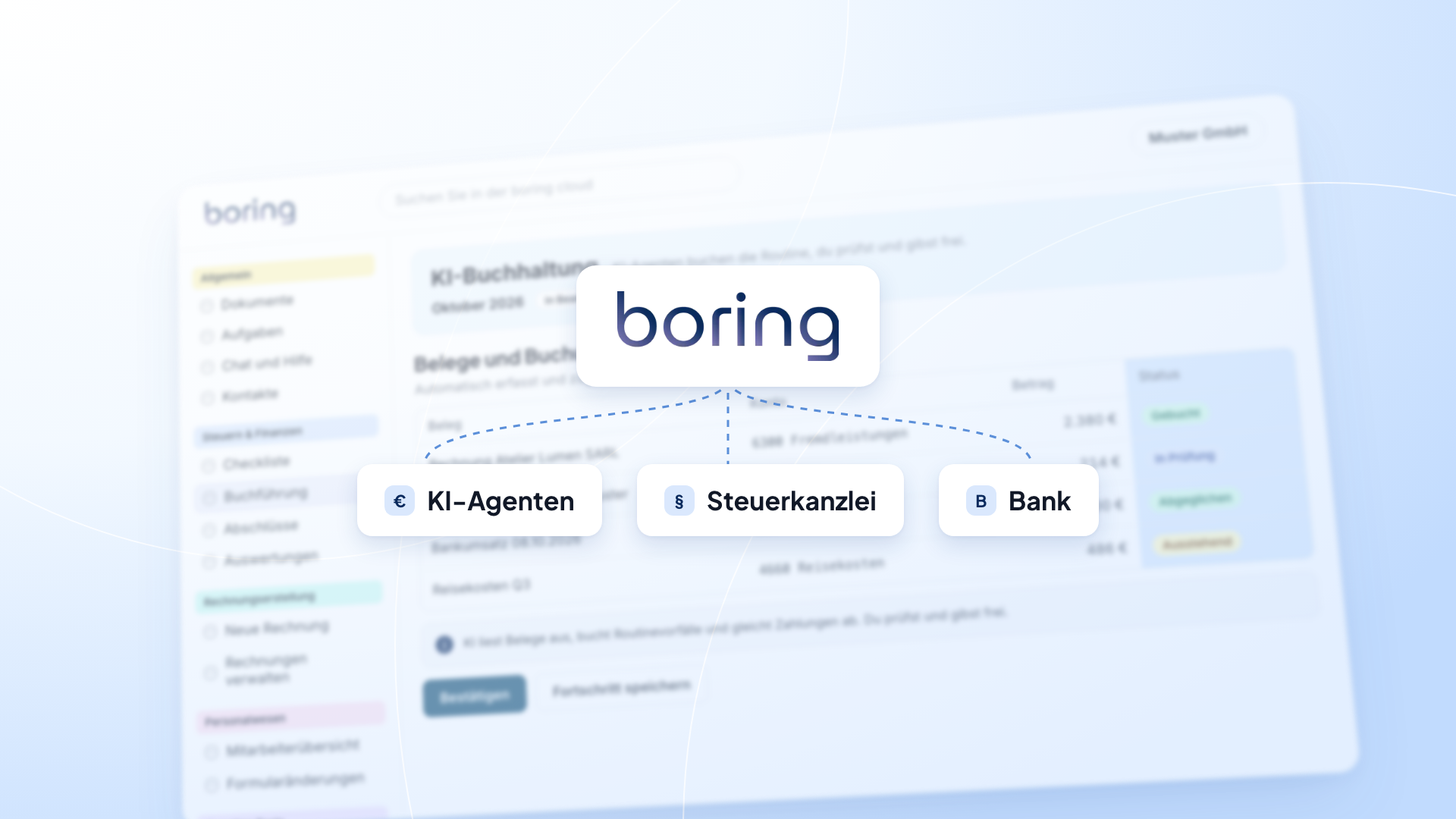
boring.tax verbindet beides in einem Konto, in drei Stufen ab 60 EUR pro Monat. Der boring.tax KI-Agent bucht deine Belege täglich, die boring.tax Buchhalter:innen prüfen den Monatsabschluss, und die boring.tax Steuerberatungsgesellschaft mbH (mit 4 Mio. EUR Haftpflichtdeckung) übernimmt Jahresabschluss, Steuererklärungen und Beratung.
In diesem Guide erfährst du, was ein digitaler Steuerberater für Startups und SaaS-Unternehmen leisten muss. Du siehst, welche Steuerfallen typisch sind, wie sich digitale Anbieter von klassischen Kanzleien unterscheiden und woran du einen guten Anbieter erkennst.
Digitaler Steuerberater: Definition und Abgrenzung
Was ist ein digitaler Steuerberater für Startups und SaaS-Unternehmen?
Ein digitaler Steuerberater für Startups und SaaS-Unternehmen ist eine zugelassene Steuerkanzlei, die Belege, Buchhaltung, Steuererklärungen und Kommunikation komplett online abwickelt und sich mit den Steuerthemen digitaler Geschäftsmodelle auskennt. Dazu gehören Abo-Umsätze, grenzüberschreitende Software-Leistungen, Reverse Charge, Holding-Strukturen und Mitarbeiterbeteiligungen.
Wichtig ist der Unterschied zu reiner Software. Ein Buchhaltungstool hilft dir beim Buchen. Steuerberatung im Sinne des Steuerberatungsgesetzes darf aber nur eine zugelassene Kanzlei leisten. Und nur sie haftet für Fehler in Jahresabschluss und Steuererklärungen.
”Digital” heißt dabei mehr als ein Upload-Ordner. Ein moderner digitaler Steuerberater arbeitet mit Bankanbindung, automatischer Belegerkennung und Live-Zahlen. Deine BWA siehst du dann nicht erst Wochen nach Monatsende.
Warum passen klassische Kanzleien oft nicht zu Startups?
Klassische Kanzleien sind nicht schlecht, aber ihr Modell kollidiert häufig mit dem Alltag von Gründer:innen. Abrechnung nach Steuerberatervergütungsverordnung, Belege im Monatsrhythmus und lange Wartezeiten passen schlecht zu einer Firma, die jede Woche Entscheidungen auf Basis von Zahlen trifft.
Dazu kommt ein Kapazitätsproblem. Laut Bundessteuerberaterkammer waren zum 01.01.2026 bundesweit 89.549 Steuerberater:innen registriert, nur 0,6 % mehr als im Vorjahr (BStBK-Berufsstatistik, zusammengefasst von IWW). Die Zahl der Auszubildenden zur Steuerfachangestellten sank im selben Zeitraum um 1,3 % auf 17.081.
Der Altersdurchschnitt der Berufsträger:innen lag laut Bundessteuerberaterkammer zum Stand 01.01.2025 bei 53,6 Jahren (BStBK Berufsstatistik 2024). Das legt nahe, dass manche Kanzleien bei neuen Mandaten wählerisch sind und kleine GmbHs mit vielen Belegen es schwerer haben, einen Platz zu finden. Das ist eine Einschätzung aus diesen Zahlen. Eine belastbare Statistik zur Annahme neuer Mandate gibt es nicht.
Für Gründer:innen ist Bürokratie kein Randthema. Laut Bitkom (Startup Report 2025) nennen 63 % der Tech-Startups Bürokratie als größte Herausforderung, noch vor Vertrieb (61 %) und Kapitalbeschaffung (52 %) (Bitkom Startup Report 2025). Laut KfW-Gründungsmonitor 2026 kosten gesetzliche und regulatorische Pflichten Gründer:innen “einige Stunden Wochenarbeitszeit” (KfW-Gründungsmonitor 2026).
Welche Steuerthemen sind bei SaaS-GmbHs besonders?
SaaS-Firmen haben fast nie das Steuerprofil eines lokalen Handwerksbetriebs. Schon im ersten Jahr kaufen und verkaufen sie international, kassieren im Voraus und entwickeln Software, die bilanziell Fragen aufwirft. Ein digitaler Steuerberater muss diese Punkte kennen, ohne dass du sie erklärst.
Reverse Charge bei ausländischen Tools
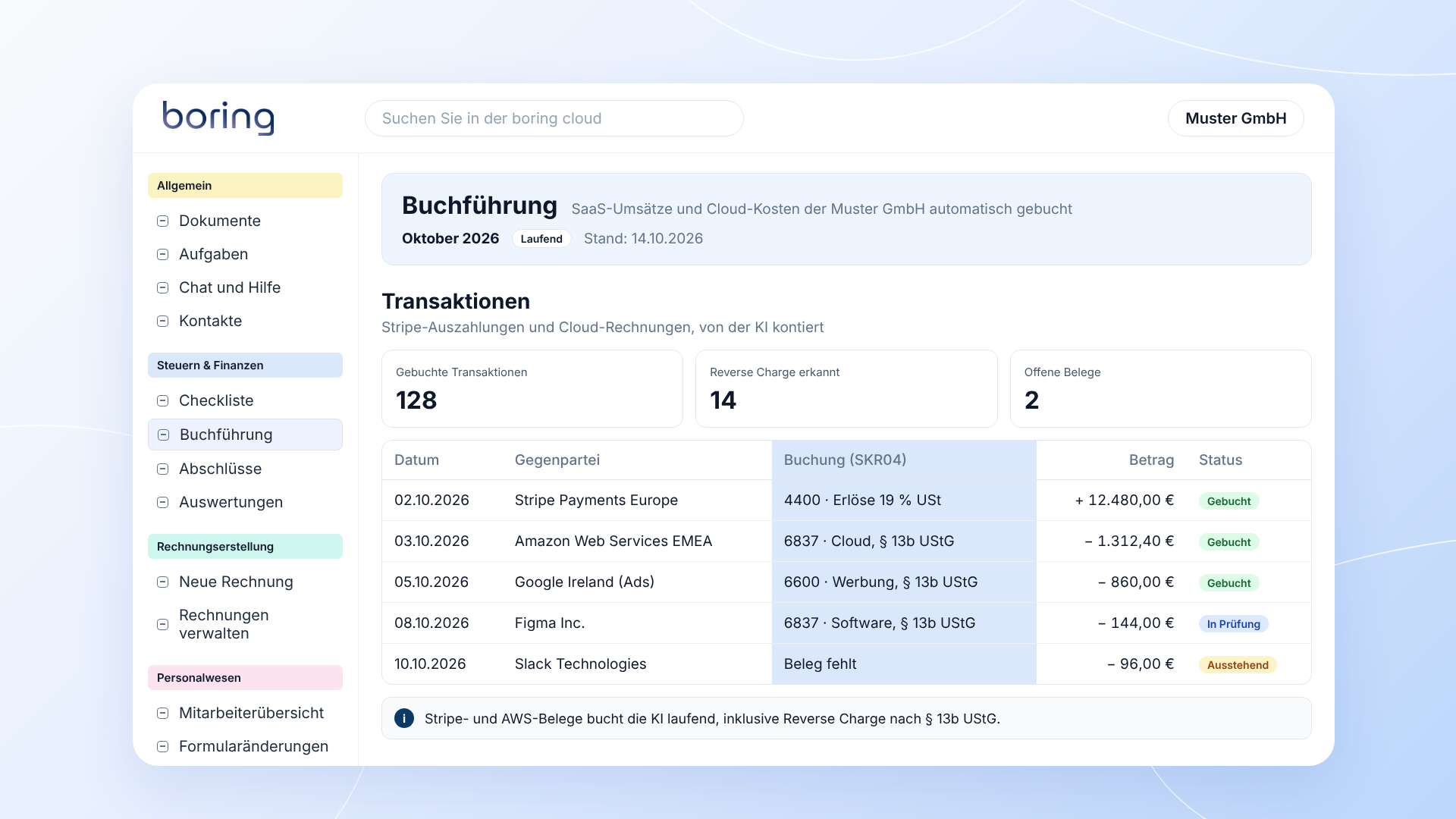
AWS, Google Ads, Figma, Slack: Viele Leistungen kommen von Anbietern aus dem Ausland. Nach § 13b UStG schuldest du als Leistungsempfänger die Umsatzsteuer und ziehst sie in der Regel gleichzeitig als Vorsteuer ab. Rechnerisch ist das oft neutral. Fehlt die Buchung aber in der UStVA, fällt das spätestens bei einer Prüfung auf.
Der boring.tax KI-Agent erkennt ausländische Rechnungen beim Einlesen und markiert sie als Reverse-Charge-Fall. So landet die Buchung automatisch in der richtigen Zeile der UStVA.
B2B-Verkäufe in andere EU-Länder
Verkaufst du deine Software an Unternehmen in der EU, liegt der Leistungsort beim Kunden (§ 3a Abs. 2 UStG). Du stellst die Rechnung ohne deutsche Umsatzsteuer aus, mit Hinweis auf die Steuerschuldnerschaft des Leistungsempfängers. Zusätzlich meldest du diese Umsätze in der Zusammenfassenden Meldung (ZM) ans Bundeszentralamt für Steuern.
In boring.tax entsteht die ZM direkt aus deinen Buchungen. Du musst die EU-Umsätze also nicht noch einmal per Hand zusammensuchen.
B2C-Verkäufe und OSS
Bei Privatkund:innen in anderen EU-Ländern gilt eine Bagatellgrenze von 10.000 EUR netto pro Jahr. Sie bezieht sich auf die Summe aller grenzüberschreitenden digitalen Leistungen an Privatkund:innen in allen anderen EU-Ländern zusammen, nicht auf ein einzelnes Land (§ 3a Abs. 5 UStG). Überschreitest du sie, gilt die Umsatzsteuer des jeweiligen Kundenlands. Gemeldet wird dann über das One-Stop-Shop-Verfahren (OSS) beim Bundeszentralamt für Steuern (§ 18j UStG). Wer Self-Service-Abos per Kreditkarte verkauft, erreicht diese Grenze schneller, als viele denken.
Jahresabos und Vorauszahlungen
Zahlt ein Kunde im November für zwölf Monate, gehört nur ein Teil des Umsatzes ins laufende Geschäftsjahr. Den Rest grenzt du über einen passiven Rechnungsabgrenzungsposten ab. Die Umsatzsteuer auf die Vorauszahlung entsteht trotzdem schon mit dem Zahlungseingang (Mindest-Istversteuerung). Mehr dazu, wann die Steuer entsteht, liest du im Beitrag zur Soll- und Ist-Besteuerung.
Selbst entwickelte Software
Nach HGB darfst du selbst geschaffene immaterielle Vermögenswerte unter Bedingungen aktivieren (§ 248 Abs. 2 HGB). Steuerlich gilt dagegen ein Aktivierungsverbot (§ 5 Abs. 2 EStG). Ob sich die Aktivierung lohnt, ist eine echte Beratungsfrage, etwa mit Blick auf Eigenkapital und Investor:innen. Genau hier kommt die boring.tax Steuerberatungsgesellschaft mbH ins Spiel.
Weitere Themen, die früh auftauchen
- Holding-Struktur: Gewinne aus dem Verkauf von GmbH-Anteilen sind in der Holding grundsätzlich zu 95 % steuerfrei, weil 5 % als nicht abziehbare Betriebsausgaben gelten (§ 8b KStG). Ob die Voraussetzungen im Einzelfall erfüllt sind, prüft die Beratung. Viele Gründer:innen setzen die Holding deshalb vor der ersten Finanzierungsrunde auf.
- Mitarbeiterbeteiligung: VSOP und ESOP haben lohnsteuerliche Folgen, die spätestens beim Exit relevant werden.
- Forschungszulage: Softwareentwicklung kann förderfähig sein, wenn sie die Kriterien für Forschung und Entwicklung erfüllt.
- E-Rechnung: Seit dem 01.01.2025 musst du E-Rechnungen empfangen können. Ab dem 01.01.2027 müssen Unternehmen mit mehr als 800.000 EUR Vorjahresumsatz sie auch ausstellen, ab dem 01.01.2028 alle (siehe § 14 UStG und die Übergangsregelung in § 27 Abs. 38 UStG). Details stehen im Artikel zur verpflichtenden E-Rechnung.
Wie verändert KI die Arbeit eines digitalen Steuerberaters?
KI übernimmt heute den Teil der Buchhaltung, der sich wiederholt: Belege erkennen, Konten zuordnen, Bankumsätze abgleichen, Reverse-Charge-Fälle markieren. Steuerberater:innen kümmern sich dann um alles, was Urteilsvermögen braucht, also um Jahresabschluss, Steuererklärungen, Strukturfragen und Beratung.
Die Verbreitung wächst schnell. Laut Bitkom (2026) setzen erstmals 57 % der deutschen Unternehmen ab 20 Beschäftigten KI ein (Bitkom, Presseinformation 2026). Ein Jahr zuvor waren es 36 %, zwei Jahre zuvor 20 %. Weitere 38 % planen oder diskutieren den Einsatz.
Für dich als Gründer:in hat das drei konkrete Folgen:
- Aktuelle Zahlen statt Schätzungen. Wenn Belege jeden Tag verbucht werden, siehst du Burn Rate und Runway auf Basis echter Buchungen. Du planst die nächste Einstellung oder Finanzierungsrunde nicht mehr mit Zahlen aus dem Vormonat.
- Weniger Rückfragen, weniger Stress zur Frist. Fehlende Belege fallen sofort auf, nicht erst am 9. des Folgemonats kurz vor der UStVA. Du klärst sie, solange du dich noch an die Ausgabe erinnerst.
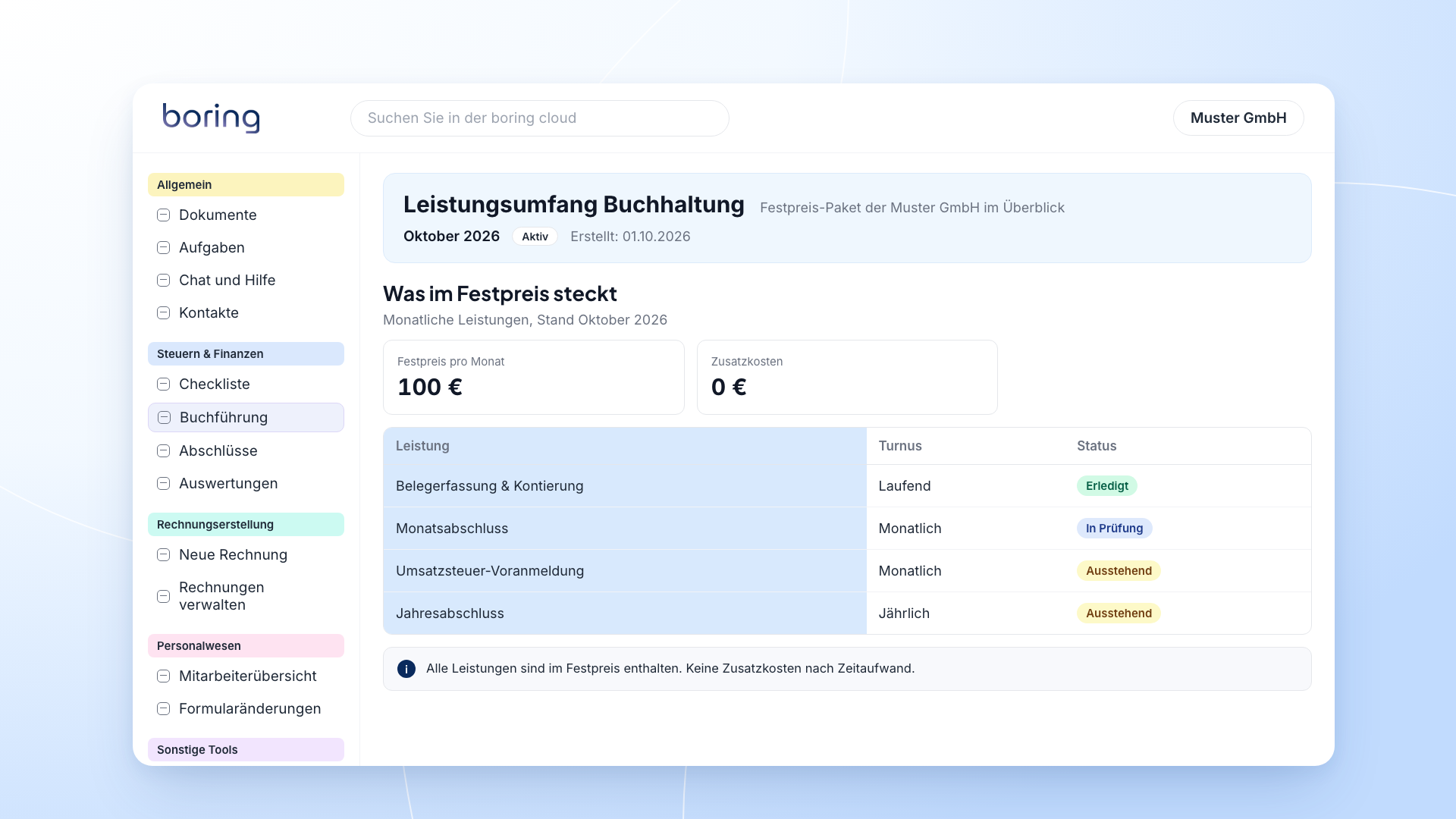
- Planbare Kosten. Wenn die Routine automatisch läuft, muss sie nicht mehr nach Zeitaufwand abgerechnet werden. Mehr Belege bedeuten dann nicht automatisch eine höhere Rechnung.
So sieht das bei boring.tax aus: Der boring.tax KI-Agent nimmt Belege per E-Mail, WhatsApp, Upload oder API entgegen, liest sie aus und ordnet sie den Bankumsätzen zu. Offene Transaktionen ohne Beleg siehst du täglich, und BWA, SuSa und GuV aktualisieren sich laufend.
Eine Grenze bleibt allerdings. KI-Tools ohne Steuerkanzlei dahinter dürfen keine Steuerberatung leisten und haften nicht für deine Erklärungen. Spätestens beim Jahresabschluss brauchst du dann wieder eine Kanzlei, also eine zweite Firma mit eigenem Zugang, eigener Rechnung und oft einer Datenübergabe.
Bei boring.tax fällt dieser Bruch weg. Die boring.tax Buchhalter:innen prüfen auf Wunsch deinen Monatsabschluss. Die boring.tax Steuerberatungsgesellschaft mbH arbeitet mit genau denselben Buchungen weiter, die der KI-Agent vorbereitet hat.
Die größten Herausforderungen und wie du sie löst
Die meisten Probleme mit der Steuerberatung entstehen nicht durch falsche Steuerbescheide. Sie entstehen im Alltag, und zwar vor allem durch diese fünf Dinge.
1. Belegchaos. Rechnungen kommen per Mail, liegen in Portalen oder auf dem Handy. Die Lösung sind mehrere Eingangskanäle, also E-Mail-Weiterleitung, Upload, Messenger und API, plus automatischer Abgleich mit der Bank. Dann siehst du jederzeit, welche Transaktion noch keinen Beleg hat.
2. Überraschungsrechnungen. Abrechnung nach Gebührenordnung und Zeitaufwand macht Kosten schwer planbar. Achte auf einen öffentlichen Festpreis, der deinen Umsatz und deine Mitarbeiterzahl abbildet.
3. Kanzlei ohne Kapazität. Wenn deine Kanzlei kündigt oder keine Zeit hat, brauchst du schnell Ersatz. Ein Anbieter, den du ohne Erstgespräch testen kannst, zeigt dir noch vor der nächsten UStVA-Frist, ob er zu dir passt.
4. Datenmigration beim Wechsel. Wer von DIY-Software zur Kanzlei wechselt, muss oft Konten, Stammdaten und Historie übertragen. Besser ist ein Setup, in dem du die Betreuungsstufe änderst, ohne das System zu wechseln. In boring.tax wechselst du zum Beispiel vom KI-Agenten zur Steuerberatungsgesellschaft im selben Konto: Buchungen, Konten und Belege bleiben, du musst keine Daten in ein anderes System übertragen.
5. Fristen. UStVA, ZM, Jahresabschluss, Offenlegung: Eine GmbH hat deutlich mehr Termine als ein Einzelunternehmen. Einen Überblick findest du im Beitrag zu den Fristen für Kapitalgesellschaften.
Wie wählst du den richtigen digitalen Steuerberater aus?
Ein guter digitaler Steuerberater für Startups und SaaS-Unternehmen erfüllt nicht nur ein oder zwei Punkte, sondern alle folgenden. Nutze die Liste als Checkliste für dein nächstes Gespräch oder deinen Test.
- Zugelassene, haftende Kanzlei. Frag nach dem Namen der Steuerberatungsgesellschaft und der Höhe der Berufshaftpflicht. “Partnerkanzleien” sind legitim, bedeuten aber eine zusätzliche Schnittstelle.
- Öffentlicher Festpreis. Du solltest vor dem ersten Gespräch wissen, was dich Buchhaltung, UStVA, Jahresabschluss und Lohn kosten. Am besten über einen Preisrechner.
- SaaS-Kompetenz. Reverse Charge, ZM, OSS, Rechnungsabgrenzung und Holding sollten Standard sein und kein Sonderfall mit Aufpreis.
- KI für die Routine. Belegerkennung, Kontierung und Bankabgleich sollten automatisch laufen. Frag konkret, was du selbst noch tun musst.
- Freigabe vor Übermittlung. Nichts sollte ohne deine Bestätigung ans Finanzamt gehen. Das schützt dich vor Fehlern, die du erst im Bescheid entdeckst.
- Wahl der Betreuungsstufe. Am Anfang reicht dir vielleicht Software. Mit Mitarbeitenden und Investor:innen brauchst du mehr. Ein Wechsel sollte ohne neue Plattform möglich sein.
- Datenstandort und Rechte. Daten in Deutschland, granulare Rollen für Co-Founder, Buchhaltung und Investor:innen, saubere Exportmöglichkeiten.
- Testbarkeit. Ein kostenloser Test auf deinen echten Zahlen sagt mehr als jede Demo.
Welche Modelle gibt es im Vergleich?
Auf dem Markt findest du grob fünf Modelle. Die Tabelle zeigt, wie sie sich bei den Kriterien unterscheiden, die für eine SaaS-GmbH zählen. Die Angaben zu Marktmodellen sind typische Muster und gelten nicht für jeden einzelnen Anbieter (Einschätzung Oktober 2026, boring.tax-Preise Stand September 2026).
| Modell | Wer bucht? | Jahresabschluss und Steuererklärungen | Preismodell | Betreuungsstufe wechseln |
|---|---|---|---|---|
| boring.tax | boring.tax KI-Agent, optional boring.tax Buchhalter:innen | boring.tax Steuerberatungsgesellschaft mbH im selben Konto | Öffentlicher Festpreis mit Preisrechner, Software-Stufe ab 60 EUR/Monat | Wechsel möglich, im selben Konto ohne Datenübergabe |
| Klassische Kanzlei | In der Regel Kanzlei-Mitarbeitende | Kanzlei | Steuerberatervergütungsverordnung, häufig nach Zeitaufwand | Wechsel möglich, mit Datenübergabe an neue Kanzlei oder Software |
| DIY-Buchhaltungssoftware | Du selbst | Externe Kanzlei nötig | Software-Abo plus Kanzleirechnung | Wechsel möglich, mit Datenübergabe an die Kanzlei |
| KI-Buchhaltung ohne eigene Kanzlei | KI, du prüfst | Meist über Partnerkanzlei | Häufig nach Transaktionen gestaffelt | Wechsel möglich, je nach Partner mit Datenübergabe |
| Digitale Kanzlei ohne Software-Stufe | Kanzlei, teils mit KI | Kanzlei | Häufig Angebot auf Anfrage | Wechsel möglich, mit Datenübergabe; ein reiner Software-Einstieg ist oft nicht vorgesehen |
Für sehr kleines Volumen ist die Software-Stufe von boring.tax gedacht: Der KI-Agent bucht, du prüfst und gibst frei, ab 60 EUR pro Monat und ohne Kanzlei. Eine reine KI-Buchhaltung ohne Kanzlei kann in diesem Bereich im Einzelfall noch günstiger sein. Sobald du Jahresabschluss, Steuererklärungen und Beratung brauchst, zählt aber das Gesamtpaket und nicht nur der Einstiegspreis. Bei boring.tax wechselst du dafür einfach die Stufe.
boring.tax vs. klassische Kanzleien: Der Vergleich
Die meisten Gründer:innen landen am Ende bei einer von zwei Optionen: der klassischen Kanzlei um die Ecke oder einem digitalen Modell. Die Tabelle stellt beide direkt gegenüber, bezogen auf eine operative SaaS-GmbH (Preise Stand September 2026).
| Kriterium | boring.tax | Klassische Kanzlei |
|---|---|---|
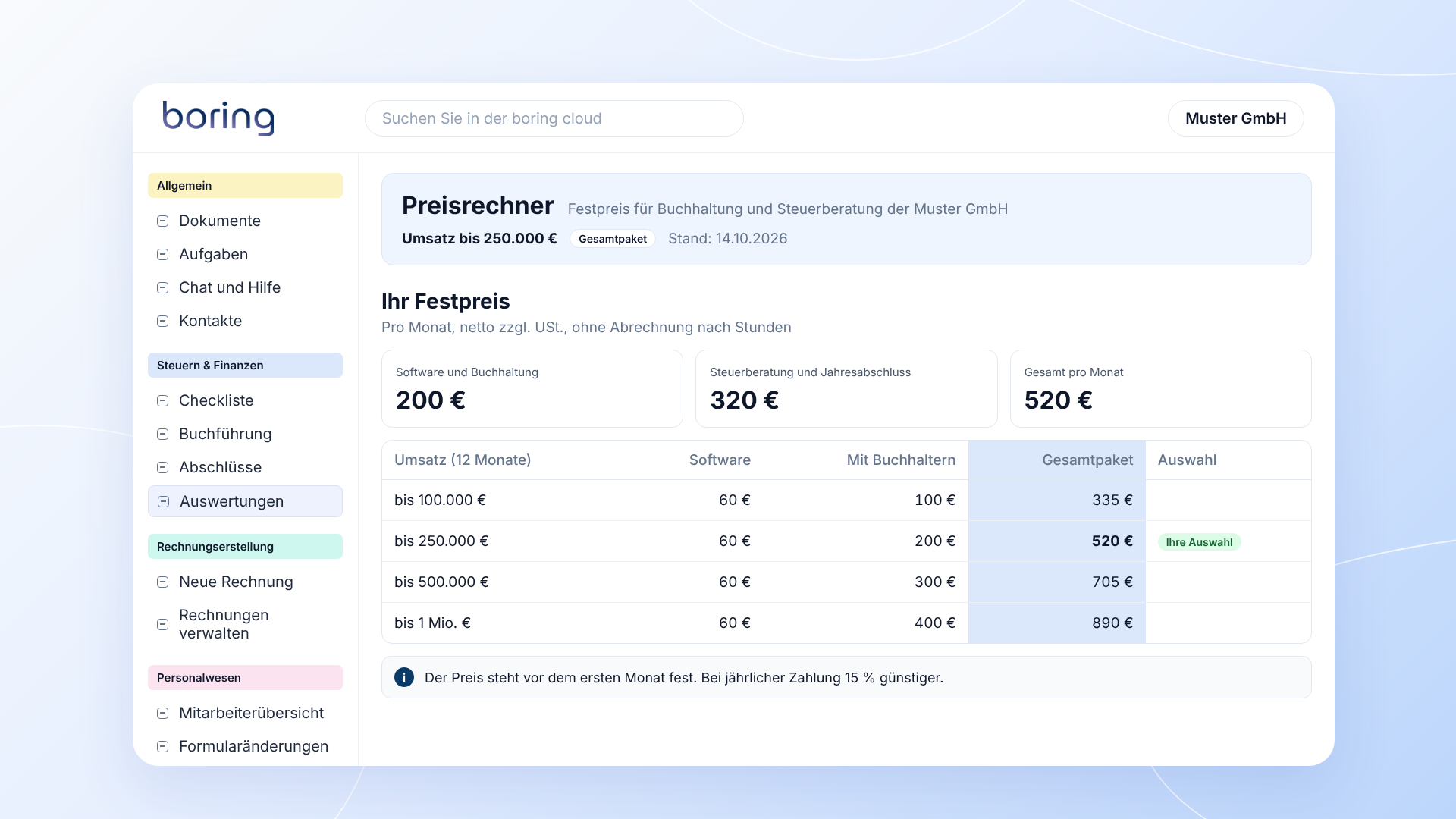
| Preis | Fester Monatspreis nach Umsatzband: Software-Stufe ab 60 EUR, Gesamtpaket mit Kanzlei 335 bis 890 EUR (bis 1 Mio. EUR Umsatz), Lohn 20 EUR pro Mitarbeitendem | Abrechnung nach Steuerberatervergütungsverordnung oder Zeitaufwand, schwankt je nach Belegmenge |
| Transparenz | Öffentlicher Preisrechner, Kosten vor dem ersten Gespräch bekannt | Angebot häufig erst nach Erstgespräch, Zusatzleistungen oft separat |
| Aktualität | Laufende Buchung durch den boring.tax KI-Agenten, Live-BWA und offene Belege täglich sichtbar | Belege im Monatsrhythmus; BWA nach typischer Erfahrung oft vier bis sechs Wochen nach Monatsende, je nach Kanzlei unterschiedlich |
| Haftung | Eigene boring.tax Steuerberatungsgesellschaft mbH mit 4 Mio. EUR Haftpflichtdeckung, Software und Kanzlei aus einer Hand | Berufshaftpflicht der Kanzlei, Software meist von Drittanbietern ohne gemeinsame Verantwortung |
| KI-Integration | KI-Agent für Belegerkennung, Kontierung, Bankabgleich, Reverse Charge und ZM, direkt im Kanzlei-Workflow | Je nach Kanzlei, häufig manuelle Erfassung oder separate Tools |
Der entscheidende Unterschied steckt nicht in einer einzelnen Zeile, sondern darin, wie alles zusammenspielt. Bei einer klassischen Kanzlei bleibt die Buchhaltung oft ein Monatsprojekt, das du anstößt. Bei boring.tax läuft sie laufend im Hintergrund, und die Kanzlei arbeitet auf denselben Zahlen weiter.
Klassischer Steuerberater oder digitale Steuerkanzlei für die GmbH?
Für eine SaaS-GmbH passt in der Regel die digitale Steuerkanzlei, für eine kleine GmbH mit wenigen Belegen und rein deutschem Geschäft kann die klassische Kanzlei vor Ort genügen. Als Faustregel hilft dir diese Entscheidung:
- Wähle eine digitale Steuerkanzlei wie boring.tax, wenn mindestens zwei Punkte zutreffen: Du hast Belege in mehreren Quellen (Stripe, Gmail, Portale), Tools oder Kund:innen im Ausland, du willst laufend aktuelle Zahlen und einen festen Preis, oder du brauchst Reporting für Investor:innen.
- Wähle eine klassische Kanzlei, wenn du wenige Belege hast, kaum Auslandsbezug, eine Kanzlei mit freier Kapazität, die du persönlich schätzt, und dir persönlicher Kontakt vor Ort wichtiger ist als Tempo.
Unsicher? Starte mit der Software-Stufe und hole die Kanzlei später dazu, ohne das System zu wechseln.
Beispiel: Eine SaaS-GmbH im zweiten Geschäftsjahr
Das folgende Szenario ist ein Beispiel, kein Kundenfall. Eine B2B-SaaS-GmbH aus Leipzig macht 420.000 EUR Umsatz, hat neun Mitarbeitende und Kund:innen in Deutschland, Österreich und den Niederlanden. Fast alle Tools werden von Anbietern aus Irland und den USA abgerechnet.
Vorher: Die Gründerin sammelt am Monatsende Belege aus sechs Quellen und schickt sie an die Kanzlei. Die BWA kommt nach rund fünf Wochen. Reverse-Charge-Buchungen fehlen zweimal, die ZM für die niederländischen Kunden wird einmal verspätet abgegeben. Die Kanzleirechnung schwankt je nach Aufwand.
Nachher: Belege kommen per Mail-Weiterleitung und Upload rein, die Bank ist angebunden. Der boring.tax KI-Agent ordnet zu und markiert Reverse-Charge-Fälle und EU-Umsätze für die ZM. Die Gründerin sieht offene Belege täglich. Das Team der boring.tax Steuerberatungsgesellschaft mbH prüft, übermittelt die UStVA nach Freigabe und erstellt den Jahresabschluss.
Kosten im Beispiel: Die Stufe “Mit Kanzlei + Steuerberater” kostet je nach Umsatzband so viel (netto pro Monat, Preise Stand September 2026, den aktuellen Stand findest du im Preisrechner):
| Umsatzband | Gesamtpaket mit Kanzlei, netto pro Monat |
|---|---|
| Bis 100.000 EUR Umsatz | 335 EUR |
| Bis 500.000 EUR Umsatz (Band des Beispiels) | 705 EUR |
| Bis 1 Mio. EUR Umsatz | 890 EUR |
Die Beispiel-GmbH liegt mit 420.000 EUR im Band bis 500.000 EUR und zahlt 705 EUR. Dazu kommt Lohn mit 20 EUR pro Mitarbeitendem, also 180 EUR bei neun Mitarbeitenden. Zusammen sind das 885 EUR pro Monat netto, als fester Betrag.
So unterstützt dich boring.tax
Du startest in der Stufe, die zu deiner Firma passt, und wechselst jederzeit im selben Konto.
- boring.tax KI-Agent (Software-Stufe, ab 60 EUR pro Monat): Der KI-Agent bucht, du prüfst und gibst frei. Die UStVA bereitest du in boring vor und übermittelst sie selbst direkt an ELSTER (eigene Hersteller-ID seit Juli 2026).
- boring.tax Buchhalter:innen: Wird es mehr, nimmst du Buchhalter:innen dazu, die deine Buchungen prüfen und einen geprüften Monatsabschluss liefern.
- boring.tax Steuerberatungsgesellschaft mbH: In der höchsten Stufe übernimmt das Steuerberatungsteam der hauseigenen boring.tax Steuerberatungsgesellschaft mbH (seit Juni 2026, 4 Mio. EUR Haftpflichtdeckung) UStVA-Übermittlung, Jahresabschluss, Körperschaft- und Gewerbesteuererklärung, E-Bilanz und Beratung. Die Preise je Umsatzband stehen in der Tabelle im Beispiel oben.
Was im Hintergrund für dich arbeitet:
- Belege per E-Mail, WhatsApp, Upload, API oder Qonto, Bankanbindung über finAPI
- BWA, SuSa und GuV, auf Wunsch als bestätigte, finale Zahlen
- Zusammenfassende Meldung direkt aus deinen Buchungen
- Rechnungen, Mahnwesen und wiederkehrende Rechnungen für deine Abos
- HR- und Lohnportal für Mitarbeitende, Lohndaten und Onboarding
- Rollen und Rechte für Co-Founder, Team und Investor:innen
Du behältst die Kontrolle: Nichts geht ohne deine Freigabe oder die des Steuerberatungsteams ans Finanzamt, und die Daten liegen in Deutschland. Hast du eine Holding, läuft sie für 500 EUR im Jahr im selben Konto mit, inklusive Jahresabschluss, KSt/GewSt, E-Bilanz und Offenlegung. Im August 2026 nutzten über 330 zahlende Unternehmen die Plattform.
Häufige Fragen
Was kostet ein digitaler Steuerberater für eine SaaS-GmbH? Bei boring.tax liegt das Gesamtpaket mit Kanzlei je nach Umsatzband bei 335 EUR (niedrigstes Band), 705 EUR (bis 500.000 EUR) und 890 EUR (bis 1 Mio. EUR) pro Monat netto, die Software-Stufe startet bei 60 EUR (Preise Stand September 2026). Lohn kostet 20 EUR pro Mitarbeitendem. Für klassische Kanzleien ist “einige hundert Euro pro Monat” nur eine grobe Schätzung für eine operative GmbH mit Jahresabschluss und Steuererklärungen, keine amtliche Statistik. Die tatsächliche Höhe hängt von Belegmenge, Zeitaufwand und Kanzlei ab, lass dir deshalb ein schriftliches Angebot geben.
Darf ein KI-Tool meine Steuererklärung machen? Nein, Steuerberatung und die Übermittlung im Auftrag Dritter sind Steuerberater:innen vorbehalten. Ein KI-Tool kann deine Buchhaltung vorbereiten. Für Jahresabschluss und Erklärungen brauchst du eine zugelassene Kanzlei, entweder eine Partnerkanzlei oder eine hauseigene Kanzlei wie die boring.tax Steuerberatungsgesellschaft mbH, die erstellt und übermittelt. Alternativ machst du sie selbst.
Ab wann braucht ein Startup einen Steuerberater? Spätestens mit dem ersten Jahresabschluss deiner GmbH oder UG solltest du eine Kanzlei an Bord haben. Viele Gründer:innen starten die laufende Buchhaltung mit Software und holen die Kanzlei dazu, sobald Mitarbeitende, Investor:innen oder EU-Umsätze ins Spiel kommen.
Muss ich für Software aus den USA Umsatzsteuer zahlen? Ja, bei Leistungen ausländischer Anbieter schuldest du als Unternehmen die Umsatzsteuer nach § 13b UStG selbst. In der Regel ziehst du sie gleichzeitig als Vorsteuer wieder ab, sodass keine Zahllast entsteht. Melden musst du sie trotzdem in der UStVA.
Kann ich von meiner aktuellen Kanzlei zu einem digitalen Steuerberater wechseln? Ja, ein Wechsel ist jederzeit möglich, ideal zum Jahreswechsel oder nach einem abgeschlossenen Jahresabschluss. Die bisherige Kanzlei übergibt Saldenvorträge und Unterlagen. Plane etwa einen Monat Vorlauf ein, damit die erste UStVA sauber läuft.
Lohnt sich eine Holding für SaaS-Gründer:innen? Für viele ja, vor allem mit Blick auf einen späteren Exit, da Veräußerungsgewinne in der Holding grundsätzlich zu 95 % steuerfrei sind (§ 8b KStG). Die Holding verursacht aber eigene Kosten für Jahresabschluss und Erklärungen. Lass dich beraten, bevor du Anteile verschiebst, denn eine nachträgliche Einbringung kann teuer werden.
Bereit, es auszuprobieren?
Für eine SaaS-GmbH brauchst du beides: KI, die die tägliche Routine erledigt, und eine haftende Kanzlei für die Themen, bei denen es auf Erfahrung ankommt. boring.tax gibt dir beides in einem Konto. Du startest mit dem KI-Agenten ab 60 EUR pro Monat und gehst bis zur eigenen Steuerberatungsgesellschaft, ohne das System zu wechseln.
Teste die Plattform 14 Tage kostenlos auf deinen eigenen Zahlen. Du brauchst keine Kreditkarte und musst kein Verkaufsgespräch führen. Verbinde dein Bankkonto, leite die ersten Belege weiter und schau zu, wie deine offenen Transaktionen verschwinden.
Code shippen. Belege rein. So soll Steuer sein: boring.
Noch kein boring.tax-Kunde? Jetzt kostenlos starten →
Digital Tax Advisor for Startups and SaaS: The 2026 Guide
Your AWS invoice comes from Ireland, and your customer in Amsterdam pays the annual subscription up front. Your receipts are scattered across Stripe, Gmail and some customer portal. Your accounting firm wants the documents “by the 10th at the latest,” collected once a month.
A digital tax advisor only helps a SaaS GmbH if two things come together. AI has to take over the day-to-day bookkeeping. And a real, liable tax firm has to understand the tax issues of your business model, at a fixed price.
boring.tax combines both in one account, in three tiers starting at EUR 60 per month. The boring.tax AI agent books your receipts daily, the boring.tax accountants review the monthly close, and boring.tax Steuerberatungsgesellschaft mbH (with EUR 4 million in professional liability coverage) handles annual financial statements, tax returns and advice.
In this guide you will learn what a digital tax advisor for startups and SaaS companies has to deliver. You will see which tax pitfalls are typical, how digital providers differ from traditional firms, and how to recognize a good provider.
Digital tax advisor: definition and scope
What is a digital tax advisor for startups and SaaS companies?
A digital tax advisor for startups and SaaS companies is a licensed tax firm that handles receipts, bookkeeping, tax returns and communication entirely online, and that understands the tax issues of digital business models. These include subscription revenue, cross-border software services, reverse charge, holding structures and employee equity.
The difference from pure software matters. An accounting tool helps you with bookkeeping. But tax advice within the meaning of the German Tax Advisory Act can only be provided by a licensed firm. And only that firm is liable for errors in annual financial statements and tax returns.
”Digital” also means more than an upload folder. A modern digital tax advisor works with bank connections, automatic receipt recognition and live figures. You then see your BWA (management accounts) without waiting weeks after month-end.
Why do traditional firms often not fit startups?
Traditional firms are not bad, but their model often clashes with the day-to-day reality of founders. Billing under the German tax advisor fee ordinance, receipts on a monthly rhythm and long waiting times fit poorly with a company that makes decisions based on numbers every week.
There is also a capacity problem. According to the German Federal Chamber of Tax Advisors, 89,549 tax advisors were registered nationwide as of 01.01.2026, only 0.6% more than the year before (BStBK professional statistics, summarized by IWW). The number of trainees for tax assistants fell by 1.3% to 17,081 over the same period.
According to the Federal Chamber of Tax Advisors, the average age of professionals was 53.6 years as of 01.01.2025 (BStBK professional statistics 2024). This suggests that some firms are selective about new clients, and small GmbHs with many receipts have a harder time finding a spot. This is our interpretation of these figures. There is no reliable statistic on how firms accept new clients.
For founders, bureaucracy is not a side issue. According to Bitkom (Startup Report 2025), 63% of tech startups name bureaucracy as their biggest challenge, ahead of sales (61%) and fundraising (52%) (Bitkom Startup Report 2025). According to the KfW Start-up Monitor 2026, legal and regulatory obligations cost founders “several hours of work per week” (KfW Start-up Monitor 2026).
Which tax issues are special for SaaS GmbHs?
SaaS companies almost never have the tax profile of a local craft business. In their very first year they buy and sell internationally, collect payment up front, and develop software that raises accounting questions. A digital tax advisor must know these points without you having to explain them.
Reverse charge on foreign tools
AWS, Google Ads, Figma, Slack: many services come from providers abroad. Under § 13b UStG, you as the recipient owe the VAT and usually deduct it as input VAT at the same time. In terms of the numbers, this is often neutral. But if the entry is missing from the UStVA (VAT return), it will be noticed at the latest during an audit.
The boring.tax AI agent recognizes foreign invoices when it reads them in and flags them as reverse charge cases. The entry then lands automatically in the correct line of the UStVA.
B2B sales to other EU countries
If you sell your software to businesses in the EU, the place of supply is with the customer (§ 3a Abs. 2 UStG). You issue the invoice without German VAT, with a note that the recipient is liable for the tax. You also report these sales in the EC Sales List (ZM) to the Federal Central Tax Office.
In boring.tax, the ZM is generated directly from your bookings. You do not have to gather your EU sales by hand again.
B2C sales and OSS
For private customers in other EU countries, a de minimis threshold of EUR 10,000 net per year applies. It refers to the total of all cross-border digital services to private customers across all other EU countries combined, not to a single country (§ 3a Abs. 5 UStG). If you exceed it, the VAT of the respective customer country applies. Reporting is then done through the One-Stop-Shop procedure (OSS) with the Federal Central Tax Office (§ 18j UStG). If you sell self-service subscriptions by credit card, you reach this threshold faster than many people think.
Annual subscriptions and prepayments
If a customer pays in November for twelve months, only part of the revenue belongs in the current financial year. You defer the rest through a deferred income item. The VAT on the prepayment still arises upon receipt of payment (minimum cash-basis taxation). You can read more about when the tax arises in the article on accrual and cash-basis taxation.
Self-developed software
Under the HGB (German Commercial Code), you may capitalize internally generated intangible assets under certain conditions (§ 248 Abs. 2 HGB). For tax purposes, however, a ban on capitalization applies (§ 5 Abs. 2 EStG). Whether capitalization pays off is a real advisory question, for example with a view to equity and investors. This is exactly where boring.tax Steuerberatungsgesellschaft mbH comes in.
Other topics that come up early
- Holding structure: Gains from the sale of GmbH shares are generally 95% tax-exempt in the holding company, because 5% are treated as non-deductible business expenses (§ 8b KStG). Whether the requirements are met in an individual case is something your advisor checks. Many founders therefore set up the holding before the first funding round.
- Employee equity: VSOP and ESOP have payroll tax consequences that become relevant at the latest at exit.
- Research allowance: Software development can qualify for funding if it meets the criteria for research and development.
- E-invoicing: Since 01.01.2025, you must be able to receive e-invoices. From 01.01.2027, companies with more than EUR 800,000 in prior-year revenue must also issue them, and from 01.01.2028 all companies must (see § 14 UStG and the transitional rule in § 27 Abs. 38 UStG). Details are in the article on mandatory e-invoicing.
How does AI change the work of a digital tax advisor?
AI now takes over the part of bookkeeping that repeats: recognizing receipts, assigning accounts, matching bank transactions, flagging reverse charge cases. Tax advisors then focus on everything that requires judgment, meaning annual financial statements, tax returns, structuring questions and advice.
Adoption is growing fast. According to Bitkom (2026), for the first time 57% of German companies with 20 or more employees use AI (Bitkom, press release 2026). A year earlier it was 36%, and two years earlier 20%. Another 38% are planning or discussing its use.
For you as a founder, this has three concrete consequences:
- Current numbers instead of estimates. When receipts are booked every day, you see burn rate and runway based on real bookings. You no longer plan your next hire or funding round with last month’s numbers.
- Fewer follow-up questions, less stress at deadlines. Missing receipts stand out immediately, not on the 9th of the following month right before the UStVA. You sort them out while you still remember the expense.
- Predictable costs. When the routine runs automatically, it no longer has to be billed by time spent. More receipts then do not automatically mean a higher invoice.
Here is how that looks at boring.tax: the boring.tax AI agent accepts receipts by email, WhatsApp, upload or API, reads them out and matches them to bank transactions. You see open transactions without a receipt every day, and BWA, SuSa (trial balance) and GuV (income statement) update continuously.
One limit remains, though. AI tools without a tax firm behind them cannot provide tax advice and are not liable for your returns. At the latest at the annual financial statements, you then need a firm again, which means a second company with its own access, its own invoice and often a data handover.
At boring.tax, this break disappears. The boring.tax accountants review your monthly close on request. boring.tax Steuerberatungsgesellschaft mbH continues working with exactly the same bookings the AI agent prepared.
The biggest challenges and how to solve them
Most problems with tax advice do not come from wrong tax assessments. They arise in day-to-day work, mainly from these five things.
1. Receipt chaos. Invoices arrive by email, sit in portals or on your phone. The solution is multiple input channels, meaning email forwarding, upload, messenger and API, plus automatic matching with the bank. Then you can see at any time which transaction still has no receipt.
2. Surprise invoices. Billing by fee schedule and time spent makes costs hard to plan. Look for a public fixed price that reflects your revenue and your headcount.
3. A firm without capacity. If your firm terminates the relationship or has no time, you need a replacement quickly. A provider you can test without an intro call shows you, before the next UStVA deadline, whether it fits you.
4. Data migration when switching. If you move from DIY software to a firm, you often have to transfer accounts, master data and history. A better setup is one where you change the level of support without changing systems. In boring.tax, for example, you move from the AI agent to the tax advisory firm in the same account: bookings, accounts and receipts stay in place, and you do not have to transfer data to another system.
5. Deadlines. UStVA, ZM, annual financial statements, public disclosure: a GmbH has significantly more deadlines than a sole proprietorship. You can find an overview in the article on deadlines for corporations.
How do you choose the right digital tax advisor?
A good digital tax advisor for startups and SaaS companies does not meet just one or two points, but all of the following. Use the list as a checklist for your next conversation or your trial.
- Licensed, liable firm. Ask for the name of the tax advisory firm and the amount of its professional liability coverage. “Partner firms” are legitimate, but they mean an additional interface.
- Public fixed price. You should know before the first conversation what bookkeeping, UStVA, annual financial statements and payroll will cost you. Ideally through a price calculator.
- SaaS expertise. Reverse charge, ZM, OSS, revenue deferral and holding structures should be standard, not a special case with a surcharge.
- AI for the routine. Receipt recognition, account assignment and bank matching should run automatically. Ask specifically what you still have to do yourself.
- Approval before submission. Nothing should go to the tax office without your confirmation. This protects you from errors you would otherwise only discover in the assessment.
- Choice of support tier. At the start, software may be enough for you. With employees and investors, you need more. Switching should be possible without a new platform.
- Data location and permissions. Data in Germany, granular roles for co-founders, accounting and investors, and clean export options.
- Testability. A free trial on your real numbers tells you more than any demo.
Which models are there, and how do they compare?
On the market you will find roughly five models. The table shows how they differ on the criteria that matter for a SaaS GmbH. The statements about market models are typical patterns and do not apply to every individual provider (assessment October 2026, boring.tax prices as of September 2026).
| Model | Who does the bookkeeping? | Annual financial statements and tax returns | Pricing model | Switching support tier |
|---|---|---|---|---|
| boring.tax | boring.tax AI agent, optionally boring.tax accountants | boring.tax Steuerberatungsgesellschaft mbH in the same account | Public fixed price with price calculator, software tier from EUR 60/month | Switching possible, in the same account without a data handover |
| Traditional firm | Usually firm staff | Firm | German tax advisor fee ordinance, often based on time spent | Switching possible, with a data handover to a new firm or software |
| DIY accounting software | You yourself | External firm required | Software subscription plus firm invoice | Switching possible, with a data handover to the firm |
| AI bookkeeping without its own firm | AI, you review | Mostly via a partner firm | Often tiered by transactions | Switching possible, depending on the partner with a data handover |
| Digital firm without a software tier | Firm, partly with AI | Firm | Often a quote on request | Switching possible, with a data handover; a pure software entry is often not offered |
For very small volumes, the boring.tax software tier is the right fit: the AI agent books, you review and approve, from EUR 60 per month and without a firm. Pure AI bookkeeping without a firm may be even cheaper in this range in individual cases. As soon as you need annual financial statements, tax returns and advice, though, the overall package counts, not just the entry price. With boring.tax, you simply change the tier.
boring.tax vs. traditional firms: the comparison
Most founders end up with one of two options: the traditional firm around the corner or a digital model. The table compares both directly, based on an operating SaaS GmbH (prices as of September 2026).
| Criterion | boring.tax | Traditional firm |
|---|---|---|
| Price | Fixed monthly price by revenue band: software tier from EUR 60, full package with firm EUR 335 to 890 (up to EUR 1 million in revenue), payroll EUR 20 per employee | Billing under the tax advisor fee ordinance or by time spent, varies with receipt volume |
| Transparency | Public price calculator, costs known before the first conversation | Quote often only after an initial conversation, additional services often billed separately |
| Timeliness | Continuous booking by the boring.tax AI agent, live BWA and open receipts visible daily | Receipts on a monthly rhythm; BWA, in typical experience, often four to six weeks after month-end, varying by firm |
| Liability | Own boring.tax Steuerberatungsgesellschaft mbH with EUR 4 million in liability coverage, software and firm from a single source | Professional liability of the firm, software usually from third parties without shared responsibility |
| AI integration | AI agent for receipt recognition, account assignment, bank matching, reverse charge and ZM, directly in the firm’s workflow | Depends on the firm, often manual entry or separate tools |
The decisive difference is not in any single row, but in how everything works together. With a traditional firm, bookkeeping often remains a monthly project that you have to kick off. With boring.tax, it runs continuously in the background, and the firm keeps working on the same numbers.
Traditional tax advisor or digital tax firm for your GmbH?
For a SaaS GmbH, the digital tax firm is usually the better fit. For a small GmbH with few receipts and purely German business, a traditional local firm can be enough. This rule of thumb helps you decide:
- Choose a digital tax firm like boring.tax if at least two points apply: you have receipts in several sources (Stripe, Gmail, portals), you have tools or customers abroad, you want current numbers at all times and a fixed price, or you need reporting for investors.
- Choose a traditional firm if you have few receipts, hardly any international exposure, a firm with free capacity that you value personally, and in-person contact locally matters more to you than speed.
Not sure? Start with the software tier and bring in the firm later, without changing systems.
Example: a SaaS GmbH in its second financial year
The following scenario is an example, not a customer case. A B2B SaaS GmbH from Leipzig has EUR 420,000 in revenue, nine employees, and customers in Germany, Austria and the Netherlands. Almost all of its tools are billed by providers from Ireland and the US.
Before: The founder collects receipts from six sources at month-end and sends them to the firm. The BWA arrives after about five weeks. Reverse charge entries are missing twice, and the ZM for the Dutch customers is filed late once. The firm’s invoice varies with the effort involved.
After: Receipts come in by email forwarding and upload, and the bank is connected. The boring.tax AI agent assigns them and flags reverse charge cases and EU sales for the ZM. The founder sees open receipts every day. The team at boring.tax Steuerberatungsgesellschaft mbH reviews, submits the UStVA after approval and prepares the annual financial statements.
Costs in the example: The “With firm + tax advisor” tier costs the following depending on the revenue band (net per month, prices as of September 2026, see the price calculator for the current status):
| Revenue band | Full package with firm, net per month |
|---|---|
| Up to EUR 100,000 in revenue | EUR 335 |
| Up to EUR 500,000 in revenue (band of the example) | EUR 705 |
| Up to EUR 1 million in revenue | EUR 890 |
At EUR 420,000, the example GmbH falls in the band up to EUR 500,000 and pays EUR 705. On top of that comes payroll at EUR 20 per employee, so EUR 180 for nine employees. Together that is EUR 885 per month net, as a fixed amount.
How boring.tax supports you
You start in the tier that fits your company and switch at any time within the same account.
- boring.tax AI agent (software tier, from EUR 60 per month): The AI agent books, you review and approve. You prepare the UStVA in boring and submit it yourself directly to ELSTER (own manufacturer ID since July 2026).
- boring.tax accountants: As things grow, you add accountants who review your bookings and deliver a reviewed monthly close.
- boring.tax Steuerberatungsgesellschaft mbH: In the highest tier, the tax advisory team of the in-house boring.tax Steuerberatungsgesellschaft mbH (since June 2026, EUR 4 million in liability coverage) takes over UStVA submission, annual financial statements, corporate income tax and trade tax returns, e-balance sheet and advice. The prices per revenue band are in the table in the example above.
What works for you in the background:
- Receipts by email, WhatsApp, upload, API or Qonto, bank connection via finAPI
- BWA, SuSa and GuV, on request as confirmed, final figures
- EC Sales List directly from your bookings
- Invoices, dunning and recurring invoices for your subscriptions
- HR and payroll portal for employees, payroll data and onboarding
- Roles and permissions for co-founders, team and investors
You stay in control: nothing goes to the tax office without your approval or that of the tax advisory team, and the data is stored in Germany. If you have a holding company, it runs along in the same account for EUR 500 per year, including annual financial statements, KSt/GewSt (corporate and trade tax), e-balance sheet and public disclosure. Over 330 paying companies used the platform in August 2026.
FAQ
What does a digital tax advisor cost for a SaaS GmbH? At boring.tax, the full package with firm costs EUR 335 (lowest band), EUR 705 (up to EUR 500,000) and EUR 890 (up to EUR 1 million) per month net depending on the revenue band, and the software tier starts at EUR 60 (prices as of September 2026). Payroll costs EUR 20 per employee. For traditional firms, “a few hundred euros per month” is only a rough estimate for an operating GmbH with annual financial statements and tax returns, not an official statistic. The actual amount depends on receipt volume, time spent and the firm, so ask for a written quote.
Can an AI tool prepare my tax return? No, tax advice and submission on behalf of third parties are reserved for tax advisors. An AI tool can prepare your bookkeeping. For annual financial statements and returns, you need a licensed firm, either a partner firm or an in-house firm like boring.tax Steuerberatungsgesellschaft mbH, which prepares and submits them. Alternatively, you do them yourself.
When does a startup need a tax advisor? At the latest with the first annual financial statements of your GmbH or UG, you should have a firm on board. Many founders start day-to-day bookkeeping with software and bring in the firm as soon as employees, investors or EU sales come into play.
Do I have to pay VAT on software from the US? Yes, for services from foreign providers you owe the VAT yourself as a business under § 13b UStG. You usually deduct it again as input VAT at the same time, so no tax payable arises. You still have to report it in the UStVA.
Can I switch from my current firm to a digital tax advisor? Yes, a switch is possible at any time, ideally at the turn of the year or after completed annual financial statements. Your previous firm hands over opening balances and documents. Plan for about one month of lead time so that the first UStVA runs smoothly.
Is a holding worth it for SaaS founders? For many, yes, especially with a later exit in mind, since capital gains in the holding are generally 95% tax-exempt (§ 8b KStG). But the holding creates its own costs for annual financial statements and returns. Get advice before you move any shares, because a later contribution can become expensive.
Ready to try it out?
For a SaaS GmbH you need both: AI that handles the daily routine, and a liable firm for the topics where experience matters. boring.tax gives you both in one account. You start with the AI agent from EUR 60 per month and go all the way up to your own tax advisory firm, without changing systems.
Test the platform free for 14 days on your own numbers. You do not need a credit card and do not have to sit through a sales call. Connect your bank account, forward your first receipts and watch your open transactions disappear.
Ship code. Send receipts. That’s how tax should be: boring.
Not yet a boring.tax user? Start for free →